The first sale is the expensive one. A small business pays for the advert, the discount, the free sample and the time, and then the customer walks out and never comes back. The second sale costs almost nothing, because the customer already knows the shop, already trusts the product, and already knows the way. That is the starting point for any small business customer retention strategy, and it is the habit this guide builds.
Retention is the cheapest growth a small business can buy. Research often cited by Bain and Company found that a 5 percent increase in customer retention can lift profits by 25 to 95 percent, and most marketers put the cost of winning a new customer at five times the cost of keeping one. A business with a hundred customers that keeps ten more of them each year grows faster than a business that wins fifty new ones and loses forty. The maths is simple, and most small businesses ignore it.
The third thing to know is the pace. Retention is not a campaign, it is a weekly habit, and the whole routine takes about thirty minutes a week. A thank-you message after the first order, a small offer after thirty days, and a personal note after ninety days are enough to keep most customers coming back. That is the promise of this guide: a small business customer retention strategy that fits in half an hour a week, with a weekly plan, offers that work, and numbers that tell the truth.
This guide is written for a business with one owner, one phone and no ad budget. It covers the customer list, the first thirty days, the seven moves that turn one-time buyers into regulars, and the weekly plan that keeps it going. Follow the plan for a month, and more customers will come back. Skip the follow-up, send nothing after the sale, and the customers will drift to the next shop.
The Quick Shortlist
The short version first, for a business that wants the plan without the reading. A good small business customer retention strategy has five parts: a customer list with names and dates, a thank-you after every first order, a small offer after thirty days, a personal note after ninety days, and a weekly check of four numbers. Everything in this guide hangs off those five parts.
| Part | What it means | Time |
|---|---|---|
| Customer list | Names, phone or email, first order date, last order date | 1 hour once |
| Thank-you | A message after every first order, within a day | 5 minutes a day |
| Thirty-day offer | A small offer, sent thirty days after the first order | 10 minutes a week |
| Ninety-day note | A personal note to customers who have gone quiet | 10 minutes a week |
| Weekly check | Four numbers, checked every Friday | 10 minutes a week |
Read the thank-you row first, because the first message decides whether the customer comes back. A customer who hears nothing after the first order assumes the business does not care, and a customer who gets a short thank-you the same day feels seen. A thank-you costs nothing and it is the most valuable message in this guide.
Read the list row second, because retention without a list is guessing. A business that knows who bought, when they bought, and what they bought can send the right offer to the right person. A business with no list sends the same discount to everyone, and the discount goes to people who would have come back anyway.
How We Judged a Good Customer Retention Strategy
A good customer retention strategy is judged by repeat purchases, not by likes or opens, because an open never bought anything. This guide scores every move on four tests: does it bring a customer back, does it cost less than winning a new customer, does it cost nothing but time, and does it make the customer feel like a regular, not a number. A move that fails two of those tests does not make the plan.
The first test is the return, because a retained customer is a customer who buys again. The second test is the cost, because a retention offer that costs more than a new-customer advert is not a saving. A small discount, a free sample or a personal note costs pennies, and a new-customer advert costs dollars. The third test is the time, because a small business has no marketing team to hide behind. Every move in this guide costs nothing but thirty minutes a week.
The fourth test is the feeling, because customers come back to businesses that make them feel like regulars. A message that uses the customer name, remembers the last order, and offers something useful beats a generic discount sent to a thousand people. A strategy that passes all four tests is a strategy worth following for a month.
The Playbook, Step by Step
The playbook has seven moves, and they run in order. Do the first two in week one, add the next three in week two, and run all seven from week three onward. Each move takes ten minutes or less, and the whole week takes about thirty minutes once the list is built.
1. Build the Customer List Before Anything Else
Open a simple spreadsheet and list every customer from the last year: name, phone or email, first order date, last order date, and what they bought. A bakery lists the cake flavour and the date. A salon lists the service and the stylist. A plumber lists the job and the address. The list is the foundation for everything else, because retention without a list is guessing.
Sort the list into three groups: regulars who bought in the last thirty days, quiet customers who bought thirty to ninety days ago, and lost customers who have not bought in ninety days. The regulars get a thank-you, the quiet ones get an offer, and the lost ones get a personal note. This move takes an hour once, and it is the most valuable hour in this guide, because a business that knows its customers can keep them.
2. Send a Thank-You After Every First Order
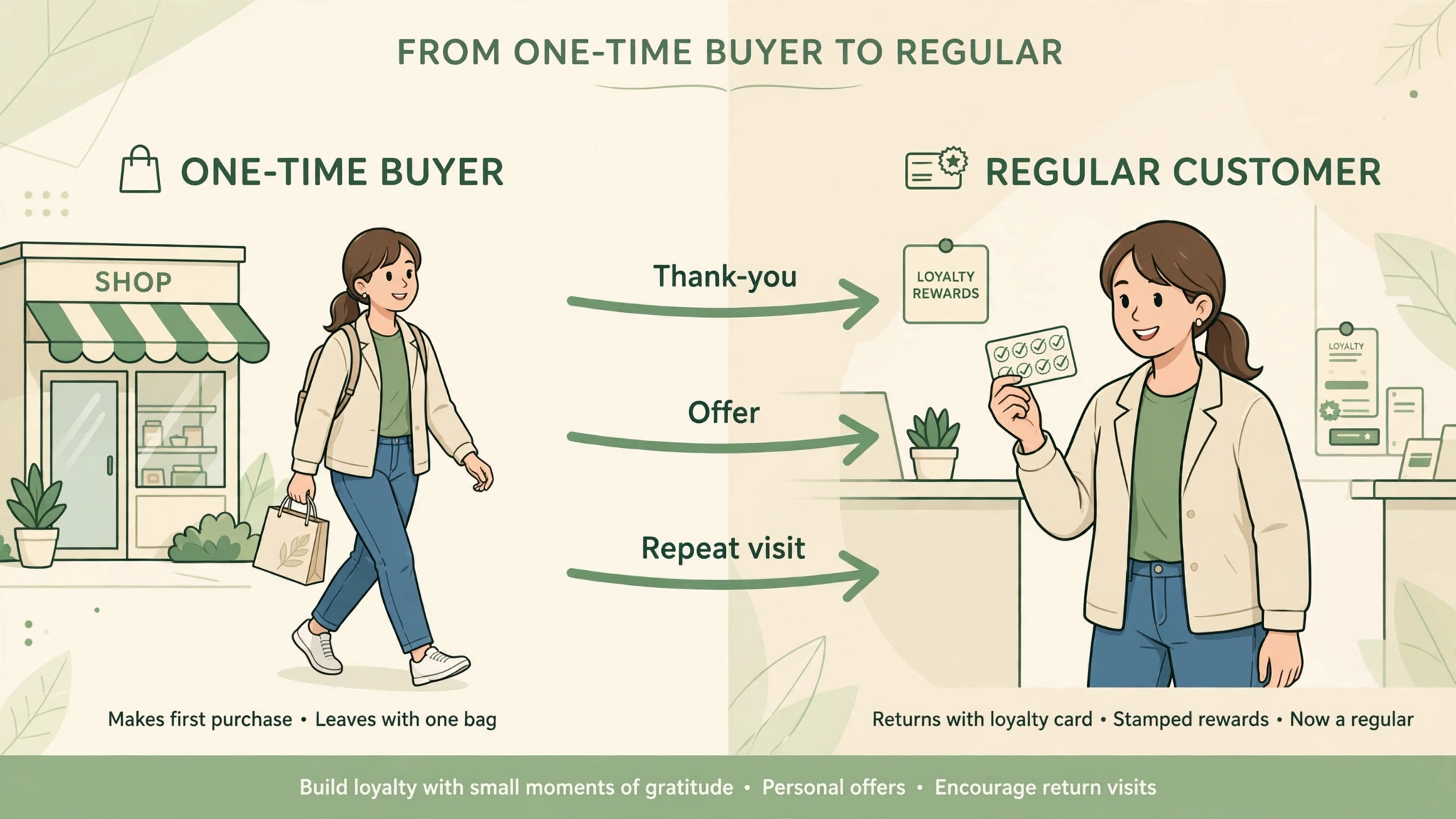
Send a short thank-you message within a day of every first order, by text or email, with the customer name and one detail from the order. A bakery writes “Thank you, Sarah, we hope the lemon cake was a hit at the party.” A salon writes “Thank you, James, great to meet you today, see you in six weeks.” The message is short, personal and sent by the owner, not by a system.
A thank-you costs nothing and it is the most valuable message in this guide, because the first day after the first order is when the customer decides whether to come back. A customer who hears nothing assumes the business does not care. A customer who gets a thank-you the same day feels seen, and a customer who feels seen comes back. This move takes five minutes a day and it is the habit that everything else hangs off.
3. Send a Small Offer Thirty Days After the First Order
Thirty days after the first order, send a small offer that is easy to use and hard to ignore. A bakery sends “10 percent off your next cake, this week only.” A salon sends “Free conditioning treatment with your next cut, book by Friday.” A plumber sends “Free drain check with any call-out this month.” The offer has a price, a deadline and a clear next step, and it goes only to customers who have not come back on their own.
The offer should be small, because a small offer that gets used beats a big offer that feels like a bribe. Ten percent off, a free add-on or a free sample are enough. Send the offer by text, because texts get read and emails get ignored, and send it once, not three times, because a customer who is chased feels hunted. This move takes ten minutes a week and it is the engine that brings quiet customers back.
4. Write a Personal Note to Quiet Customers After Ninety Days
Ninety days after the last order, send a personal note, not an offer, to customers who have gone quiet. A bakery writes “Hi Sarah, we miss you, the lemon cake is back on the menu this week.” A salon writes “Hi James, it has been a while, your usual chair is free on Thursday.” The note uses the name, remembers the last order, and asks a question, because a question earns a reply and an offer earns a delete.
A personal note works better than a discount for a lost customer, because the customer left for a reason, and a discount does not fix a reason. A note shows the business noticed, and a business that notices earns a second chance. Send five notes a week, on Friday, and keep the tone like the owner, not like a system. This move takes ten minutes a week and it is the move that wins back the customers other businesses lose.
5. Start a Simple Loyalty Card, Paper or Digital
Start a loyalty card that is simple enough to explain in one sentence: buy nine, get the tenth free. A bakery stamps a card for every cake. A salon stamps a card for every cut. A coffee shop stamps a card for every coffee. The card should be paper if the customers are older, and digital if they are younger, but the rule is the same: nine stamps, tenth free, no expiry date.
A loyalty card works because it gives the customer a reason to come back nine more times, and it gives the business a reason to stamp it with a smile. The card should be given at the first order, not the fifth, because a customer who gets the card early feels like a regular from day one. This move takes an hour to set up and it pays for months, because every stamp is a visit that would not have happened.
6. Ask for Feedback and Fix One Thing a Week
Ask one customer a week for feedback, with a short question, such as “What could we do better?” or “What would make you come back more often?” Listen to the answer, fix one thing a week, and tell the customer you fixed it. A bakery that hears “the shop is too cold” fixes the heating and tells the customer. A salon that hears “the wait is too long” staggers the bookings and tells the customer.
Feedback works because a customer who is asked feels heard, and a customer who is heard comes back. Fixing one thing a week also makes the business better every week, which is how a small business beats a big one. This move takes ten minutes a week and it is the habit that turns complaints into loyalty, because a fixed problem earns more trust than a perfect record.
7. Measure Four Numbers and Ignore the Rest
Check four numbers every Friday, and ignore everything else. The numbers are repeat purchase rate, average days between orders, quiet customers won back, and reviews from repeat customers. Repeat purchase rate shows how many customers buy again. Average days between orders shows whether customers come back faster. Quiet customers won back shows whether the ninety-day notes work. Reviews from repeat customers show whether the regulars are happy enough to say so in public.
Write the four numbers in a notebook every Friday, and compare them with last week, not with a big business. A small business that lifts repeat purchases from 20 percent to 25 percent is winning, even if the total sales barely move. A strategy that is measured weekly gets better weekly, and a strategy that is never measured stays at one-time buyers.
Side by Side Comparison
Retention is not the only way a small business grows, and the choice matters. The table below compares retention with the two other growth paths small businesses use most, on the four tests that matter: cost, speed, trust and sales.
| Factor | Retention | New customer ads | Referrals |
|---|---|---|---|
| Cost per customer | Pennies, a message or a stamp | Dollars, an advert or a discount | Free, a happy customer tells a friend |
| Speed | Weeks, the customer already knows you | Days, an advert runs today | Months, word of mouth is slow |
| Trust | High, the customer already bought | Low, a stranger doubts an advert | Highest, a friend recommends you |
| Best tool | Thank-you, offer, loyalty card | Social ads, flyers, discounts | Ask, reward, thank |
| Time per week | About 30 minutes | About 2 hours | About 30 minutes |
| Sales path | Repeat order, bigger basket | First order, small basket | First order, warm lead |
| Risk | Low, the customer already likes you | High, the advert may not work | Low, but slow to start |
Retention wins for a business that already has customers, because keeping one costs five times less than winning one, and a repeat customer spends more per visit than a first-time buyer. New customer ads win for a business that has no customers yet, because retention needs a list to work on. Referrals win for a business with happy regulars, because a friend recommendation beats any advert. Run retention first, because it is the cheapest, and add referrals second, because they are the warmest.
The Weekly Plan for Your small business customer retention strategy
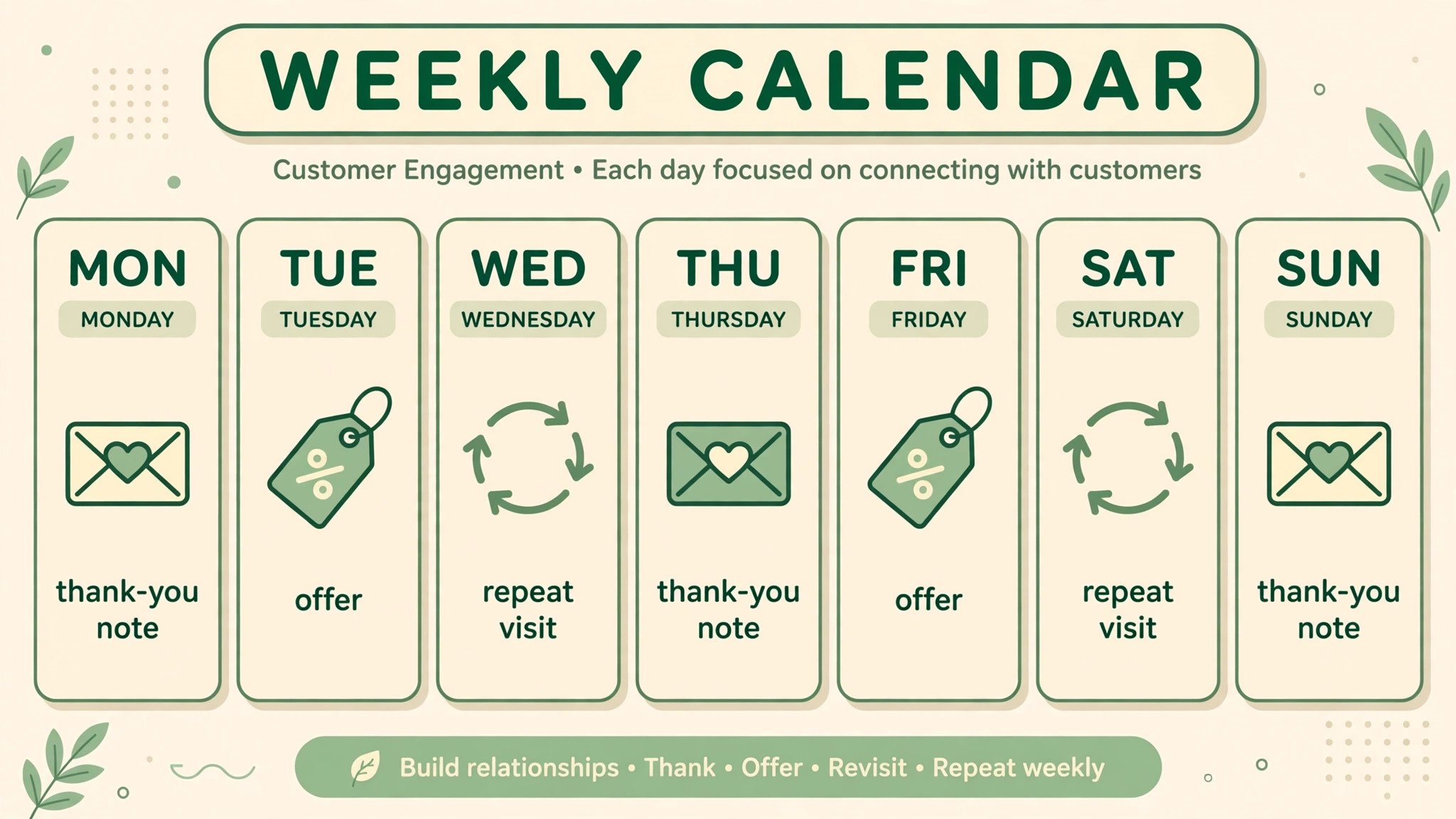
The weekly plan fits on one page, and it runs the same every week. Monday is for the thirty-day offers, Wednesday is for the thank-you messages, Friday is for the ninety-day notes and the numbers, and every day is for stamping loyalty cards. The plan below is the full small business customer retention strategy in a week, and it takes about thirty minutes in total.
| Day | Task | Time |
|---|---|---|
| Monday | Send thirty-day offers to quiet customers | 10 minutes |
| Tuesday | Ask one customer for feedback | 5 minutes |
| Wednesday | Send thank-you messages for first orders | 5 minutes |
| Thursday | Stamp loyalty cards and check the list | 5 minutes |
| Friday | Send ninety-day notes, check the four numbers | 10 minutes |
| Saturday | Ask one happy customer for a review | 5 minutes |
| Sunday | Rest, no retention work | None |
Run the plan for four weeks before judging it, because the first week builds the list and the second week builds the habit. The third week is when the thirty-day offers start to bring customers back, and the fourth week is when the repeat rate rises. A plan that is followed for a month works. A plan that is followed for three days does not.
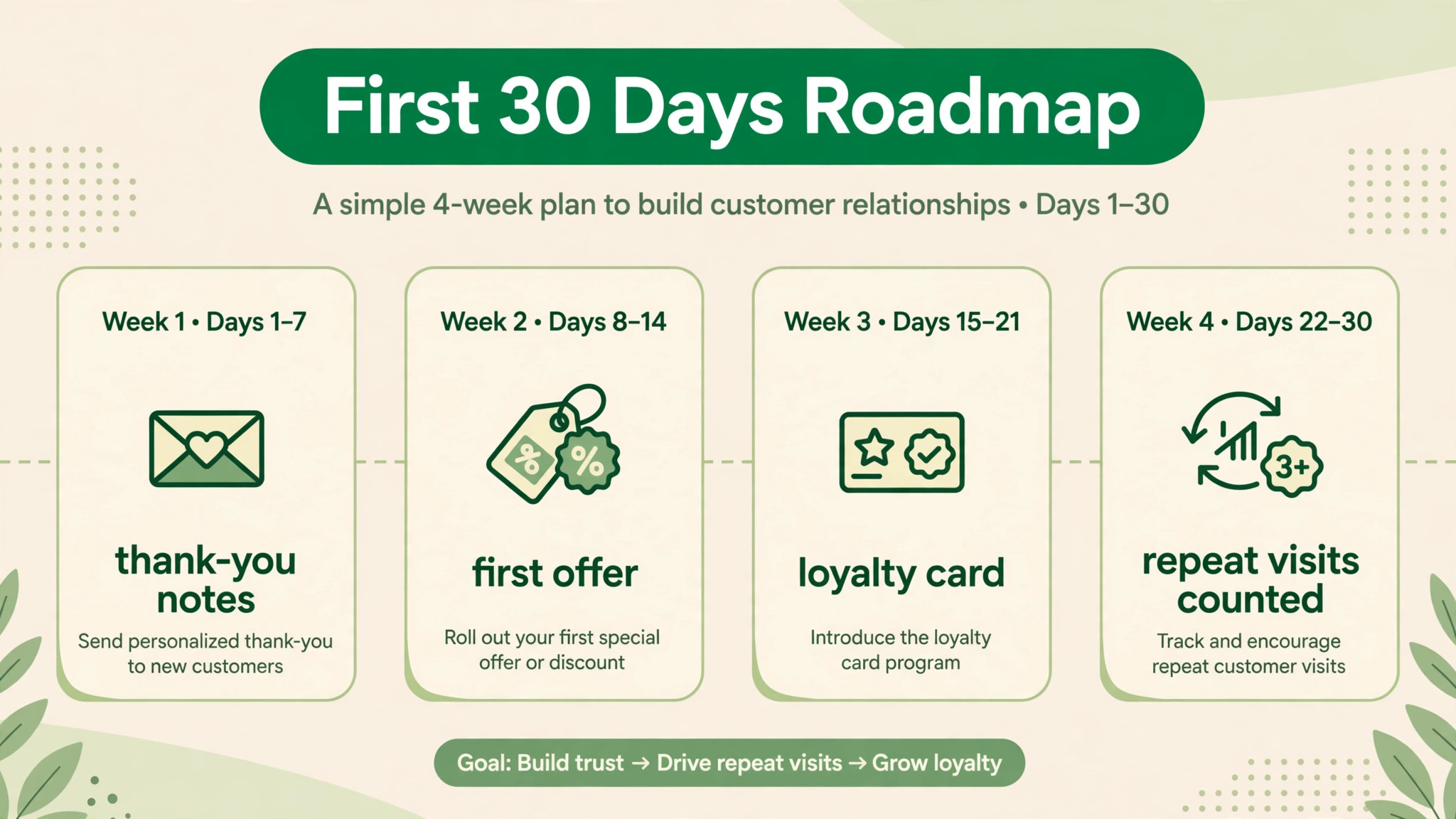
The First 30 Days on Retention
Week one is for the list and the thank-you. Build the customer list, sort it into regulars, quiet and lost, and send a thank-you after every first order. Do not worry about the repeat rate, because week one is about the foundation, not the number. End the week by checking the four numbers and writing them down.
Week two is for the offers and the loyalty card. Send the first thirty-day offers, start the loyalty card, and keep the thank-you habit going. The first offer will bring back one or two customers, which is normal. End the week by checking the four numbers again and comparing them with week one.
Week three is for the notes and the feedback. Send the first ninety-day notes, ask one customer for feedback, fix one thing, and keep the daily rhythm going. The first note will win back a customer who had been forgotten, because a personal note reaches a customer that a discount cannot. End the week by checking the four numbers and noting which move brought the most repeat orders.
Week four is for the decision. Look at the four weeks of numbers and decide what to do more of. If thank-you messages bring the most repeat orders, send more of them. If thirty-day offers bring the most, send them at twenty days instead. If the loyalty card brings the most, promote it at the counter. A small business customer retention strategy that is measured for a month gets better for a month, and that is the whole point.
The Math of Keeping Customers
Retention is easy to talk about and hard to measure, so this section does the maths with real numbers. A small business with a hundred customers, each spending 50 dollars a visit, and each visiting four times a year, takes 20,000 dollars a year from those customers. If ten of them leave and never come back, the business loses 2,000 dollars a year, and winning ten new customers to replace them costs five times as much as keeping them would have. That is the arithmetic behind every small business customer retention strategy, and it is the number to remember.
The first number to know is the repeat rate. Count how many of the last hundred customers bought again within ninety days, and divide by a hundred. A cafe should see 40 to 50 percent, because coffee is a daily habit. A salon should see 30 to 40 percent, because hair grows back on a schedule. A plumber should see 10 to 20 percent, because pipes rarely break twice. The right target depends on the trade, and the only wrong target is no target at all. Measure the rate this month, write it down, and measure it again next month.
The second number is the gap between visits. Count the average days between a customer first order and their second order, and watch whether the gap shrinks. A bakery that cuts the gap from forty days to thirty days gains three extra visits a year from every regular, and three extra visits at 50 dollars each is 150 dollars per customer per year. A loyalty card, a thirty-day offer and a thank-you message all shrink the gap, and the gap is the number that shows whether they work.
The third number is the basket size. Count the average spend per visit for repeat customers and compare it with first-time customers. Repeat customers almost always spend more, because they trust the business, they know the menu, and they order the extras. A salon regular books the cut and the colour, while a first-time customer books only the cut. A bakery regular buys the cake and the coffee, while a first-time customer buys only the cake. The basket gap is the profit of retention, and it grows every year the customer stays.
The fourth number is the win-back rate. Count how many of the ninety-day notes bring a customer back, and divide by the notes sent. Five notes a week that win back one customer a week is a 20 percent win-back rate, and one customer a week is fifty customers a year. A customer won back by a personal note spends more than a new customer won by an advert, because they already know the shop and they come back warmer. The win-back rate is the number that shows whether the notes are worth the ten minutes.
Put the four numbers together and the value of retention appears. A business that lifts its repeat rate by five points, cuts the gap by ten days, and wins back one customer a week grows by thousands of dollars a year, without spending a dollar on adverts. That is the practical side of a small business customer retention strategy, and it is the maths that justifies the thirty minutes a week.
Frequently Asked Questions
How do I keep customers coming back to my small business?
Send a thank-you after the first order, a small offer after thirty days, and a personal note after ninety days, and run a simple loyalty card on top. The three messages cost nothing, take thirty minutes a week, and cover every stage of the customer journey. A business that follows up keeps customers. A business that sends nothing after the sale loses them.
How much does customer retention cost a small business?
Almost nothing, about thirty minutes a week and a few small offers. A thank-you message costs nothing, a thirty-day offer costs a small discount, and a loyalty card costs a stamp and a free tenth item. Winning a new customer costs about five times as much, because adverts, discounts and free samples all cost money. Retention is the cheapest growth a small business can buy.
What is a good repeat purchase rate for a small business?
It depends on the trade, but most small businesses should aim for 20 to 30 percent of customers buying again within ninety days. A cafe or a salon should aim higher, because customers come back often by nature. A plumber or a builder should aim lower, because customers need the service rarely. Compare the rate with last month, not with another trade, and grow it by five points at a time.
How do loyalty cards work for a small business?
Buy nine, get the tenth free, with no expiry date, and give the card at the first order. Stamp the card at every visit, and tell the customer how many stamps they have left. A paper card works for older customers, and a digital card works for younger ones, but the rule is the same. A loyalty card gives the customer a reason to come back nine more times, and it costs the business one free item in ten.
How do I win back customers who stopped coming?
Send a personal note after ninety days, not a discount, because the customer left for a reason and a discount does not fix a reason. Use the name, remember the last order, and ask a question, such as “We miss you, the lemon cake is back, would you like us to save you one?” Five notes a week, sent on Friday, will win back one or two customers a week, and those customers come back warmer than new ones.
Our Verdict
Build the list, send a thank-you after every first order, send a small offer after thirty days, write a personal note after ninety days, and run a simple loyalty card. That is the whole plan, and it fits in thirty minutes a week. A small business that follows it for a month will have more repeat purchases, shorter gaps between orders, more quiet customers won back, and more reviews from regulars than it has today. A small business that sends nothing after the sale will keep paying to win customers it already had.
The plan also rewards patience, because retention compounds slowly and then all at once. The first month brings a few repeat visits, the second month brings a few more, and by the third month the regulars start bringing friends, which is how a small business grows without adverts. A business that measures weekly, fixes one thing a week, and keeps the messages personal will see the repeat rate climb a few points every month, and a few points a month is a different business by the end of the year.
Retention is the cheapest growth a small business can buy, and it is the growth that compounds, because a customer who comes back twice comes back a third time, and a customer who comes back three times brings a friend. The owner who thanks every customer, who notices when one goes quiet, and who fixes one thing a week will beat the business that buys adverts and never follows up. That is the lesson of this small business customer retention strategy, and it is the plan to follow for the next thirty days.