

A mini golf course makes its money in short bursts. A family arrives, plays eighteen holes in forty minutes, buys ice cream and leaves, and the next family is waiting at the first tee. The software that runs the course decides whether that flow stays smooth or turns into a queue at the till and a party double booked for the same hour. The best software for mini golf courses handles tee times, parties, scorecards and snack sales in one place, so the course fills every slot and the staff stays at the counter, not on the phone.
This guide compares ten tools on published prices, the course job each one does best and the catch that only shows up after the trial ends. Prices below are published starting prices as of late 2026, with annual billing noted where it changes the number. Start with the shortlist, then read the reviews that match the golf you actually run.
The Quick Shortlist
The table below matches each common mini golf course job to the single tool that handles it best. Use it to narrow the best software for mini golf courses to two or three candidates before you read the full reviews. Prices are monthly list prices unless noted, and annual billing is usually cheaper than paying month to month.
| Job | Best tool | Why it wins |
|---|---|---|
| Low volume courses that want no monthly bill | FareHarbor | FareHarbor is one of the most widely used booking platforms in the tour and activities industry, owned by Booking Holdings, and it handles online reservations, payments and availability in one place |
| US courses that want dynamic pricing and a fast POS | Peek Pro | Peek Pro is a feature rich booking platform with a fast mobile POS, a dynamic pricing engine and abandoned cart recovery, and it is trusted by more than 4,000 operators globally |
| US venues with a game floor and a prize counter | CenterEdge | CenterEdge Advantage is a US family entertainment veteran that bundles POS, ticketing, party booking, memberships, digital signage and its own card processing in one on site system |
| Multi activity venues where mini golf shares a building | Clubspeed | Clubspeed is a venue management system for family entertainment centres, kart tracks, trampoline parks and mini golf, with CRM, digital waivers, POS, gift cards, online booking and RFID in one platform |
| Growing venues that need ticketing, parties and memberships | ROLLER | ROLLER is a cloud venue management platform that serves more than 3,000 attraction venues, with online ticketing, POS, self serve kiosks, digital waivers, memberships and loyalty in one system |
| Courses where birthday parties are nearly all the revenue | Party Center Software | Party Center Software is a party scheduler first, and it handles party pages, invitations, RSVPs, waivers, guest lists and the POS from one system built for the birthday trade |
| Courses that drive their own bookings | Rezdy | Rezdy is a booking platform for tour and activity operators, and its strength is the pricing model, because direct bookings carry no commission, so a course that fills its own diary keeps the margin |
| Courses that want Viator and TripAdvisor distribution | Bókun | Bókun is a TripAdvisor owned booking platform with booking fees of 1 to 1 |
| Courses that want a modern booking flow | Xola | Xola is a booking platform for tour and activity operators, with a modern checkout, gift cards and distribution tools that suit a course selling experiences online |
| Courses that want a published low commission | TicketingHub | TicketingHub charges a published 3 |
How We Judged the Shortlist
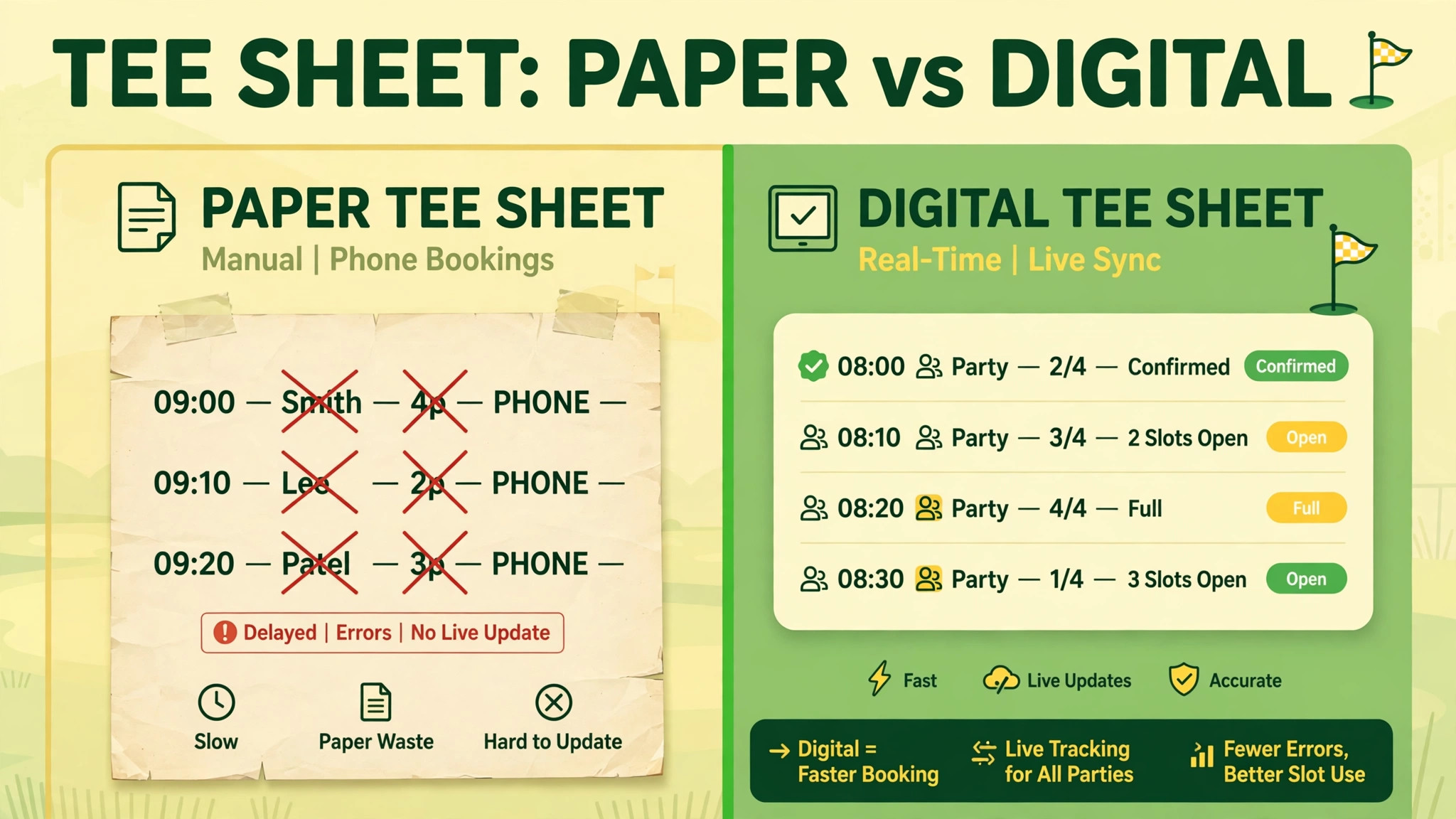
A tool earned a place here only if it does a real course job in 2026, not if it added a booking button to an old till. The best software for mini golf courses was judged on the five checks in the table below, because those are the checks that decide whether a course keeps paying after the first year. A booking tool that cannot sell a party, or a party tool that cannot take a walk in, fails no matter how polished the demo looks.
The second check is whether the price is published and how it scales, including per seat and per booking charges that change the real bill as the business grows. The third is output quality in daily use, because a tool that needs a workaround for every second booking costs more time than the old spreadsheet. The fourth is fit with the systems already in place, from the POS to the payment provider, because a tool that cannot talk to them creates double entry.
| Check before you buy | What to ask | Why it matters |
|---|---|---|
| Tee time booking | Online booking, walk ins and party slots | A course lives on filled tee times, not just a phone list |
| Parties and events | Birthday parties, group bookings and deposits | Parties are the highest margin hour on the course |
| Published price | Starting price and what scales it | Per booking fees change the real bill fast |
| POS and snacks | Till, snack bar and gift cards | A course sells ice cream and merch, not just golf |
| The catch | Caps, fees and contract terms | A quote only platform hides the price until the demo |
The 10 Tools, Reviewed One by One
Each review below gives the published starting price, the mini golf course job the tool does best and the catch that only shows up after the trial ends. Read the reviews for the best software for mini golf courses that match the work you do most, and skip the rest until you have a shortlist of two or three.
1. FareHarbor
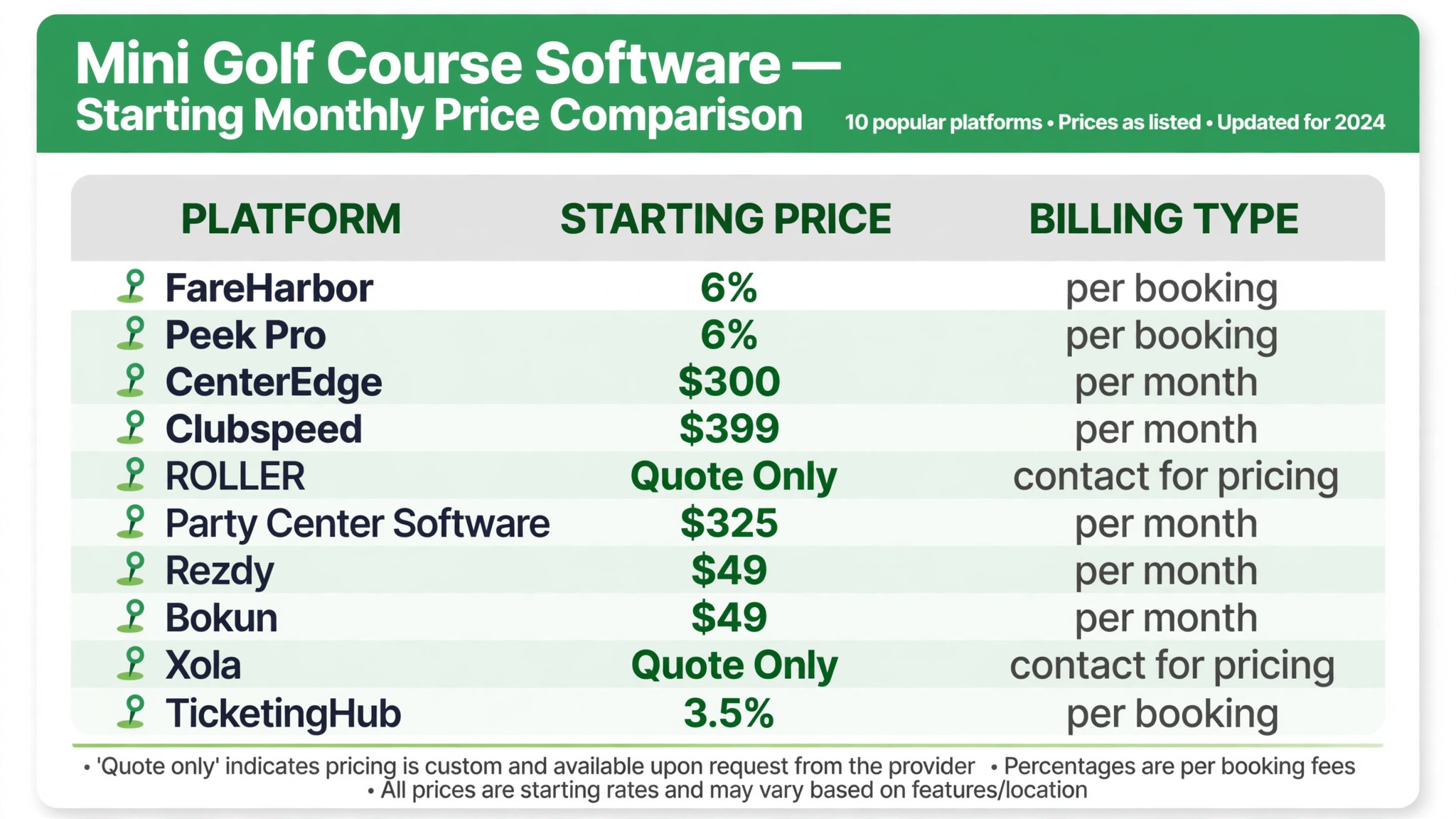
Starting price No monthly fee; about 6 percent commission per booking, passed to the customer at checkout. Best for Low volume courses that want no monthly bill. Watch out The 6 percent applies to every booking, including walk ups.
FareHarbor is the pick for low volume courses that want no monthly bill, and it earns that place on the strength of what it does every day rather than on the promise in the demo. FareHarbor is one of the most widely used booking platforms in the tour and activities industry, owned by Booking Holdings, and it handles online reservations, payments and availability in one place. There is no monthly fee and no setup fee, so a small course can start taking online bookings without a subscription, and the distribution network reaches more than 2,500 affiliates.
The catch is the commission. At about 6 percent on every booking, including walk ups, a busy course pays more here than on a flat monthly plan once volume passes roughly 100 to 150 bookings a month.
2. Peek Pro
Starting price Free plan with 6 percent commission on direct bookings; Pro from 199 dollars a month with reduced fees. Best for US courses that want dynamic pricing and a fast POS. Watch out Commission plus processing reaches about 8.3 percent per booking.
Peek Pro is the pick for us courses that want dynamic pricing and a fast pos, and it earns that place on the strength of what it does every day rather than on the promise in the demo. Peek Pro is a feature rich booking platform with a fast mobile POS, a dynamic pricing engine and abandoned cart recovery, and it is trusted by more than 4,000 operators globally. Dynamic pricing lets a course charge more on a busy Saturday and less on a quiet Tuesday, which is real revenue for a business with fixed capacity.
The free plan charges 6 percent commission plus 2.3 percent processing, an effective rate of about 8.3 percent per booking, before the channel manager fee of 100 to 500 dollars a month.
3. CenterEdge
Starting price From 300 dollars a month for 1 to 3 workstations, 550 dollars for 4 to 9, 800 dollars for 10 to 15. Best for US venues with a game floor and a prize counter. Watch out Runs on a Windows server and Windows stations, not pure cloud.
CenterEdge is the pick for us venues with a game floor and a prize counter, and it earns that place on the strength of what it does every day rather than on the promise in the demo. CenterEdge Advantage is a US family entertainment veteran that bundles POS, ticketing, party booking, memberships, digital signage and its own card processing in one on site system. Its pricing is published and honest, at 300 dollars a month for one to three workstations, with redemption adding 100 dollars a month and integrations 50 dollars a month.
The catch is the architecture. It runs on a Windows server and Windows stations in the building, with a cloud webstore around it, so a course that wants pure cloud should look elsewhere.
4. Clubspeed
Starting price From 399 dollars a month; higher tiers from 699 dollars a month. Best for Multi activity venues where mini golf shares a building. Watch out The price is high for a golf only course, and the tiers are sales led.
Clubspeed is the pick for multi activity venues where mini golf shares a building, and it earns that place on the strength of what it does every day rather than on the promise in the demo. Clubspeed is a venue management system for family entertainment centres, kart tracks, trampoline parks and mini golf, with CRM, digital waivers, POS, gift cards, online booking and RFID in one platform. The event management tools handle parties and group events alongside the tee sheet, which suits a venue where mini golf is one of several activities.
At 399 dollars a month for the entry tier, a golf only course pays for a platform built for much bigger venues, so it only makes sense when the building does more than mini golf.
5. ROLLER
Starting price Pricing on request; operators report quotes from around 400 dollars a month up to 700 dollars a month or more. Best for Growing venues that need ticketing, parties and memberships. Watch out Quote only, and waivers are a paid add on.
ROLLER is the pick for growing venues that need ticketing, parties and memberships, and it earns that place on the strength of what it does every day rather than on the promise in the demo. ROLLER is a cloud venue management platform that serves more than 3,000 attraction venues, with online ticketing, POS, self serve kiosks, digital waivers, memberships and loyalty in one system. Multi venue controls let a group push products, prices and POS menus to every site from head office, which is the feature that matters once a course adds a second location.
ROLLER does not publish prices, waivers are a paid add on, and a venue can have only one active waiver, so get the full quote including add ons before you compare it with anything else.
6. Party Center Software
Starting price Reported quotes from 325 dollars a month per location, all in and month to month, with a 500 dollar activation fee; marketing automation adds about 85 dollars a month. Best for Courses where birthday parties are nearly all the revenue. Watch out Quote only in practice, and the website and SEO are sold as extras.
Party Center Software is the pick for courses where birthday parties are nearly all the revenue, and it earns that place on the strength of what it does every day rather than on the promise in the demo. Party Center Software is a party scheduler first, and it handles party pages, invitations, RSVPs, waivers, guest lists and the POS from one system built for the birthday trade. A recent quote came in at 325 dollars a month per location with waivers included, which is honest pricing for a venue where parties are the business.
The catch is the extras. Websites, SEO and email campaigns are sold as additional services, and the 500 dollar activation fee is a one off cost that should be in the first year budget.
7. Rezdy
Starting price From 49 dollars a month, with 0 percent commission on direct bookings. Best for Courses that drive their own bookings. Watch out The monthly fee means low volume courses pay more than on commission plans.
Rezdy is the pick for courses that drive their own bookings, and it earns that place on the strength of what it does every day rather than on the promise in the demo. Rezdy is a booking platform for tour and activity operators, and its strength is the pricing model, because direct bookings carry no commission, so a course that fills its own diary keeps the margin. The platform handles availability, payments and reseller channels, and the monthly fee is predictable, which makes budgeting simple.
The catch is the floor. At 49 dollars a month before any booking, a course with very low volume pays more here than on a commission only plan, so check the break even point first.
8. Bókun
Starting price Start from 49 dollars a month plus 1.5 percent; Plus from 149 dollars a month plus 1.25 percent; Premium from 499 dollars a month plus 1 percent. Best for Courses that want Viator and TripAdvisor distribution. Watch out Owned by TripAdvisor, so the marketplace shapes the product.
Bókun is the pick for courses that want viator and tripadvisor distribution, and it earns that place on the strength of what it does every day rather than on the promise in the demo. Bókun is a TripAdvisor owned booking platform with booking fees of 1 to 1.5 percent, far lower than the 6 percent charged by the commission heavy platforms. Distribution through Viator and TripAdvisor puts the course in front of travellers who would never have found its website, and the fee on those bookings is zero on the parent channel.
The catch is the ownership. As a TripAdvisor product, the roadmap follows the marketplace, and a course that does not want OTA bookings may find the distribution features are the main event.
9. Xola
Starting price Pricing on request; sold through a demo. Best for Courses that want a modern booking flow. Watch out No published price, so the quote decides everything.
Xola is the pick for courses that want a modern booking flow, and it earns that place on the strength of what it does every day rather than on the promise in the demo. Xola is a booking platform for tour and activity operators, with a modern checkout, gift cards and distribution tools that suit a course selling experiences online. The booking flow is clean on a phone, which matters when most guests book from the car park, not from a desktop.
Xola does not publish prices, so a small course cannot budget for it without a demo and a quote, and the platform is priced for operators with real volume.
10. TicketingHub
Starting price No monthly fee; 3.5 percent per booking on pay as you go. Best for Courses that want a published low commission. Watch out Card processing sits on top of the 3.5 percent.
TicketingHub is the pick for courses that want a published low commission, and it earns that place on the strength of what it does every day rather than on the promise in the demo. TicketingHub charges a published 3.5 percent per booking on pay as you go, with no monthly fee and no contract, which makes it the most transparent commission plan on this list. The platform handles ticketing, bookings and distribution, and the operator can pass the fee to guests or absorb it, which keeps the pricing decision with the course.
Card processing is charged on top of the 3.5 percent at the payment provider’s rate, so the real cost per booking is higher than the headline, and the comparison should include it.
Side by Side Comparison
The table below puts the best software for mini golf courses side by side on the numbers that decide the purchase. Prices are starting monthly prices as published in late 2026, and quote only tools are marked so you can see where the price is a negotiation rather than a number.
| Tool | Starting price | Best for |
|---|---|---|
| FareHarbor | No monthly fee; about 6 percent commission per booking, passed to the customer at checkout. | Low volume courses that want no monthly bill |
| Peek Pro | Free plan with 6 percent commission on direct bookings; Pro from 199 dollars a month with reduced fees. | US courses that want dynamic pricing and a fast POS |
| CenterEdge | From 300 dollars a month for 1 to 3 workstations, 550 dollars for 4 to 9, 800 dollars for 10 to 15. | US venues with a game floor and a prize counter |
| Clubspeed | From 399 dollars a month; higher tiers from 699 dollars a month. | Multi activity venues where mini golf shares a building |
| ROLLER | Pricing on request; operators report quotes from around 400 dollars a month up to 700 dollars a month or more. | Growing venues that need ticketing, parties and memberships |
| Party Center Software | Reported quotes from 325 dollars a month per location, all in and month to month, with a 500 dollar activation fee; marketing automation adds about 85 dollars a month. | Courses where birthday parties are nearly all the revenue |
| Rezdy | From 49 dollars a month, with 0 percent commission on direct bookings. | Courses that drive their own bookings |
| Bókun | Start from 49 dollars a month plus 1.5 percent; Plus from 149 dollars a month plus 1.25 percent; Premium from 499 dollars a month plus 1 percent. | Courses that want Viator and TripAdvisor distribution |
| Xola | Pricing on request; sold through a demo. | Courses that want a modern booking flow |
| TicketingHub | No monthly fee; 3.5 percent per booking on pay as you go. | Courses that want a published low commission |
What It Costs in Year One
A realistic year one budget for a small course runs from about 50 dollars a month for a booking tool to about 700 dollars a month once a full venue platform, parties and the till are all covered. The table below prices three honest stacks, so you can see what the monthly total looks like before you sign anything. The best software for mini golf courses on this list cover the whole range, from free plans that cost nothing until the bookings arrive to platforms that charge hundreds a month before the first guest walks in, so the stack matters more than any single price.
| Stack | What you get | Monthly cost | Covers |
|---|---|---|---|
| Lean, one course | Rezdy plus TicketingHub | 49 dollars a month plus 3.5 percent per booking | Booking, tee times and payments |
| Party heavy course | Party Center Software plus FareHarbor | 325 dollars a month plus 6 percent per booking | Parties, waivers and online booking |
| Multi activity venue | ROLLER plus CenterEdge | Pricing on request plus 300 dollars a month | Ticketing, parties, memberships and arcade |
The honest way to compare is to price the stack at your real volume for a full year, including the transaction fees, the add ons and the renewal price, and then divide by twelve. A cheap month one that doubles in month thirteen is not a cheap tool, and a dear month one that stays flat for three years is often the better buy.
What to Check Before You Sign
Ask what happens at the cap. Every tool on this list has a limit somewhere, whether it is a booking count, a user count, a court count or a transaction fee, and the limit that matters is the one you will hit first. A free plan that caps at fifty bookings a month is a trial, not a system, and a paid plan that charges per location doubles the bill when you open a second site. Get the cap in writing before you sign, and ask what the upgrade costs.
Read the contract and the data export terms before you sign. A platform that holds your customer list, your booking history and your payment records hostage is a platform you cannot leave, and the cost of leaving is the real price of the software. Ask how to export every record, how long the contract runs, and what happens to the data on the day you cancel. A vendor that answers clearly is a vendor worth trusting.
Trial the tool on a real busy day, not on a quiet afternoon. A demo on a Tuesday tells you nothing about a Saturday, and the tool that looks fast with ten bookings may crawl with two hundred. Run a full day on the trial, move a booking, cancel a booking, take a payment and chase a late payer, then ask the team what broke. The answer is worth more than any sales call.
How to Pick the Right Tool from the best software for mini golf courses
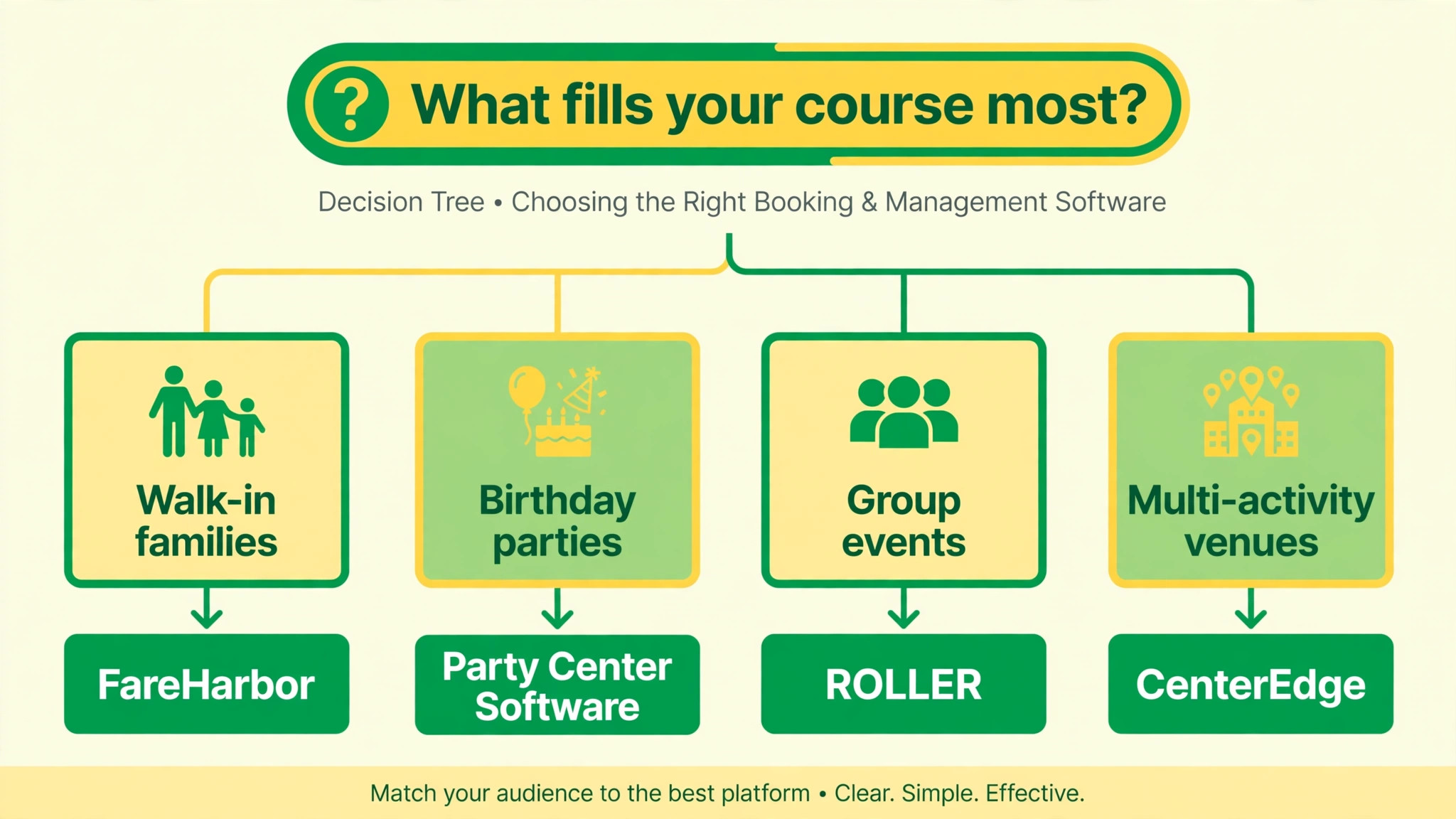
Start with the golf you run most. If the course is mostly walk in families and birthday parties, pick a party first platform and treat tee sheet depth as second choice, because a party tool handles a walk in badly and a tee sheet tool handles a party worse. If the course sits inside a bigger family venue, a venue platform beats a golf specialist you will never fill.
Price the stack at your real booking volume, not the demo volume. A commission of 6 percent on every booking looks small until a busy Saturday, and a platform at 325 dollars a month only pays for itself if the party bookings actually rise. Ask each vendor for the bill at your booking count, your busiest month and your quietest month, and compare those three numbers before you sign. That is the test every best software for mini golf courses on this list has to pass, and the tool that passes it at your volume is the one to buy.
Trial each finalist on a real Saturday, not a quiet Tuesday. Book a tee time, sell a party, take a walk in and run the snack bar, then see what the staff sees. The tool that survives a full weekend without a phone call to support is the one to buy.
Frequently Asked Questions
What is the cheapest mini golf software to start with
FareHarbor is the cheapest credible start, with no monthly fee and about 6 percent commission per booking passed to the customer. Rezdy starts at 49 dollars a month with no commission on direct bookings, which suits a course that fills its own diary. Start there, and add a full venue platform only when parties and the till make the small tools strain.
Which software is best for birthday parties at a mini golf course
Party Center Software is the strongest pick for parties, because the whole product is built around party pages, invitations, RSVPs, waivers and guest lists. ROLLER is the pick when parties sit alongside ticketing and memberships. Pick Party Center Software for parties first, and ROLLER when the venue does more than parties.
Do I need a golf platform or just a booking tool
A booking tool is enough while the course runs walk ins and simple tee times. The best software for mini golf courses earns its price when birthday parties, group events and snack sales need one system, because then the party tools and the till matter. Until then, a booking tool plus a card reader keeps more money in the course.
How much should a small mini golf course budget for software
A realistic year one budget is 49 to 100 dollars a month for a booking tool, 300 to 400 dollars a month once a party platform joins the stack, and 400 to 700 dollars a month with a full venue platform added. Budget for the stack at your booking volume, not for one tool, and trial each one on a real weekend before you commit to annual billing.
Our Verdict
If you buy one tool this quarter, buy Party Center Software if parties are your best margin and FareHarbor if you want to start with no monthly bill. Party Center Software is the strongest party platform on this list, with invitations, RSVPs and waivers built for the birthday trade, at a reported 325 dollars a month. FareHarbor is the best value for a low volume course, with no monthly fee and a 6 percent commission that only costs money when bookings arrive.
Across the whole list, the best software for mini golf courses that win are the ones that match the mini golf course you actually run, and both of these do that from the first month.
Whatever you pick, start with the bookings that fill your tee sheet, trial it on a real weekend, and keep a paper tee sheet for the first month. The tools on this list all work. The difference is whether the tool sells parties or only takes bookings, and whether you measure the return in slots filled and parties booked rather than in features used.