A freelance editor charges 50 to 150 dollars per episode, and a studio charges more again for a polished hour of audio. An AI podcast editor charges nothing to try and 16 dollars a month to edit, and that gap is the reason most small podcasters start with AI. The gap also hides the real question, which is not whether AI is cheaper, because it is, but what the subscription actually buys. That question is the heart of ai podcast editor pricing, and it is the number this guide works out for every tool.
A tool that sells editing for 11 dollars a month and a tool that charges 24 dollars a month are not selling the same thing. The first sells a fixed number of processed hours. The second sells a full studio with recording, editing and publishing. A podcaster who releases one episode a month pays less with the cheap plan, and a podcaster who releases four episodes a month pays less with the plan that counts hours, not episodes. The billing model decides the bill more than the headline price does.
The third thing to check is the hour. Most podcast editors sell monthly hours, and one hour of audio costs one hour of allowance, while a credit based editor sells credits that buy different jobs at different rates. A plan with 10 hours a month sounds generous until the weekly show, when the hours run out and the tool asks for more money. Knowing ai podcast editor pricing means knowing how many finished episodes the monthly allowance actually covers, not just what the plan costs.
Prices in this guide are US list prices checked in November 2026, before tax. Monthly prices are per month, with the annual billing rate beside the monthly rate where the vendor publishes one. Where a vendor hides its prices behind a page that shows pounds to some visitors, this guide uses the dollar figure from its pricing page instead of guessing.
At a Glance. ai podcast editor pricing in One Table
The table below is the short answer. Prices are in US dollars, before tax. Free means free to edit and preview, and the paid column is what it costs to export a clean episode without limits.
| Tool | Free plan | Entry paid price | What you get | Per episode cost |
|---|---|---|---|---|
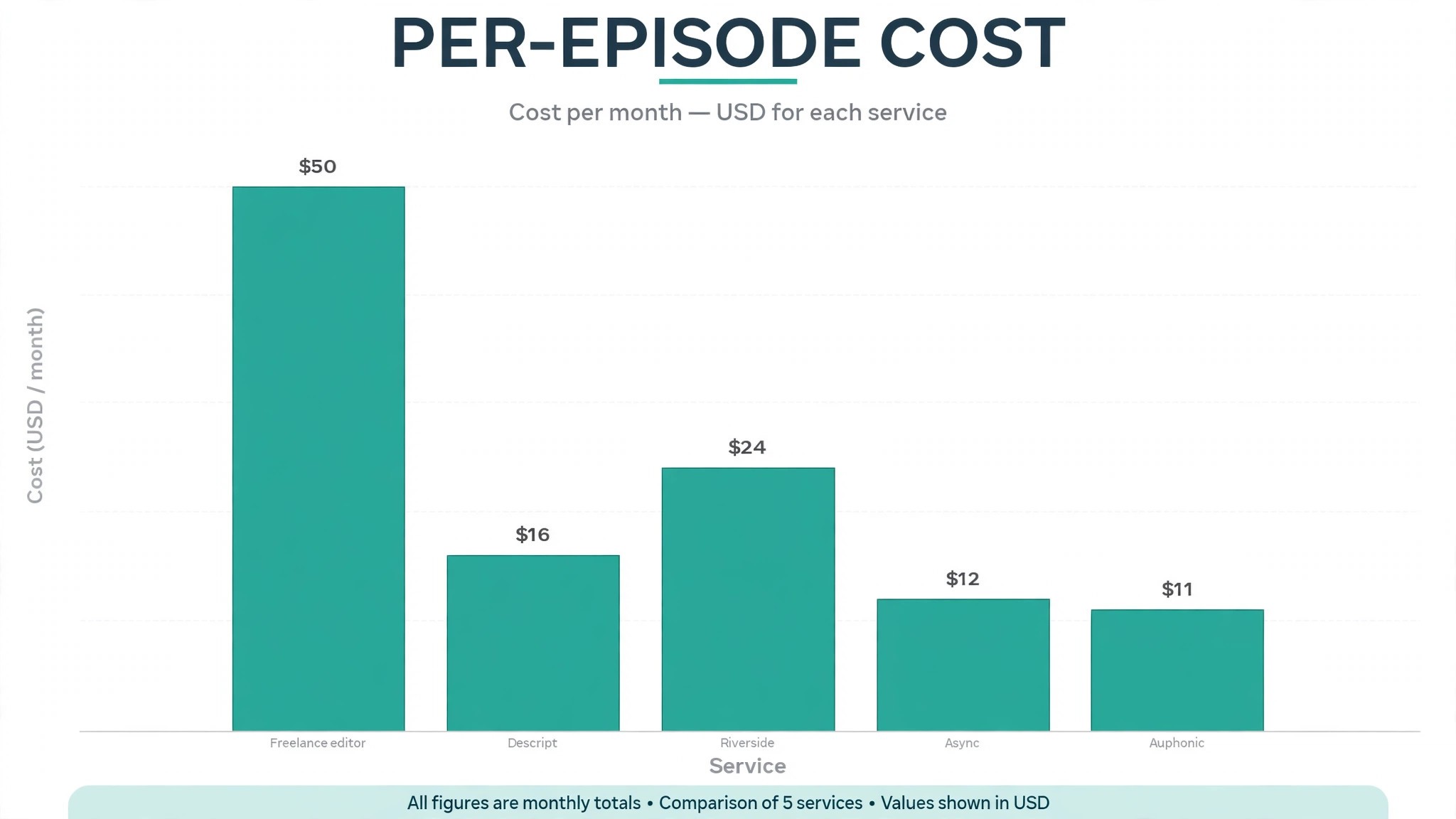
| Descript | Free, 1 media hour a month | Hobbyist 16 dollars a month billed annually | Text editing, Studio Sound, 10 media hours | About 4 dollars per hour long episode |
| Riverside | Free trial, 2 hours multitrack | Pro 24 dollars a month billed annually | Studio recording, AI editing, 4K export | About 6 dollars per hour long episode |
| Async | Free, lifetime limits | Essentials 11.99 dollars a month billed annually | Browser studio, AI editing, 450 credits | About 3 dollars per hour long episode |
| Auphonic | Free, 2 hours a month | S plan 11 dollars a month billed annually | Levelling, noise and loudness, 9 hours | About 1.22 dollars per hour of audio |
| Adobe Podcast | Free, 1 hour a day | Premium 9.99 dollars a month | Speech enhancement, studio tools | About 2.50 dollars per hour long episode |
| Resound | Free plan | Creator 15 dollars a month | Automatic edit drafts, filler removal | About 3.75 dollars per hour long episode |
| Podsqueeze | Free plan | Starter 8.99 dollars a month | Show notes, clips and repurposing | About 2.25 dollars per hour long episode |
| Cleanvoice | Free trial | About 11 dollars a month for 10 hours | Filler removal, silence and mouth sounds | About 1.10 dollars per hour of audio |
Read the per episode column first, because an editor without hours is an editor that stops working mid month. Descript Hobbyist gives 10 media hours a month, while Auphonic S gives 9 hours, so both cover about nine hour long episodes. That gap between the hour plan and the credit plan is the oldest trick in ai podcast editor pricing, and every tool in this table plays it in some form.
Read the billing column second, because a subscription and a credit pack behave differently as the volume grows. Descript Hobbyist at 16 dollars a month covers 10 hours, so 10 episodes cost 16 dollars, or about 1.60 dollars per episode hour. Auphonic S at 11 dollars a month covers 9 hours, so 9 episodes cost 11 dollars, or about 1.22 dollars per episode hour. The billing model, not the headline price, decides what a weekly show costs.
How the Billing Models Work
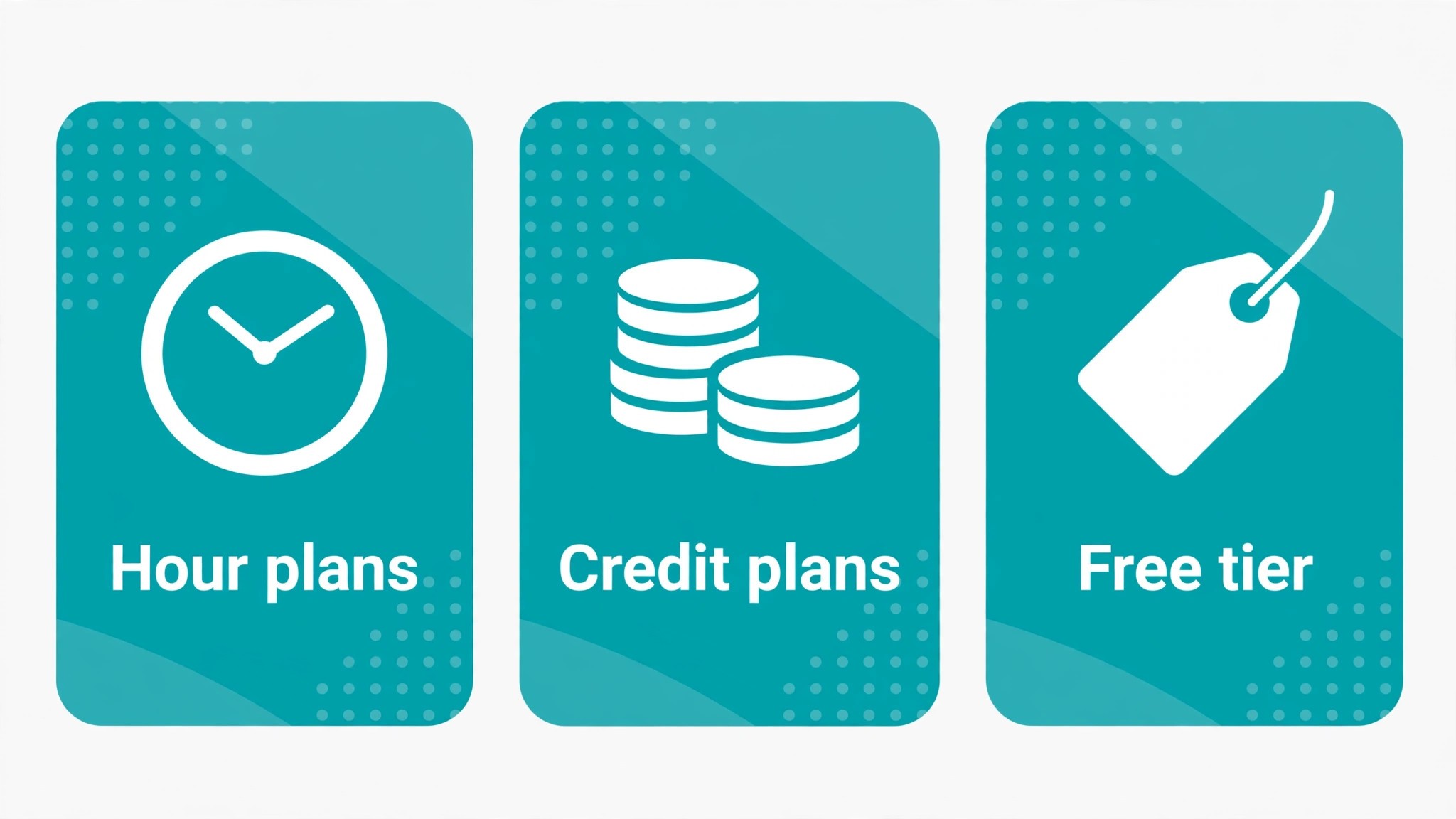
Podcast editors sell in three ways, and the model matters more than the price. Hour plans sell a fixed number of media hours a month, so Descript Hobbyist at 16 dollars a month buys 10 hours, which is the cheapest honest price in this guide for a podcaster who edits by transcript. Credit plans sell credits that buy different jobs at different rates, so Async Essentials at 11.99 dollars a month buys 450 credits shared across audio, video and image tools, which suits a creator who makes more than audio.
One time credits sell a fixed number of hours once, so Auphonic one time credits from 12 dollars buy 5 hours that never expire, which suits a podcaster who records in bursts.
The second thing to check is what counts as one hour. Descript counts every upload toward media hours, so a two hour raw recording uses two hours even when the finished episode is one hour. Auphonic counts processed audio only, so a two hour recording that becomes one hour of finished audio uses one hour. A podcaster who records long and cuts hard should check which hour the tool counts, because the difference doubles the bill.
The third thing to check is the export. A free plan that exports at 720p with a watermark is fine for testing, but a finished episode needs a clean export, and that sits on the paid plan. Descript free exports at 720p with a watermark, Riverside free exports with a watermark, and Auphonic free adds a jingle to the audio. That export check is part of ai podcast editor pricing, because a free edit that cannot be published is not free at all.
1. Descript
Descript is the all round pick in this guide, and its pricing is a subscription with a free tier. The free plan gives 1 media hour a month with watermarked 720p exports. Hobbyist costs 16 dollars a month billed annually, or 24 dollars month to month, with 10 media hours and 400 AI credits. Creator costs 24 dollars a month billed annually, or 35 dollars month to month, with 30 media hours and 800 AI credits. Business costs 50 dollars a month billed annually, with 40 hours and 1,500 credits.
Worked cost for 4 episodes a month. Hobbyist at 16 dollars a month covers 10 media hours, so 4 hour long episodes cost 16 dollars in total, or about 4 dollars per episode. A podcaster who releases weekly and edits by transcript should pay Hobbyist, because 16 dollars a month buys the broadest editor in this guide. A podcaster who releases daily should pay Creator, because 30 hours covers the volume.
Descript earns its price with text editing. It edits audio and video through the transcript, so cutting a sentence cuts the audio, and its AI co editor Underlord handles filler removal, Studio Sound cleanup and clip creation. A podcaster who edits by reading should test Descript first, because 16 dollars a month buys the fastest edit in this guide. The weakness is the hour counting, because every upload counts toward the allowance, even a failed take.
2. Riverside
Riverside is the recording first pick in this guide, and its pricing is a subscription with a trial. The free plan gives 2 hours of multitrack recording at 720p with a watermark. Pro costs 24 dollars a month billed annually, or 29 dollars month to month, with 5 recording hours a month in up to 4K, plus Magic Clips, Magic Audio and the AI co creator. Grow costs 34 dollars a month billed annually, with 15 hours and livestreaming.
Worked cost for 4 episodes a month. Pro at 24 dollars a month covers 5 recording hours, so 4 hour long episodes cost 24 dollars in total, or about 6 dollars per episode. A podcaster who records remote interviews should pay Riverside, because the local capture records each guest in studio quality, even when the internet drops. A podcaster who only edits should buy Descript instead, because 16 dollars beats 24 dollars for the same edit.
Riverside earns its price with recording quality. The studio grade local capture means a guest on a bad connection still sounds clean, and the AI editing, clean up and clips happen where the recording already is, without exporting to another tool. A podcaster who records remote guests every week should test Riverside first, because 24 dollars a month buys the best remote recording in this guide. The weakness is the hour cap, because 5 hours a month is a small allowance for a daily show.
3. Async
Async, formerly Podcastle, is the budget studio pick in this guide, and its pricing is a subscription with a free tier. The free plan gives lifetime limits, with 10 AI credits and 1 hour of recording. Essentials costs 11.99 dollars a month billed annually, or 19.99 dollars month to month, with 450 credits a month shared across AI video, image and audio tools. Pro costs 23.99 pounds a month billed annually, with 1,200 credits, and Teams costs 49.99 pounds per creator a month.
Worked cost for 4 episodes a month. Essentials at 11.99 dollars a month covers 450 credits, so 4 hour long episodes cost 11.99 dollars in total, or about 3 dollars per episode. A beginner who wants a browser studio that records, edits and enhances in one place should pay Essentials, because 11.99 dollars a month buys the cheapest full studio in this guide. A creator who also makes video should check the credit sharing, because video jobs use the same 450 credits.
Async earns its price with the browser workflow. A podcaster can record up to 10 participants, edit by asking in plain words what to cut, and enhance the audio with Magic Dust, all without installing software. A beginner who wants one tool for the whole episode should test Async first, because 11.99 dollars a month buys the easiest studio in this guide. The weakness is the credit sharing, because a heavy video month eats the audio allowance.
4. Auphonic
Auphonic is the cheapest finishing pick in this guide, and its pricing is a mix of free hours and credit plans. The free plan gives 2 hours of processed audio a month, with an Auphonic jingle added and no carry over of unused hours. The S plan costs 11 dollars a month billed annually, with 9 hours a month, and larger plans cost 25 dollars for 21 hours, 52 dollars for 45 hours, 113 dollars for 100 hours and 245 dollars for 250 hours. One time credits start at 12 dollars for 5 hours.
Worked cost for 4 episodes a month. S at 11 dollars a month covers 9 hours, so 4 hour long episodes cost 11 dollars in total, or about 2.75 dollars per episode, and the per hour cost is about 1.22 dollars. A podcaster who records clean audio and only needs levelling, noise and loudness should pay Auphonic, because 11 dollars a month buys the cheapest professional finish in this guide. A podcaster who needs editing should buy Descript instead, because Auphonic does not cut.
Auphonic earns its price with the finish. Its automatic levelling, noise reduction and loudness mastering make every episode sound the same, which is the last step before publishing and the one most podcasters skip. A podcaster who already edits elsewhere should test Auphonic first, because 11 dollars a month buys the best sounding finish in this guide. The weakness is the scope, because it does not edit, it only finishes.
5. Adobe Podcast
Adobe Podcast is the speech cleanup pick in this guide, and its pricing is a subscription with a free tier. The free plan gives 1 hour of speech enhancement a day, and Premium costs 9.99 dollars a month, with studio tools and higher limits. The tool is best known for Enhance Speech, which turns a noisy phone recording into studio quality audio in one click, and the studio covers recording, editing and publishing.
Worked cost for 4 episodes a month. Premium at 9.99 dollars a month covers the enhancement a weekly podcaster does, so 4 hour long episodes cost 9.99 dollars in total, or about 2.50 dollars per episode. A podcaster who records in a noisy room should pay Adobe Podcast, because 9.99 dollars a month buys the best speech cleanup in this guide. A podcaster who needs full editing should buy Descript instead, because Adobe Podcast is a cleanup tool first.
Adobe Podcast earns its price with the cleanup. A recording made on a phone in a kitchen comes back sounding like a studio, which suits interviewers who cannot control the room. A podcaster who records guests in bad rooms should test Adobe Podcast first, because 9.99 dollars a month buys the cheapest rescue in this guide. The weakness is the scope, because the editing tools are thinner than Descript and the pricing sits inside a larger Adobe bundle.
6. Resound
Resound is the automatic draft pick in this guide, and its pricing is a subscription with a free tier. The free plan covers automatic edit drafts with limits, and Creator costs 15 dollars a month, with more hours and more features. The tool listens to a recording, cuts the filler, the silences and the false starts, and hands back a draft edit that the podcaster reviews, which suits a host who hates the first pass.
Worked cost for 4 episodes a month. Creator at 15 dollars a month covers the automatic drafts a weekly podcaster does, so 4 hour long episodes cost 15 dollars in total, or about 3.75 dollars per episode. A podcaster who dreads the first edit should pay Resound, because 15 dollars a month buys the fastest first draft in this guide. A podcaster who wants full control should buy Descript instead, because Resound drafts, it does not finish.
Resound earns its price with the draft. A two hour recording becomes a tight one hour draft in minutes, and the podcaster only reviews the cuts instead of making them, which saves the hour a weekly show used to spend on the first pass. A podcaster who records long and cuts hard should test Resound first, because 15 dollars a month buys the best automatic draft in this guide. The weakness is the finish, because the draft still needs a human review before it goes live.
7. Podsqueeze
Podsqueeze is the repurposing pick in this guide, and its pricing is a subscription with a free tier. The free plan covers show notes and clips with limits, and Starter costs 8.99 dollars a month, with more episodes and more features. The tool turns one episode into show notes, timestamps, social clips and a newsletter draft, which suits a podcaster who promotes every episode on five channels.
Worked cost for 4 episodes a month. Starter at 8.99 dollars a month covers the repurposing a weekly podcaster does, so 4 hour long episodes cost 8.99 dollars in total, or about 2.25 dollars per episode. A podcaster who promotes every episode should pay Podsqueeze, because 8.99 dollars a month buys the cheapest promotion kit in this guide. A podcaster who only needs editing should buy Descript instead, because Podsqueeze repurposes, it does not edit.
Podsqueeze earns its price with the promotion. One episode becomes a week of social posts, which is the work most podcasters skip, and the show notes are good enough to publish with a light edit. A podcaster who wants every episode to reach five channels should test Podsqueeze first, because 8.99 dollars a month buys the best repurposing in this guide. The weakness is the scope, because it does not record or edit audio.
8. Cleanvoice
Cleanvoice is the cleanup pick in this guide, and its pricing is a subscription with a free trial. The free trial covers filler removal with limits, and the paid plan costs about 11 dollars a month for 10 hours, with filler word removal, silence detection, mouth sound removal and audio cleanup. The tool does one job at a time, which suits a podcaster who already edits elsewhere and only needs the audio cleaned.
Worked cost for 4 episodes a month. The paid plan at about 11 dollars a month covers 10 hours, so 4 hour long episodes cost 11 dollars in total, or about 2.75 dollars per episode, and the per hour cost is about 1.10 dollars. A podcaster who edits in another tool and only needs cleanup should pay Cleanvoice, because 11 dollars a month buys the cheapest filler removal in this guide. A podcaster who needs a full editor should buy Descript instead, because Cleanvoice cleans, it does not cut.
Cleanvoice earns its price with the single job. Filler words, silences and mouth sounds disappear in one pass, and the result sounds like a careful edit, which is the difference between an amateur episode and a professional one. A podcaster who umms a lot should test Cleanvoice first, because 11 dollars a month buys the best filler removal in this guide. The weakness is the scope, because it does not record, edit or publish.
Free vs Paid
The free tier is the first thing to check, and the free plans in this guide are not equal. Descript free gives 1 media hour a month, Riverside free gives 2 hours of multitrack recording, Async free gives lifetime limits, Auphonic free gives 2 hours of processed audio a month, Adobe Podcast free gives 1 hour of enhancement a day, Resound free gives automatic drafts with limits, Podsqueeze free gives show notes with limits, and Cleanvoice free gives a trial. That split between free editing and paid clean exports is the first thing ai podcast editor pricing teaches a new podcaster.
The paid tier is the second thing to check, and the cheapest honest price for a full editor is Async Essentials at 11.99 dollars a month billed annually, while the cheapest honest price for a finishing tool is Auphonic S at 11 dollars a month billed annually. A podcaster who releases one episode a month should pay the cheapest plan and stop there, because a bigger allowance renews whether it is used or not. A podcaster who releases weekly should pay the annual rate, because the monthly rate costs about twenty percent more over a year.
The rule is simple. Count the episodes the podcaster releases in a month, divide the price by that count, and that is the per episode cost. That per episode figure is the heart of ai podcast editor pricing, and it is the number that decides the value.
Total Cost of Ownership
The sticker price is not the total cost, and a buyer that budgets on the sticker price will be surprised in month two. The total cost includes the subscription, the extra hours, the higher tier when the allowance runs out, and the cost of an episode that cannot be published. A 16 dollar plan with 10 hours costs another 16 dollars when the hours run out mid month, so the real price of a heavy recording month is 32 dollars, not 16. A 11 dollar plan with 9 hours costs 11 dollars forever, and that certainty is worth money to a podcaster that records on a schedule.
Add the hidden costs to every tool. An episode that needs re recording because the editor mangled the audio costs another hour of the guest’s time, which wipes out the saving from the cheapest editor. An episode that uses a model that invents words costs a re edit later, which is the most expensive outcome in this guide. A subscription that renews at a higher rate, such as Descript at 24 dollars monthly against 16 dollars on annual billing, costs 50 percent more, so commit annually or pay monthly on purpose, never by accident.
The export limit is the second hidden cost. A free plan that exports at 720p with a watermark will not cover a video podcast, and a buyer who discovers that after editing four episodes must redo them all. Descript Creator at 24 dollars a month billed annually covers 4K exports, and Riverside Pro at 24 dollars a month covers 4K recording, so a video podcaster should check the export before buying. A filler removal tool is the same kind of check, because a host who umms needs it and a scripted host does not.
The rule is simple. Take the published price, work out the cost per episode at the volume the podcaster actually releases, add the renewal, and that is the real yearly cost. That per episode figure is the heart of ai podcast editor pricing, and it is the number that decides the value.
Cheapest by Situation
| Situation | Best value | Why it wins |
|---|---|---|
| One episode a month, zero budget | Auphonic free | 2 hours a month, free forever |
| Full editing by transcript | Descript Hobbyist | 16 dollars a month annual, 10 hours |
| Remote interviews in studio quality | Riverside Pro | 24 dollars a month annual, 4K capture |
| Budget browser studio | Async Essentials | 11.99 dollars a month annual |
| Professional finish only | Auphonic S | 11 dollars a month annual, 9 hours |
| Noisy room rescue | Adobe Podcast Premium | 9.99 dollars a month |
| Automatic first draft | Resound Creator | 15 dollars a month |
| Show notes and promotion | Podsqueeze Starter | 8.99 dollars a month |
Read the table by situation, not by price alone. The cheapest tool for one episode is not the cheapest tool for a weekly show, because the billing model flips the math. A buyer that chooses the cheapest tool and then discovers it lacks the hours the show needs will pay twice, once for the cheap edit and once for the replacement. That situation test is the core of ai podcast editor pricing. A buyer that buys the editor it needs for the show it has, with the allowance that show requires, will not pay twice.
Frequently Asked Questions
Is there a truly free AI podcast editor?
Yes, with limits. Auphonic free gives 2 hours of processed audio a month, which is the only free option in this guide with a usable monthly allowance. Descript free gives 1 media hour a month, Riverside free gives 2 hours of multitrack recording, Async free gives lifetime limits, and Adobe Podcast free gives 1 hour of enhancement a day. That split between free editing and paid clean exports is the first thing ai podcast editor pricing teaches a new podcaster.
How much does one edited episode cost?
One hour long episode costs about 4 dollars on Descript Hobbyist at 16 dollars a month for 10 media hours, and about 2.75 dollars on Auphonic S at 11 dollars a month for 9 hours. A freelance editor charges 50 to 150 dollars per episode, and a studio charges more again for a polished hour of audio. Count the episodes the podcaster releases, divide by the allowance, and that is the per episode cost.
Do I own the episode an AI editor makes?
Ownership depends on the tool and the tier. Descript, Riverside, Async and Auphonic give the buyer full rights to the episodes they edit on paid plans, and the exports are standard MP3 or WAV files. Adobe Podcast free gives limited rights, so the rights only clear on the paid plan. Read the licence on the pricing page before paying, because an episode the buyer cannot publish is an episode that will need replacing. A music licence is a separate legal step, and no editor in this guide files it for the buyer.
How much does an AI podcast editor cost in 2026?
An AI podcast editor costs 9 to 24 dollars a month on a subscription, depending on the tool and the allowance included. A freelance editor charges 50 to 150 dollars per episode, and a studio charges more again for a polished hour of audio. The AI price buys hours and files, and the editor price buys judgment and craft. A podcaster that needs clean episodes fast should pay the AI price. A podcaster that needs a show nobody else has should pay the editor price.
Which AI podcast editor is best for a small business?
It depends on the job. Descript Hobbyist is best for full editing by transcript at 16 dollars a month. Riverside Pro is best for remote interviews at 24 dollars a month. Auphonic S is best for a professional finish at 11 dollars a month. Async Essentials is best for a budget browser studio at 11.99 dollars a month. A small business that releases one episode a month should choose Auphonic free or Async. A small business that releases weekly should choose Descript or Riverside.
Verdict
For most podcasters, the best value is Descript Hobbyist at 16 dollars a month on annual billing, with 10 media hours and text based editing, because it is the cheapest honest price in this guide for a full editor that handles a real weekly show. A podcaster that releases weekly and edits by transcript should pay 16 dollars and stop there. For a podcaster that only needs a finish, Auphonic S at 11 dollars a month is the best pick, because the levelling and loudness work is the best sounding finish in this guide.
For quality, Riverside Pro at 24 dollars a month is the best pick for remote interviews, and Async Essentials at 11.99 dollars a month is the best pick for a budget browser studio. For a zero budget, Auphonic free and Adobe Podcast free both hand over a clean episode with no payment. The right tool is the one that fits the volume, the recording need, and the budget at the tier the buyer will use in six months, not at the entry price, because the entry price buys hours that may not cover the show. That is the honest read on ai podcast editor pricing in 2026.