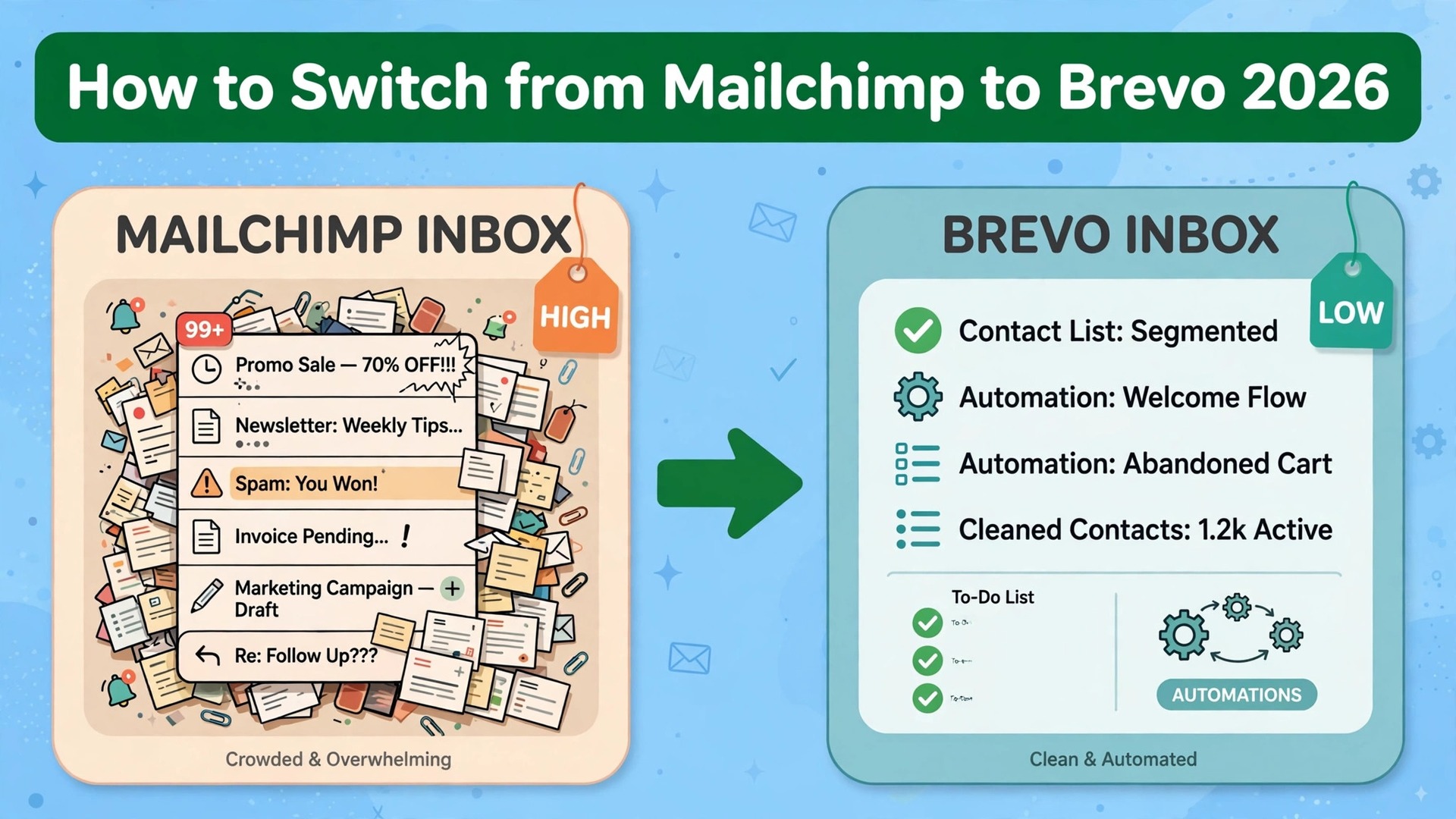
The list grows to 20,000 contacts, the Mailchimp bill grows to 250 dollars a month, and half the list has not opened an email in a year. That is the moment most senders start asking how to switch from Mailchimp to Brevo, and it is a fair question.
Mailchimp charges by the number of contacts stored, including unsubscribed contacts that can never receive an email. Brevo charges by the number of emails sent, not by contacts stored, and all contacts are stored free. A business with 20,000 contacts that only emails 5,000 active subscribers each month still pays for all 20,000 on Mailchimp. On Brevo, the same business pays for the emails it actually sends, and the saving is the whole point of the switch.
The switch is not about which tool is better in general. It is about which pricing model matches the way the business actually emails. Mailchimp Standard for 20,000 contacts costs about 250 dollars a month. Brevo Business for 20,000 email sends costs about 65 dollars a month, with automation, A/B testing and multi user access included. For a business with a large list that emails a small active segment, the gap is real. For a business that emails its whole list every week, Brevo can cost more, and this guide says so plainly.
This guide walks through how to switch from Mailchimp to Brevo in seven steps, with a checklist, a cost comparison, and a clear account of what transfers, what does not, and what to test before cancelling Mailchimp. Follow the steps in order, run both tools side by side for two weeks, and the move will be boring in the best way. Skip the steps, cancel early, and tags, automations and templates can vanish without a trace.
The Price Gap That Starts the Conversation
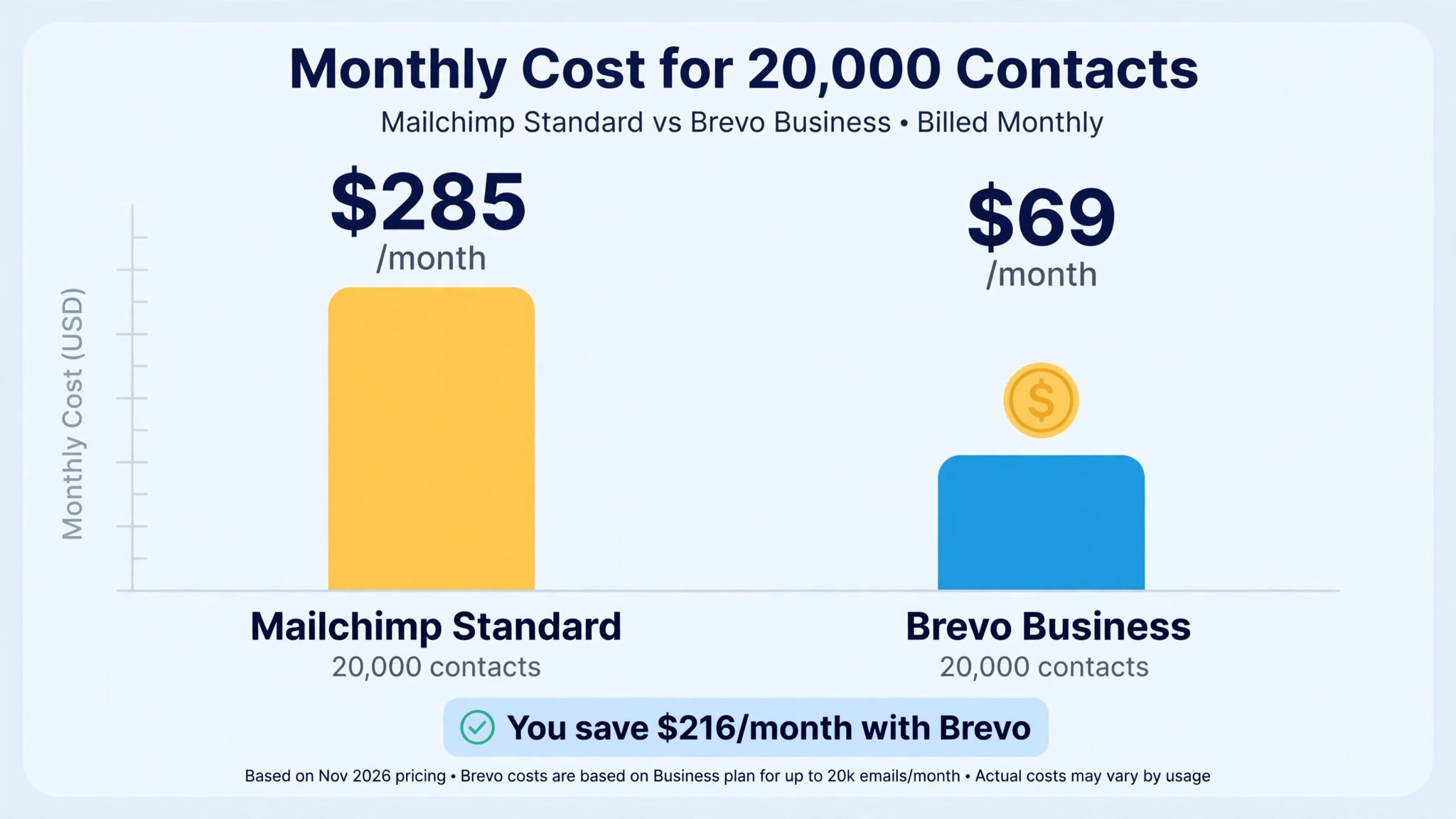
Cost is the reason most businesses switch, and the numbers explain why. Mailchimp Free costs nothing for up to 250 contacts and 500 sends a month. Essentials costs 13 dollars a month for 500 contacts on introductory pricing, with 3 users, scheduling and automations up to 4 steps. Standard costs 20 dollars a month for 500 contacts, with 5 users, up to 200 automation flows, generative AI and dynamic content. At 10,000 contacts, Essentials costs about 110 dollars a month, Standard costs about 135 dollars a month and Premium costs about 350 dollars a month. At 20,000 contacts, Standard costs about 250 dollars a month.
Brevo Free costs nothing for up to 300 emails a day, with up to 100,000 contacts stored free and a Brevo logo on emails. Starter costs 9 dollars a month for 5,000 email sends, with no Brevo logo, AI content generation, segmentation, forms and basic reports. Business costs 65 dollars a month for 20,000 email sends, with automation, A/B testing and multi user access included. All contacts are stored free on every plan, always.
A business with 10,000 contacts on Mailchimp Standard pays about 135 dollars a month. The same business on Brevo Starter for 20,000 emails a month pays about 29 dollars a month in some listings, and on Business for 20,000 sends pays about 65 dollars a month, a saving of about 70 dollars a month, or about 840 dollars a year. A business with 20,000 contacts on Mailchimp Standard pays about 250 dollars a month against about 65 dollars on Brevo Business, a saving of about 185 dollars a month.
The free plans tell the same story. Mailchimp Free caps at 250 contacts, so it is a plan for a tiny list. Brevo Free stores up to 100,000 contacts and sends 300 emails a day, so a whole small business can run on it before paying anything. A business that wants to test Brevo with real sends can do it free, which makes the trial cheap and the decision easy.
Mailchimp vs Brevo at a Glance
| Feature | Mailchimp | Brevo |
|---|---|---|
| Pricing model | Per contact stored | Per email sent |
| Free plan | 250 contacts, 500 sends a month | 300 emails a day, 100,000 contacts |
| Entry paid plan | Essentials 13 dollars a month | Starter 9 dollars a month, 5,000 sends |
| Mid plan | Standard 20 dollars a month, 500 contacts | Business 65 dollars a month, 20,000 sends |
| Contacts stored | Charged, including unsubscribed | Free, unlimited on every plan |
| Transactional email | Mandrill, paid add on from 20 dollars a month | Native, included on all plans |
| SMS and WhatsApp | Paid add on on Essentials and above | SMS and WhatsApp on credits |
| CRM | Basic, paid tiers | Built in CRM included at no extra cost |
| Automations | 4 steps on Essentials, 200 flows on Standard | Visual workflow builder on Business |
| A/B testing | Standard and above | Business and above |
Brevo bundles more into each tier for a sender with a large list, and that bundling is the point of the switch. Transactional email, SMS, WhatsApp and a basic CRM all live in the same account, so a business stops paying for Mandrill and a separate CRM. Mailchimp stays stronger on templates and ease of use, with a larger template library and a gentler learning curve, and that polish is worth real money to a team that values design over price. Check which side of that trade your business sits on before you move.
The Trade-Offs Nobody Mentions First
A switch guide that only lists the savings is not honest, so this section states the trade plainly. Mailchimp is a polished email tool with the largest template library in the category. Brevo is a broader marketing platform with a cheaper pricing model, and the difference shows in the daily work. A team that opens Mailchimp, picks a template and sends it will find Brevo less polished, with fewer templates and a steeper learning curve. The first week in Brevo feels slower, even when the bill is lower, and a team that hates setup will feel that friction daily.
A team that already pays for Mandrill for transactional email will not miss the polish, because Brevo includes transactional email natively and saves the Mandrill fee at once. The question is not which tool is better. The question is whether the business wants one cheap platform or one polished email tool, and learning how to switch from Mailchimp to Brevo starts with answering that question honestly.
The contact model deserves a second look, because it decides the saving for businesses that email rarely. Mailchimp counts every stored contact toward the bill, including unsubscribed and non engaging contacts on some plans, so costs climb with list size regardless of how often the business emails. Brevo stores all contacts free and charges only for sends, so a business with 50,000 contacts that emails 5,000 of them a month pays for 5,000 sends, not for 50,000 contacts. Count the active segment before deciding, and the math will make the choice.
The template gap also matters. Mailchimp wins on templates, ease and brand ecosystem, while Brevo wins on pricing model, built in CRM and SMS. A business that sends a beautifully designed newsletter every week will feel the template gap. A business that sends a simple offer to a large list will feel the price gap more. Run the two totals, and the answer will be clear.
How to Switch from Mailchimp to Brevo in 7 Steps
Step 1. Audit the Mailchimp account before touching anything
Open Mailchimp and list every audience, every list, every tag, every segment, every automation, every template, every signup form and every campaign report. Export each audience as a CSV with merge fields and tags, and export unsubscribed and cleaned contacts as separate files. Note the renewal date and the contract terms, because cancelling mid contract can carry a fee. Pay special attention to tags, automations and templates, because the integration does not move those cleanly. This audit takes an hour and prevents the most common switch failure, which is discovering a workflow only after it was deleted.
Step 2. Clean the list and decide what moves
Clean the list before you import it, because a dirty list will hurt deliverability on the new platform. Remove bounced and cleaned contacts, suppress unsubscribed contacts, and segment the active subscribers from the ones who have not opened in a year. Brevo own guidelines note that only contacts who have consented to receive updates in the last two years should move, so check consent dates before you import. A clean list of 5,000 active subscribers will earn more than a dirty list of 20,000, and it will cost less on Brevo.
Step 3. Connect the Mailchimp integration and import contacts
Open Brevo, connect the native Mailchimp integration, and import the contacts. The integration syncs contact attributes, first name, last name and standard fields, and imports Mailchimp audience lists as Brevo lists, with contact sync updates for up to 1 million contacts. Import a single small list first, check the counts against the Mailchimp original, open a few contacts to confirm fields survived, and fix the mapping before the big import. A pilot import that takes an afternoon prevents a workspace wide mess.
Step 4. Rebuild automations, templates and forms
Once the import looks clean, rebuild what the integration leaves behind. Mailchimp tags do not transfer via the integration, so import them as custom contact attributes or Brevo list assignments instead. Mailchimp automation sequences must be recreated in Brevo automation workflow builder, because Customer Journeys do not import. Email templates must be rebuilt in Brevo drag and drop editor or imported as HTML files from Mailchimp. Signup forms must be replaced with Brevo forms on the website. This is the largest single task in the switch, so budget a full afternoon for a normal account and do not promise a one hour migration.
Step 5. Authenticate the domain and warm up sending
Authenticate the domain with Brevo DKIM and SPF records, and keep DMARC in place. Domain authentication is the step that decides whether the first Brevo send lands in the inbox or in spam, so do not skip it. Then warm up sending with a small, engaged segment first, and grow the volume over two weeks. A sudden send to the whole list from a new platform can hurt deliverability, while a gradual warm up builds a good sender reputation.
Step 6. Run both tools side by side for two weeks
Send from Brevo for two weeks while Mailchimp stays open and the old automations finish. Watch the open rates, click rates and bounce rates daily, check that unsubscribes are suppressed, and confirm the rebuilt automations actually fire. Compare a Brevo report with the Mailchimp export from step 1 to spot any gap in performance. Fix the problems while Mailchimp is still available as a fallback, not after it is cancelled. Two quiet weeks of parallel running cost nothing and catch every problem early.
Step 7. Cancel Mailchimp and confirm the data is safe
Once two weeks of Brevo sends look clean, export the final audience data and any remaining reports from Mailchimp, then cancel the subscription before the renewal date. Confirm the cancellation email arrives, and check that no auto renewal is set. Keep the Mailchimp export files for six months, because the integration does not move everything and the old exports are the only record of tags, automations and templates. The switch is done when Brevo has run cleanly for two weeks and Mailchimp is cancelled without a surprise charge.
What Comes Across and What Stays Behind
Brevo native Mailchimp integration moves the core contacts well. Contact attributes, first name, last name and standard fields transfer, Mailchimp audience lists import as Brevo lists, and contact sync updates up to 1 million contacts. For a normal audience, that covers most of what a business needs to keep emailing on day one.
What does not transfer is specific, and the team should name it before starting. Mailchimp tags do not transfer via the integration, so import them as custom attributes or list assignments. Mailchimp automation sequences must be recreated in Brevo workflow builder. Email templates must be rebuilt or imported as HTML. Signup forms must be replaced. Transactional sending through Mandrill must be moved separately, by recreating templates in Brevo and swapping SMTP or API credentials in the app, testing every message type.
Only contacts who have consented in the last two years should move, according to Brevo own guidelines, so a business should not import a list it bought or a list that never opted in. That is the full picture of how to switch from Mailchimp to Brevo without losing the subscribers that matter.
The Go-Live Checklist
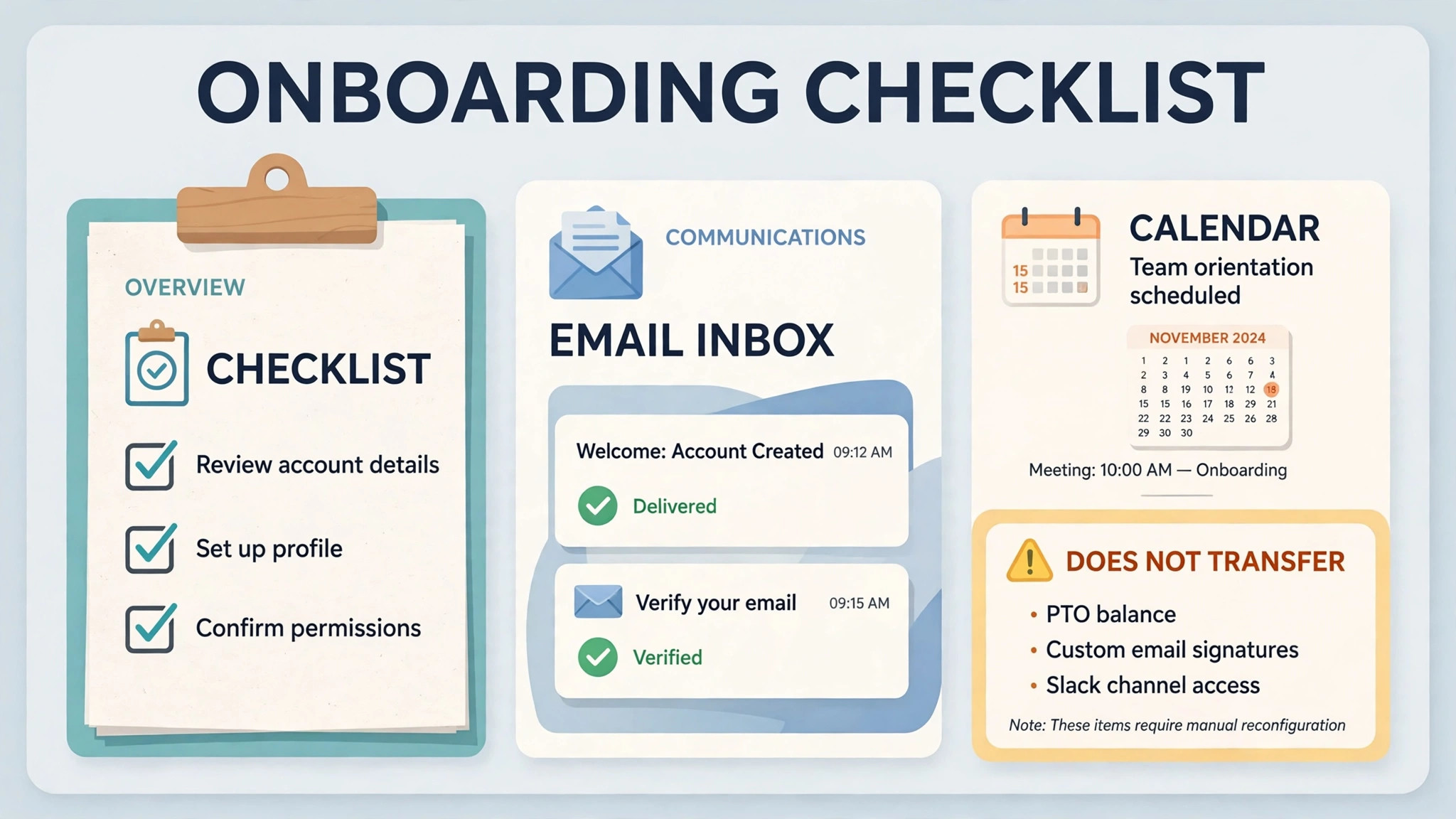
Use this checklist before starting step 1, and do not skip a line.
- List every Mailchimp audience, tag, segment, automation and template. – Export each audience as a CSV with merge fields and tags. – Export unsubscribed and cleaned contacts as separate files. – Flag tags, automations, templates and signup forms. – Choose the Brevo plan by monthly send volume, not by list size. – Decide how Mailchimp tags map, to lists or custom attributes.
- List the Mailchimp automations the business actually uses. – Authenticate the domain with DKIM, SPF and DMARC before the first send. – Plan a replacement for any Mailchimp feature Brevo lacks. – Set a switch date in a quiet week, not during a launch. – Tell the team the switch date and the new workflow before step 1.
What the Switch Saves in Real Money
The saving depends on list size and send volume, because the two tools charge in different ways. A business with 10,000 contacts on Mailchimp Standard pays about 135 dollars a month. The same business on Brevo Business for 20,000 sends pays about 65 dollars a month, a saving of about 70 dollars a month or about 840 dollars a year. The same business on Brevo Starter for 5,000 sends pays about 9 dollars a month, if 5,000 sends cover the month.
A business with 20,000 contacts on Mailchimp Standard pays about 250 dollars a month. The same business on Brevo Business for 20,000 sends pays about 65 dollars a month, a saving of about 185 dollars a month or about 2,220 dollars a year. A business with 50,000 contacts on Mailchimp Standard pays about 450 dollars a month, while Brevo Business for 40,000 sends costs about 75 dollars a month, a saving of about 375 dollars a month.
The saving shrinks when the business emails its whole list every week. A business that sends 60,000 emails a month to 10,000 contacts will pay more on Brevo than a business that sends 5,000 emails a month to the same list, because Brevo charges by volume. Count the monthly sends, not just the contacts, run the two totals, and the answer will be clear. For most businesses with a large list that emails a small active segment, Brevo saves hundreds of dollars a year.
Run the same math for your own list before you commit to how to switch from Mailchimp to Brevo, because the totals decide the plan.
Your First Two Weeks in Brevo
The parallel run only helps if the team tests the right things, so set the tests before the first Brevo send is scheduled. Send to a small, engaged segment first, including one welcome automation, one promotional campaign and one transactional message, and confirm each one arrives, opens and tracks correctly. Then compare the Brevo open and click rates against the Mailchimp export from step 1, checking totals by segment and by campaign. That test plan is the part of the switch that most teams skip, and it is the part that catches the problems while Mailchimp is still available as a fallback.
Test the automations and the forms next, because those are the workflows that break quietly. Trigger one rebuilt automation and confirm it fires, submit a signup form and confirm the contact lands in the right Brevo list, and have a second teammate confirm they see the same contact. Also test a transactional message, since Mandrill must be replaced by Brevo SMTP or API, and a missed order confirmation costs more than a missed newsletter. A test that covers sends, automations, forms and transactional mail in the first week leaves the second week for fixing what failed, which is exactly how a quiet switch is supposed to work.
Five Mistakes That Stall the Move
The first mistake is cancelling Mailchimp before the Brevo import is checked. A team that cancels on day one loses the tags, the automations and the template history in one move, and the rebuild takes days instead of hours. Keep Mailchimp until step 7, and the switch stays boring. The second mistake is importing the whole list at once without cleaning it. A dirty list with bounced and unsubscribed contacts will hurt deliverability on the new platform, and fixing it after the fact costs more than cleaning it first.
The third mistake is forgetting the tags. Mailchimp tags do not transfer via the integration, so a business that relies on tags for segments will lose its targeting unless it maps tags to Brevo lists or attributes first. Count the tags before choosing a plan. The fourth mistake is skipping domain authentication. A send from a domain without DKIM and SPF will land in spam, and the team will blame Brevo for a problem that authentication would have fixed. Authenticate before the first send, not after.
The fifth mistake is underestimating the manual rebuild. Automations, templates and forms do not transfer, and a team that budgets an hour for the rebuild will run out of time. Budget an afternoon, rebuild the top automations first, and leave the long tail of old templates behind. The switch is a good time to clean the account, not a reason to move every old campaign into the new tool.
Life After the Switch
The first month after the move is when the saving becomes real, and it is also when the new habits form. Set a weekly review in Brevo, one hour where the team checks open rates, clears bounces and updates the segments, because a platform that charges by sends needs a steadier rhythm than Mailchimp did. Tune the rebuilt automations after two weeks, not on day one, because the first fortnight shows which workflows fire too often and which never fire at all. The work of learning how to switch from Mailchimp to Brevo does not end on cancel day. It ends when the team stops opening the old tool out of habit, and that usually takes a full month.
Revisit the plan choice after 90 days. A business that started on Starter may find it needs Business for automation and A/B testing, and a business that started on Business may find it can drop to Starter if it sends fewer emails than it expected. Count the sends again too, because Brevo bills by volume, and a segment that never opens should come off the active list.
Clean the list every quarter, not just at the switch. Remove bounces, suppress unsubscribes and move the contacts who have not opened in a year into a re-engagement campaign before you email them again. A clean list keeps deliverability high, keeps the send volume low and keeps the bill low, which is the whole reason the switch was worth doing. A sender that cleans the list quarterly will spend less, reach more inboxes and keep the new platform working long after the first month, with fewer bounces and better open rates every single week. The switch saves money once. The habits save it every month after.
Frequently Asked Questions
How long does it take to switch from Mailchimp to Brevo?
Most small businesses finish the switch in one to two weeks. The audit and list cleaning take an afternoon, the import and the manual rebuild take another afternoon, and the two week parallel run catches the problems while Mailchimp is still available. A business with many audiences, heavy automation or a large list should budget three weeks. Do not promise a one day switch, because the manual rebuild and the warm up are what make the move safe.
Will I lose my subscribers when I switch from Mailchimp to Brevo?
Contacts, lists and standard fields transfer through the native Mailchimp integration, so export each audience first and run a pilot import on one list to confirm the mapping. Tags, automations and templates do not transfer cleanly, so flag them in the audit and rebuild them by hand. Keep Mailchimp running until the Brevo import is checked, and no subscriber will be lost.
Is Brevo really cheaper than Mailchimp?
For most businesses with a large list that emails a small active segment, yes, by a wide margin. Brevo Business for 20,000 sends costs about 65 dollars a month against about 250 dollars for Mailchimp Standard at 20,000 contacts, so the saving is about 185 dollars a month. The only common case where the saving shrinks is a business that emails its whole list every week, because Brevo charges by volume. Count the monthly sends before deciding.
Does Brevo have the same templates as Mailchimp?
Brevo has fewer templates than Mailchimp, and templates do not transfer, so the team rebuilds its preferred templates by hand or imports them as HTML. Mailchimp wins on templates, ease and brand ecosystem, while Brevo wins on pricing model, built in CRM and SMS. Pick the two or three templates the business actually uses and rebuild those first.
Can I keep my Mailchimp automations when I switch?
No, automations do not transfer from any source. Mailchimp Customer Journeys must be rebuilt as Brevo workflows, and Brevo automation is included on Business. List the automations the business actually uses, rebuild the top ones first, and check the plan before choosing. A business with heavy automation should test the rebuild before committing.
The Call
Switch to Brevo if the business is paying for Mailchimp by contact count and only emailing a small active segment, if the business wants transactional email, SMS and CRM in the same account, or if the bill is the problem. A business with 10,000 to 50,000 contacts will save hundreds to thousands of dollars a year, get a built in CRM and transactional email that Mailchimp charges extra for, and lose nothing it actually uses, as long as the audit flags the tags and the automations first. For those businesses, learning how to switch from Mailchimp to Brevo is worth an afternoon, and the saving repeats every month.
Stay on Mailchimp if the business loves the template library and sends beautifully designed newsletters every week, if the business emails its whole list every week and the volume pricing would cost more, or if the business is mid launch and cannot afford a week of parallel running. A business that values design over price will feel Brevo as thin, and a business with a small list can find Mailchimp Essentials cheaper than Brevo Business. Stay also if the contract renewal is close and the business is mid campaign. A switch during a campaign costs more in chaos than it saves in subscription fees.
The decision rule is simple. Count the contacts, count the sends, list the automations the business actually uses every week, and run the two totals with transactional email included. If Brevo covers the weekly workflow and costs less, switch in a quiet week and follow the seven steps. If Mailchimp covers a weekly workflow that Brevo cannot match, stay and clean the list instead. The right tool is the one that matches the work, not the one with the lower headline price.