
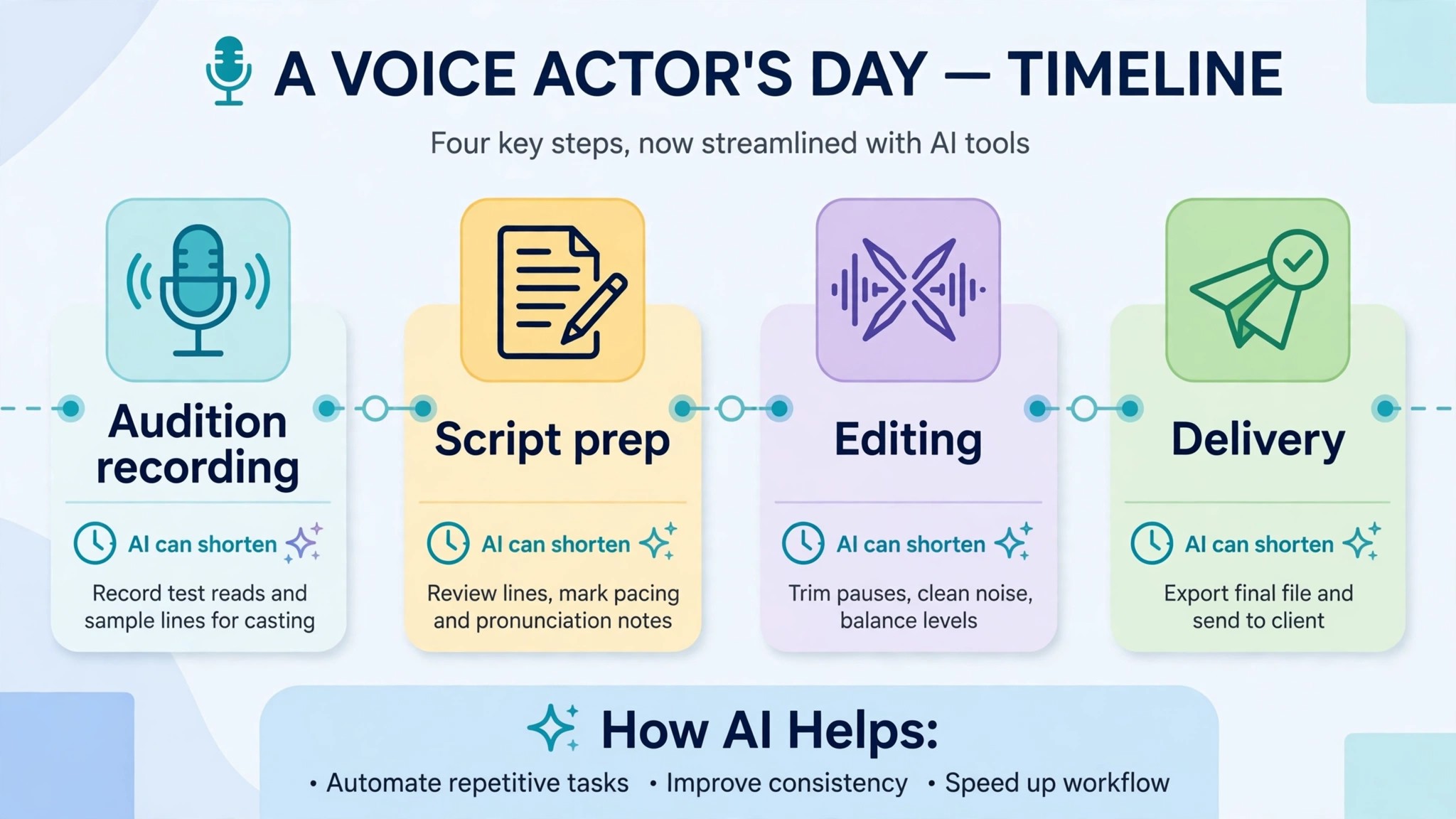
A voice actor’s day is split between the work that pays and the work that surrounds it. The paid part is the performance, the read that lands the audition and the session that fills the invoice. The surrounding work is script prep, demo edits, audition takes that need a quick fix, and the endless search for the next booking. The best ai tools for voice actors are the ones that shrink the surrounding work without touching the performance itself, because no client hires a voice actor for software, and no software should pretend to be the actor.
The money in voice work has also changed. Clients now ask for faster turnarounds, more languages and more revisions, and they expect the first take to arrive the same day. An actor who still does every pickup in the booth and every edit by hand will lose bookings to one who uses the best ai tools for voice actors to handle the mechanical half of the job. The performance still belongs to the actor, and the client can hear the difference between a directed read and a generated one. The tools below are judged on that line, on whether they help a real actor work faster without asking the actor to hand the performance itself to software.
This guide compares five tools on published prices, the voice job each one does best and the catch that only shows up after the trial ends. One honest note runs through the whole guide. AI voice tools can clone a voice, fix a flubbed word and draft a demo, and they can also be misused to copy a voice without permission. A working actor should read every licence, keep control of their own voice data, and never upload a voice sample to a tool whose terms they have not read. The tools below are judged on what they do for a working actor, not on how well they imitate one.
The Quick Shortlist
The table below matches each common voice job to the single tool that handles it best. Use it to narrow the best ai tools for voice actors to two or three candidates before you read the full reviews. Prices are monthly list prices unless noted, and annual billing is usually cheaper than paying month to month.
| Job | Best tool | Why it wins |
|---|---|---|
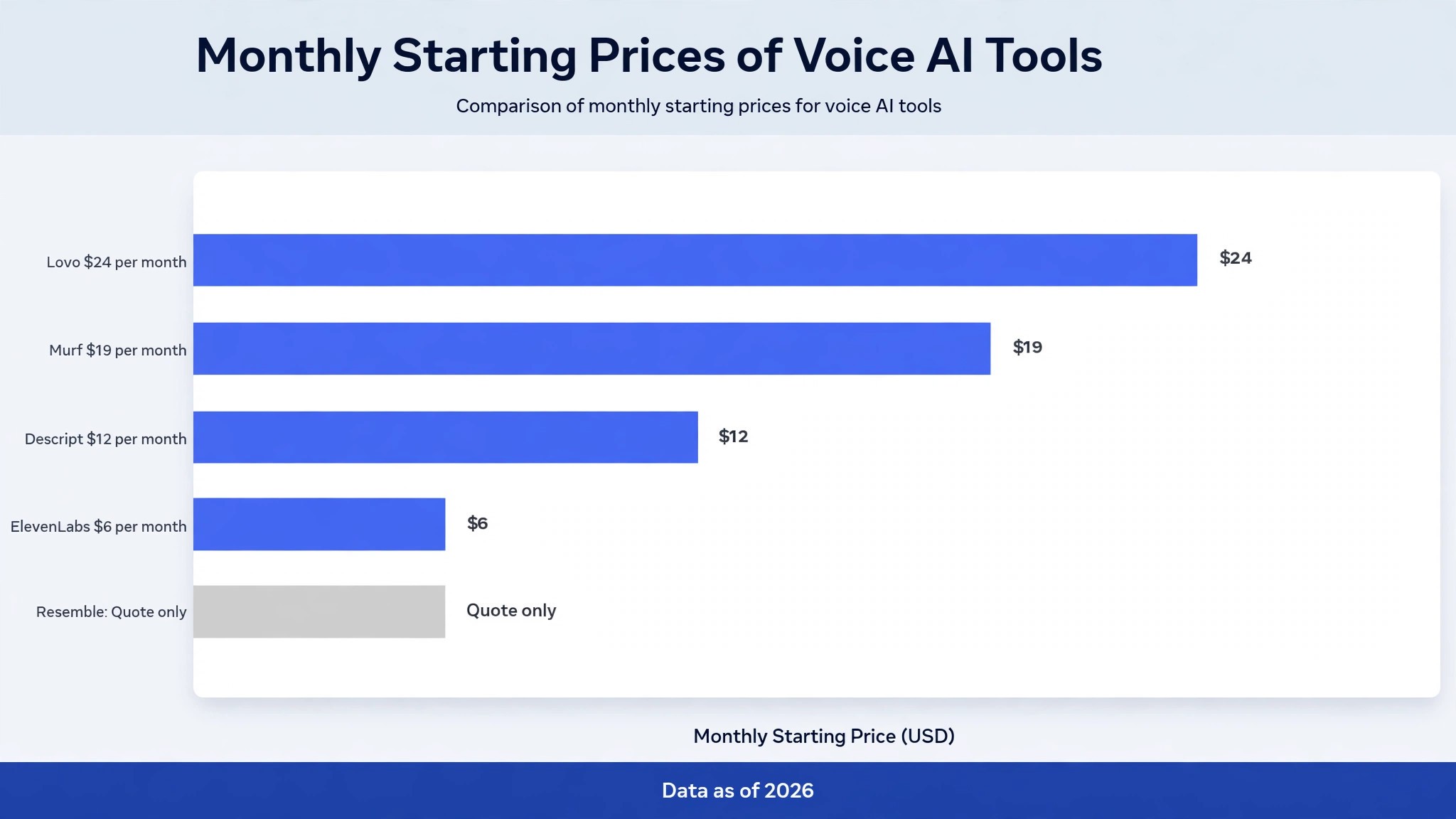
| Cloning your own voice for pickups | ElevenLabs | Most natural cloning, from 6 dollars a month for Starter |
| Studio voiceovers with many voices | Murf AI | Creator at 19 dollars a month billed annually, commercial rights included |
| Fixing a flubbed word without re-recording | Descript | Overdub corrects words in your own voice, Creator at 24 dollars a month |
| Quick multilingual voiceovers | Lovo AI | From 24 dollars a month, strong voices in many languages |
| A custom voice for a brand or game | Resemble AI | Quote based, built for custom voices and real time use |
How We Judged the Best AI Tools for Voice Actors
A tool earned a place here only if it does a real voice job in 2026, not if it added an AI label to an old audio editor. The best ai tools for voice actors were judged on five things that decide whether an actor keeps paying after the first year.
First, the voice job it does, from cloning to editing to dubbing, because a tool that does one job well beats a platform that does five jobs poorly. Second, voice quality, because a listener can hear a flat or robotic read in the first three seconds, and a demo that sounds synthetic will cost an actor the audition rather than win it. Third, whether the price is published and how it scales, including character and credit caps that change the real bill as the workload grows.
Fourth, licensing and control, because a voice is an actor’s livelihood, and a tool that trains on uploaded audio or claims broad rights over a clone is a risk no working actor should take lightly. Fifth, the catch, from credit pools that drain fast on dubbing to clones that sound right on short lines and wrong on long narration.
A demo is the other test that matters, and it is the one most buyers skip. A vendor demo voice is recorded in a treated room, directed by a professional and mixed by an engineer, so it flatters every tool on this list.
The honest test is your own script, in your own room, with your own microphone, because that is the audio your clients will hear. Run the same two hundred words through every tool you trial, listen on headphones rather than laptop speakers, and ask a colleague which take they would hire. The tool that wins that test is the one to buy, even if another tool has the longer feature list or the lower headline price. Voice quality is not a number on a pricing page, it is what a listener hears in the first three seconds.
Run the same test on a second script in a different style, because a voice that sounds warm on a commercial can sound flat on a documentary. The two script test takes an hour and it saves a year of paying for the wrong tool.
| Check before you buy | What to ask | Why it matters |
|---|---|---|
| Voice quality | Test on your own scripts, not the demo | Demo voices flatter every tool |
| Character and credit caps | Monthly limit and what a long script costs | A cap that runs out mid project stops the work |
| Commercial licence | Which plans allow paid client work | A free plan rarely covers commercial use |
| Voice data rights | Does the tool train on your uploads | Your voice is your asset, protect it |
| Language range | Which languages and accents are real | A listed language can still sound flat |
| Contract terms | Monthly or annual, and what year two costs | Annual billing locks the price but not the need |
The 5 Tools, Reviewed One by One
1. ElevenLabs
Starting price Free plan, then 6 dollars a month for Starter, or 5 dollars a month billed annually. Best for Cloning your own voice for pickups. Watch out Every product draws on one shared credit pool, so dubbing and music drain it fast.
ElevenLabs is the top choice for voice actors in 2026, and the reason is simple. Its voices sound more human than any rival, with the pacing, breathing and emotional range that make a long narration listenable rather than merely intelligible. The Eleven v4 model supports more than 90 languages, and the same account covers text to speech, Instant and Professional Voice Cloning, Studio for long form audio, dubbing, transcription, music and sound effects. For an actor who needs one platform that handles most audio jobs, that breadth is the point.
The cloning workflow is where ElevenLabs earns its keep for a working actor. Instant Voice Clone starts on the Starter plan from a short sample, and Professional Voice Clone starts on Creator at 22 dollars a month, trained on more audio for higher fidelity. A pickup line that would have meant a new studio session can be generated in the cloned voice, and a long script can be drafted as audio before the actor records the final take. The free plan gives 10,000 characters a month, which is enough to test quality on your own scripts, though it carries no commercial licence and no cloning.
The catch is the credit pool. Every product draws on the same monthly credits, and dubbing costs far more per minute than plain text to speech, so a Creator plan that buys about two hours of narration buys only about forty minutes of watermark free dubbing. Credits also do not roll over on the free plan, and inputs and outputs are used for training unless the actor opts out, which is a setting worth checking on day one. For an actor who wants the best sounding voice and the cheapest paid entry with a commercial licence, ElevenLabs is the right first tool, and Starter at 6 dollars a month is the lowest risk way to test it on real work.
2. Murf AI
Starting price Free plan, then Creator at 19 dollars a month billed annually. Best for Studio voiceovers with many voices. Watch out The per character API pricing can surprise developers, so check the plan before building on it.
Murf AI is a voiceover studio first, and that focus shows in how it is built. Instead of a chat box that happens to make audio, Murf gives the actor a timeline, a script editor and a library of more than 120 voices in many languages, with pitch, speed, emphasis and pause controls on every line. For an actor producing e-learning, corporate narration, explainer videos and ads, that studio layout is faster than generating audio one paragraph at a time and stitching it together elsewhere.
The strength is the workflow for client work. A script can be split across several voices, each line can be tuned until it sounds right, and the finished audio exports cleanly for video editors. Creator at 19 dollars a month billed annually includes 24 hours of voice generation a year and commercial rights, which is generous for the price, and Business at 66 dollars a month billed annually lifts the allowance to 96 hours a year. For a working actor who sells finished voiceovers rather than raw takes, that included time matters more than any feature list.
The catch is that Murf is a studio, not a cloning specialist. Its cloning exists but is not the equal of ElevenLabs for a personal voice, and the voices, while strong, are a library to choose from rather than a mirror of the actor’s own instrument. An actor who wants to clone their own voice should start with ElevenLabs and use Murf for everything else. For studio voiceover work at a fair price, Murf earns its place, and the free plan is enough to test voice quality on a real script.
3. Descript
Starting price Hobbyist at 12 dollars a month, Creator at 24 dollars a month. Best for Fixing a flubbed word without re-recording. Watch out Overdub corrections are capped on Hobbyist, so check the limit before relying on it.
Descript is the only tool on this list that a voice actor buys for the edit rather than the voice, and that is exactly why it belongs here. It transcribes a recording, lets the actor edit audio by editing text, and its Overdub feature can fix a misread word in the actor’s own voice without a new recording session. For an actor who records long narration, that one feature pays for the subscription the first time a client asks for a single word change in a finished hour of audio.
The strength is the whole editing workflow. Removing filler words, cutting long pauses, cleaning room tone and exporting 4K video all happen in the same project, and Creator at 24 dollars a month includes unlimited Overdub corrections and unlimited projects. An actor who also edits video for clients, or who records video auditions, gets a video editor and an audio editor in one subscription, which is a better deal than buying them separately.
The catch is voice quality in the clone itself. Overdub is built to fix mistakes in the actor’s own voice inside a recording, and it does that job well, but it is not a general voice generator and should not be judged as one. Hobbyist at 12 dollars a month includes only ten Overdub corrections a month, so a working actor needs Creator. For an actor who records long form audio and dreads the re-record, Descript is the best editing pick on this list, and it pairs well with ElevenLabs for generation.
4. Lovo AI
Starting price From 24 dollars a month. Best for Quick multilingual voiceovers. Watch out Voice quality varies by language, so test each language you sell.
Lovo AI is the pick for an actor who sells voiceover in more than one language, or who needs a fast multilingual draft before recording the final take. From 24 dollars a month, it offers a large voice library across many languages, an AI writer that drafts scripts, and an editor that lets the actor tune pronunciation, emphasis and pacing line by line. For a small studio that takes on e-learning and corporate work in several markets, that language range is the selling point.
The strength is speed across languages. A script can be generated in English, then the same project can be voiced in Spanish, French or German without finding a new speaker for each version, and the Genny platform keeps the script, the voices and the edits in one place. An actor who works as a producer as well as a performer will use that workflow more than any single voice.
The catch is consistency. The best Lovo voices sound strong, but quality varies by language and by voice, so an actor should test each language they plan to sell rather than trusting the headline count. The price is also mid range, which makes Lovo a harder sell for an actor who only works in English. For multilingual voiceover work, Lovo earns its place, and the trial is worth using to audition the exact languages on your rate card.
5. Resemble AI
Starting price Quote based, with a pay as you go option reported at a fraction of a cent per second. Best for A custom voice for a brand or game. Watch out Quote based pricing means the bill depends on the project, so get it in writing.
Resemble AI is the specialist pick, built for custom voices rather than for a library of stock voices. It clones a voice from a short sample, lets a developer or studio use it through an API, and supports real time voice use in games, apps and interactive media. For an actor who licenses their voice to a brand, a game studio or an app, Resemble is the tool that turns a voice into a product with a contract behind it.
The strength is control and integration. A custom voice can be tuned, versioned and deployed through an API, and the platform is built for teams that need a voice to work inside software rather than inside a single recording session. That makes Resemble the right pick for an actor whose work is moving from sessions to licensing, where the voice itself becomes the deliverable.
The catch is price transparency. Resemble is quote based for most serious use, so a buyer cannot budget from the website and must go through a sales conversation to learn the number. A solo actor who just needs a demo clone will find ElevenLabs cheaper and faster. For custom voice licensing and real time use, Resemble earns its place as the most developer friendly option on this list, and any actor considering it should get the licence terms in writing before uploading a voice sample.
Side by Side Comparison
The table below puts the best ai tools for voice actors side by side on price, best job and free plan, so you can compare the published prices against the quote only tool at a glance.
| Tool | Starting price | Best for | Free plan |
|---|---|---|---|
| ElevenLabs | 6 dollars a month | Cloning your own voice for pickups | Yes |
| Murf AI | 19 dollars a month billed annually | Studio voiceovers with many voices | Yes |
| Descript | 12 dollars a month | Fixing a flubbed word without re-recording | Trial only |
| Lovo AI | 24 dollars a month | Quick multilingual voiceovers | Trial only |
| Resemble AI | Quote only | A custom voice for a brand or game | Trial only |
How to Pick the Right Tool for Your Voice Work
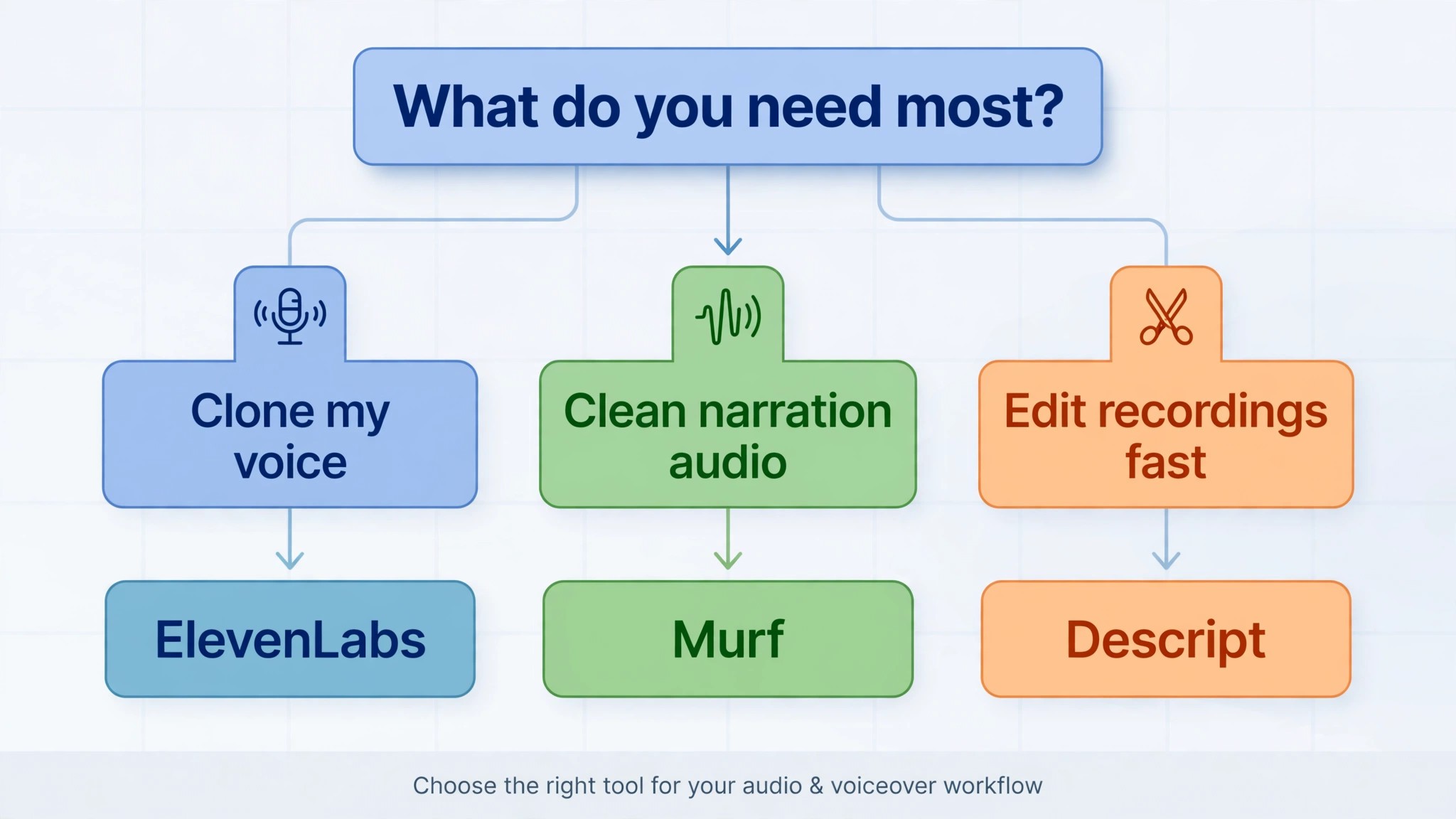
The best ai tools for voice actors are not the ones with the longest feature list. They are the ones that fix the bottleneck in your week. An actor losing hours to re-records should buy Descript. An actor who needs a clone for pickups should buy ElevenLabs Starter. An actor producing studio voiceovers for clients should buy Murf AI. An actor selling work in several languages should buy Lovo AI. An actor licensing a voice to a brand should talk to Resemble AI. Start from the bottleneck, not from the vendor homepage.
Budget the full bill, not the headline price, and budget by finished audio rather than by the plan name. A plan that advertises a large character count can still buy only a short stretch of finished narration once dubbing, music and sound effects draw on the same credits. Work out how many finished minutes you deliver in a normal month, then check what each plan buys in those minutes before you compare prices.
The table below shows what a working actor actually pays in year one for the most common combinations, using published starting prices. Character and credit caps are the lines that surprise buyers, so ask how many minutes of finished audio a plan really buys, and remember that dubbing and music draw on the same credit pool as plain narration on ElevenLabs.
| Stack | Monthly cost | What it covers |
|---|---|---|
| ElevenLabs Starter | 6 dollars | Cloning and commercial use for light work |
| Murf AI Creator, annual | 19 dollars | Studio voiceovers with commercial rights |
| Descript Creator | 24 dollars | Editing plus unlimited Overdub corrections |
| ElevenLabs Creator plus Descript Creator | About 46 dollars | Best clone plus best editor |
| Lovo AI | 24 dollars | Multilingual voiceovers from one platform |
| Murf AI Business, annual | 66 dollars | High volume studio work, 96 hours a year |
The other mistake is buying for the work you wish you had instead of the work you actually sell. An actor who records audiobooks does not need a real time game voice API, and an actor who sells corporate narration in one language does not need a library of a hundred voices in forty languages. Look at your last twenty invoices, count which jobs paid, and buy the tool that makes those jobs faster. The rest of the feature list is a distraction until the paying work changes. A tool that saves an hour on every audiobook chapter is worth more than a platform that does ten things you never bill for.
Frequently Asked Questions
Can AI tools replace a voice actor
No, and any client who thinks otherwise will learn it from the first flat read. The best ai tools for voice actors handle pickups, fixes, drafts and multilingual versions, but a performance still needs an actor who understands the script, the audience and the emotion in each line. A clone can repeat words, it cannot make the choices that turn a script into a performance. A director gives notes that only a human performer can interpret, such as asking for a read that sounds tired but hopeful, or warm without sounding salesy. Those are judgments, not settings, and no slider in any tool reproduces them.
Use the tools to cut the surrounding work, and keep the performance itself human, because that is what clients pay for.
Is it safe to clone my own voice with these tools
It is safe when you read the terms first and keep control of the sample. Check whether the tool trains on your uploads, whether you can delete your voice data, and what the commercial licence covers before you upload anything. ElevenLabs lets you opt out of training on your inputs and outputs, and that setting is worth finding on day one. Never upload a voice sample to a tool whose terms you have not read, and never clone another actor’s voice without their written permission.
Keep a copy of the terms as they stood when you signed up, because pricing pages and licence terms change and a later change should not quietly take rights you never agreed to give. If a tool will not let you delete your voice data, that alone is a reason to choose a rival.
What is the cheapest good AI tool for voice actors to start with
ElevenLabs Starter at 6 dollars a month is the cheapest paid entry with a commercial licence, and its free plan is enough to test voice quality on your own scripts.
Murf AI has a free plan for studio voiceovers, and Descript Hobbyist at 12 dollars a month is the cheapest way to test Overdub on real recordings. Start with the job that costs you the most time each week, and add a second tool only when the first one cannot do a job you are paid to do. A free plan is the right way to test voice quality, but it is not the right way to deliver paid work, because most free plans exclude commercial use. Pay for the cheapest plan that covers commercial work as soon as a client is paying you for the audio.
Which tool is best for audiobooks and long narration
ElevenLabs Creator at 22 dollars a month is the strongest pick for long narration, because its voices hold up over hours of listening and its Studio product is built for long form audio. Murf AI is the better pick when the audiobook needs many character voices from one studio, and Descript is the best editor for fixing the inevitable flubbed words in a long session. Budget by finished minutes, not by the headline character count, and test a full chapter before you commit to a plan. A chapter test also shows whether the voice stays consistent across an hour, which is the quality that separates a good narration tool from a good demo.
If the voice drifts or tires by page twenty, the listener will notice long before the actor does. That drift is the flaw that a short vendor demo never shows, and it is the reason a full chapter test matters more than any feature comparison.
How do I keep my voice consistent across a long project?
Test a full chapter before you commit, because a voice that sounds right in a demo can drift by page twenty, and the listener will notice long before the actor does. The best ai tools for voice actors in this guide hold up best when you test them on real scripts, and ElevenLabs Creator at 22 dollars a month is the strongest pick for long narration because its voices hold up over hours of listening.
Keep Descript beside it for the flubbed words, and budget by finished minutes, not by the headline character count. A chapter test shows whether the voice stays consistent across an hour, which is the quality that separates a good narration tool from a good demo.
Our Verdict
If you buy one tool this quarter, buy ElevenLabs Starter. At 6 dollars a month it is the cheapest honest way into voice cloning with a commercial licence.
Its voices are the best sounding on this list by a clear margin, and the Starter plan is cheap enough to test on real client work without a long commitment.
The best ai tools for voice actors earn their keep by giving you back the hours that re-records and pickups used to eat, and ElevenLabs does that from the first week, whether the saving is a single fixed word or a full pickup session you never had to book. Start on Starter, move to Creator when the work grows, and keep Descript beside it for the edits that a clone should never be asked to make.
Whatever you pick, start with the bottleneck, trial with your own scripts, and read the licence terms before you upload a voice sample. The tools on this list all work, and the best ai tools for voice actors are the ones that leave the performance to you while they handle the rest. The difference is whether the tool matches the voice work you actually sell, and whether you measure the return in hours saved and auditions won rather than in features used.