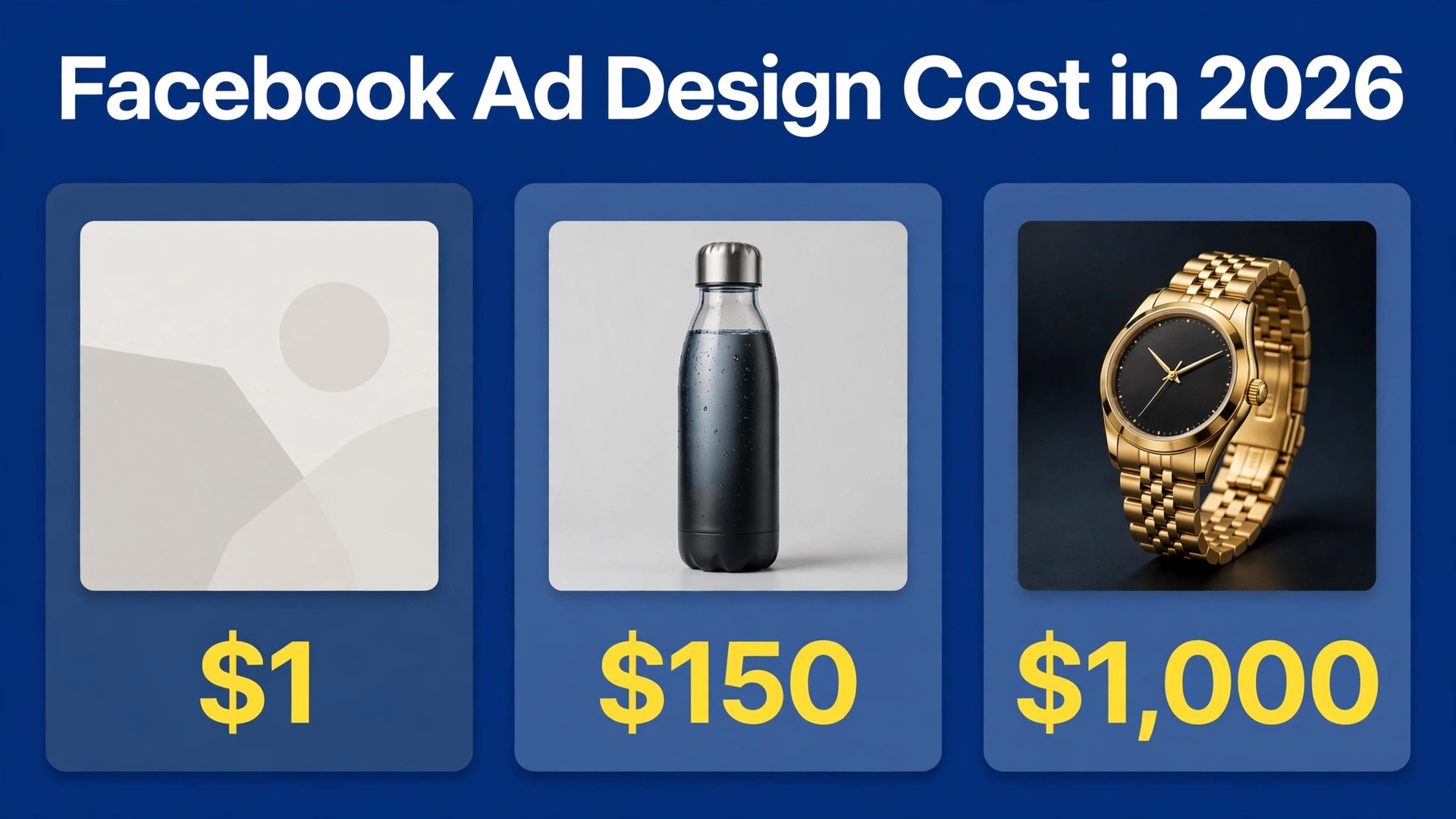
One Facebook ad can cost $1 from an AI tool, $150 from a freelance designer, or $1,000 from an agency, and all three prices are real. The difference is what comes with it. The $1 ad is a generated image with no strategy behind it. The $150 ad is a new concept built for your product, your audience and your brand. The $1,000 ad is a tested concept with four copy variations, a revision round and a strategist checking the result. This guide breaks down Facebook ad design cost in 2026 by provider, by format and by what actually drives the price, so you can spot a fair quote before you pay.
The first thing to understand is that design and ad spend are two separate bills. Facebook charges you to show the ad, and the designer charges you to make it. A business that budgets $500 a month for ads and forgets the design bill will run out of creative in week two. A business that pays for great creative and gives it $50 of spend will never learn whether the ad works. Budget for both, and keep the two numbers apart when you compare quotes, because a quote that looks cheap usually excludes the sizes, the variations or the revisions that a real campaign needs.
Facebook Ad Design Cost at a Glance
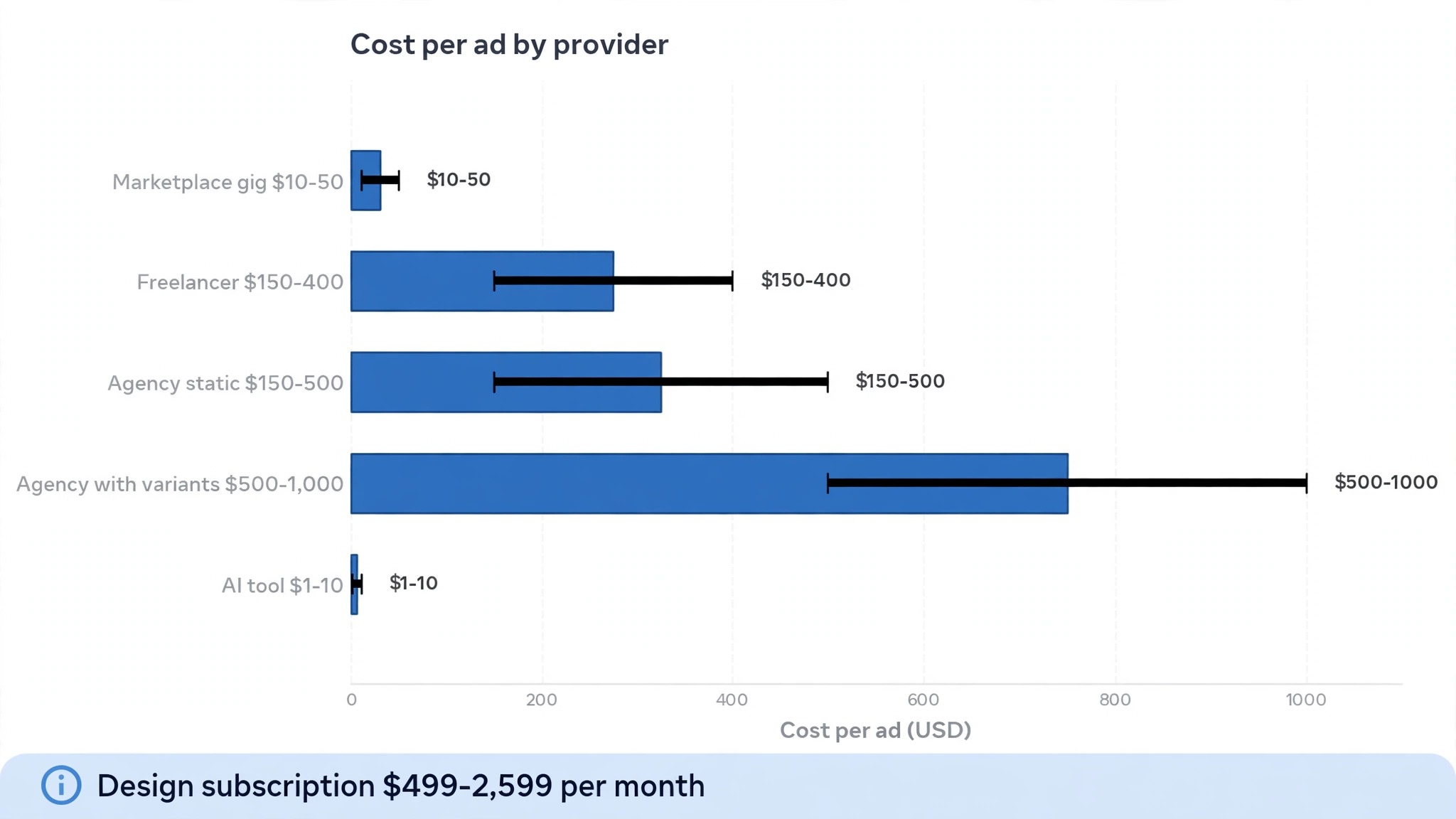
The table below shows the ranges businesses are commonly quoted in late 2026. These are market ranges gathered from pricing guides published in October 2026, not a price list, so use them to check a quote rather than to set a budget to the dollar.
| Provider | Typical price | What you get |
|---|---|---|
| Marketplace gig | $10 to $50 per ad | One static image, little strategy |
| Freelance designer | $150 to $400 per new concept | New idea, layout, headline, brand fit |
| Freelance variation | $20 to $75 per version | New headline or size on an existing ad |
| Agency static ad | $150 to $500 per ad | Strategy, design, revisions included |
| Agency with copy variants | $500 to $1,000 per ad | One design, four copy variations |
| Design subscription | $499 to $2,599 a month | Unlimited requests, all sizes |
| Agency retainer | $2,000 to $10,000 a month | Full creative service, ongoing |
| AI ad tool | $1 to $10 per finished ad | Generated image, fast, no strategy |
The range is wide because the job is wide. A single static image for a one off sale is a small job. A month of creative for a store that tests five concepts a week is a large one. The rest of this guide walks through each provider in turn, so you can match the price to the job you actually have.
What Facebook Ad Design Cost Looks Like by Provider
Marketplace Gigs
Marketplace gigs are the cheapest way to get an ad made, at $10 to $50 per ad, and the price tells you what to expect. You get one static image, built from a template, with little or no thinking about your audience, your offer or your brand. For a simple announcement, a price change or a local event, that can be enough. For a campaign that has to convert cold traffic, it usually is not, and the money saved on design gets spent on ad impressions that do not convert.
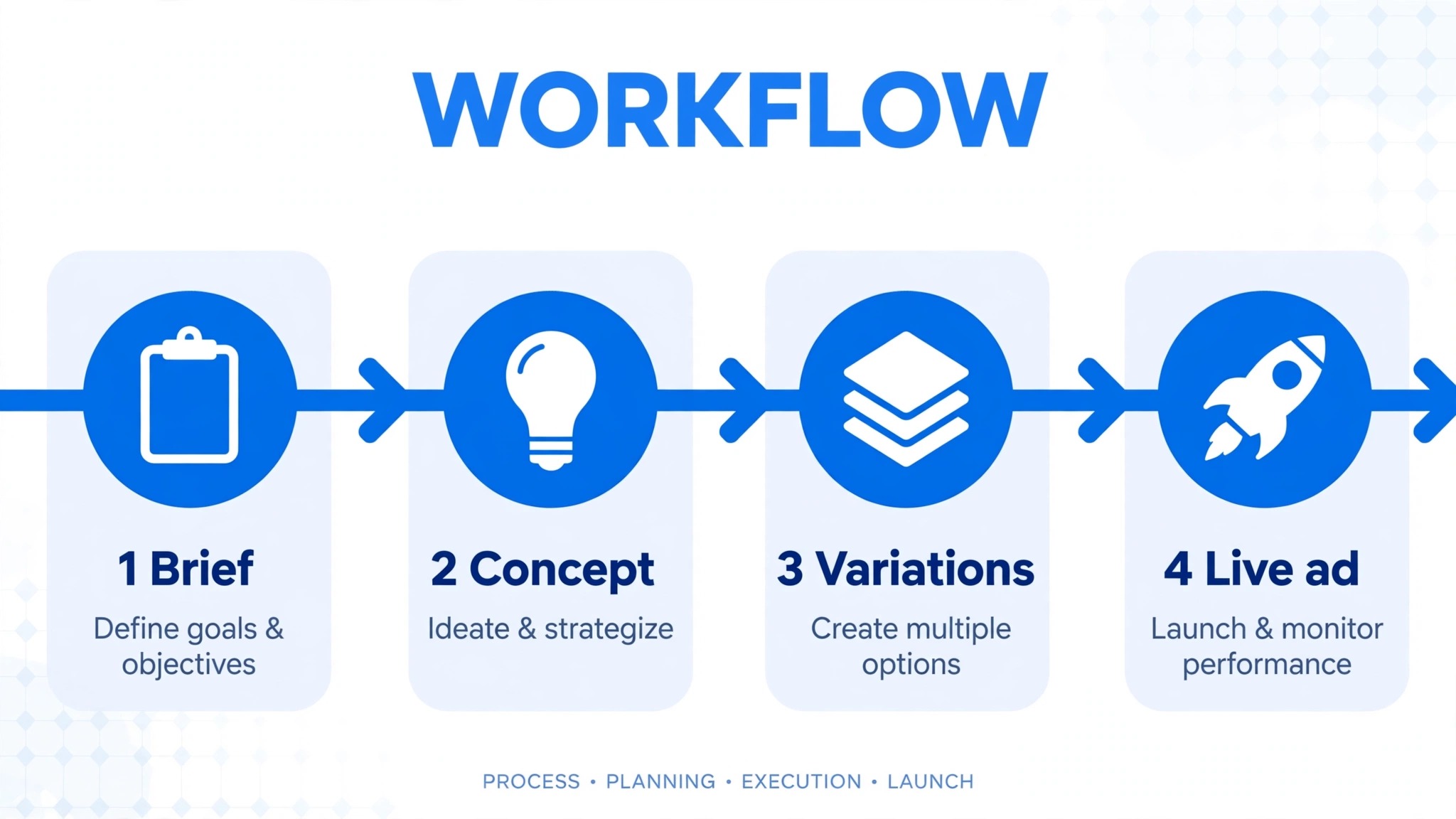
The hidden cost of a cheap gig is the rework. A $25 ad that needs three rounds of fixes, each billed separately, costs more than a $150 ad that arrives right the first time. Cheap gigs also tend to deliver a single size, so a campaign that needs feed, story and square versions will pay for each resize on top. Use marketplace gigs for simple, low stakes ads, and keep the brief tight, with the exact text, the exact image and the exact size written down before you order.
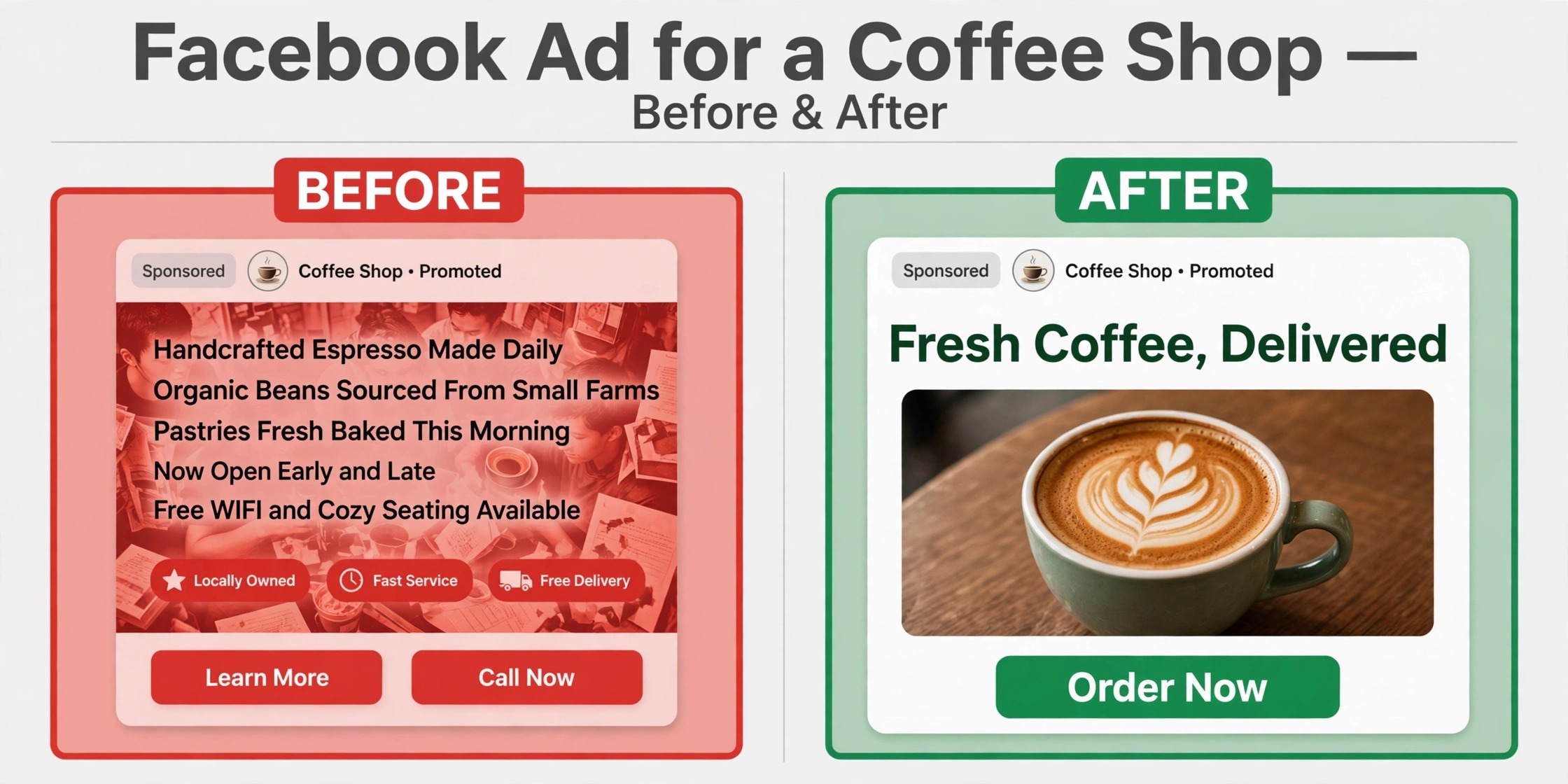
Freelance Designers
A freelance designer is the middle of the market, and the most common choice for a small business. Guides published in October 2026 commonly quote $150 to $400 for a new static ad concept, $20 to $75 for each extra variation or size of an ad that already exists, and $300 to $1,500 for a batch of five to ten variations. Hourly rates on Upwork run $15 to $35 an hour for most designers, with the full range stretching from $15 to $150 an hour and averaging about $25.
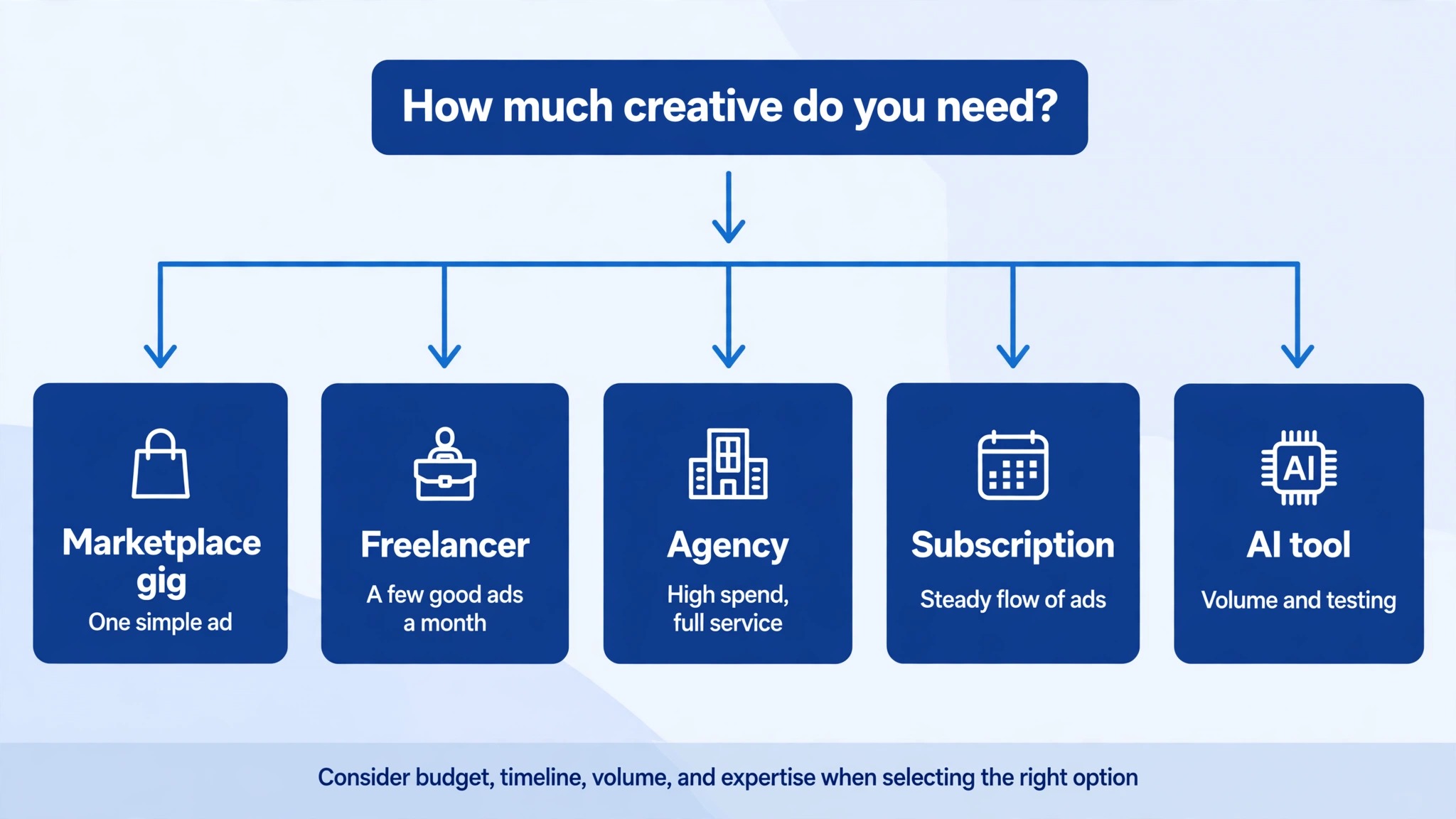
What you pay for is the thinking. A good freelancer asks about the product, the audience, the offer and the landing page before opening the design tool, and the ad reflects those answers. The price usually covers one concept in one size, with one or two revision rounds. Extra sizes, extra concepts and extra revisions cost more, so ask what is included before you agree. A freelancer who charges $200 for a concept and $25 per resize is cheaper for a five size campaign than a freelancer who charges $150 and bills every resize at $75.
Freelancers suit businesses that need a few ads a month and want a person who learns their brand over time. The relationship matters. A designer who has made ten ads for you knows which headlines your audience clicks and which colours your brand uses, and the eleventh ad is better for it. The risk is availability. A freelancer with three clients can go quiet in a busy week, and a campaign that needs ten ads by Friday will wait.
Agencies
Agencies sit at the top of the price range, and their quotes reflect the team behind the work. Performance creative agencies commonly quote $150 to $500 per static ad for basic work, and $500 to $1,000 for a static with four copy variations, with $750 as a typical figure for the package. A monthly creative retainer runs $2,000 to $10,000 or more, depending on volume and on whether strategy, copy and testing are included.
What the agency price buys is a process. A strategist plans the concepts, a designer builds them, a copywriter writes the variations, and someone checks the results and kills the losers. That process is worth the money when ad spend is high, because a 20 percent better ad on a $10,000 monthly spend pays for itself many times over. It is not worth the money when the monthly spend is $500, because the design bill will be larger than the media bill and the maths never works.
Agencies suit businesses spending at least a few thousand dollars a month on ads, testing several concepts a week, and needing creative as a service rather than a one off job. The quote should spell out how many concepts, how many variations, how many sizes and how many revision rounds are included, because those four numbers decide whether the retainer is generous or thin. Ask for them in writing before you sign.
Design Subscriptions
Design subscriptions sell unlimited requests for a flat monthly fee, and they suit businesses that need a steady flow of creative. Prices run $499 to $2,599 a month, with ManyPixels at $699 a month and Penji at $995 a month as two widely quoted examples. The plan covers static ads, social posts and web graphics, with all sizes and revisions included, and Penji assigns an art director on every tier. Motion and video usually cost extra, so check whether animation is included before you sign up for a video heavy campaign.
The number that matters is cost per variant per week, not cost per ad. A $699 subscription that delivers twenty ad variations a week costs about $9 per variation. A freelancer charging $150 per concept costs far more for the same volume, but far less if you only need two ads a month. Subscriptions win on volume and on speed, because a request submitted in the morning can be back the next day. They lose when the work needs deep brand knowledge, because a rotating queue of designers will never know your product the way a dedicated freelancer does.
AI Ad Tools
AI tools are the cheapest route, at $1 to $10 per finished ad, and they are the fastest. AdCreative.ai charges $39 a month for ten credits on its Starter plan, which works out to $3.90 per downloaded ad. Adrio charges $29 a month for 300 credits, which works out to about $0.97 per ad on its Basic plan. StoreToAds starts at $29 a month for nine designs, with larger plans at $99, $149 and $199 a month for more designs. Canva Pro, at about $12 a month on annual billing, and Adobe Express Premium at $9.99 a month, both include AI image tools that can build an ad from a prompt and a product photo.
AI ads work best as a starting point and as a volume tool. A store that needs twenty variations of a winning concept can generate them in an hour, test them, and keep the winners.
A business that needs a single ad to carry a new product launch will usually get a better result from a person, because the AI does not know what makes the product different. The smart use is a mix, with AI generating the volume and a designer refining the winners. The worst use is publishing the first AI result without checking it, because AI tools still produce odd hands, wrong text and off brand colours, and a mistake in a paid ad is visible to thousands of people.
What Drives the Price Up or Down
Five factors decide whether a quote lands at the low end or the high end of the ranges above, and understanding them is how you negotiate without cutting quality.
The first is the format. A single static image is the cheapest ad to design. A carousel with five cards costs more, because each card is a design. A video ad costs the most, because it needs a script, footage or animation, editing and captions. A business that tests with statics and only makes video for the winners will spend far less than a business that orders video for every idea.
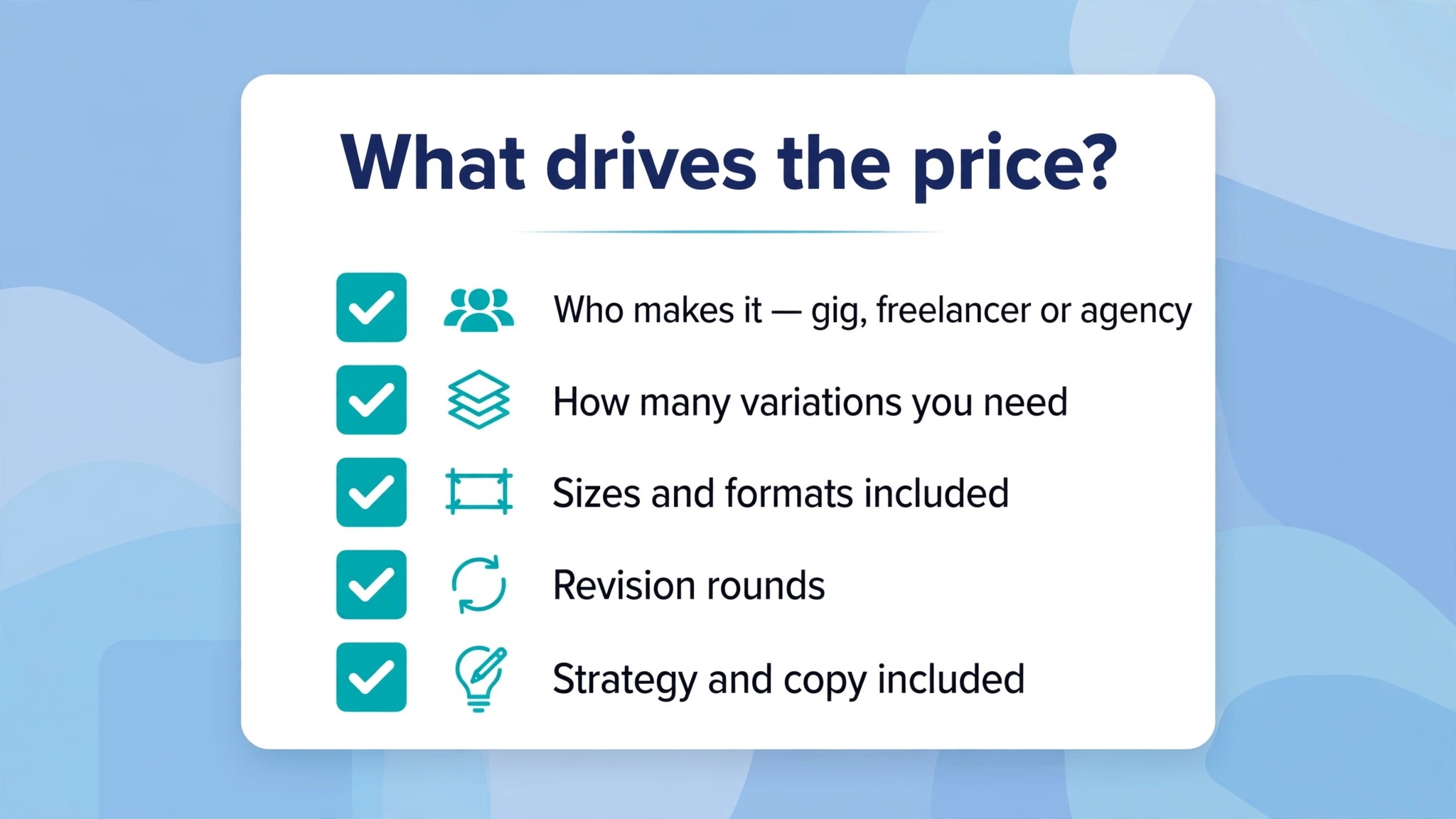
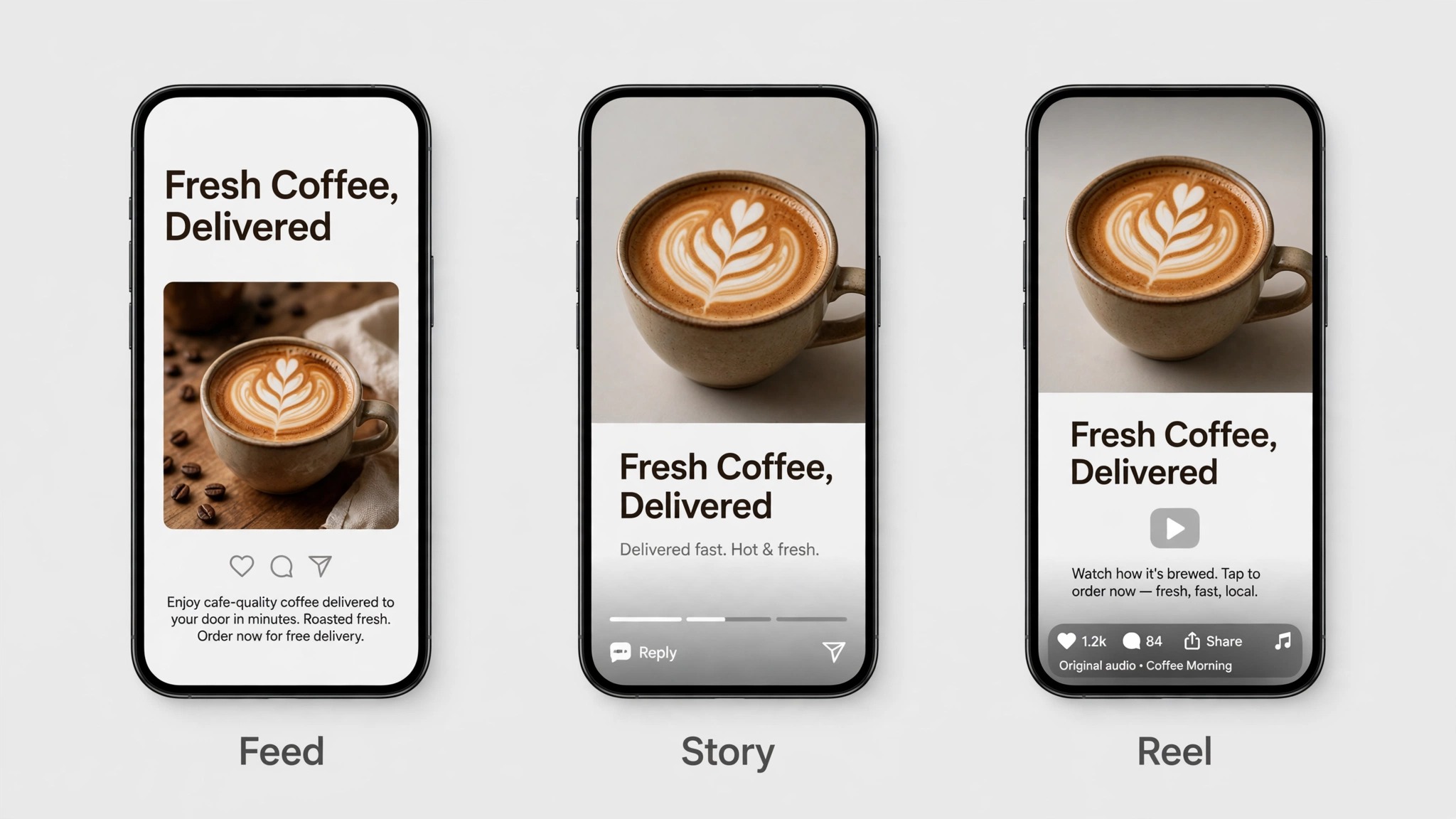
The second is the number of sizes. Facebook shows ads in the feed, in stories, in reels and in the right column, and each placement wants a different shape. A standard set covers square at 1 by 1, vertical at 4 by 5, story at 9 by 16 and wide at 1.91 by 1. One concept in four sizes is four files, and many designers bill each resize separately. A quote for one size is not a quote for a campaign, so ask for the full set price before you agree.
The third is the number of variations. Testing needs variations, and variations cost money. A concept with three headlines and two images is six ads, and each one needs design time even when the layout is the same. Some designers charge $20 to $75 per variation, others include two variations in the concept price. Either way, the variation count is the number that turns a $200 quote into a $600 bill, so agree it up front.
The fourth is revisions. One or two revision rounds are usually included in a freelance or agency quote. The third round is where the billing starts, and a client who changes the offer halfway through the design will pay for the rework. The cheapest way to keep revisions low is a good brief. Write the headline, the offer, the image direction and the call to action before the designer starts, and the first draft will be close to the final one.
The fifth is the designer experience. A designer who has made a hundred Facebook ads knows which layouts get clicks and which ones get ignored, and charges for that knowledge. A beginner charges less and learns on your budget. For a simple announcement the beginner is fine. For a campaign that carries real spend, the experienced designer is cheaper in the end, because a better ad wastes less of your media budget.
Facebook Ad Sizes and Formats
An ad designed for the wrong size gets cropped, and cropping kills the message. The table below lists the formats most campaigns need, with the sizes Facebook recommends. Build the design at these sizes from the start, because resizing a finished ad is where headlines get cut off and logos land in the wrong place.
| Placement | Size in pixels | Ratio |
|---|---|---|
| Feed square | 1080 by 1080 | 1 by 1 |
| Feed portrait | 1080 by 1350 | 4 by 5 |
| Link image | 1200 by 628 | 1.91 by 1 |
| Story and reel | 1080 by 1920 | 9 by 16 |
| Right column | 1200 by 628 | 1.91 by 1 |
The portrait 4 by 5 feed size deserves special attention, because it takes up more of the phone screen than a square ad and usually earns more attention for the same spend. Many designers still deliver square first out of habit, so ask for the 4 by 5 version as well. The story size, 1080 by 1920, needs a different layout entirely, with the headline at the top, the product in the middle and the call to action near the bottom, because a square layout squeezed into a tall frame looks lost.
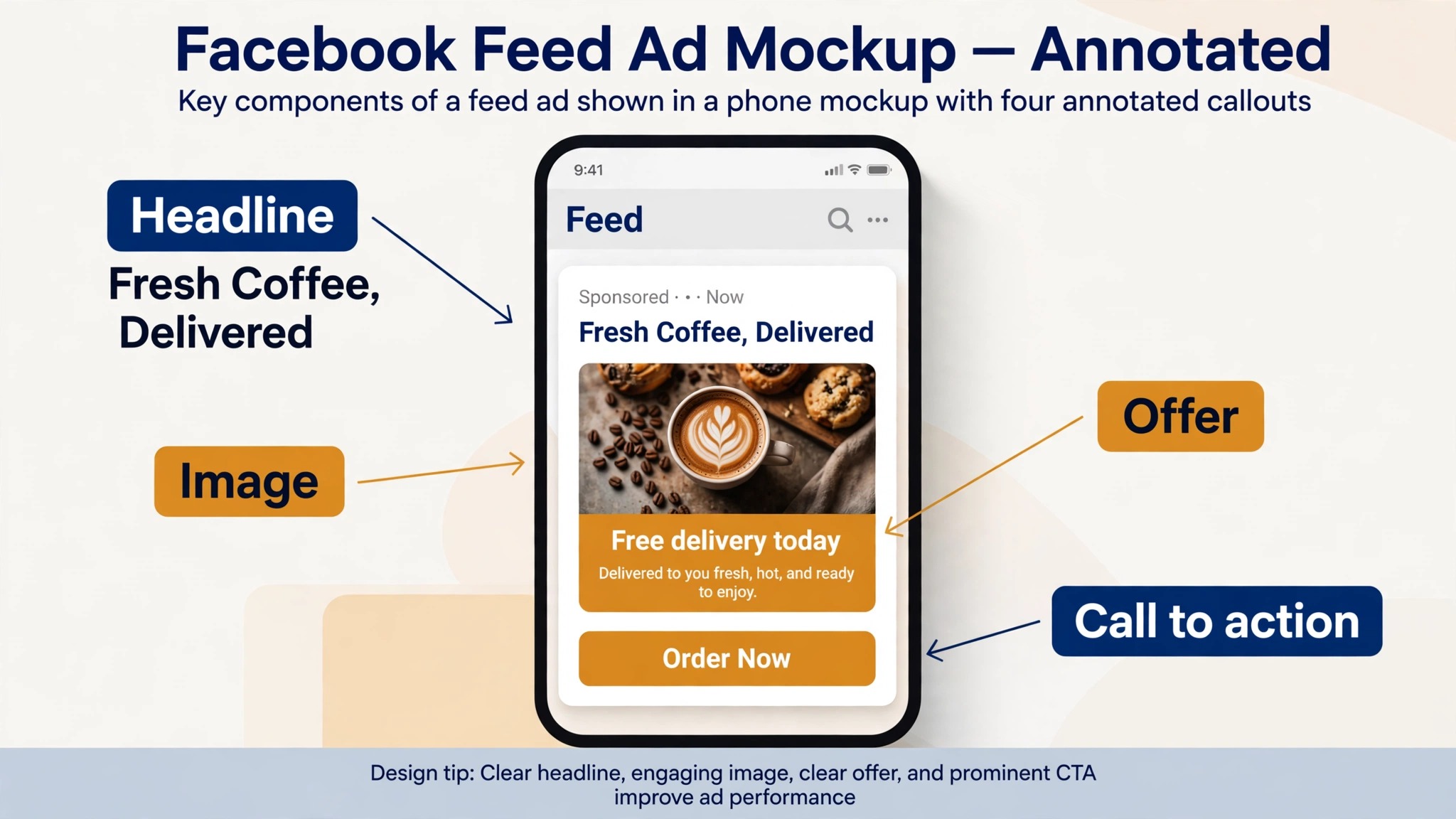
Text on the image should stay under 20 percent of the area, which is an old Facebook guideline that still holds as good practice even though it is no longer enforced as a hard rule. An ad crowded with text looks like a flyer and gets scrolled past. Let the image carry the attention, let the headline carry the offer, and let the ad copy below the image do the explaining. A designer who fills the image with paragraphs is designing a poster, not an ad.
Three Worked Budgets
A budget makes sense when it is attached to a real business, so here are three examples with the design bill spelled out. Each one assumes the ad spend is separate, and each one shows where the design money actually goes.
A local cafe spending $300 a month on ads needs one new concept a month in two sizes, plus one variation. A freelance designer at $150 for the concept and $25 per extra size and variation brings the design bill to about $200 a month. An AI tool at $29 a month would cut that to a tenth, but the cafe owner would spend the saved money on time spent fixing AI mistakes. The freelancer is the better buy at this scale, because the relationship and the brand knowledge are worth more than the saving.
An online store spending $3,000 a month on ads needs five concepts a month, each in three sizes, with two variations per concept. At freelance rates that is roughly $750 for the concepts, $500 for the sizes and $500 for the variations, or about $1,750 a month. A design subscription at $699 a month covers the same volume for less, with all sizes and revisions included, so the subscription wins here. The store should keep a freelancer on call for the one hero campaign a quarter that needs a human eye.
A brand spending $20,000 a month on ads needs twenty concepts a month, video for the winners, and a strategist reading the results. An agency retainer at $5,000 a month is the honest price for that volume, because it covers strategy, copy, design, video and testing in one bill. At this spend, a 10 percent better ad is worth $2,000 a month in media efficiency, so the retainer pays for itself when the creative is good. Below this spend, the same retainer would eat the budget alive.
Hidden Costs to Watch For
The quote is rarely the whole bill. Stock photos are the first extra. A designer who licenses a photo for your ad will pass the cost on, and a photo used in a paid campaign needs a proper licence, not a free download from a search engine. Ask whether stock is included, and who owns the licence if the campaign runs for a year.
Fonts are the second extra. A brand font that needs a commercial licence, or a font the designer bought for one project, can add a fee. Most designers use fonts that are free for commercial use, but check before the campaign launches, because a font licence problem is an expensive thing to discover after the ad has run.
Rush fees are the third extra. An ad needed tomorrow costs more than an ad needed next week, and the rush fee can be 50 percent on top of the normal price. Plan the creative calendar a month ahead and the rush fee disappears. A campaign that is always urgent is a campaign that is always overpaying.
Revisions beyond the agreed rounds are the fourth extra. A quote that includes two revision rounds is fair, and a client who asks for a fifth round should expect to pay for it. The fix is a brief that is finished before the design starts, and a single decision maker who approves the work. Five people giving feedback in five directions will burn through the revision rounds before the ad is close to done.
How to Get a Fair Quote
A good brief gets a fair quote, because the designer can see the job clearly. Write down the product, the audience, the offer, the landing page, the sizes you need, the number of variations, the deadline and the revision rounds you expect. Send the same brief to two or three designers and compare the quotes like for like. A quote that is half the price of the others usually excludes something, and the missing item will appear as an extra later.
Ask four questions before you agree. What is included in the price, and what costs extra. How many concepts, variations, sizes and revision rounds does it cover. Who owns the final files, and in what format will they be delivered. How long will it take, and what happens if the deadline slips. A designer who answers all four clearly is a designer who has done this before, and the answers are worth more than a low price.
Pay in stages for larger jobs. A deposit to start, a payment on first draft, and the balance on delivery is fair to both sides. For a subscription or a retainer, pay monthly and review the output monthly, because a subscription that delivers nothing in week one will not deliver in week four either. Keep the final files yourself, in the original editable format as well as the exported images, so a future designer can pick up where the last one stopped.
Mistakes That Waste the Design Budget
The first mistake is ordering creative before the offer is decided. An ad designed for 20 percent off cannot be reused for free shipping, and a designer who builds for one offer and then rebuilds for another has done the job twice. Decide the offer, write the headline, then order the design.
The second mistake is testing one ad at a time. A single ad tells you nothing, because you cannot tell whether the result came from the image, the headline or the audience. Test at least three variations of each concept, change one thing at a time, and give each test enough spend to mean something. A test with $5 behind it is not a test, it is a guess.
The third mistake is judging an ad by how it looks to you. The owner is not the audience. An ad that looks plain to the owner can convert well, and an ad the owner loves can fail with real buyers. Judge ads by clicks, by cost per result and by sales, not by taste. A designer who shows you the numbers is doing their job. A designer who only shows you pretty images is not.
The fourth mistake is reusing the same creative for months. Facebook audiences tire of an ad they have seen ten times, and performance falls even when nothing else changes. Plan a refresh every four to six weeks, with new headlines and new images for the winners. A subscription or a freelancer on retainer makes refreshes cheap, because the concept already exists and only the execution is new.
Frequently Asked Questions About Facebook Ad Design Cost
How much does it cost to design one Facebook ad?
A single static Facebook ad is commonly quoted at $150 to $400 from a freelance designer for a new concept, and $10 to $50 from a marketplace gig. Each extra variation or size of an ad that already exists is commonly $20 to $75. Agency prices run $150 to $500 per static, and $500 to $1,000 for a static with four copy variations. AI tools can produce an ad for $1 to $10. These prices are for design only, and ad spend is a separate bill.
How much should a small business budget for Facebook ad design?
A small business spending $300 to $1,000 a month on ads should budget $150 to $400 a month for design, which covers one or two new concepts in two sizes with a variation. A business spending $3,000 a month should budget $700 to $1,750, and a design subscription at $699 a month is usually the best value at that volume. The design budget should be set alongside the ad spend budget, not after it, because creative runs out before spend does.
What is included in a typical Facebook ad design cost?
A typical freelance quote includes one new concept in one size, with one or two revision rounds. Sizes, variations, extra concepts and extra revisions usually cost more, at $20 to $75 per variation or resize. An agency quote usually includes strategy, copy variations and revisions in the price. Always ask what is included before you agree, and get the answer in writing, because the items left out of a quote are the items that appear as extras later.
Is it cheaper to use an AI tool or hire a designer?
An AI tool is cheaper per ad, at $1 to $10, against $150 to $400 for a freelance designer. The AI tool is the better buy for volume, for testing many variations of a winning concept, and for simple ads. The designer is the better buy for a new product launch, for a campaign that carries real spend, and for any ad where the idea matters more than the image. Most businesses that test seriously use both, with AI for volume and a designer for the winners.
How often should Facebook ad creative be refreshed?
Plan a refresh every four to six weeks, with new headlines and new images for the winning concepts. Audiences tire of an ad they have seen many times, and performance falls even when nothing else changes. A refresh does not mean starting from scratch. New copy on a proven layout, or a new image on a proven headline, is enough to lift performance, and it costs far less than a new concept.
Do I need different designs for feed, stories and reels?
Yes. The feed wants a square or portrait image, stories and reels want a tall 9 by 16 design, and each placement crops differently. A single square ad squeezed into a story frame looks lost, and a story design cropped into a square loses its headline. Budget for three sizes as a minimum, and ask for the full set price up front, because resizing is where cheap quotes turn expensive.
What a Facebook Ad Should Cost You
Facebook ad design cost is not one number, it is a range that runs from $1 to $1,000 per ad, and the right price depends on the job. A $25 gig is fine for a simple announcement. A $200 freelancer is the right buy for a small business that needs a few good ads a month. A $699 subscription is the right buy for a store testing five concepts a week. A $5,000 agency retainer is the right buy for a brand spending $20,000 a month on ads. The mistake is not the price you pay, it is paying a price built for a different job.
Write the brief, agree the sizes and variations up front, test three variations of every concept, and judge the result by the numbers, not by taste. Knowing the facebook ad design cost range before you hire is what keeps a $25 gig from turning into a $2,000 surprise. Do that, and the design bill will be the cheapest money in the whole campaign, because a good ad makes every dollar of spend work harder.