
A jewelry store does not sell like a clothing shop. Every piece is one of a kind, or close to it. A ring has a serial number, a certificate, a stone weight, a metal weight, a vendor, a cost and a story, and if any of those details is lost, the sale is lost with it. A repair ticket, a custom order, a layaway plan and an appraisal all move through the same counter, and a general retail system treats them all as a simple sale. The best software for jewelry stores understands that difference, so the piece, the customer and the job stay connected from the case to the bench to the till.
This guide compares twelve systems on real published prices, the job each one does best, and the catch that only appears after the demo. Prices come from vendor pricing pages and third party roundups checked in November 2026, and where a vendor sells by quote only, this guide says so instead of guessing. Start with the shortlist table, then read the reviews that match your store size and your mix of retail, repair and custom work.
The Quick Shortlist
The table below matches each common jewelry job to the single system that handles it best. Use it to narrow the best software for jewelry stores to two or three candidates before you read the full reviews. Prices are monthly list prices unless noted, and annual billing is usually cheaper than paying month to month.
| Job | Best tool | Why it wins |
|---|---|---|
| Deep jewelry POS for an independent store | The Edge | Serialized inventory, repairs and appraisals in one desktop system |
| Modern cloud POS for a growing store | Jewel360 | All in one cloud POS from 199 dollars a month reported annual |
| Manufacturing plus retail in one system | PIRO Fusion | Fusion from 299 dollars a month reported |
| Full ERP for a jeweler with wholesale | Gem-Logic | Essential from 299 dollars a month |
| General retail POS with strong inventory | Lightspeed Retail | Basic from 89 dollars a month |
| Online plus in store selling | Shopify POS | Pro from 89 dollars a month per location |
| Cheap all in one for a small shop | Deelo | From 19 dollars a seat a month |
| Clienteling and repeat customers | Clientbook | From 350 dollars a month per store reported |
| Inventory capacity by item count | CaratIQ | Basic from 300 dollars a month for three users |
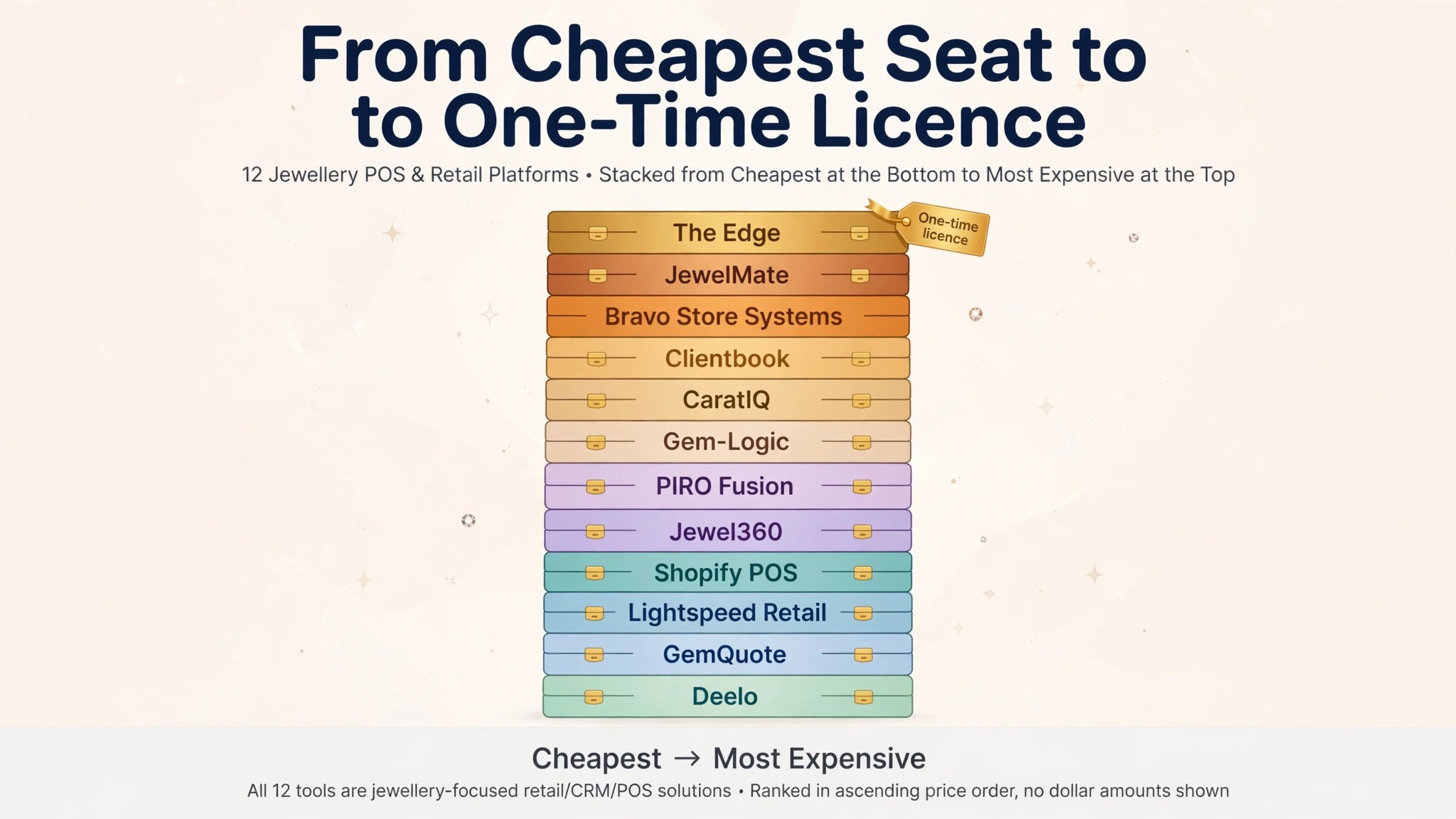
| Long running wholesale and retail | JewelMate | One time price of 3,500 dollars reported |
| Buying estate pieces plus retail | Bravo Store Systems | Quote only |
| Fast quotes for a bench jeweler | GemQuote | Solo from 39 dollars a month |
How We Judged the Best Software for Jewelry Stores
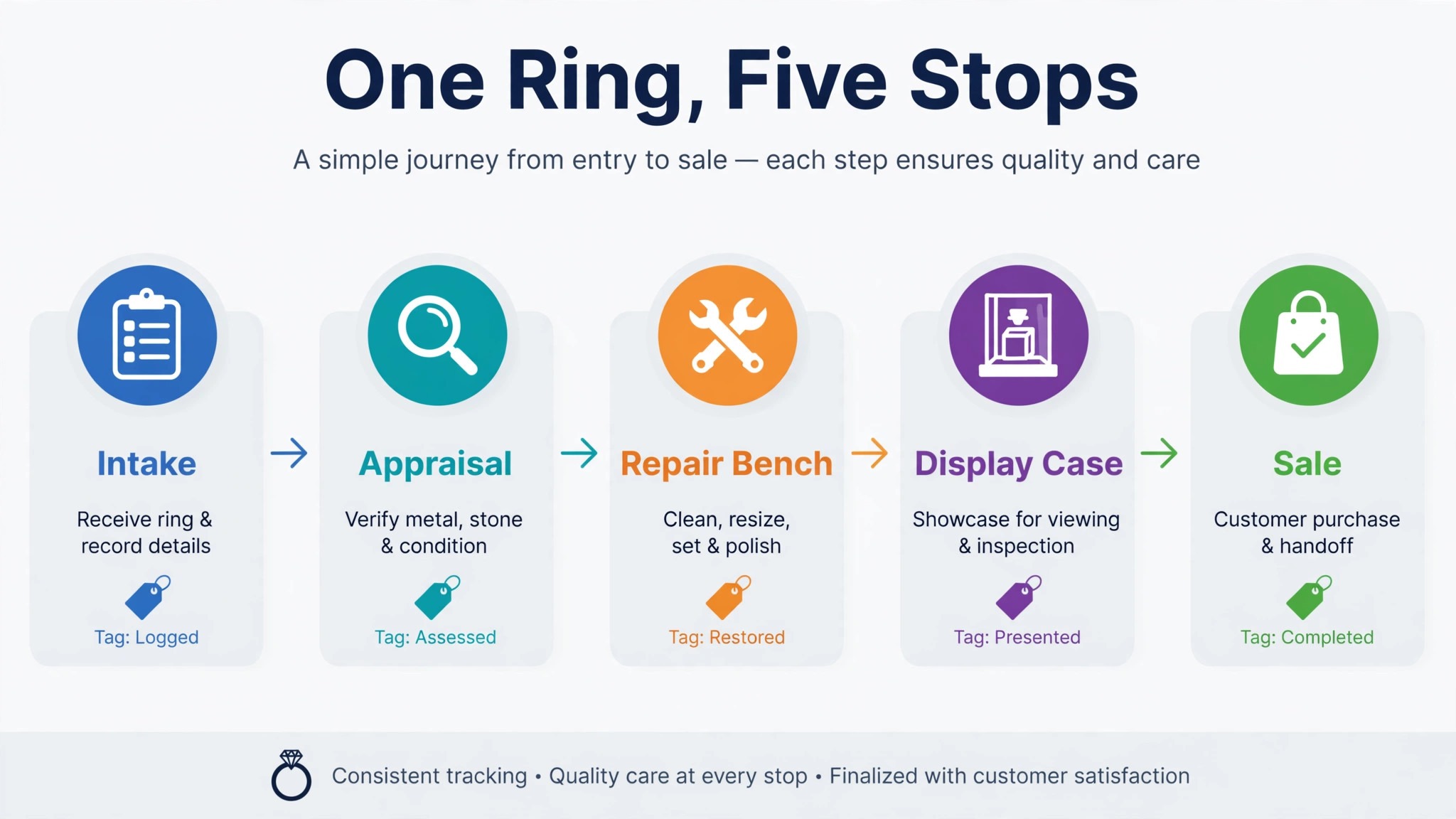
A system earned a place here only if it does real jewelry work in 2026, not if it added a custom field to a general till. We judged each one on five things that decide whether a store keeps paying after the first year. The best software for jewelry stores has to pass all five, because a system that rings a sale well but loses a repair ticket still costs the store money and trust every week.
First, the inventory job, from serialized one of a kind pieces to loose stones to memo and consignment stock, because a jewelry store cannot sell what it cannot find. Second, the job ticket job, from repairs to custom orders to appraisals, because the bench is where much of the profit and the reputation sit. Third, the customer job, from layaway to clienteling to follow up, because a jewelry customer buys again only if the store remembers them.
Fourth, the starting price a small shop can actually buy, including whether a free trial exists and what the paid plan really includes. Fifth, the catch, from a large upfront licence to add on modules that double the bill to a desktop system that needs a server in the back office. Every review below names that catch in plain words.
| Check before you buy | What to ask | Why it matters |
|---|---|---|
| Serialized inventory | One record per piece, with certificate and stone details | Stops selling the wrong piece twice |
| Repair tracking | Ticket status the customer can check | Fewer phone calls about one repair |
| Layaway and memo | Payment plans and consignment in the same system | Keeps cash flow visible |
| Data migration cost | What it costs to move your old records | The first year bill is rarely the sticker price |
| Cloud or desktop | Where the data lives, and how you reach it from home | Desktop systems need local IT support |
| Payment processing | Card rates and who processes the sale | A cheap plan with dear card rates costs more |
The 12 Tools, Reviewed One by One
1. The Edge
Starting price 4,600 dollars one time reported for the initial licence, plus 920 dollars a year for maintenance and support. Best for Deep jewelry POS for an independent store. Watch out Data conversion runs 2,250 dollars reported, and training adds 1,000 dollars reported, so the first year cost is far above the licence alone.
The Edge is the incumbent in independent jewelry retail, and its depth is the reason it stayed. It handles serialized inventory, repairs, custom orders, appraisals, layaway, memo and consignment in one system that was built for jewelers, not adapted from general retail. More than 4,000 active stores use it, according to the vendor, and that installed base means the workflows match how a real jewelry counter works.
The strength is the system of record. Each piece carries its stone, certificate, vendor, cost and sales history as it moves from receiving to the display case to the customer. Repair envelopes, appraisal forms and custom order tracking sit in the same record, so the bench and the front desk never work from different notes. For a store that has run on paper tickets for years, that single record is the whole point of the move.
2. Jewel360
Starting price 199 dollars a month reported on annual billing, or 299 dollars a month billed monthly. Best for Modern cloud POS for a growing store. Watch out A setup fee of 750 dollars reported sits on top, and features are gated by tier.
Jewel360 is the cloud answer to The Edge, and it suits a store that wants its whole operation on one modern system. Inventory, repairs, e-commerce and a built in CRM run in the browser, with no server to maintain and no local IT to call. The Startup plan at 199 dollars a month reported on annual billing gives a small store a real entry point, with Core and Plus tiers above it for larger shops.
The inventory record is the centre of the store. Each serialized piece carries its stone, certificate, vendor, cost, location and sales history as it moves through the shop. Work orders, repairs and appraisals connect to the same record, and the CRM keeps the customer history beside the piece history. For a store that wants to check stock from home and run more than one location from one dashboard, that cloud access matters.
The catch is the tier gating. Features sit behind higher tiers, so the system you see on the demo may not be the system you get at the starting price, and the setup fee of 750 dollars reported adds to the first bill. Get a written list of which features sit in your tier before you sign. Jewel360 still earns second place for stores that want a modern cloud POS built for jewelry.
3. PIRO Fusion
Starting price 299 dollars a month reported for Fusion, with small businesses reported at 300 to 500 dollars a month. Best for Manufacturing plus retail in one system. Watch out Retail POS, QuickBooks integration and Shopify sync are reported as separate add ons, so the full stack costs far more than Fusion alone.
PIRO Fusion is the system for a jeweler that makes as well as sells. It is a web based ERP built for jewelry manufacturing, wholesale and retail, with inventory, production, CRM, sales and reporting in one platform. Fusion at 299 dollars a month reported covers the core, and the system handles style and item grouping, complex styles with bills of material, multilevel pricing and jewelry tag printing.
The strength is the production side. A bench that builds custom pieces needs to track raw materials, loose stones, labour and vendor costs, and PIRO keeps those details in the same record as the retail sale. That matters for a store that designs its own lines or runs a busy custom desk. The CRM and e-commerce modules extend the same record to the customer and the website.
The catch is the add on stack. Retail POS is reported at 169 dollars a month, QuickBooks integration at 100 dollars a month, and Shopify sync at another 100 dollars a month, so a store running the full stack pays 958 to 1,258 dollars a month reported. Price the full stack, not Fusion alone, and check the 60 day money back guarantee terms. PIRO earns its place for makers and wholesalers, not for a pure retail shop.
4. Gem-Logic
Starting price 299 dollars a month for Essential, with Growth at 699 dollars a month. Best for Full ERP for a jeweler with wholesale. Watch out Extra stores cost 199 dollars a month each, and extra users cost 29 dollars a month each.
Gem-Logic is a cloud ERP for jewelers that includes every module in every plan, and the price moves with stores and users rather than with features. Essential at 299 dollars a month includes one store and three users, Growth at 699 dollars a month adds a weekly call and custom integrations, and Enterprise is priced by conversation. Every plan includes sales, stock, repairs, customer data and more, with no locked features.
The value is the lack of surprises. A store does not discover on demo day that the repair module costs extra, because all modules are included. The system covers finished pieces, raw materials and loose stones, with customizable fields, tags and pricing methods. For a jeweler that runs wholesale alongside retail, that single ERP record keeps both sides honest.
The catch is the per store and per user math. An extra store adds 199 dollars a month and three more included users, and an extra user adds 29 dollars a month, so a growing group pays more even though the features never change. A 14 day free trial lets a small shop test the real system before it pays. Gem-Logic earns its place for jewelers that want one ERP without module games.
5. Lightspeed Retail
Starting price 89 dollars a month for Basic on annual billing, with Core at 149 dollars and Plus at 289 dollars. Best for General retail POS with strong inventory. Watch out It has no native memo, consignment or repair workflow, so jewelry jobs need custom fields and workarounds.
Lightspeed Retail is the modern general POS that many jewelers use when multi location inventory matters more than jewelry specific fields. Basic at 89 dollars a month covers POS, payments and core inventory with purchase orders and low stock alerts. Core at 149 dollars adds multi location transfers and advanced reporting, and Plus at 289 dollars adds loyalty, analytics and accounting integrations.
The strength is the retail polish. The interface is clean, the catalog handles variants and serialized items, and the reporting suits an owner who manages several sites. E-commerce, loyalty and payments run in the same platform, so a store that sells online and in store keeps one stock count. For a jeweler with a large branded range and a simple repair book, that polish is enough.
6. Shopify POS
Starting price 89 dollars a month per location for POS Pro. Best for Online plus in store selling. Watch out The free POS plan is basic, and jewelry specific repair and appraisal work needs apps or workarounds.
Shopify POS suits a jeweler whose website is as important as the shop floor. The online store and the counter share one inventory, so a piece sold online leaves the display case count at once, and a piece sold in store leaves the website at once. POS Pro at 89 dollars a month per location adds the retail features a busy counter needs, including staff roles and advanced inventory.
The strength is the channel sync. A small jeweler can list the case online, take a deposit for a custom order, and keep the customer record in one place. The app store adds repair tracking and appraisal tools, though they cost extra and need setup. For a store that sells through Instagram, a market stall and a website as well as the shop, that sync is the point.
7. Deelo
Starting price 19 dollars a seat a month. Best for Cheap all in one for a small shop. Watch out It is a newer platform, so the installed base and the third party integrations are smaller than the incumbents.
Deelo is the cheapest all in one on this list, and it suits an independent jeweler that wants CRM, inventory, repair tickets, custom orders, appraisals, invoicing and automation in one login without a large upfront cost. The price of 19 dollars a seat a month is far below the cost of stacking a dedicated POS, a work order tool and a CRM, and the system was built for independent jewelers and small chains.
The strength is the single platform. Inventory carries custom fields for serial, certificate, carat and metal weight. Repair tickets and custom orders sit beside the customer record, docs handle appraisals, and automation sends milestone alerts. A client portal lets customers check the status of a repair without phoning the shop. For a three person store, that breadth at that price is hard to match.
8. Clientbook
Starting price 350 dollars a month per store location reported. Best for Clienteling and repeat customers. Watch out It sits on top of your POS, so it is an extra bill, not a replacement for one.
Clientbook is not a POS. It is the relationship layer that sits on top of the POS you already run, and it is built only for the associate’s client book. It tracks customer relationships, sends follow ups, and helps the associate remember who bought what, when they last visited, and what they might want next. The price of 350 dollars a month per store location reported buys that focus, with a 14 day free trial.
The value is repeat business. A jewelry store lives on anniversaries, birthdays, repairs and the next piece, and Clientbook turns those dates into tasks for the associate. Direct two way connections exist today with The Edge, Shopify POS, Jewel360, RAIN and Lightspeed, so the sales history flows in without retyping. For a store with a strong associate team, that memory is worth more than another inventory feature.
9. CaratIQ
Starting price 300 dollars a month for Basic, for three users and up to 20,000 items. Best for Inventory capacity by item count. Watch out Professional at 550 dollars a month and Premium at 800 dollars a month climb fast, and extra users cost 100 dollars a month each.
CaratIQ ties its price to capacity, which suits a store that knows exactly how much stock it holds. Basic at 300 dollars a month covers three users and up to 20,000 items. Professional at 550 dollars a month covers five users and up to 50,000 items, and Premium at 800 dollars a month covers seven users and up to 100,000 items. Each plan caps storage, emails, texts and call minutes, with overage charges past those limits.
The strength is the clear ladder. A store can count its items, pick the tier that fits, and know when it will need to move up. The system covers inventory, sales and customer records in one cloud platform, and the capacity model stops a small shop paying for an enterprise tier it will never use. For a store with a large loose stone or finished piece count, that clarity helps.
10. JewelMate
Starting price 3,500 dollars one time reported on Capterra. Best for Long running wholesale and retail. Watch out It is a perpetual licence system, so implementation, migration, training and hardware need a tailored quote.
JewelMate has served the jewelry industry since 1989, and it suits a wholesale and retail jeweler that wants a long running system for finished pieces, raw materials and loose stones. Inventory records cover customizable fields, tags, pricing methods and physical count reports, and the system handles the wholesale side alongside the retail counter.
The strength is the depth of the inventory record. A wholesaler needs to track styles, materials and vendor costs across a large catalog, and JewelMate was built for that volume. The system is on premise, which suits a business that wants its data on its own machines and its own network. For a jeweler that has run the same way for decades, that stability is a feature.
11. Bravo Store Systems
Starting price Quote only. Best for Buying estate pieces plus retail. Watch out No published price, so the only way to budget it is a sales conversation.
Bravo Store Systems suits a jeweler that buys as well as sells. It handles appraisals, repairs, custom orders and layaway alongside estate buying, scrap tracking and precious metal margin, with an owned marketplace and AI pricing on intake. The Product Estimator suggests buy and resale prices from real transaction data, so a newer associate can make a confident offer on an estate piece without the best buyer standing beside them.
The strength is the buying side. Most jewelry systems handle the retail sale well and the buying side as an afterthought, while Bravo treats estate buying, lending and scrap as first class work. That matters for a store that takes trade ins, buys estate collections and sells pre owned pieces alongside new stock. The cloud platform also covers multi channel e-commerce without a separate system.
12. GemQuote
Starting price 39 dollars a month for Solo, or 97 dollars a month for Pro. Best for Fast quotes for a bench jeweler. Watch out It is a quoting tool first, not a full POS, so a store still needs a till and an inventory system.
GemQuote is the smallest tool on this list, and it is the most useful for a bench jeweler who quotes custom work every day. Solo at 39 dollars a month and Pro at 97 dollars a month buy a quoting system that turns a customer conversation into a clear written quote fast, with a 7 day free trial that needs a card. The tool is built for quote first work, not for ringing a sale.
The value is speed and clarity. A customer who asks what a custom ring will cost gets a written answer while they are still in the shop, and the bench gets the same details without a phone call. For a custom studio that lives on quotes, that speed wins jobs that a slow reply would lose. It pairs well with a full POS like Jewel360 or Lightspeed, which handles the sale after the quote is accepted.
Side by Side Comparison
The table below puts the whole list on one page, so you can compare the best software for jewelry stores side by side before you trial two or three of them. Prices are starting prices unless noted, and the free plan column tells you whether you can test the system without paying first. Use the table to cut the list, then read the reviews for the systems that survive the cut.
| Tool | Starting price | Best for | Free plan |
|---|---|---|---|
| The Edge | 4,600 dollars one time reported | Deep jewelry POS | No |
| Jewel360 | 199 dollars a month reported annual | Modern cloud POS | No |
| PIRO Fusion | 299 dollars a month reported | Manufacturing plus retail | No |
| Gem-Logic | 299 dollars a month | Full ERP | Trial |
| Lightspeed Retail | 89 dollars a month | General retail POS | No |
| Shopify POS | 89 dollars a month per location | Online plus in store | Free POS |
| Deelo | 19 dollars a seat a month | Cheap all in one | No |
| Clientbook | 350 dollars a month per store reported | Clienteling | Trial |
| CaratIQ | 300 dollars a month | Inventory capacity | No |
| JewelMate | 3,500 dollars one time reported | Wholesale and retail | No |
| Bravo Store Systems | Quote only | Estate buying plus retail | No |
| GemQuote | 39 dollars a month | Fast quotes | Trial |
How to Pick the Right System for Your Shop
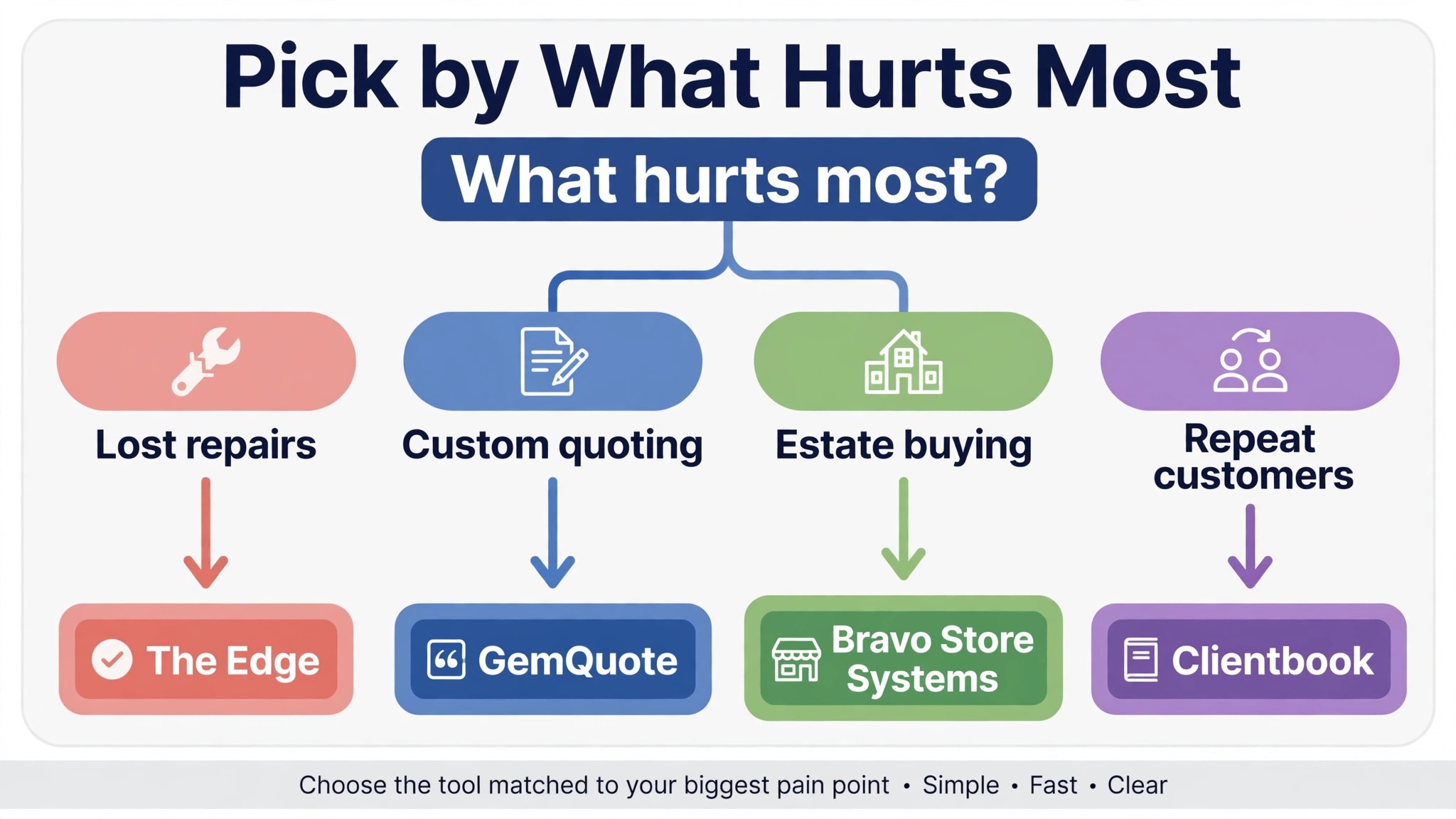
The best software for jewelry stores is not the one with the longest feature list. It is the one that fixes the job your shop feels every week. A shop that loses repair tickets should buy Jewel360 or Deelo. A shop that makes its own pieces should buy PIRO Fusion or Gem-Logic. A shop that buys estate pieces should buy Bravo Store Systems. A shop that lives on repeat customers should add Clientbook to the POS it already runs. A shop with no budget should start on Deelo or GemQuote and move up when the volume justifies it. Start from the job, not from the vendor homepage.
Budget the full stack, not the headline plan price. The table below shows what a three person shop actually pays in year one for the most common choices, using starting prices and reported setup fees. Data migration, training and card processing are the lines that surprise buyers, so ask for them in writing before you sign.
| Stack for a three person shop | Monthly cost | What it covers |
|---|---|---|
| Deelo, 3 seats | 57 dollars | CRM, inventory, repairs, appraisals |
| Jewel360 Startup | 199 dollars reported annual | Cloud POS, inventory, repairs, CRM |
| Lightspeed Basic plus GemQuote | 128 dollars | Retail POS plus fast custom quotes |
| Gem-Logic Essential | 299 dollars | Full ERP, one store, three users |
| The Edge, year one | Licence plus fees reported | Deep POS, desktop, plus conversion and training |
| Clientbook plus your POS | 350 dollars reported plus POS | Clienteling on top of the till |
Frequently Asked Questions
What is the cheapest good system for a small jewelry shop
Deelo at 19 dollars a seat a month is the cheapest full system with a published price, and a three person shop pays 57 dollars a month for CRM, inventory, repairs and appraisals in one login. GemQuote at 39 dollars a month is cheaper as an add on, but it is not a full POS. The cheapest stack that actually works is usually Deelo for the shop plus GemQuote only if custom quoting is a daily job.
The best software for jewelry stores that fits a small shop best is usually the one with the clearest starting price and the shortest setup, because a shop that can start this week learns faster than a shop that waits for a sales call.
Do I need a separate system for repairs
No, not if you pick a system with a real repair ticket workflow. The Edge, Jewel360, PIRO Fusion, Gem-Logic and Deelo all track a repair from intake to bench to pickup, with a status the customer can check. A separate repair system only makes sense if your bench is a large workshop with its own staff and its own intake, or if your POS has no repair module at all. Check the ticket status and the customer message before you assume the module is enough.
How much does jewelry software really cost in year one
A small shop on a cloud system pays 57 to 299 dollars a month for the subscription, plus card processing and any apps it adds. A shop on The Edge pays a licence near 4,600 dollars reported, plus conversion near 2,250 dollars and training near 1,000 dollars, before the first sale. A shop on PIRO pays 299 dollars a month for Fusion, plus add ons that can lift the total past 958 dollars a month reported. Always budget the first year, not the first month.
Which system is best for custom orders
PIRO Fusion is the strongest pick for a maker that builds custom pieces, because it tracks materials, labour and vendor costs in the same record as the retail sale. GemQuote is the best cheap add on for a bench jeweler that quotes every day, because it turns a conversation into a written quote while the customer is still in the shop. The best software for jewelry stores with a busy custom desk still needs a human check on every quote, because no system knows the stone in front of you as well as the bench does.
Our Verdict
If you buy one system this quarter, buy Jewel360. It covers the most of the jewelry job at a published starting price a small shop can afford, and it is the fastest way to move from paper tickets and a desktop server to a cloud system the whole team can use. The best software for jewelry stores earns its keep by keeping the piece, the customer and the job in one record, and Jewel360 does that from the first week, without a large upfront licence.
Whatever you pick, start with the job, trial with real pieces, and keep a human check on appraisals and custom quotes for the first month. The systems on this list all work. The difference is whether the system matches the work your shop actually does, and whether you measure the return in kept repairs and repeat customers rather than in features used.