
A referral program is the cheapest growth channel a small business owns, and most small businesses do not have one. That is the verdict, and the numbers behind it are hard to argue with. Referred customers convert three to five times better than customers from other channels, they stay about 37 percent longer, and they carry about 16 percent higher lifetime value. And 83 percent of satisfied customers say they would refer a business, but only 29 percent actually do, a gap of 54 points that exists for one reason. A small business referral program strategy closes that gap by asking the right customer at the right moment, and this guide shows how to build one.
Nobody asked them, and nobody made it easy. A small business referral program strategy in 2026 is about closing that gap, by asking the right customers, at the right moment, with a reward that is worth sharing, and a process that takes a minute, not an afternoon. This guide gives you a 90 day plan to build it, with the setup, the first 30 days, the scaling phase, the templates, and the numbers to watch.
Word of mouth drives 20 to 50 percent of all purchase decisions, according to McKinsey research, and 92 percent of consumers trust a recommendation from a friend or family member above every other form of advertising.
Why a Small Business Referral Program Strategy Matters Now
Customer acquisition costs rose 40 percent from 2023 to 2025, and the average cost to win an ecommerce customer is now 78 dollars, according to data reported through Shopify in 2026. Paid advertising gets more expensive every year, while referrals get cheaper, because a referred customer costs about 25 percent less to acquire than a customer from a paid channel, and spends about 25 percent more on the first purchase.
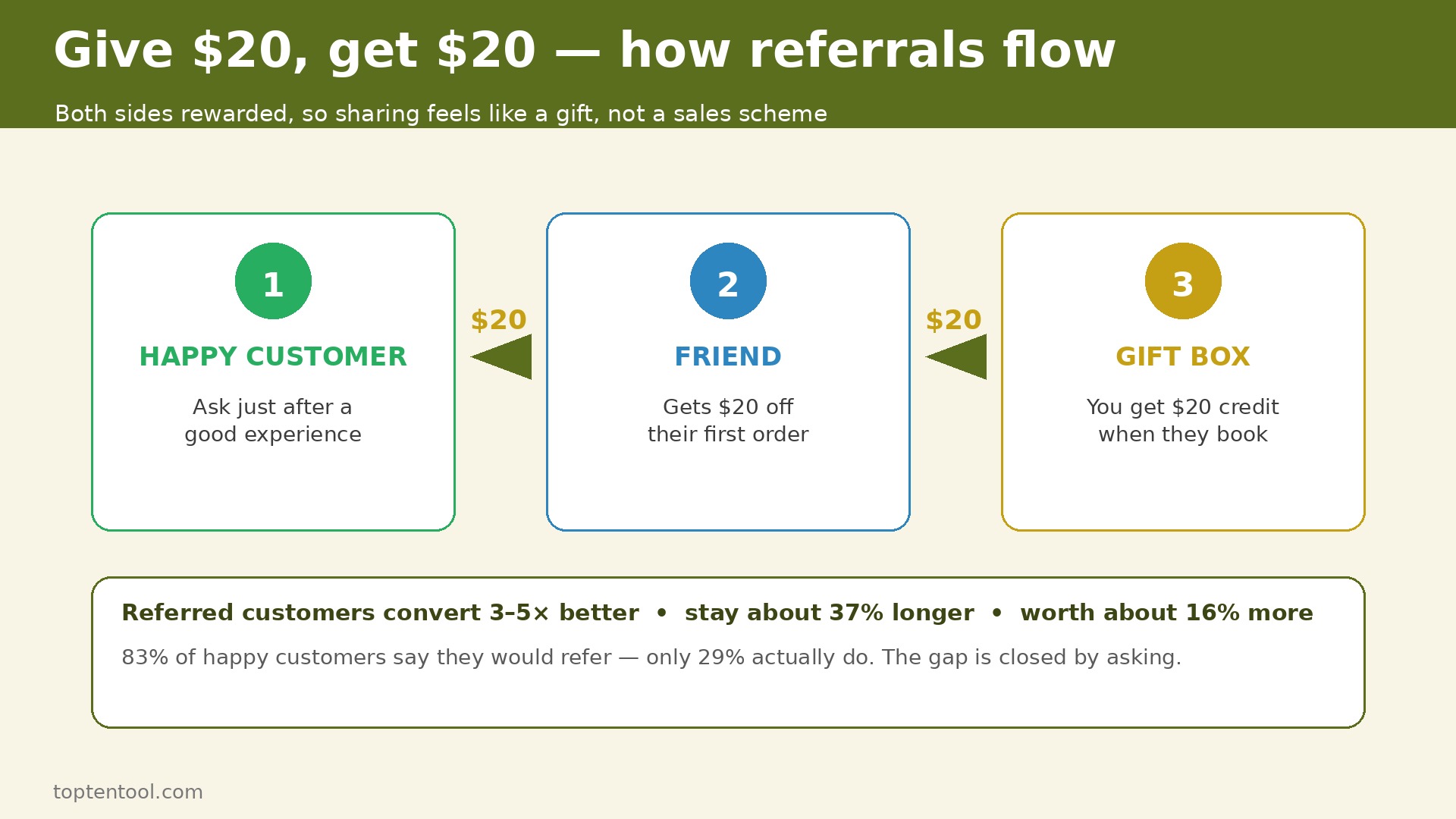
Referred customers are not just cheaper. They are better customers. They convert three to five times more often than leads from other channels, they churn at meaningfully lower rates, and they carry a higher lifetime value because they arrived pre vetted by someone they already trust. They are also 30 to 57 percent more likely to refer others themselves, which means a referral program compounds, because every referred customer becomes a potential referrer.
The third reason a small business referral program strategy matters now is that your customers are already willing. The gap between the 83 percent who say they would refer and the 29 percent who actually do is not a trust problem, and it is not a satisfaction problem. It is an asking problem, and a friction problem.
Phase 1. Setup in Week 1
Set up a small business referral program strategy in the first week, and keep it simple, because a complicated program will not be used, and a simple program that works is better than a clever program that nobody understands. Start with the reward, and make it worth sharing for both sides. Give the referrer and the friend the same reward, or give the friend a slightly larger one, because a program that rewards only the referrer feels like a sales scheme, and a program that rewards both feels like a gift.
A 20 dollar credit for the referrer and 20 dollars off for the friend is a clear, fair offer. A 10 percent discount for both is clear too. A free product, a free month, or a free upgrade can work better than cash for a service business, because it brings the friend back for a second visit.
Choose the reward size by working backward from the value of a customer. If a new customer is worth 200 dollars in lifetime value, a 20 dollar reward for each side costs 40 dollars to win a 200 dollar customer, and that is a good trade.
If a new customer is worth 50 dollars, a 20 dollar reward for each side costs 40 dollars to win a 50 dollar customer, and that is a bad trade, so the reward should be 10 dollars, or a free small item that costs you 5 dollars. The reward should feel generous to the customer and affordable to you, and the only way to know both is to work out the numbers before you launch.
Pick the tool in week one, and keep it simple. A referral link with a unique code for each customer is the core of the program, and it can run through a simple referral app, through your email tool, or through a printed card with a code on it. Referral software such as ReferralCandy, Yotpo, or the built in referral feature in your ecommerce platform will track links, codes, and rewards automatically, and it costs from about 50 dollars a month for a small business.
A printed card costs nothing but printing, and it works for a local shop where customers talk face to face. Choose the tool that matches how your customers actually share, not the tool with the most features, because a tool your customers never open is a tool that never refers anyone.
Week 1 setup checklist
- Work out the lifetime value of a new customer, and set a reward that costs less than 25 percent of that value.
- Choose a reward for both sides, such as 20 dollars credit for the referrer and 20 dollars off for the friend.
- Pick a tracking method, a referral app, a unique code per customer, or a printed card with a code.
- Write the referral message in one sentence, with the reward, the link, and the next step.
- Add the referral offer to your website, your email signature, and your receipt or thank you page.
- Tell your team about the program, and give them a simple script for asking customers to refer a friend.
- Launch the program to your 20 best customers first, by email or in person, before you announce it to everyone.
Phase 2. The First 30 Days
Ask your best customers first, and ask them at the right moment, because the first 30 days are about learning who refers, and what they say when they do. The right moment is just after a good experience, when the customer is happiest, and most likely to say yes. For a service business, that moment is the day the job is finished, when the customer is looking at the result.
For a shop, that moment is the day the customer picks up an order they love, or the day they leave a five star review. For an online store, that moment is the day the delivery arrives, and the customer opens the box. Ask then, not a month later, because a happy customer asked today will refer, and a happy customer asked next month will have forgotten.
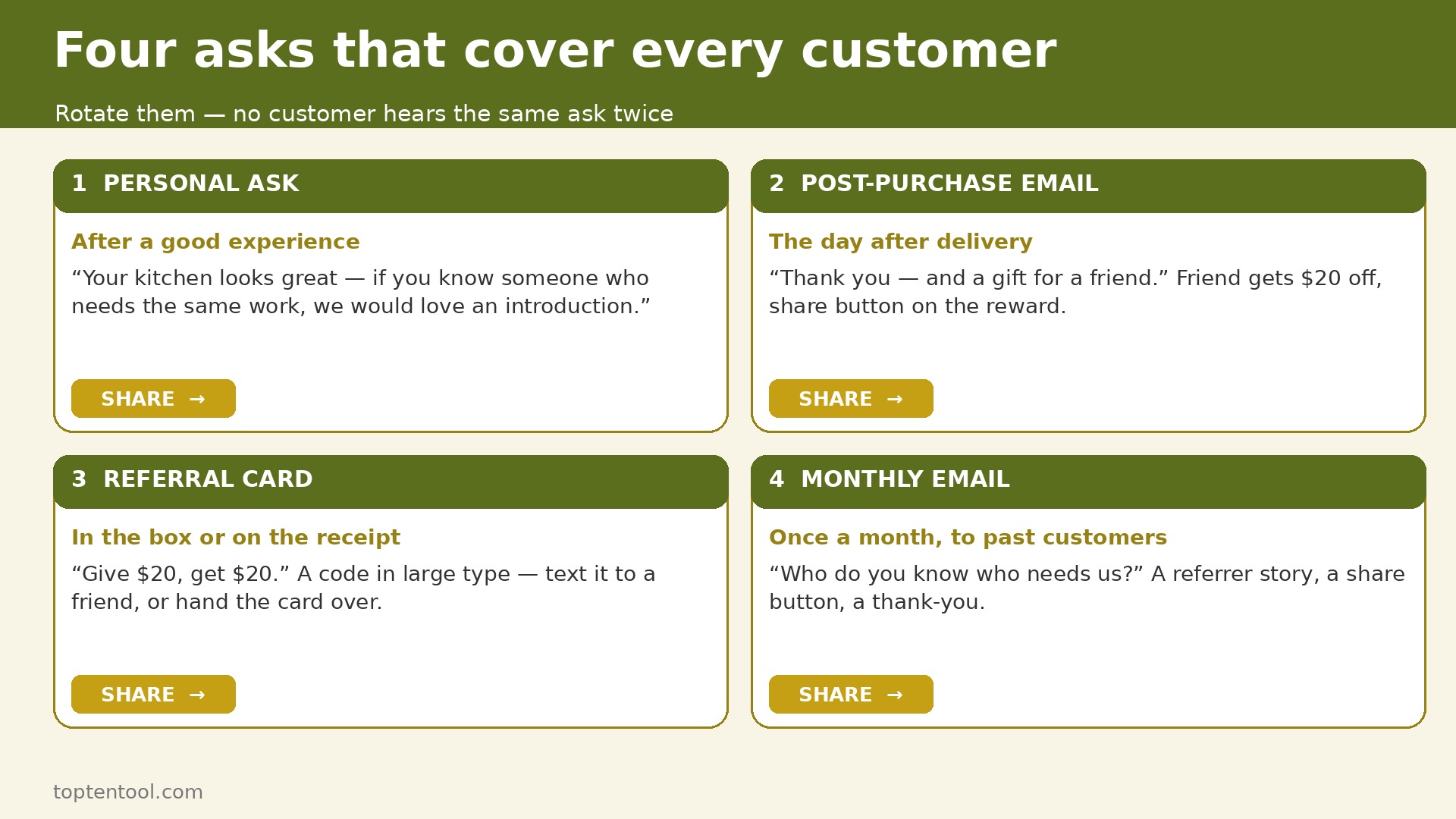
Use three asks in the first 30 days, and rotate them, so no customer hears the same ask twice. The first ask is in person, or in a personal email, and it is the strongest, because a personal ask from someone the customer trusts is hard to refuse. The second ask is in the follow up message after a purchase, a short email or text that says thank you, here is your referral link, and your friend gets 20 dollars off.
The third ask is on the receipt, the thank you page, or the packaging, where a printed card with a code and a short message does the asking for you. Those three asks cover the customer who buys in person, the customer who buys online, and the customer who needs a reminder, and together they reach every customer at least once.
Track every referral in a small business referral program strategy in the first 30 days, and learn from the data. Note which customers refer, which channel they use, and what the friend buys. If in person asks bring more referrals than email asks, do more in person asks. If one reward brings more referrals than another, keep the better reward. If a particular customer refers three friends in a month, thank them personally, and ask them what made them share, because that answer is the best marketing research you will ever get, and it is free. A referral program that learns in the first month will outperform a referral program that never changes in a year.
The first 30 day launch calendar
| Week | Focus | Action | Goal |
|---|---|---|---|
| Week 1 | Setup and launch | Set the reward, pick the tool, launch to 20 best customers | Program live, first referrals |
| Week 2 | Personal asks | Ask in person and by personal email after a good experience | Learn who refers and why |
| Week 3 | Follow up asks | Add the referral link to the post purchase email and thank you page | Reach every customer at least once |
| Week 4 | Review and reward | Thank referrers personally, pay the first rewards, share the first results | First rewards paid, first data |
Pay the first rewards fast, and pay them in public where you can, because a referrer who waits a month for a reward will not refer again, and a referrer who gets a reward in a day will tell their friends about it.
Phase 3. Scaling From Day 31 to Day 90
After 30 days, you have data, and the scaling phase is about doing more of what worked and less of what did not. Open the referral data, sort your referrers by number of referrals, and list the top five. Those five customers are your best marketers, and they deserve more than a standard reward. Give them a higher tier, such as a 50 dollar reward after five referrals, or a free product after 10, because a tiered program gives your best referrers a reason to keep going, and it tells every other customer what is possible. A tiered program is also the cheapest way to scale, because it pays more only to the customers who already proved they refer.
Add a referral ask to every customer touchpoint in a small business referral program strategy in the scaling phase, because a program that lives in one email will be forgotten, and a program that appears at every happy moment will be used. Add the referral link to the email signature of every team member. Add it to the order confirmation page, the delivery box, the invoice, and the loyalty card.
Add a referral section to the website, with a clear headline, the reward, and a share button. Add a monthly referral email to past customers, with a story about a referrer, a reminder of the reward, and a link to share. Each touchpoint is a new chance for a customer to refer, and the cost of adding one is near zero.
Run a referral campaign once in the scaling phase, because a campaign gives customers a reason to refer now, not later. A double reward weekend, or a refer three friends and get a free product month, will lift referrals for a week, and the lift will persist after the campaign ends, because customers who refer once are more likely to refer again.
Scaling checklist for days 31 to 90
- List your top five referrers, and give them a higher tier, such as 50 dollars after five referrals.
- Add the referral link to every touchpoint, email signatures, order pages, delivery boxes, invoices, and loyalty cards.
- Send a monthly referral email to past customers, with a referrer story and a share link.
- Run one referral campaign, such as a double reward weekend, and measure referrals per week.
- Ask every new referred customer to refer a friend, because referred customers are 30 to 57 percent more likely to refer others.
- Review referral data every Monday, and plan the week around the top performing ask and reward.
- Thank every referrer personally, and share the first results with the team, so everyone knows the program works.
Templates You Can Copy
Use these templates to ask for referrals without sounding pushy, and to give customers the words they need to share. Each template is a structure, not a script, and the best asks fill the structure with real details from real work.
Template 1. The personal ask after a good experience
Thank you. Name what went well, in one sentence, such as your new kitchen looks great, and I am glad you love it. Ask. Say we are a small business, and most of our new customers come from referrals, so if you know someone who needs the same work, we would love an introduction. Reward.
Say your friend gets 20 dollars off their first job, and you get 20 dollars credit when they book. Next step. Hand them a card with your referral link, or send the link by text before they leave. Example. A builder finishes a kitchen, tells the customer it looks great, asks if they know someone who needs a kitchen, offers 20 dollars each way, and hands them a card with the link.
Template 2. The post purchase email
Subject. Thank you, and a gift for a friend. Body. Thank the customer for their order, in one sentence. Ask. Say if you love what you bought, share it with a friend, and they will get 20 dollars off their first order. Link. Give the referral link as a button, with the reward written on the button. Close. Say thank you again, and sign with a real name, not a company name. Example. A gift shop sends an email the day after delivery, thanks the customer, offers 20 dollars off for a friend, gives a share button, and signs with the owner name.
Template 3. The referral card in the box or on the receipt
Headline. Give 20 dollars, get 20 dollars. Body. One sentence, such as share this card with a friend, and you both save 20 dollars on your next order. Code. Print a unique code, or a short link, in large type, so the customer can read it without glasses. Next step. Tell the customer where to share it, such as text this code to a friend, or hand this card to someone who needs us. Example. A bakery puts a card in every bag, with give 20 dollars, get 20 dollars, a code, and a line that says text this code to a friend who loves fresh bread.
Template 4. The monthly referral email to past customers
Subject. Who do you know who needs us. Body. Tell a short story about a referrer, in two sentences, such as Sarah referred her sister last month, and her sister just booked her first appointment. Ask. Say if you know someone who needs the same help, share your link, and you both save 20 dollars. Link. Give the referral link as a button. Close. Thank the customer for being part of the business, and sign with a real name. Example. A salon sends a monthly email with a referrer story, a share button, and a thank you from the owner.
Keep a running list of referrers, and thank each one personally, by name, within a day of the referral. Keep a running list of referral stories, and share one story a month, because a story about a real referrer is more persuasive than any offer.
Measurement. Which Metrics Matter, and What Good Looks Like
Referral rate matters more than total referrals, because a rate tells you whether the program is working, and a total tells you only how big the business is. Referral rate is the number of customers who refer at least one friend, divided by the total number of customers, and a good referral rate for a small business is 5 to 10 percent in the first 90 days, rising to 10 to 20 percent over a year.
A business with 500 customers and a 10 percent referral rate has 50 referrers, and if each referrer brings one friend, that is 50 new customers, at a cost of 40 dollars each in rewards, or 2,000 dollars for 50 customers worth 200 dollars each, or 10,000 dollars in lifetime value. That is the math that justifies the program.
Track these numbers every Monday, and compare them week to week, not day to day, because daily numbers jump around, and weekly numbers show the trend. A good first month for a small business is 20 customers asked personally, at least five referrals, at least two new customers from referrals, and the first rewards paid.
| Metric | How to work it out | Good for a small business |
|---|---|---|
| Referral rate | Customers who refer, divided by total customers | 5 to 10 percent in 90 days |
| Referrals per week | Total referrals, divided by weeks | At least 1 per week by month two |
| Conversion rate of referred leads | Referred leads who buy, divided by referred leads | 3 to 5 times higher than other channels |
| Cost per referred customer | Total rewards paid, divided by new referred customers | At least 25 percent lower than paid ads |
| Lifetime value of referred customers | Average lifetime value of referred customers | About 16 percent higher than other customers |
| Retention of referred customers | Referred customers still active after 12 months | About 37 percent higher than other customers |
| Second referrals | Referred customers who refer others | At least 1 in 10 referred customers |
Use a unique code or link for every customer, so you can trace every referral to the person who made it, and pay the reward without asking the customer to prove it.
Common Mistakes to Avoid
The first mistake is never asking, because 83 percent of satisfied customers say they would refer, but only 29 percent actually do, and the gap exists because nobody asked them. Ask every happy customer, at the moment they are happiest, and ask them by name, in person or in a personal email, not in a generic blast. The second mistake is offering a reward that is too small to matter, such as 5 percent off, because a reward that feels trivial will not motivate anyone to share, and a reward that feels generous will. Offer 20 dollars, or 10 percent with a minimum that makes it real, and make the reward the same for both sides, so it feels fair.
The third mistake is making the process too hard, with a form to fill, an app to download, or a link that does not work on a phone, because a customer who has to work to refer will not refer. Give them a link they can text in one tap, or a card they can hand to a friend, and test the process yourself before you launch it.
The fourth mistake is paying the reward too slowly, because a referrer who waits a month for a reward will not refer again, and a referrer who gets a reward in a day will tell their friends about it. Pay fast, and thank them personally. The fifth mistake is rewarding only the referrer, because a program that rewards only one side feels like a sales scheme, and a program that rewards both feels like a gift, and a gift is shared more often.
The sixth mistake is forgetting to ask referred customers to refer, because referred customers are 30 to 57 percent more likely to refer others themselves, and the cheapest new referrer is the customer you just won by referral. Ask every new referred customer, at the moment they are happiest, and the flywheel will turn. The seventh mistake is giving up after a month, because a referral program compounds slowly, and the business that runs a program for 90 days and quits learns nothing, while the business that runs it for a year owns a channel that brings customers every week, at a cost that falls every year.
Budget and Time Table
A small business referral program strategy costs little in cash and little in time, and that is why it is the best value growth channel a small business owns. Plan for two hours a week for the first 90 days, and spend it asking customers, thanking referrers, paying rewards, and reviewing the data. A referral app costs from about 50 dollars a month, and a printed card costs about 50 dollars for 500 cards, and those two items are the whole cash budget for a local business. A business that uses a simple code and a spreadsheet pays nothing in cash, and two hours a week in time.
| Item | Cost | Time per week |
|---|---|---|
| Referral app, optional | From about 50 dollars a month | 30 minutes |
| Printed referral cards | About 50 dollars for 500 cards, once | None |
| Rewards paid | 20 dollars per side, only when a referral converts | None, paid from new revenue |
| Personal asks after a good experience | 0 dollars | 30 minutes |
| Thanking referrers personally | 0 dollars | 30 minutes |
| Monthly referral email | 0 dollars | 30 minutes per month |
| Reviewing referral data | 0 dollars | 30 minutes per week |
Total cash cost for 90 days is about 150 dollars for an app, or about 50 dollars for printed cards, plus rewards that are paid only when a new customer arrives, so the program never costs money before it makes money. The total time cost is about 24 hours over 90 days.
Frequently Asked Questions
How much should a small business offer for a referral?
Offer a reward that costs less than 25 percent of the lifetime value of a new customer, and make it the same for both sides, or slightly larger for the friend. A 20 dollar credit for the referrer and 20 dollars off for the friend is a clear, fair offer for a business where a new customer is worth 200 dollars. A 10 percent discount works too, if the minimum makes it real. A free product, a free month, or a free upgrade can work better than cash for a service business.
When should a small business ask for a referral?
Ask just after a good experience, when the customer is happiest, and most likely to say yes. For a service business, that moment is the day the job is finished. For a shop, it is the day the customer picks up an order they love. For an online store, it is the day the delivery arrives. Ask then, not a month later, because a happy customer asked today will refer, and a happy customer asked next month will have forgotten.
How do I track referrals for a small business?
Give every customer a unique referral link or code, through a referral app, your email tool, or a printed card, and track every referral to the person who made it. A referral app such as ReferralCandy or Yotpo will track links, codes, and rewards automatically, from about 50 dollars a month. A printed card with a code costs about 50 dollars for 500 cards, and it works for a local shop where customers talk face to face.
What is a good referral rate for a small business?
A good referral rate is 5 to 10 percent in the first 90 days, rising to 10 to 20 percent over a year. Referral rate is the number of customers who refer at least one friend, divided by the total number of customers. A business with 500 customers and a 10 percent referral rate has 50 referrers, and if each referrer brings one friend, that is 50 new customers, at a cost that is at least 25 percent lower than paid advertising.
How do I get customers to actually refer, not just say they will?
Ask them personally, at the moment they are happiest, give them the words to share, give the friend a clear reward, and make the process take a minute, not an afternoon. Give them a link they can text in one tap, or a card they can hand to a friend. Pay the reward fast, thank them personally, and ask every new referred customer to refer a friend, because referred customers are 30 to 57 percent more likely to refer others themselves.
Verdict
A small business referral program strategy works when the business asks the right customers, at the right moment, with a reward that is worth sharing, and a process that takes a minute. Work out the lifetime value of a new customer, and set a reward that costs less than 25 percent of that value, for both sides. Launch to your 20 best customers in week one, ask in person after a good experience, and add the referral link to every touchpoint in the first 30 days. Scale from day 31, by giving your top referrers a higher tier, running one campaign, and asking every new referred customer to refer a friend.
Measure referral rate, referrals per week, and cost per referred customer every Monday, and fix the ask, the reward, or the process when the numbers are low. Budget two hours a week and about 150 dollars in cash for 90 days, and expect the first referrals in week one, the first rewards paid in week two, and a referral rate above 10 percent by day 90. Your customers are already willing, 83 percent say they would refer, and the 54 point gap between willing and doing is closed by asking, and by making it easy.