
Only 40 percent of local businesses have a dedicated website, according to BrightLocal research reported in 2026, which means six in 10 local competitors have no home on the web where a customer can read, learn, and buy. A business that publishes one useful article a week publishes 52 articles in a year, and a business that publishes 52 useful articles owns the answers to 52 questions its customers are already asking. That library is the whole case for content marketing in one pair of numbers. A small business content marketing strategy turns that library into a system, and this guide lays out the first 90 days of it.
A small business content marketing strategy in 2026 is not about blogging for its own sake, and it is not about stuffing keywords into thin pages. It is about answering the questions your customers ask, in the words they use, on a website you own, and turning the readers who find those answers into buyers who trust you before they ever call. This guide gives you a 90 day plan to build that library, with the setup, the first 30 days, the scaling phase, the templates, and the numbers to watch.
Content marketing works because it compounds, and paid advertising does not. An advert stops the moment you stop paying for it, and the traffic stops with it. An article keeps working after you publish it, because search can surface it for months or years, and because every new article makes the whole site stronger.
Why a Small Business Content Marketing Strategy Matters Now
Search is still the place where a small business content marketing strategy finds buying intent. A customer who searches for how much does a roof repair cost, or best plumber near me, or how to choose a wedding photographer, is a customer who is already looking to buy, and the business that answers that question in a useful article is the business that gets the call.
Social media can build awareness, and it can do it fast, but a social post disappears in a day, and a search result can bring a customer every week for a year. Content marketing is the only channel a small business owns outright, because the website is yours, the email list is yours, and the articles are yours, and no algorithm change can take them away.
AI overviews changed what ranks, and that change helps a small business content marketing strategy that writes well. A short generic answer can be summarized by an AI overview in one paragraph, and the visitor never needs to click. A situation specific comparison, a fee breakdown with real numbers, a step by step workflow with a template, or a local guide with real prices cannot be summarized in one paragraph, because the value is in the detail.
A small business content marketing strategy that publishes decision help, not definitions, is resistant to AI overviews, because the reader has to click to get the numbers, the checklist, and the template. Write the article an overview cannot copy, and the click is yours.
The third reason a small business content marketing strategy matters now is trust. A customer who reads your article about how you price a job, how long a job takes, and what can go wrong, knows more about you than a customer who saw one advert, and that knowledge is the difference between a customer who haggles on price and a customer who accepts your quote.
Phase 1. Setup in Week 1
Set up the foundation in the first week, because a content plan built on a weak foundation will not rank, will not convert, and will not last. Start with the website, and confirm it loads fast on a phone, because most readers arrive on mobile, and a slow page loses them before they read a word.
Confirm the site has a clear service page for every service you sell, with a price range, a description, and a way to contact you, because an article that ranks but links to a vague service page will not convert. Add a simple contact form, a phone number, and an email address to every page, so a reader who is ready to buy never has to search for how to reach you.
Choose your first 20 topics in week one, and choose them from real customer questions, not from a keyword tool alone. Open your inbox, your messages, and your call log, and list the 20 questions customers ask you most often. Those 20 questions are your first 20 articles, and they are better topics than any keyword list, because they are questions real customers asked, in their own words, and the article that answers them will match the search a future customer types. Add a local angle to every topic, because a plumber in Austin who writes how much does a water heater repair cost in Austin will rank for a search a national article cannot win.
Set up the tools you need, and keep them simple. A free analytics tool tells you which articles bring readers. A free search console tells you which searches bring readers, and which articles rank on page two and need a little more work. An email list, even a simple one, lets you send each new article to past customers, who are the most likely to read it, share it, and refer a friend.
Week 1 setup checklist
- Confirm the website loads fast on a phone, and every service page has a price range and a contact option.
- List the 20 questions customers ask you most often, from your inbox, messages, and call log.
- Turn those 20 questions into 20 article titles, with a local angle on each one.
- Set up analytics and search console, and check them once a week, not once a day.
- Start an email list, even a simple one, and add every past customer who agrees.
- Write the first article, publish it, and send it to five past customers for feedback.
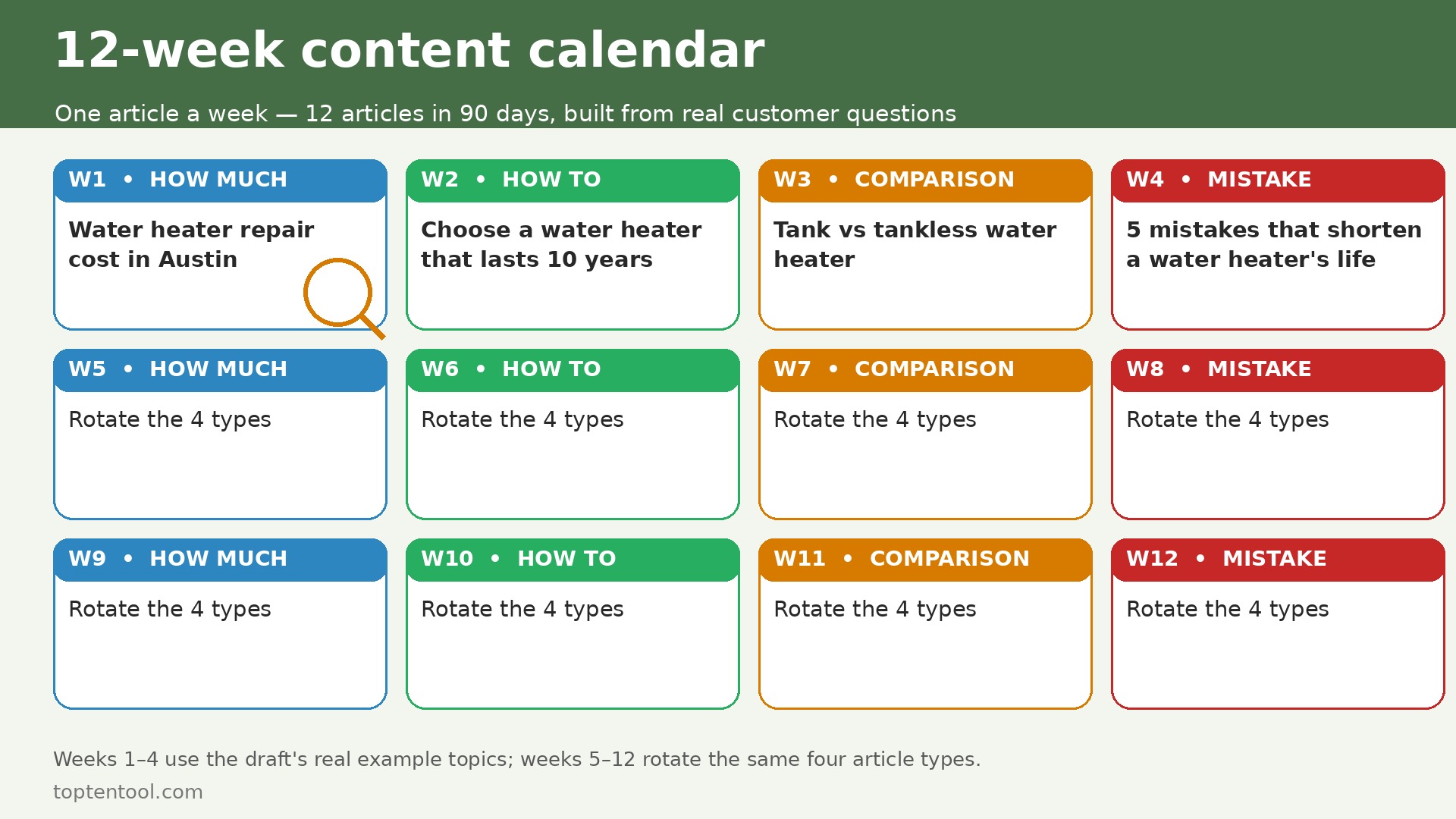
- Create a simple content calendar, with one article per week for the next 12 weeks.
Phase 2. The First 30 Days
Publish one article a week for the first 30 days, and publish it on the same day each week, so readers and search engines both learn when to expect new content. The goal of the first month is not traffic. It is learning what your customers read, and building a library that search can find. A business that publishes four useful articles in 30 days learns more about its customers than a business that publishes one perfect article in the same period, because four articles give you four data points, and one article gives you one.
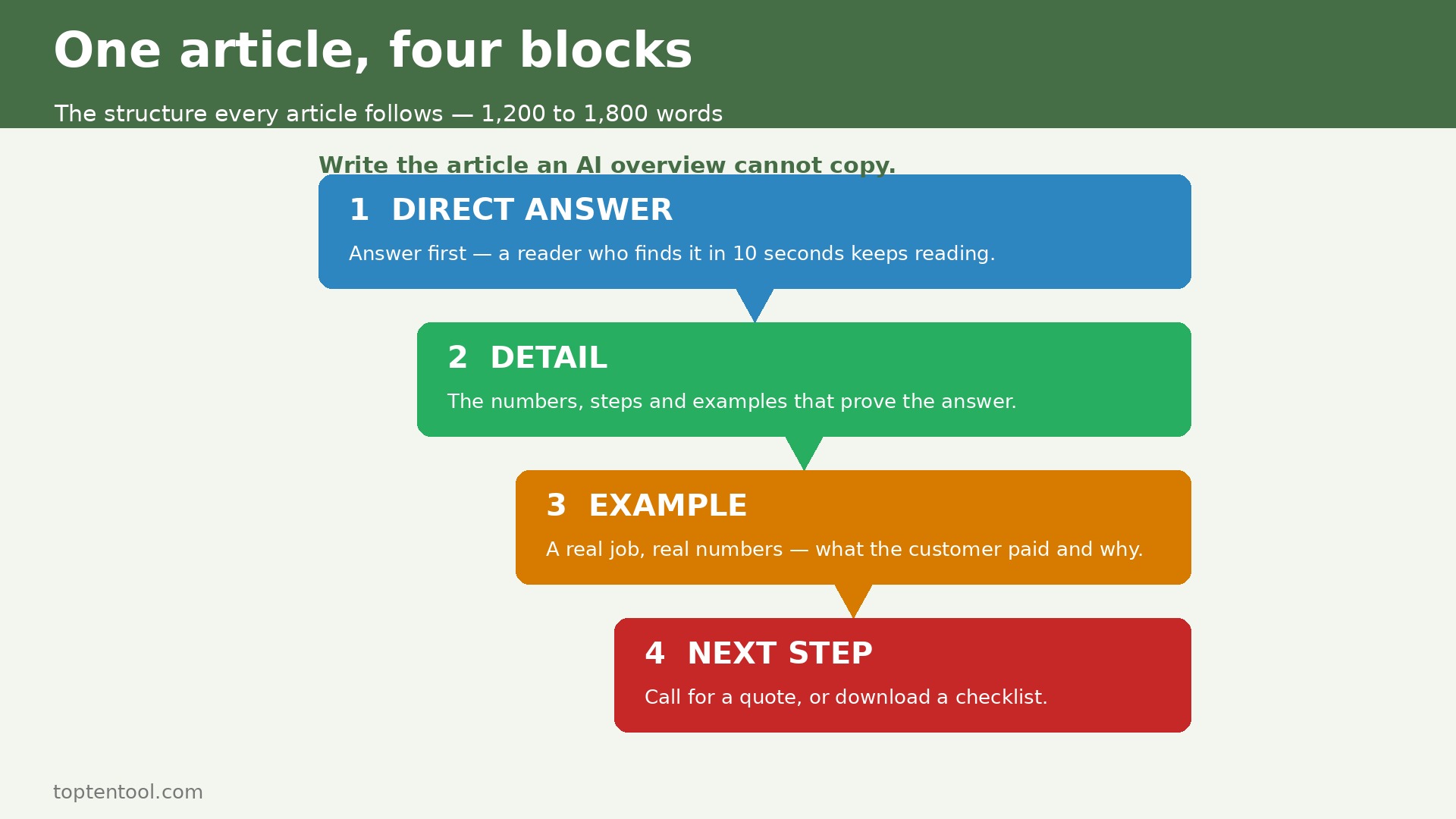
Write each article to answer one question, fully, in 1,200 to 1,800 words, with a clear structure that a busy reader can scan. Start with a direct answer in the first paragraph, because a reader who finds the answer in 10 seconds will keep reading, and a reader who has to hunt for it will leave.
Follow the answer with the detail, the numbers, the steps, and the examples that prove it, and end with a next step that tells the reader what to do, such as call for a quote, book a consultation, or download a checklist. Use short paragraphs, clear headings, and a table or a checklist where the reader needs to compare options, because a scannable article is read, and a wall of text is skipped.
Use four article types, and rotate them through the month, so the library never feels repetitive. The first type is the how much article, which gives a real price range, explains what changes the price, and shows a worked example. The second type is the how to article, which gives a step by step process a reader can follow, with a checklist they can copy.
The third type is the comparison article, which compares two options side by side, with a table, and names the best choice by situation. The fourth type is the mistake article, which names the most common mistake customers make, explains why it costs them money, and shows how to avoid it. Those four types cover most customer questions, and they are the articles that rank, because they give a reader a decision, not a definition.
The first 30 day publishing calendar
| Week | Article type | Example topic | Goal |
|---|---|---|---|
| Week 1 | How much | How much does a water heater repair cost in Austin | First article live, first data |
| Week 2 | How to | How to choose a water heater that lasts 10 years | Learn which questions get reads |
| Week 3 | Comparison | Tank vs tankless water heater, which is right for you | Show expertise, build trust |
| Week 4 | Mistake | The 5 mistakes that shorten a water heater life | First enquiries, first shares |
Share every article in three places, and do it on the day you publish it. Send it to your email list, with a one paragraph summary and a link. Post it on your main social channel, with a short video or a photo that shows the work, and a link to the article. And link to it from a relevant service page on your website, so a reader who lands on the service page can find the article, and a reader who lands on the article can find the service page.
Phase 3. Scaling From Day 31 to Day 90
After 30 days, you have data, and the scaling phase is about doing more of what worked and less of what did not. Open analytics, sort your articles by readers and by time on page, and list the top three. Those three articles are your strategy for the next 60 days.
Update each one with fresh numbers, a new example, and a clearer answer, because an updated article ranks better than a new article on the same topic, and because a reader who finds an article from last month with this year prices will trust it more. Write a second article on each top topic, from a different angle, and link the two articles together, because a cluster of articles on one topic ranks better than a single article alone.
Increase the pace in the scaling phase, from one article a week to two articles a week, if the first month proved you can sustain one, because two articles a week builds a library twice as fast, and a library of 20 articles in 90 days is a real asset.
If two articles a week is too much, stay at one a week, and spend the saved time updating old articles, adding internal links, and turning the best article into a video, a checklist, and a social post, because one article that becomes four pieces of content reaches more people than four articles that are never repurposed. Repurposing is the cheapest way to scale, and it is how a small business with one writer can look like a business with a team.
Start guest posting and local partnerships in the scaling phase, because a link from a local newspaper, a supplier, a trade association, or a complementary business is worth more than 10 social shares. Offer to write a useful article for a local site, with a link back to your article, and offer to link to a complementary business from your article, because a link exchange with a real business in your town is honest, useful, and effective.
Collect customer stories in this phase, and turn the best one into a case study, with real numbers, real photos, and a real result, because a case study is the most persuasive article a small business can publish, and it is the article a customer will send to a friend who is thinking of hiring you.
Scaling checklist for days 31 to 90
- List your top three articles by readers and time on page, and update each one with fresh numbers.
- Write a second article on each top topic, from a different angle, and link the two together.
- Increase to two articles a week if you can sustain it, or stay at one and repurpose the best article into a video and a checklist.
- Turn the best article into a downloadable checklist, and offer it in exchange for an email address.
- Offer one guest article to a local site, and ask one complementary business for a link exchange.
- Collect one customer story, and turn it into a case study with real numbers and photos.
- Review analytics every Monday, and plan the week around the top performing topic.
Templates You Can Copy
Use these templates to write your next 20 articles without staring at a blank screen. Each template is a structure, not a script, and the best articles fill the structure with real details from real work.
Template 1. The how much article
Direct answer. Give the price range in the first paragraph, with a worked example. What changes the price. List the five factors that move the price up or down, with a sentence on each one. Worked example. Show a real job, with real numbers, and explain what the customer paid and why. How to save. Give three honest ways to keep the cost down, without cutting corners.
Next step. Tell the reader to call for a quote, and to mention the article when they call. Example. A roofer writes how much does a roof repair cost in Austin, gives a range of 500 to 2,500 dollars, explains what changes the price, shows a real repair at 1,200 dollars, and ends with call for a free inspection.
Template 2. The how to article
Direct answer. Say what the reader will be able to do by the end of the article, in one sentence. Steps. Give the steps in order, numbered, with a sentence on each one, and a warning where a step can go wrong. Checklist. Give a copyable checklist the reader can print or save. What to watch for. List the three signs that the job needs a professional, and tell the reader to call you if they see one. Example. A plumber writes how to stop a leaking tap in 10 minutes, gives six steps, a checklist, and three signs to call a plumber.
Template 3. The comparison article
Direct answer. Name the best choice by situation in the first paragraph, such as option A for a small home, option B for a large home. Comparison table. Show the two options side by side, with price, lifespan, running cost, and maintenance. Detail. Give a paragraph on each option, with a real example. Verdict. Name the best choice for three different situations, and tell the reader how to decide. Example. A heating engineer writes tank vs tankless water heater, gives a table, a paragraph on each, and a verdict for a small flat, a family home, and a large house.
Template 4. The mistake article
Direct answer. Name the mistake in the first paragraph, and say what it costs. Mistakes. List five mistakes, with a paragraph on each one, explaining why it happens and what it costs. How to avoid it. Give a short fix for each mistake. Next step. Tell the reader to save the article, and to call you if they have already made one of the mistakes. Example. A landscaper writes the 5 mistakes that kill a new lawn, lists each mistake, gives a fix, and ends with call for a free lawn check.
Keep a running list of questions customers ask you, and turn each question into an article. Keep a running list of jobs you complete, and turn each job into a worked example with real numbers.
Measurement. Which Metrics Matter, and What Good Looks Like
Readers matter more than page views, because a reader who stays for three minutes and reads to the end is worth more than 10 visitors who leave in 10 seconds. Time on page is the most honest metric a small business has, because it tells you whether the article answered the question, and whether the reader trusted you enough to keep reading. Search clicks matter next, because a click from search is a customer who was already looking to buy, and a click from social media is a reader who was passing by. Enquiries matter most, because an article that brings readers but no enquiries is a library, not a marketing channel, and the goal is enquiries.
Track these numbers every Monday, and compare them week to week, not day to day, because daily numbers jump around, and weekly numbers show the trend. A good first month for a small business is four articles, at least one article with more than 100 readers, an average time on page above two minutes, and the first enquiry that mentions an article.
A good second month is eight articles, at least one article on page one of search for its target question, and at least one enquiry per week that came from content. A good third month is 12 to 20 articles, at least three articles on page one, and at least two enquiries per week that you can trace to content. If the numbers are below those levels, the fix is usually a clearer direct answer, a stronger title, or a better next step, not more articles.
| Metric | Where to find it | Good for a small business |
|---|---|---|
| Readers per article | Analytics, page views | At least 100 readers in the first month |
| Time on page | Analytics, average engagement time | Above 2 minutes |
| Search clicks | Search console, clicks | Growing week to week |
| Search position | Search console, average position | Page one for at least one article by month two |
| Enquiries from content | Ask customers, use a form field | At least 1 per week by month two |
| Email signups | Email list, new subscribers | At least 5 per month by month three |
| Links to your articles | Search console, links | At least 1 local link by month three |
Ask every new customer how they found you, and add a field to your contact form that asks where they heard about you, with content, search, social, and referral as options.
Common Mistakes to Avoid
The first mistake is writing for search engines instead of customers, with keyword stuffed sentences that no human would read, because a reader who finds a stuffed article will leave in seconds, and a search engine that sees readers leave will stop ranking it. Write for the customer, in their words, and the search ranking will follow.
The second mistake is publishing thin articles of 300 words that answer nothing, because a thin article cannot rank for a competitive question, and it cannot persuade a reader to call. Write 1,200 to 1,800 words, and answer the question fully. The third mistake is publishing once and never updating, because prices change, and an article with last year prices will lose trust, and lose its ranking to a fresher article.
The fourth mistake is writing without a next step, because an article that ends without telling the reader what to do next wastes the trust it just built. End every article with a call to action, such as call for a quote, book a consultation, or download a checklist. The fifth mistake is never sharing the article, because an article that is published but never sent to the email list, never posted on social media, and never linked from a service page will take months to be found, and the sharing is part of the work.
The sixth mistake is copying a competitor article, because a copy will never outrank the original, and a reader who has read both will trust the original more. The seventh mistake is giving up after a month, because content marketing compounds slowly, and the business that publishes for 90 days and quits learns nothing, while the business that publishes for a year owns the answers in its town.
Budget and Time Table
A small business content marketing strategy costs time before it costs money, and the time is the real budget. Plan for three hours per article, one article per week for the first month, and two articles per week from day 31, and spend the time writing, editing, sharing, and reviewing analytics.
A writer who charges 100 dollars per article will cost 400 dollars a month for one article a week, and 800 dollars a month for two, and that is a fair price for a good writer who knows your trade. A business that writes its own articles pays nothing in cash, and three hours per article in time, and that time is the cheapest marketing a small business can buy.
| Item | Cost | Time per week |
|---|---|---|
| Writing, one article a week | 0 dollars if you write it, about 100 dollars if you hire a writer | 3 hours |
| Editing and publishing | 0 dollars | 30 minutes |
| Sharing to email and social | 0 dollars | 30 minutes |
| Updating old articles | 0 dollars | 1 hour from day 31 |
| Email list tool | Free up to 500 subscribers on most tools, then about 10 dollars a month | 15 minutes |
| Analytics and search console | Free | 30 minutes per week |
| Guest article and link outreach | 0 dollars | 1 hour per month from day 31 |
Total cash cost for 90 days is zero dollars if you write the articles yourself, plus about 30 dollars for an email tool if your list grows past the free tier, and the total time cost is about 40 hours. A single new customer per week, at an average job value of 500 dollars, returns 6,000 dollars in 90 days, which covers the time many times over, and the articles keep working after the 90 days are over, because search can surface an old article for years.
Frequently Asked Questions
How often should a small business publish content?
Publish one article a week for the first 30 days, and two articles a week from day 31 if you can sustain it. One article a week builds a library of 12 articles in 90 days, and two articles a week builds a library of 20. Publishing once a month is too slow, and the library will not grow fast enough to rank.
How long does content marketing take to work for a small business?
Expect the first signs in 30 days, the first enquiries in 60 days, and a steady stream in 90 days, with real search traffic building over six to 12 months. A good first month is four articles, at least one article with more than 100 readers, and an average time on page above two minutes. Content compounds slowly, and the business that publishes for a year owns the answers in its town.
What should a small business write about first?
Write about the 20 questions customers ask you most often, in their own words, with a local angle on each one. Start with how much articles, because price is the question every customer asks first, and a price article with real numbers is the article most likely to bring an enquiry. Follow with how to articles, comparison articles, and mistake articles, and rotate the four types through the month.
How long should a small business blog article be?
Write 1,200 to 1,800 words, and answer one question fully, with a direct answer in the first paragraph, the detail in the middle, and a next step at the end. A 3,000 word article is fine if the question needs it, but a long article that repeats itself is worse than a short article that answers the question.
How do I turn blog readers into customers?
End every article with a clear next step, such as call for a quote, book a consultation, or download a checklist. Link every article to the relevant service page, so a reader who is ready to buy can find it in one click. Ask every new customer how they found you, and add a field to your contact form that asks where they heard about you. A reader who reads three of your articles before they call is a customer who already trusts you.
Verdict
A small business content marketing strategy works when the business answers the questions its customers ask, in the words they use, on a website it owns, and turns the readers who find those answers into buyers who trust it before they ever call. Start with the 20 questions customers ask you most often, and turn them into 20 article titles with a local angle. Publish one article a week for 30 days, using the four types, and learn which topics your readers actually read.
Scale from day 31, by updating your best articles, writing a second article on each top topic, and turning the best article into a checklist, a video, and a guest post. Measure time on page, search clicks, and enquiries every Monday, and fix the direct answer, the title, or the next step when the numbers are low. Budget three hours per article and zero dollars in cash if you write it yourself, and expect the first enquiries in 60 days and a steady stream in 90. Content compounds, adverts do not, and the library you build in 90 days will still be selling for you in 90 weeks.