

The problem with best shipping software for small business shows up on an ordinary working day. A customer asks for the right file, a teammate uses last years version, and nobody can say which one is current. The work itself is fine. The system around it is not. That gap is where the right tool earns its keep, and it is also where the wrong tool wastes money for a year.
Most teams do not set out to buy a bad tool. They buy the one with the loudest demo, the longest feature list, or the lowest first month price. Then the daily work starts, and the gaps appear. The export is wrong, the sharing link confuses a client, or the plan that looked cheap turns out to cap the one feature the team uses most.
This guide fixes that by starting with the work, not the marketing. Every tool below was judged on what it does on a normal day, how it charges, who it fits, and where it falls short. The goal is a short list you can act on, with the trade offs stated plainly so the choice survives contact with real work.
The best pick by job
Start here if you are short on time. The table below matches the most common jobs to the tool that handles each one best, so you can find your fit without reading every entry. The best shipping software for small business in this table were ranked on the core job first, then on price and ease of use.
| Job | Best tool |
|---|---|
| Multi channel sellers that need automation | ShipStation |
| US sellers who ship USPS and UPS only | Pirate Ship |
| Low volume sellers who want a free start | Shippo |
| Cross border sellers that need duties handled | Easyship |
| Amazon sellers who want free shipping tools | Veeqo |
| Developers and platforms that need a shipping API | ShipEngine |
| Sellers who need inventory with their shipping | Ordoro |
| Small sellers who want simple labels and email marketing | ShippingEasy |
If your job is not in the table, read the full entries for the two tools closest to your situation. The comparison table later in this guide covers price and best fit for every tool, so a quick scan there will narrow the list to two or three names.
What the best shipping software for small business do differently
Shipping software earns its keep in two ways, which are cheaper postage and less time per order. A tool that saves two dollars a label but adds five minutes of manual work per order is a bad trade at volume. Count both the postage saving and the minutes saved before you choose.
Start with your carriers and your channels. If you only ship USPS and UPS from the US, a free tool may be all you need. If you sell on three marketplaces and ship internationally, you need a multi carrier platform with duties and tracking. The carrier list on the pricing page is the first filter.
Check the shipment caps on every plan. Many plans price by monthly shipment count, so a plan that looks cheap at 50 shipments can jump sharply at 500. Count your real monthly volume, including the busy season, and price the tier you will actually use.
Test the tracking experience as a customer. A branded tracking page that shows the order moving builds trust, while a bare carrier link feels unfinished. Send a test order to yourself and follow the tracking from purchase to delivery before you commit.
The best shipping software for small business in this guide were judged on real daily work, not on a demo. Price, fit, and the quality of the core job mattered more than the length of the feature list.
Side by side comparison
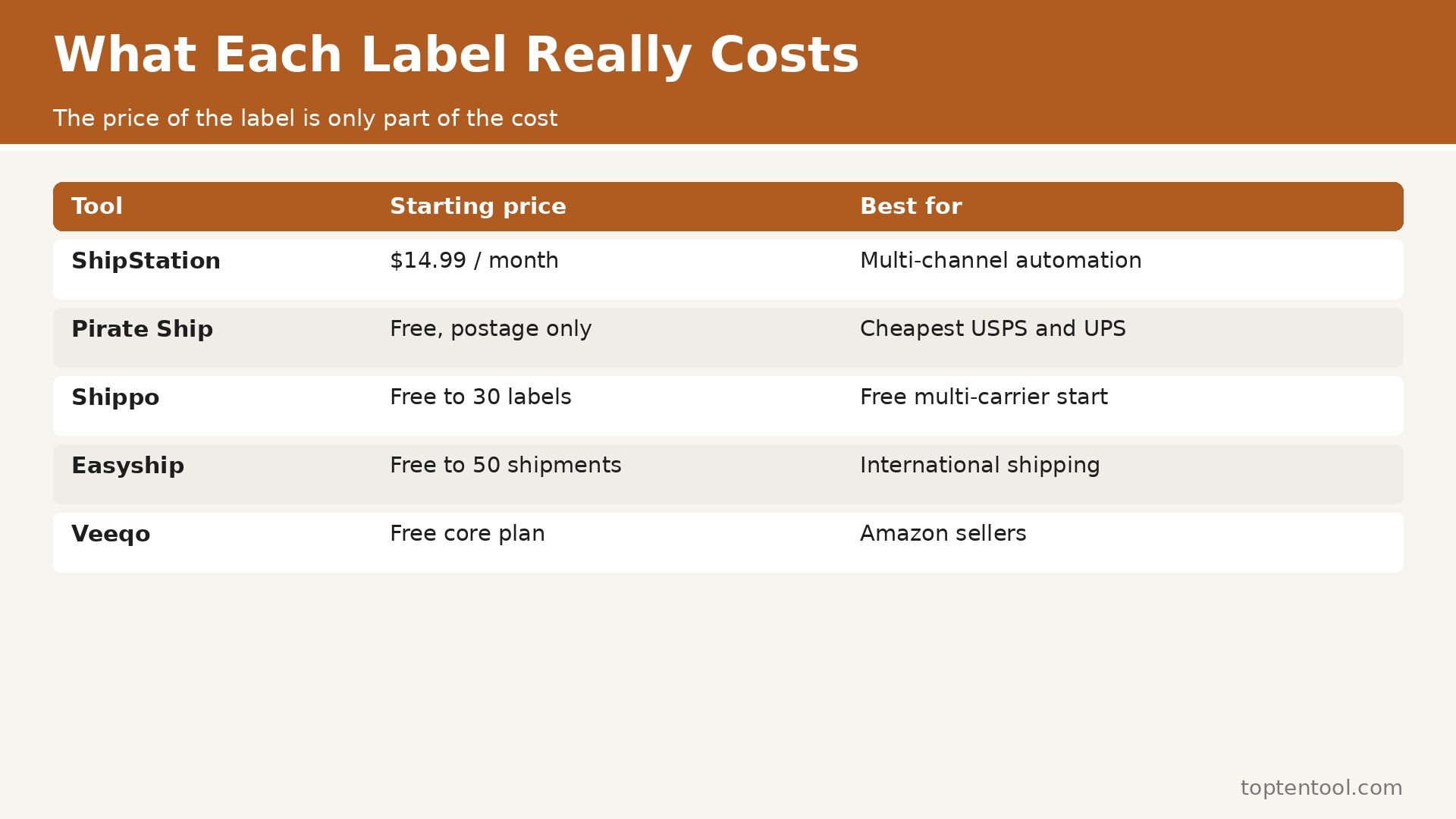
The table below puts price and best fit side by side, so the trade offs are easy to see. The best shipping software for small business that look cheapest on the first line are not always cheapest in real use, since shipment caps, per user fees and add ons change the total. Read the price column together with the best fit column before you rank the tools.
| Tool | Starting price | Best for |
|---|---|---|
| ShipStation | Starter 14.99 dollars per month | Multi channel automation |
| Pirate Ship | Free, postage only | Cheapest USPS and UPS |
| Shippo | Free to 30 labels, Pro 17 dollars per month | Free multi carrier start |
| Easyship | Free to 50 shipments, Plus 29 dollars per month | International shipping |
| Veeqo | Free core plan | Amazon sellers |
| ShipEngine | Quote based | Shipping API for platforms |
The tools in detail
1. ShipStation
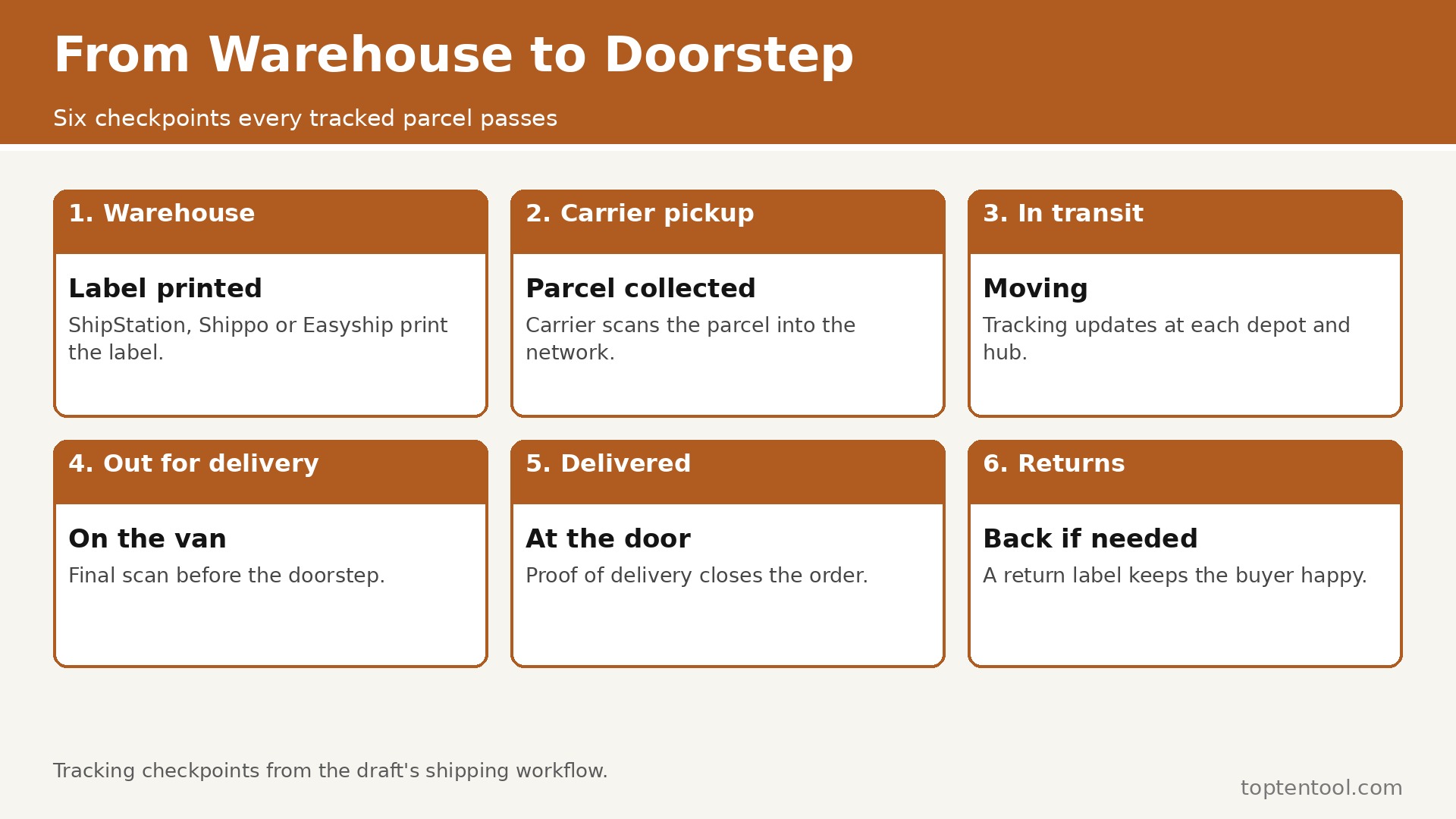
ShipStation is built for multi channel sellers that need automation. Orders from Shopify, Amazon, eBay, Etsy and WooCommerce feed into one dashboard. Automation rules assign carriers, split or combine orders, and route by weight or destination. More than 200 carriers and integrations cover most selling channels.
Pricing is Starter from 14.99 dollars per month for 50 shipments. ShipStation fits multi channel sellers that need automation best. The interface can feel cluttered at volume, and the Premium tier jumps to 349.99 dollars a month.
2. Pirate Ship
Pirate Ship is built for US sellers who ship USPS and UPS only. No monthly fee, no minimums and no markup on postage, with the carriers paying the platform. Discounts run up to 87 percent off USPS Priority Mail and up to 81 percent off UPS Ground. Labels print in minutes with no credit card needed to sign up.
Pricing is Free, postage only, no monthly fee. Pirate Ship fits US sellers who ship USPS and UPS only best. Carrier coverage is narrow, with no FedEx and no DHL, and there is no public API.
3. Shippo
Shippo is built for low volume sellers who want a free start. The free plan covers discounted USPS, UPS, FedEx and DHL rates with no monthly fee. More than 40 carriers connect in one place, with unlimited store integrations. Branded tracking pages and up to five logins come with the Pro plan.
Pricing is Starter free for up to 30 labels a month, Pro from 17 dollars per month. Shippo fits low volume sellers who want a free start best. A 5 cent per label fee applies on the free plan when you connect your own carrier account.
4. Easyship
Easyship is built for cross border sellers that need duties handled. More than 550 courier services cover international shipping from one dashboard. Duties and taxes calculate at checkout, so customers see the full cost before they buy. Crowdfunding and marketplace integrations suit sellers with global buyers.
Pricing is Free for up to 50 shipments, Plus from 29 dollars per month. Easyship fits cross border sellers that need duties handled best. The free plan is limited, and the per shipment fees add up at higher volume.
5. Veeqo
Veeqo is built for Amazon sellers who want free shipping tools. Amazon offers the core plan free, recovering cost through cashback and label commissions. Inventory, orders and shipping share one dashboard. Multi warehouse support suits sellers with stock in more than one place.
Pricing is Free core Shipping plan, with unlimited orders, users and warehouses. Veeqo fits Amazon sellers who want free shipping tools best. It is an Amazon product, so sellers who want independence from Amazon should weigh that before committing.
6. ShipEngine
ShipEngine is built for developers and platforms that need a shipping API. A single API connects to many carriers, so a platform can offer shipping without building each integration. Label generation, rate shopping and tracking run through the same API. The API suits marketplaces and software products that ship on behalf of users.
Pricing is Quote based pricing, with rates by volume. ShipEngine fits developers and platforms that need a shipping API best. There is no simple small business dashboard, so non technical sellers should choose a different tool.
7. Ordoro
Ordoro is built for sellers who need inventory with their shipping. Inventory management sits beside shipping, so stock levels update as orders go out. Dropshipping and supplier management tools suit sellers who never hold stock. Automation rules handle routine orders without manual work.
Pricing is Pricing varies by plan, with a free trial to start. Ordoro fits sellers who need inventory with their shipping best. The pricing is less transparent than the free tools, so a sales call is needed for an exact number.
8. ShippingEasy
ShippingEasy is built for small sellers who want simple labels and email marketing. Label printing, rate shopping and tracking cover the daily shipping job. Built in email marketing helps a small store follow up after delivery. Customer support is known for being helpful to new sellers.
Pricing is Pricing varies by plan, with a free trial to start. ShippingEasy fits small sellers who want simple labels and email marketing best. The feature set is lighter than ShipStation, so high volume sellers may outgrow it.
9. Stamps.com
Stamps.com is built for sellers who print a lot of USPS postage. USPS postage prints from the office, with discounts on common services. Batch printing handles many orders at once. Address verification cuts down on failed deliveries.
Pricing is Pricing varies by plan, with a monthly subscription for the service. Stamps.com fits sellers who print a lot of USPS postage best. The monthly fee adds up for a seller who ships only a few orders a week, and the focus is USPS first.
10. ShipWorks
ShipWorks is built for sellers who want deep automation on desktop and cloud. Automation rules, batch processing and reporting suit a busy shipping desk. Connections to many sales channels and carriers keep orders in one place. The interface is powerful once learned, with detailed control over every step.
Pricing is Pricing varies by plan, with a free trial to start. ShipWorks fits sellers who want deep automation on desktop and cloud best. The learning curve is longer than the simpler tools, and the price needs a quote for larger teams.
11. SendCloud
SendCloud is built for European sellers and cross border ecommerce. Checkout, shipping and returns share one platform built for European ecommerce. Branded tracking and returns portals keep customers informed after the sale. More than 400 carriers and integrations cover the European market well.
Pricing is Pricing varies by plan, with a free tier to start. SendCloud fits European sellers and cross border ecommerce best. US sellers get less value, since the carrier strength is centered on Europe.
12. XPS Ship
XPS Ship is built for small businesses that want rate shopping without a subscription. Rate shopping compares carriers side by side before a label is printed. No long contract is needed to start, which suits a cautious small business. The interface is simple and the setup is quick.
Pricing is Pricing varies by plan, with a free tier to start. XPS Ship fits small businesses that want rate shopping without a subscription best. The feature set is narrower than ShipStation or Shippo, so automation heavy teams will want more.
Mistakes to avoid
Most buyers in this category make the same few mistakes, and the tools that look best on paper are often the ones that punish those mistakes most. A short list of the common errors will save more money than a long feature comparison.
The most common mistake is comparing only the monthly subscription. Postage is the real cost, and a tool with slightly higher fees but better carrier discounts can be cheaper overall. Run your real order mix through the rate comparison before you decide.
Another mistake is ignoring the shipment cap. A plan that covers 50 shipments a month will either block the 51st order or charge extra, and the busy season is the worst time to discover that. Price the tier that covers your peak month.
The third mistake is leaving tracking as an afterthought. Customers who cannot see where their order is will email support, and those emails cost time. A branded tracking page pays for itself in fewer where is my order messages.
A simple decision checklist
Use this checklist before you pay for any of the best shipping software for small business above. It takes ten minutes and it catches the errors that turn a good tool into a bad purchase.
- Write down the one job the tool must do well every day, and test that job first.
- Count the real users, locations or volume the plan must cover, including the busy season.
- Check the price of the tier that includes the features you need, not the cheapest tier on the page.
- Test the tool with a real task from your own work, not the sample data in the demo.
- Read the contract terms, the renewal rules and the cancellation process before you sign.
Frequently asked questions
These are the questions buyers ask most often about best shipping software for small business. The answers are short, and each one points back to the comparison above so you can check the detail for yourself.
What is the cheapest shipping software for a small business?
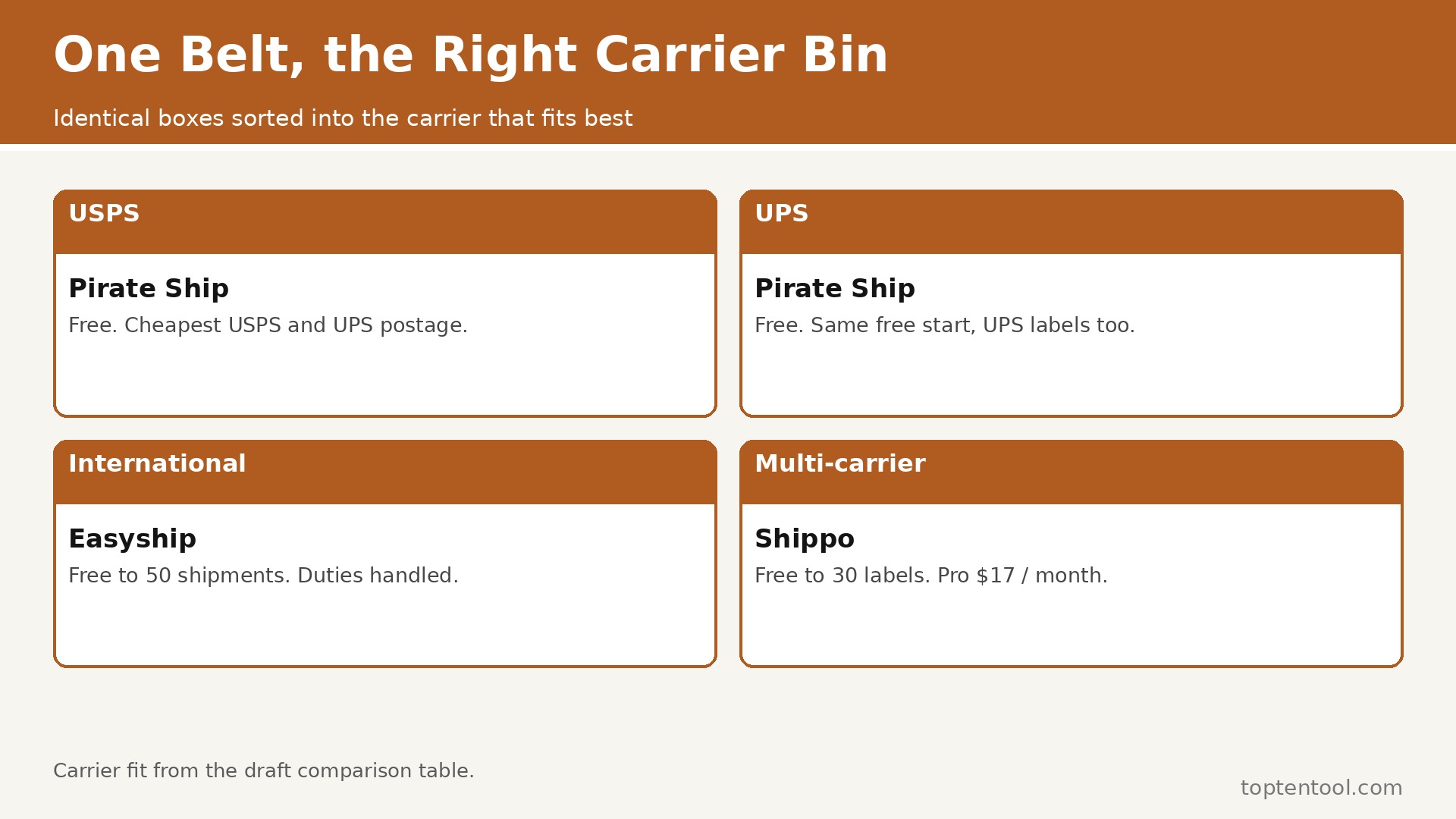
Pirate Ship is the cheapest for US sellers who use USPS and UPS, since it charges no monthly fee at all. Shippo is the cheapest free start for sellers who also need FedEx or DHL, with 30 free labels a month.
How much does ShipStation cost?
ShipStation starts at 14.99 dollars a month for 50 shipments on Starter, with Standard at 29.99 dollars a month and Premium from 349.99 dollars a month. The price rises with shipment volume, so count your monthly orders before choosing a tier.
Do I need shipping software if I only ship a few orders a week?
Probably not a paid plan. A free tool like Pirate Ship or Shippo covers a few orders a week with discounted postage and no monthly fee. Move to a paid plan when manual label printing starts taking more than an hour a day.
What is the best shipping software for international orders?
Easyship is the strongest pick for international selling, since it handles duties and taxes at checkout and connects to more than 550 courier services. ShipStation and Shippo also cover international carriers well for sellers with simpler needs.
Can shipping software save money on postage?
Yes. Most platforms offer commercial rates that beat retail counter prices by a large margin, with discounts up to 87 percent on some services. The saving comes from the carrier rate, not the software, so compare the discounted rates for your common package sizes.
One more point deserves attention before you choose. ShipStation leads this list for a reason, but the lead is narrow, and the second and third tools each win on a specific job. A buyer who reads only the ranking will miss those wins. Read the best fit column again with your own job in mind, and let that decide the shortlist rather than the order of the entries.
Support quality is easy to overlook until something breaks. Pirate Ship and ShipStation both have a reputation for answering quickly, while some of the cheaper tools in this list rely on email support with slower replies. If your team depends on the tool every day, the speed of support is worth real money, and it should count in the decision alongside price.
Training time is a real cost too. A tool that takes a week to learn will cost more than a tool with a slightly higher monthly price that the team learns in a day. Ask each vendor for a short trial with your own data, and watch how long it takes a new user to finish a routine task without help. That test tells you more than any feature list.
Integration with the tools you already use matters more as the stack grows. A platform that connects cleanly to your current system will save hours of manual copying, while a tool that needs workarounds will add a weekly chore. Check the integration list for the two or three apps your team opens every day, and confirm the connection works on the plan you would actually buy.
Finally, remember that the best tool is the one the team will keep using. A powerful platform that sits unused is worse than a simple tool that everyone opens daily. Involve the people who will use it in the trial, listen to what frustrates them, and choose the tool they reach for without being told. That habit is what turns a purchase into a result.
Think about the second year, not just the first month. A tool with a low entry price and a steep renewal can cost more over two years than a pricier tool with stable pricing. Ask about renewal rates, price changes on higher tiers, and what happens when the team grows past the current plan. A vendor that answers those questions plainly is easier to trust with a long term commitment.
Data export is a quiet test of a good vendor. Before you commit, check how your work leaves the platform if you ever decide to move. A tool that exports cleanly to standard formats respects your business, while a tool that locks data inside is betting that you will never leave. The export test takes five minutes and it is worth doing on every shortlisted tool.
Seasonal peaks deserve a specific check. A tool that handles a normal week well can still struggle in the busiest month of the year, when volume doubles and the team is under pressure. Ask the vendor how the plan behaves at peak volume, whether limits can be raised temporarily, and what the cost of that extra capacity looks like. The answer will tell you whether the tool is built for real business cycles.
Security and privacy checks belong on the shortlist too. Ask where data is stored, who can access it, and how the vendor handles a request to delete it. A tool that handles customer or employee data should answer those questions without hesitation. If the answers are vague, treat that as a warning sign rather than a detail to check later.
Start small even when the plan allows a big rollout. Pick one team, one project or one location, run the tool there for a month, and measure the result before you roll it out everywhere. A pilot catches the problems that a demo hides, and it gives the team a success story to share when the wider rollout begins. That careful start is how a good tool becomes part of the daily routine instead of another unused subscription.
Measure the result after the first month with numbers you already track. Time saved per order, per call or per project is the clearest test, followed by the cost per order and the number of errors or rework. If the tool has not moved at least one of those numbers in thirty days, the problem is either the tool or the way the team uses it, and both are worth a frank review before the next payment.
Keep the decision record simple. Write down why you chose the tool, what it must do in the first ninety days, and what would make you switch. That short note stops the team from drifting into a tool that no longer fits, and it makes the next review a fact based conversation instead of a debate about feelings. A good purchase is one you can explain a year later.
Talk to a current user before you buy, not just to the sales team. A short call with a business of a similar size will reveal the daily friction that a demo never shows, like a slow mobile app, a confusing setting, or a support queue that only answers quickly before the sale. Most vendors will arrange a reference call if you ask, and the ones that refuse are telling you something.
Check what happens when the team changes. A tool that is easy to join should also be easy to leave, with clear steps for removing a user, moving their work, and keeping the history. Staff turnover is normal, and a platform that makes offboarding painful will cost time on every departure. Ask about that process during the trial, while you still have a choice.
Look at the roadmap with a skeptical eye. A vendor that promises every feature on your wish list is selling a future, not a product. Buy the tool for what it does today, and treat the roadmap as a bonus. If the core job is not covered now, no promised update should change the decision.
Finally, set a review date in the calendar the day you buy. Ninety days is enough to know whether the tool is working, and a fixed review stops a mediocre tool from becoming a permanent cost through habit. At the review, check the numbers you recorded at the start, ask the team what they would change, and be willing to switch if the answer is clear. A tool should earn its renewal.
Compare the trial experience across your shortlist on the same task. Give each tool the same real job, time how long it takes, and note where you got stuck. A side by side trial on identical work is far more honest than a week with one tool followed by a week with another, since memory fades and the second tool always feels easier. Keep a simple score sheet and let the numbers decide.
Ask about limits that only appear at scale. A plan that allows ten users today may charge sharply for the eleventh, and a plan that covers a hundred orders a month may slow down at a thousand. Vendors rarely highlight those cliffs on the pricing page, so ask directly what changes at the next tier and what the migration looks like. A smooth upgrade path is a sign of a mature product.
Do not ignore the mobile experience. Much of the daily work in this category happens away from a desk, on a phone between jobs or in a meeting with a client. Open the mobile app during the trial, complete a routine task on it, and check whether the result matches the desktop version. A weak mobile app will quietly push work back to the office, where it piles up.
The verdict
For most small businesses, the choice is simple. Use Pirate Ship if you ship USPS and UPS only, since it costs nothing. Use Shippo if you need FedEx or DHL as well and want a free start. Move to ShipStation when order volume and automation needs outgrow the free tools. Easyship is the pick for international sellers, and Veeqo is the pick for Amazon sellers who want the core tools free.
Weigh and measure your five most common orders before you compare rates. Most sellers guess at package sizes and then wonder why the postage bill is higher than the quote, and the gap is usually a box that is one inch too large or a weight that was rounded down. Write the real dimensions on a card beside the packing bench, and use those numbers in every rate check. Accurate sizes also stop the surprise surcharges that carriers add when a parcel measures larger than the label claims.
Pack a test order for each carrier you plan to use and time the whole job. The fastest label tool is not always the fastest workflow, because printing, packing slips, and pickup scheduling all add minutes that a monthly fee cannot buy back. Time the full round trip from order to packed box for three tools, and the winner is usually obvious by the second day. That timed test also shows whether the team needs a label printer, a scale, or simply a better bench layout before any software can help.
Finally, check the return flow before you commit. A tool that prints outbound labels in seconds but makes returns slow will cost you repeat customers, so test a return from the customer side and see how long the refund takes to land.
That is the honest summary for best shipping software for small business in 2026. Start with the tool that matches your situation, use the free trial or free plan to test it on real work, and only then commit to a paid plan. A tool that fits the job will feel obvious within a week, and a tool that does not will show its gaps just as fast.