
A party rental company with 200 chairs, 40 tables, and a dozen tents loses money when the calendar is wrong. A tent is promised to two weddings on the same Saturday, a generator goes out without a service check, and a customer is charged for a late return that was actually on time. The best equipment rental software for small businesses prevents those failures by tracking every item, every booking, and every return in one place, and the difference shows up in the number of double bookings, which should be zero.
Small rental businesses need software that understands items, not just bookings. A camera, a excavator, and a bouncy castle are rented differently, and the system must handle availability by item, buffers for prep and return, maintenance schedules, and deposits. The 12 tools below were picked because they serve small to mid size rental businesses, publish prices a small business can check, and cover the core jobs of inventory, online booking, contracts, billing, and maintenance.
This guide compares the 12 platforms on real 2026 pricing, what each one does well, where each one falls short, and which rental type each one fits. Prices come from vendor pages and current roundups checked in November 2026. Where a vendor hides its price behind a sales call, we say so plainly, because quote only pricing is itself a fact a small business needs before shortlisting.
How we chose the best equipment rental software for small businesses
We judged every tool on the five jobs that decide whether a small rental business runs smoothly. First, inventory must track every item by serial number, status, and location, because a system that only tracks categories will double book the same tent. Second, availability must factor in buffers, prep time, and return time, because a tent that returns at noon cannot go out again at 1pm. Third, online booking must show real availability and take a reservation without a phone call. Fourth, contracts, invoices, and deposits must work in the flow rather than on paper. Fifth, maintenance must flag an item before it goes out broken.
Pricing transparency counted heavily. Small rental businesses buy software the way they buy stock, on a number they can read before they commit. Vendors that publish a rate card scored better than vendors that insist on a sales call, and vendors that charge per user were judged on what a three person team actually pays. Free plans and free trials scored higher, because a business should be able to test a system with its real inventory before paying.
We also weighted rental type fit. A party rental company needs a storefront, an AV company needs crew scheduling, and a heavy equipment yard needs maintenance depth. No single tool wins for every rental type, so this guide states the best fit for each tool plainly. Features such as barcode scanning, GPS tracking, and website builders were treated as useful extras, not as reasons to pick a platform on their own.
The best equipment rental software for small businesses at a glance
The table below gives the whole field in one view. Use it to cut the list to three candidates, then read the full reviews of those three before you book a demo. Note that per user pricing looks cheap until you multiply it by your team, so the starting prices below are the entry point, not the final bill.
| Tool | Starting price | Best for | Watch out |
|---|---|---|---|
| Booqable | From $29 a month | Small rental businesses wanting online bookings | No built in website builder |
| Rentman | From $39 a month platform base | AV and event companies scheduling crews | Modules add up, pricing is hard to compare |
| EZRentOut | From $49 a month | Heavy equipment with maintenance depth | Higher tiers jump sharply |
| HireHop | Free Starter plan, Pro from 46 pounds a month | Small rental businesses wanting a free start | Per user pricing, first user costs most |
| Quipli | From $500 a location a month | Independent tool and heavy equipment companies | Flat $6,000 a year per location |
| Current RMS | From $50 a month | Cloud AV rental management | Narrower fit than general tools |
| Rent2b | 0 euros a month plus 7.5 percent fee | Startups wanting zero monthly risk | Percentage fee grows with revenue |
| Rentsoft | From 49 euros a month | Bike and sports rentals | Euro pricing, narrow rental focus |
| Point of Rental | Quote only | Multi location rental enterprises | No published price, enterprise focus |
| Texada | Quote only | Heavy equipment enterprises | No published price, enterprise focus |
| InTempo | Quote only | Rental enterprises wanting a full suite | No published price, enterprise focus |
| Goodshuffle Pro | From $99 a month | Event rental quoting and proposals | Higher entry price than Booqable |
The 12 tools, reviewed in detail
Each review below states the price first, then the strengths, then the honest limits. Read the pick it when and skip it when lines as the verdict. If a tool matches your rental type and your team size, it belongs on your shortlist even if it sits low in this list.
1. Booqable
Booqable starts at $29 a month on the Start plan, with Grow at $69 a month and Scale at $149 a month. Some listings show Start at $35 a month, so owners should confirm the current rate before budgeting. A 14 day free trial is available, and the Start plan covers orders, inventory, quotes, contracts, and invoices with unlimited inventory and orders and no commission on bookings.
Booqable is the best all rounder for a small rental business. The availability engine does the real work, factoring in buffers, returns, and prep time, and auto calculating prices by rental length, day of week, and date rules. The online storefront shows live availability on the business website, and the 4.8 rating on G2 reflects a product small rental businesses genuinely enjoy. For a party, camera, or tool rental company that wants online bookings fast, it is the obvious pick.
There is no built in website builder, so the business must maintain its own site, and there is no GPS or fleet tracking, which matters for vehicle and trailer rental. Maintenance tracking stays basic, so a heavy equipment yard may need a second system alongside it. Transaction fees of 1 to 3 percent apply on some plans, which adds up on a busy month.
Pick it when you run a small rental business and want online bookings with a smart availability engine from $29 a month. Skip it when you need GPS tracking, deep maintenance, or a built in website builder.
2. Rentman
Rentman prices by module. The platform base costs $39 a month, with products added per power user, including Inventory from $19 a month, Crew from $14 a month, plus add ons for equipment tracking, quoting, and warehousing. Some listings show Standard Inventory at $19 per user a month and Pro at $25. A 30 day free trial needs no credit card.
Rentman is the operations platform for AV, event production, and broadcast rental teams. It manages large inventories of cables, mixers, lighting, and cameras, each with dependencies and statuses, and it schedules crews alongside equipment in one system. The shortage warnings, inventory bundles, and project planning tools are stronger than any rival for a production company. For a business that runs events, not just rentals, the depth is real.
The modular pricing is hard to compare, because the $39 base does not buy the inventory or crew tools, and the total rises fast as modules are added. Third party sources report widely different plan structures, so owners must get a written quote for their exact configuration. A small rental business that only needs inventory will pay for a production platform it does not need.
Pick it when you run an AV or event production company and need crew scheduling alongside inventory in one system. Skip it when you run a simple rental shop or need a single published price.
3. EZRentOut
EZRentOut starts from $49 a month, with higher tiers at $59 a month and $399 a month for larger operations. The platform connects rentals, maintenance, and accounting for heavy equipment, with barcode scanning and deep equipment lifecycle tracking. Owners should confirm the current tier structure before budgeting, because the jumps between tiers are steep.
EZRentOut is built for asset heavy operations that need maintenance depth. The barcode scanning, equipment lifecycle tracking, and maintenance scheduling are stronger than the storefront tools, and the accounting integration helps a heavy equipment yard track the true cost of each machine. For a tool rental or heavy equipment business, the maintenance tools are the reason to pick it.
The tier jumps are steep, with the top tier near $399 a month, which is a big leap from the $49 entry price. The online storefront is weaker than Booqable, so a business that wants a polished booking website may find it thin. The interface is functional rather than modern, and the setup takes longer than the self serve tools.
Pick it when you run a tool or heavy equipment rental business and need barcode scanning and deep maintenance tracking. Skip it when you need a polished online storefront or the cheapest entry price.
4. HireHop
HireHop offers a free Starter plan for one user, with Professional at 46 pounds a month for the first user and extra users billed per user. The platform covers inventory, bookings, and billing for small rental businesses, and the free plan is genuinely usable for a one person operation.
HireHop has the most generous entry point on this list. The free Starter plan lets a one person rental business run real inventory and bookings without any monthly bill, and the Professional plan at 46 pounds a month adds the depth a growing business needs. The interface is clean, the setup is fast, and the per user model suits a small team that grows slowly.
The per user pricing means the bill rises with every team member, and the first user costs the most, which can surprise a business that adds staff quickly. The feature set is thinner than Booqable on storefront tools and thinner than Rentman on production tools. A business that needs deep integrations may find gaps.
Pick it when you run a one person rental business and want a free starting point with a clear upgrade path. Skip it when you have a large team, because per user pricing adds up fast.
5. Quipli
Quipli charges a flat $6,000 per location per year, which is $500 a location a month, with no implementation fees, unlimited users, and unlimited inventory. There is no free plan, and owners should confirm the current annual rate before budgeting, because the model is unusual and honest.
Quipli is built for independent rental companies running tool and heavy equipment fleets, and the flat pricing model is its strength. Unlimited users and unlimited inventory mean the bill does not rise when the team grows or the fleet expands, which is rare in this category. The platform covers inventory, bookings, maintenance, and billing for a real rental yard, and the flat model makes budgeting simple.
The $500 a month price is the highest entry price on this list for a single location, and it rules out a very small business entirely. There is no free plan and no monthly billing, so the commitment is $6,000 a year from day one. A party rental company will also find the tool and equipment focus less fitting than Booqable.
Pick it when you run an independent tool or heavy equipment rental company with a real yard and want flat pricing with unlimited users. Skip it when you run a small party or event rental business, or your budget caps out under $100 a month.
6. Current RMS
Current RMS starts from $50 a month for cloud AV rental management. The platform covers inventory, bookings, and billing for AV and event rental companies, with a free trial available. Owners should confirm the current plan structure before budgeting, because the tiers are split by features.
Current RMS is a focused cloud platform for AV rental companies, with strong inventory tracking, availability, and quoting tools built for the way AV gear is rented. The interface is clean, the cloud model means no server to maintain, and the feature set is deep enough for a professional AV rental business. For a company that rents cameras, lighting, and sound, the fit is better than a general tool.
The AV focus means a general rental business will find gaps, and the feature set is narrower than Rentman on crew scheduling. The price is also higher than Booqable for a similar sized business, and the review footprint is smaller. A party rental company should look elsewhere.
Pick it when you run an AV rental company and want a focused cloud platform from $50 a month. Skip it when you rent general equipment or need crew scheduling in the same system.
7. Rent2b
Rent2b offers a Starter plan at 0 euros a month plus a 7.5 percent transaction fee, with paid plans from 39 euros a month. The platform is built for small and growing rental businesses, and the setup takes about 30 minutes. Owners should calculate the fee at their real revenue before choosing the free plan.
Rent2b is the lowest risk starting point on this list. A new rental business can start with no monthly fee and pay only when it earns, which removes the barrier that stops many small businesses from trying software at all. The platform covers inventory, bookings, and billing, and the setup is fast. For a startup testing whether rental software earns its keep, it is the obvious pick.
The 7.5 percent transaction fee grows with revenue, so a busy business pays far more than a $29 subscription. On 5,000 euros a month of bookings, the fee is 375 euros, which is more than ten times the Booqable Start plan. The platform is also European focused, and the review footprint is smaller than the established tools.
Pick it when you are starting a rental business and want zero monthly risk while you test whether software earns its keep. Skip it when you already earn steady revenue, because the percentage fee will exceed a flat subscription quickly.
8. Rentsoft
Rentsoft starts at 49 euros a month, with a free trial available. The platform is built for bike and sports rentals, with inventory, bookings, and billing tools that fit the way sports gear is rented. Owners should confirm the current plan structure before budgeting.
Rentsoft is built for bike and sports rental businesses, and that focus shows in the features. The inventory tools handle bikes, skis, and sports gear with the right fields, the booking flow fits short term sports rentals, and the interface is clean. For a bike shop that rents as well as sells, the fit is better than a general tool.
The narrow focus means a general rental business will find gaps, and the euro pricing means US operators pay in a foreign currency. The feature set is thinner than Booqable on storefront tools, and the review footprint is small. A party or tool rental company should look elsewhere.
Pick it when you run a bike or sports rental business and want software built for that rental type. Skip it when you rent general equipment or operate in the US.
9. Point of Rental
Point of Rental does not publish pricing and sells by quote, with demos available for enterprise rental operations. Owners should expect a sales conversation and a written quote before they can compare it against anything else. There is no free plan and no published trial length.
Point of Rental is built for multi location rental enterprises, with deep tools for inventory, bookings, billing, and reporting across branches. The platform handles the complexity of a real rental enterprise, including inter branch transfers and consolidated reporting. For a business with several locations, the depth is genuinely useful.
The quote only pricing and the enterprise focus make Point of Rental a poor fit for a small business. A single location rental shop cannot learn the price without a sales call, and the platform is built for teams, so a small business pays for depth it will never use. The onboarding is heavier than the self serve tools here.
Pick it when you run a multi location rental enterprise and need deep inventory and reporting across branches. Skip it when you run a single location or need a published price.
10. Texada
Texada does not publish pricing and sells by quote. Owners should expect a sales conversation and a written quote before they can compare it against anything else. The platform is built for heavy equipment rental enterprises with large fleets.
Texada is built for heavy equipment rental at scale, with deep tools for fleet management, maintenance, billing, and reporting. The platform handles the complexity of a large equipment yard, including service histories and utilization reporting. For a heavy equipment enterprise, the depth is real.
The quote only pricing and the enterprise focus make Texada a poor fit for a small business. A small tool rental shop cannot learn the price without a sales call, and the platform is built for large fleets, so a small business pays for scale it will never use.
Pick it when you run a heavy equipment rental enterprise with a large fleet. Skip it when you run a small rental business or need a published price.
11. InTempo
InTempo does not publish pricing and sells by quote. Owners should expect a sales conversation and a written quote before they can compare it against anything else. The platform is sold as a full suite for rental enterprises.
InTempo is a full suite for rental enterprises, with inventory, bookings, billing, maintenance, and reporting in one system. The platform handles the whole operation from a single vendor, which suits an enterprise that wants one system rather than several subscriptions. The depth is real for a business with real volume.
The quote only pricing and the enterprise focus make InTempo a poor fit for a small business. A small rental shop cannot learn the price without a sales call, and the platform is built for enterprises, so a small business pays for depth it will never use.
Pick it when you run a rental enterprise and want a full suite from one vendor. Skip it when you run a small rental business or need a published price and a fast setup.
12. Goodshuffle Pro
Goodshuffle Pro starts from $99 a month, with a free trial available. The platform is built for event rental companies that need quoting and proposals, with inventory, bookings, and billing tools alongside the quote builder. Owners should confirm the current plan structure before budgeting.
Goodshuffle Pro is built for event rental companies that live on quotes and proposals. The quote builder is stronger than any rival here, with professional proposals that a client can approve online, and the inventory and booking tools handle the event workflow well. For a party or event rental company that wins work through proposals, the quoting tools are the reason to pick it.
The $99 starting price is higher than Booqable at $29 a month, and the feature set is narrower outside event rental. A tool rental company will find less fit, and the review footprint is smaller than Booqable. The price alone rules it out for a very small business.
Pick it when you run an event rental company and win work through professional quotes and proposals. Skip it when you need the cheapest entry price or rent general equipment rather than event gear.
A Pick for Every Kind of Team
The best equipment rental software for small businesses depends on what you rent and how big your team is. Match your job to the pick below and you will shortlist faster than reading every review in order.
| Your job | Best pick | Why it wins |
|---|---|---|
| Small rental business, online bookings | Booqable | Best all rounder, from $29 a month |
| AV and event production | Rentman | Crew scheduling plus inventory, from $39 a month |
| Heavy equipment, maintenance depth | EZRentOut | Barcode and lifecycle tracking, from $49 a month |
| One person business, free start | HireHop | Free Starter plan for one user |
| Event rental, quoting first | Goodshuffle Pro | Best proposals, from $99 a month |
| Startup, zero monthly risk | Rent2b | 0 euros a month plus 7.5 percent fee |
The Cost, Without Surprises
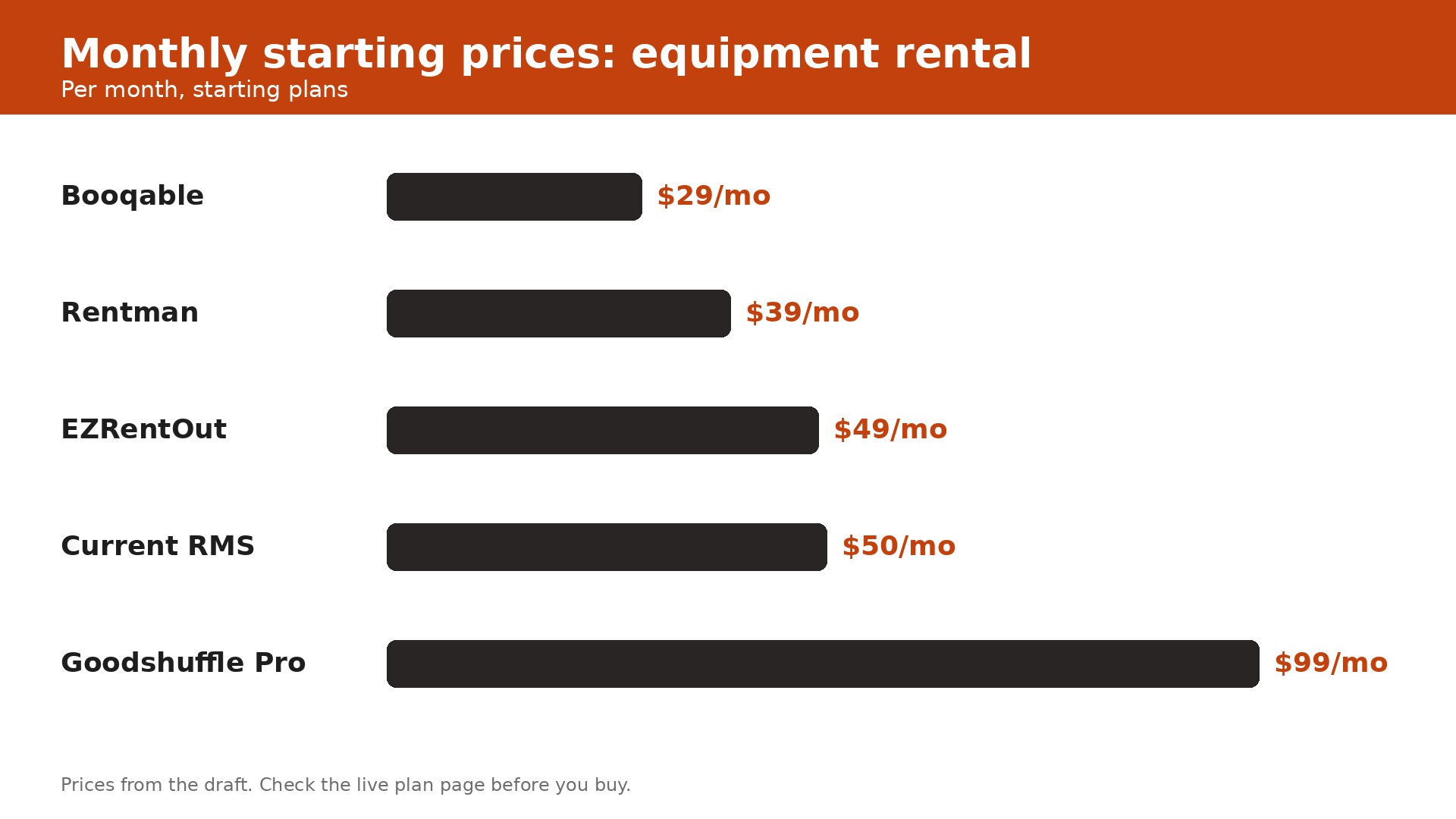
A small rental business should budget $29 to $99 a month for software. Booqable starts at $29 a month, Rentman base costs $39 a month plus modules, EZRentOut starts at $49 a month, Current RMS starts at $50 a month, and Goodshuffle Pro starts at $99 a month. HireHop offers a free Starter plan, Rent2b charges 0 euros a month plus a 7.5 percent fee, and Quipli costs $500 a location a month. Point of Rental, Texada, and InTempo are quote only. Always calculate the cost at your real team size and revenue, because per user pricing and percentage fees rise as the business grows.
The hidden costs are the modules, the transaction fees, and the percentage fees. Rentman modules add $14 to $19 per user a month on top of the $39 base, Booqable charges 1 to 3 percent on some plans, and Rent2b charges 7.5 percent on every booking on the free plan. On $5,000 a month of bookings, that 7.5 percent is $375, which is more than ten times the Booqable Start plan. Always add the percentage fees to the monthly fee before you compare tools.
The math that justifies the spend is the double booking that never happens. A tent promised to two weddings on the same Saturday costs a refund, a bad review, and a lost customer. A system that tracks every item by serial number and factors in buffers and prep time prevents that failure entirely. Judge the software on the bookings it protects, not on the price alone. The best equipment rental software for small businesses earns its keep when it prevents a double booking and flags a service date before the item goes out.
Where Small Operators Lose Money
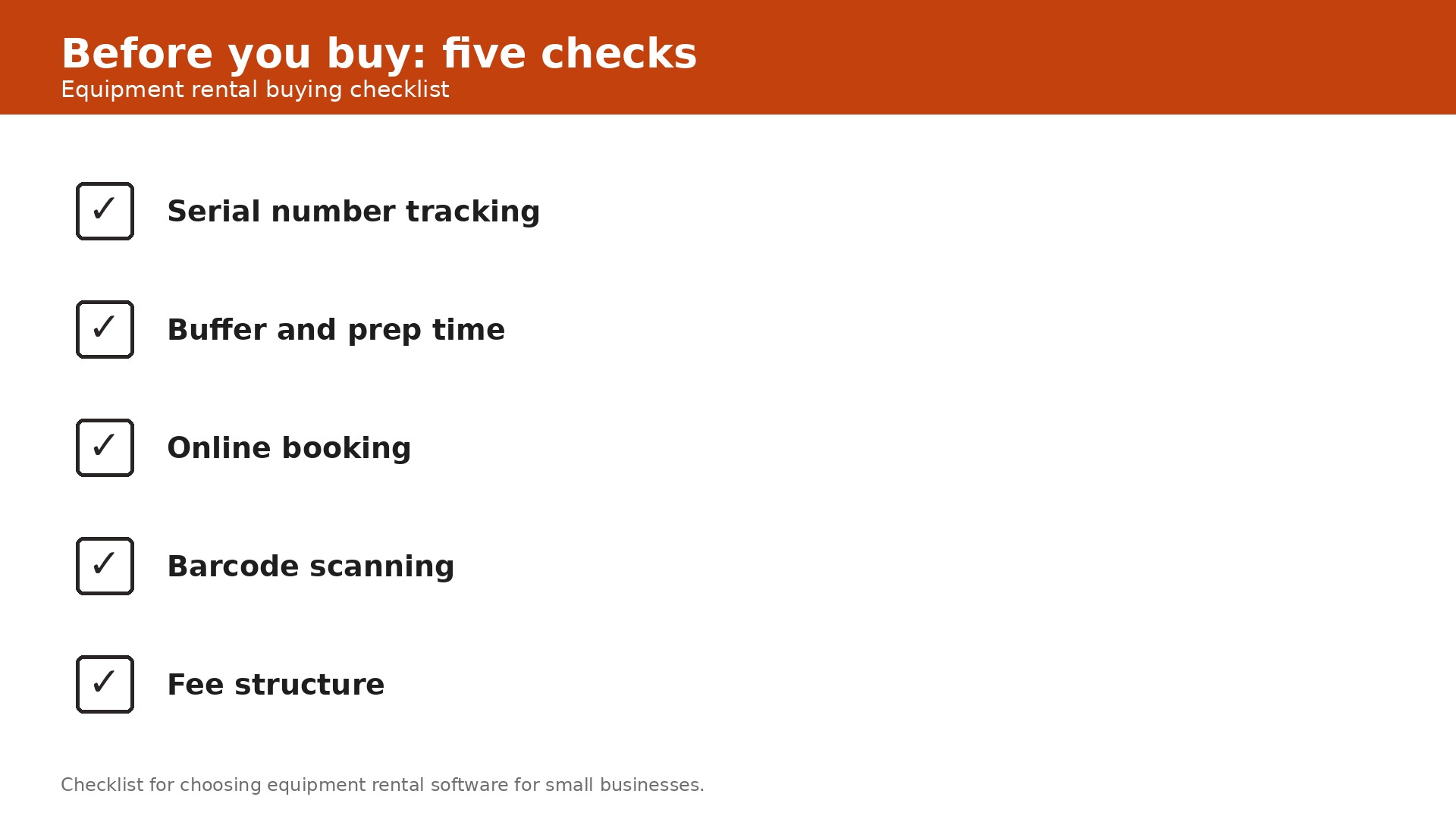
- Tracking categories instead of items. A system that knows you have 10 tents but not which tent is where will double book the same tent. Insist on serial number tracking for every item, because that is the feature that prevents the most expensive failure in this business.
- Ignoring buffers and prep time. A tent that returns at noon cannot go out again at 1pm, and a camera that returns dirty cannot go out clean. A system that does not factor in buffers will promise what the business cannot deliver.
- Choosing a percentage fee plan when a flat subscription is cheaper. A free plan with a 7.5 percent fee costs $375 a month on $5,000 of bookings, while a $29 flat plan costs $29. Calculate the fee at your real revenue before you commit.
- Buying an enterprise platform for a single location. Point of Rental, Texada, and InTempo are built for multi location enterprises, and a single shop pays for depth it will never use. Start with a small business tool and move up only when you actually grow.
- Skipping the barcode test. Barcode scanning saves hours at check in and check out, and it prevents the errors that come from typing serial numbers by hand. Test the scanning flow with real items in the trial, because a system that is slow at the door will be abandoned by the team.
Frequently Asked Questions
How much does equipment rental software cost for a small business?
Most small rental businesses pay $29 to $99 a month. Booqable starts at $29 a month, Rentman base costs $39 a month plus modules, EZRentOut starts at $49 a month, Current RMS starts at $50 a month, and Goodshuffle Pro starts at $99 a month. HireHop offers a free Starter plan and Rent2b charges 0 euros a month plus a 7.5 percent fee. Quipli costs $500 a location a month. Add module and transaction fees to the monthly fee before you compare.
What is the best equipment rental software for small businesses in 2026?
The best equipment rental software for small businesses depends on what you rent. Booqable wins for most small rental businesses, Rentman wins for AV and event production, EZRentOut wins for heavy equipment with maintenance depth, and Goodshuffle Pro wins for event rental quoting. Shortlist three tools that match your rental type, trial them with real inventory, and pick the one your team actually enjoys using. The best equipment rental software for small businesses is the one that tracks every item by serial number and shows real availability your customers can trust.
Do I need equipment rental software for a small party rental business?
Yes, if you rent more than a handful of items or take online bookings. A party rental company with 200 chairs and a dozen tents cannot track availability by hand without double booking the same tent. Software tracks every item by serial number, factors in buffers and prep time, and shows real availability online. Those three jobs save more time than the $29 a month Booqable costs.
What is the cheapest equipment rental software for a small business?
HireHop offers a free Starter plan for one user and Rent2b charges 0 euros a month plus a 7.5 percent transaction fee. Booqable starts at $29 a month, which is the cheapest paid flat plan on this list. The cheapest option is not always the cheapest overall, because a percentage fee on bookings can exceed a flat subscription once revenue grows. Calculate the fee at your real revenue before you choose.
How does equipment rental software prevent double bookings?
It tracks every item by serial number and status, and it factors in buffers, prep time, and return time when it shows availability. When a tent is booked for Saturday, the system closes it for the whole rental period plus the buffer, so no other booking can take it. Test the availability logic with a real item during your trial, and never manage availability by hand across two systems.
Should a small rental business pay per user or a flat monthly fee?
Flat pricing suits a business with a stable team, because the bill does not rise when you add a helper for the weekend. Per user pricing suits a one person business, because you pay only for yourself. Compare the 12 month total for your real team size, and check whether the per user plan includes the inventory and storefront tools or charges them as extras.