
A 12 car rental agency loses money in the gaps between bookings. A car sits unrented because the website showed it as booked, a customer waits 20 minutes at the counter while a contract is retyped, and a late return is discovered only when the next customer is already standing at the desk. The best car rental software for small businesses closes those gaps, and the difference shows up in utilisation, which is the number that decides whether a small fleet earns money or just covers its costs.
Small rental businesses need software priced for their fleet size and built for the way they rent. A five car operation taking direct bookings needs a different tool than a 50 car agency with two branches and a dealer loaner program. The 8 tools below were picked because they serve fleets of roughly 5 to 75 cars, publish prices a small business can check, and cover the core jobs of online booking, fleet tracking, contracts, payments, and maintenance.
This guide compares the 8 platforms on real 2026 pricing, what each one does well, where each one falls short, and which fleet type each one fits. Prices come from vendor pages and current roundups checked in November 2026. Where a vendor hides its price behind a sales call, we say so plainly, because quote only pricing is itself a fact a small business needs before shortlisting.
How we chose the best car rental software for small businesses
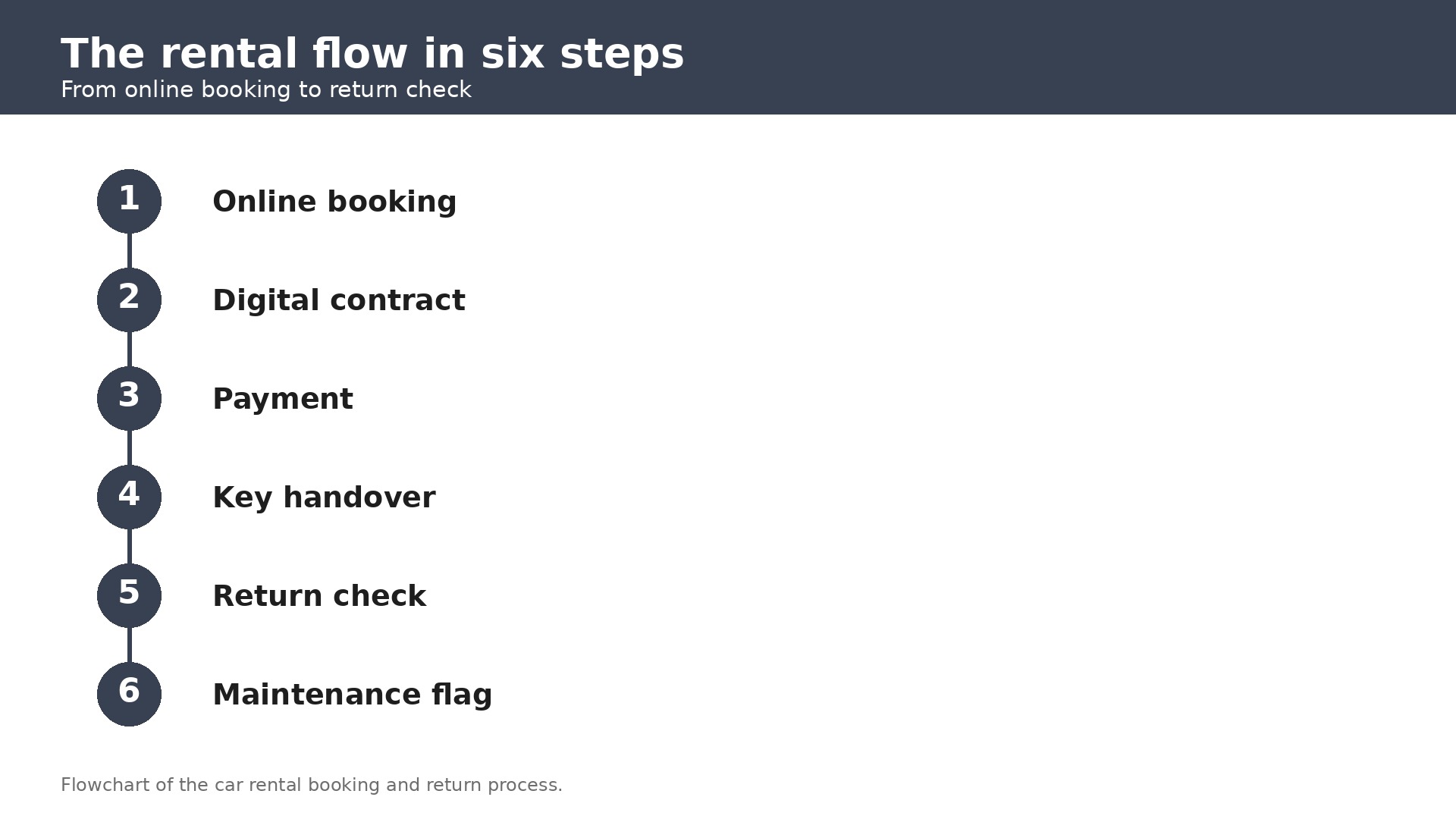
We judged every tool on the five jobs that decide whether a small rental business runs smoothly. First, online booking must show real availability and take a reservation without a phone call, because a customer who cannot book online books elsewhere. Second, fleet tracking must show which cars are out, which are due back, and which need service, in one view. Third, contracts must be digital, with e-signature and deposits handled in the flow rather than on paper at the counter. Fourth, payments must work online and at pickup without a second system. Fifth, maintenance scheduling must flag a car before it breaks down on a customer.
Pricing transparency counted heavily. Small rental businesses buy software the way they buy tyres, on a number they can read before they commit. Vendors that publish a rate card scored better than vendors that insist on a sales call, and vendors that charge per vehicle were judged on what a 10 car fleet actually pays, not on the cheapest per vehicle figure. Free plans and free trials scored higher, because a business should be able to test a system with its real fleet before paying.
We also weighted fleet size fit. A tool built for 200 cars is a bad fit for a 8 car agency, and a tool built for 5 cars will break at 50. This guide states the fleet size each tool fits plainly. Features such as GPS tracking, toll management, and API access were treated as useful extras, not as reasons to pick a platform on their own.
The best car rental software for small businesses at a glance
The table below gives the whole field in one view. Use it to cut the list to three candidates, then read the full reviews of those three before you book a demo. Note that per vehicle pricing looks cheap until you multiply it by your fleet, so the starting prices below are the entry point, not the final bill.
| Tool | Starting price | Best for | Watch out |
|---|---|---|---|
| HQ Rental Software | From $120 a month for 10 vehicles | Small to mid fleets wanting a proven system | Ticket based support on lower tiers |
| Fleetwire | From $34 a month for 5 vehicles | Solo operators and fleets under 15 cars | Very small team and review footprint |
| Car Rental Solutions | From $69.95 a month | US independents wanting website plus back office | $197 one time setup fee |
| RentSyst | From 55 euros a month for 15 vehicles | Multi branch operators preferring per vehicle pricing | Euro pricing, per vehicle rate falls with scale |
| Nomora | From 40 euros a month | Growing independents wanting all inclusive pricing | Newer product, smaller review base |
| Rent Centric | Quote only | Loaner, car sharing, and multi vehicle operators | Least pricing transparency on this list |
| TSD RENTAL | Quote only | Dealership loaner programs | No published price, dealer focus |
| VEVS | From 80 euros a month | Rental website and management in one | Euro pricing, website focus |
The 8 tools, reviewed in detail
Each review below states the price first, then the strengths, then the honest limits. Read the pick it when and skip it when lines as the verdict. If a tool matches your fleet size and your rental model, it belongs on your shortlist even if it sits low in this list.
1. HQ Rental Software
HQ Rental Software charges by fleet size. The Basic plan costs $120 a month for up to 10 vehicles, Standard costs $175 a month for 25 vehicles, and Professional costs $250 a month for 50 vehicles, with custom pricing above that. A 7 day free trial is available, and the platform holds 316 Capterra reviews at a 4.9 star average as of July 2026, the largest review base in this category.
HQ Rental is the incumbent in this category, and the review record shows it. The platform manages the full rental workflow from booking to final invoice, with online booking, digital agreements, payments, and maintenance scheduling in one system. The feature set is broad, the platform is proven with small to mid size fleets, and the customer self service tools reduce counter work. For a business that wants the safest choice, HQ is the obvious pick.
The price is higher than the budget tools, at $120 a month for 10 vehicles against $34 a month for Fleetwire at 5 vehicles. Support on lower tiers is ticket based rather than phone, which can frustrate an owner with a car due out in an hour. The interface is also older than the newest tools, and some features that look standard sit on higher tiers.
Pick it when you run a small to mid size fleet and want the most proven platform in the category, with the largest review record behind it. Skip it when you run under 10 cars on a tight budget, or you need phone support on the cheapest plan.
2. Fleetwire
Fleetwire starts at $34 a month for up to 5 vehicles, with $89 a month for up to 15 vehicles and $279 a month for up to 150 vehicles, with lower prices on yearly billing. Some listings show $24 a month for 5 vehicles on annual billing. A 14 day free trial is available, and the platform includes Turo calendar sync and a fee calculator on the budget plans.
Fleetwire is the cheapest credible option for a very small fleet. For $34 a month, a solo operator gets online booking, fleet tracking, digital contracts, and payments, with Turo calendar sync that matters for hosts who rent on Turo as well as direct. The setup is fast, the pricing is published and simple, and the tool is built for the operator who runs the business themselves.
Fleetwire is a very small team with a tiny review footprint, with only a handful of reviews on G2 and Trustpilot, so there is less public evidence about long term reliability than for HQ Rental. The feature set is thinner than the mid market tools, with less depth in multi branch management and API access. A business that grows past 50 cars will likely need to move.
Pick it when you run 5 to 15 cars on your own and want the cheapest credible system with Turo sync included. Skip it when you need a large review track record, multi branch tools, or deep API access.
3. Car Rental Solutions
Car Rental Solutions starts at $69.95 a month, with tiers at $99.95 a month for 125 units and $179.95 a month for unlimited units. A one time setup fee of $197 applies, and a 14 day free trial is available. The platform combines a booking website and a back office in one product, which suits US independent agencies.
Car Rental Solutions gives a US independent agency a booking website and a back office from one vendor, which removes the need for a separate website builder. The fleet management, booking, and payment tools are solid, the pricing is published and flat by tier, and the platform is built for the way a US agency rents. For an agency that wants its website and its operations in one place, it is a strong pick.
The $197 one time setup fee is an extra cost that the cheapest rivals do not charge, and the platform is US focused, so international operators may find fewer local integrations. The feature set is solid but not the deepest on this list, and the review footprint is smaller than HQ Rental. A business that only needs a back office and already has a website will pay for a website it does not need.
Pick it when you run a US independent agency with under 75 cars and want a booking website and a back office from one vendor. Skip it when you already have a website, or you want to avoid a setup fee.
4. RentSyst
RentSyst starts at 55 euros a month for up to 15 vehicles, with per vehicle pricing from 3.00 euros down to 2.00 euros as the fleet grows. There is no setup fee, and a 14 day free trial is available. The platform suits European operators who prefer per vehicle pricing and multi branch management.
RentSyst is built for multi branch operators who want per vehicle pricing that falls as the fleet grows. The fleet tracking, booking, and payment tools are solid, the pricing is published and transparent, and the platform handles several branches from one account. For a European operator with two or three locations, the branch tools and the per vehicle model are a good fit.
The euro pricing means US operators pay in a foreign currency, and the per vehicle model can get expensive for a large fleet compared with a flat tier. The review footprint is smaller than HQ Rental, and the platform is less well known outside Europe. A business that only has one branch will pay for multi branch tools it does not need.
Pick it when you run a multi branch rental business in Europe and want per vehicle pricing that falls as you grow. Skip it when you run a single branch in the US, or you want flat tier pricing.
5. Nomora
Nomora starts from 40 euros a month all inclusive, with no per booking fees and no per vehicle surcharge on the entry tier. The Business plan costs from 89 euros a month for 35 vehicles included on yearly billing. Setup takes about 24 hours, and the platform includes its own connector for AI assistants since October 2026.
Nomora is the most modern tool on this list, with a clean interface, fast setup, and all inclusive pricing that does not rise when the month gets busy. There are no per booking commissions, which makes the bill predictable, and the online booking portal, automated contracts, and built in payments cover the core jobs well. For a growing independent company that wants a modern system without surprise fees, it is a strong pick.
Nomora is a newer product with a smaller review base than HQ Rental, so there is less public evidence about long term reliability. The platform is European focused, and US operators may find fewer local integrations. The all inclusive model is generous, but a business that only needs the basics may find cheaper options elsewhere.
Pick it when you run a growing independent rental company and want modern all inclusive pricing with no per booking fees. Skip it when you need the largest review track record or US focused integrations.
6. Rent Centric
Rent Centric does not publish pricing and sells by quote, with per vehicle or per user models depending on the deal. Owners should expect a sales conversation and a written quote before they can compare it against anything else. A 15 day free trial is available, and the platform supports more than 40 currencies.
Rent Centric is built for operators who rent more than just cars, including loaner fleets, car sharing, and mixed vehicle types. The platform handles online reservations, billing, rate management, and maintenance in one system, with GPS tracking and mobile self service for customers. The longevity is real, and the platform appears in nearly every roundup in this category. For a dealer loaner program or a car sharing operation, it is a natural fit.
The quote only pricing is the least transparent on this list, which makes it hard for a small business to compare. The platform is built for larger and more complex operations, so a simple 10 car agency pays for depth it will never use. The onboarding is heavier than the self serve tools here.
Pick it when you run a loaner program, a car sharing service, or a mixed vehicle fleet and need a platform built for that model. Skip it when you run a simple car rental agency or need a published price before you talk to sales.
7. TSD RENTAL
TSD RENTAL does not publish pricing and sells by quote. Owners should expect a sales conversation and a written quote before they can compare it against anything else. The platform is built for dealership loaner programs and rental operations tied to a dealer.
TSD RENTAL is built for dealerships, and that focus is its strength. The platform handles loaner fleets, service rentals, and dealer operations with tools that generic car rental software does not offer, including integration with dealer management systems. For a dealership that runs a loaner fleet alongside service, the fit is better than any general tool on this list.
The quote only pricing makes it impossible to compare without a sales call, and the dealer focus means a standalone rental agency will find less fit. The platform is also heavier than the self serve tools, with a longer onboarding. A small independent agency should look elsewhere.
Pick it when you run a dealership loaner program and want software built for dealer operations. Skip it when you run a standalone rental agency or need a published price.
8. VEVS
VEVS starts at 80 euros a month, with a 7 day free trial. The platform combines a rental website and management software in one setup, with a booking engine, dynamic pricing, customer records, and online payments included. Owners should confirm the current plan structure before budgeting, because the tiers are split by features.
VEVS gives a rental business a website and management software in one product, which suits an operator who wants to launch quickly without a separate website builder. The booking engine is solid, the dynamic pricing tools help a small fleet earn more on busy days, and the customer records and payment tools cover the core jobs. For a business that needs a website first and a back office second, it is a good fit.
The 80 euro starting price is higher than Fleetwire or Nomora, and the euro pricing means US operators pay in a foreign currency. The 7 day trial is short compared with the 14 day trials elsewhere, which gives a business less time to test properly. The back office depth is also thinner than HQ Rental.
Pick it when you want a rental website and management software in one setup and are willing to pay 80 euros a month for it. Skip it when you already have a website, or you want the cheapest back office option.
Which One Fits Your Shop
The best car rental software for small businesses depends on fleet size and rental model. Match your job to the pick below and you will shortlist faster than reading every review in order.
| Your job | Best pick | Why it wins |
|---|---|---|
| 5 car operation, direct bookings | Fleetwire | From $34 a month, Turo sync included |
| US independent, under 75 cars | Car Rental Solutions | Website plus back office from $69.95 a month |
| Small to mid fleet, proven system | HQ Rental Software | Largest review base, 4.9 stars on Capterra |
| Growing independent, no per booking fees | Nomora | All inclusive from 40 euros a month |
| Multi branch in Europe | RentSyst | Per vehicle pricing from 55 euros a month |
| Dealership loaner program | TSD RENTAL | Built for dealer operations |
What the Bill Looks Like
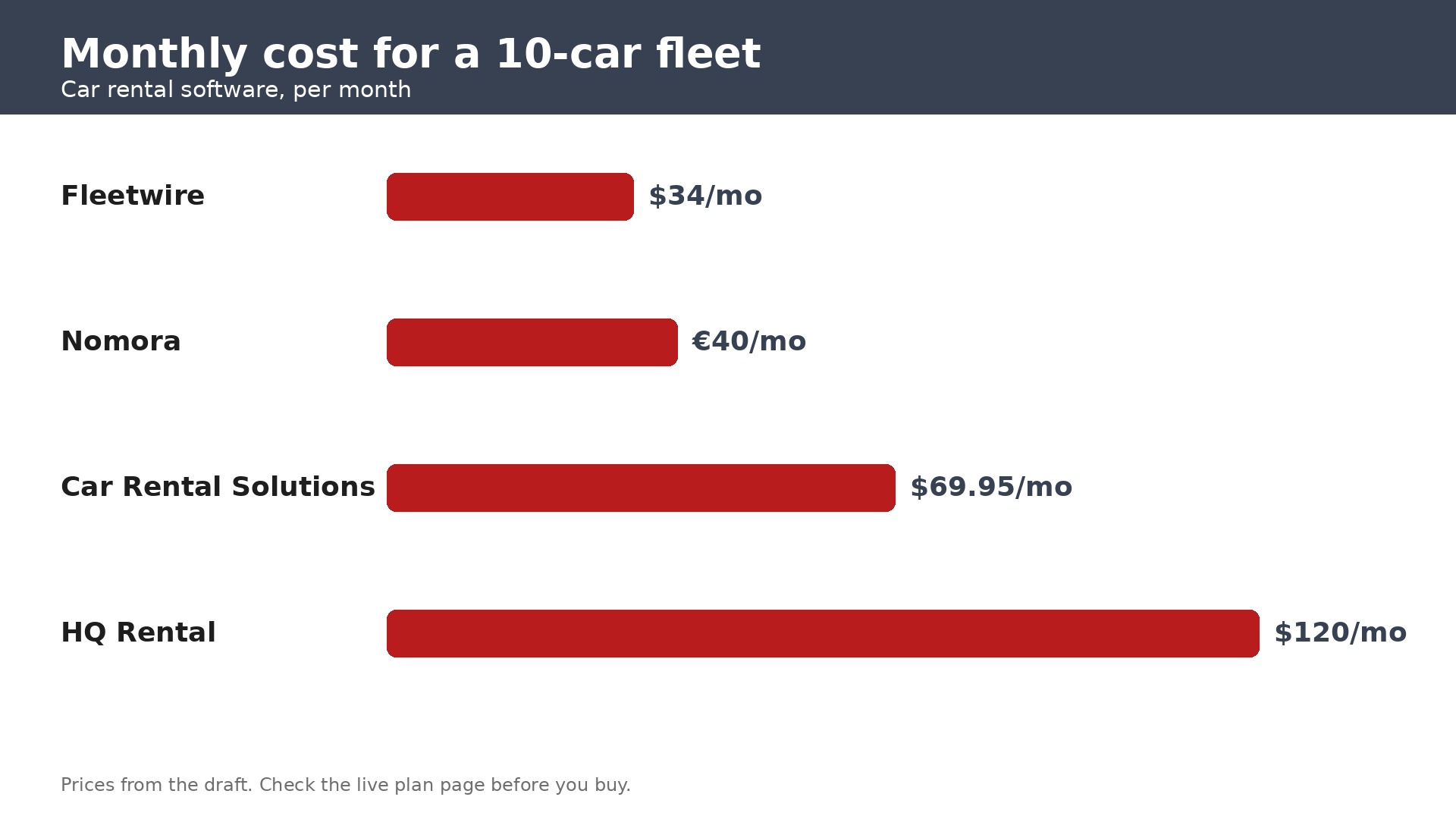
A 10 car fleet should budget $34 to $120 a month for software. Fleetwire costs $34 a month for 5 vehicles and $89 a month for 15, Car Rental Solutions costs $69.95 a month plus a $197 setup fee, Nomora costs from 40 euros a month, and HQ Rental costs $120 a month for 10 vehicles. RentSyst costs 55 euros a month for 15 vehicles, VEVS costs 80 euros a month, and Rent Centric and TSD RENTAL are quote only. Always calculate the cost at your real fleet size, because per vehicle pricing rises with every car you add.
The hidden costs are the setup fees, the per booking commissions, and the payment processing. Car Rental Solutions charges a $197 setup fee, Nomora charges no per booking fees, and most tools pass card processing of about 3 percent through separately. Always ask for a 12 month total that includes setup, subscription, and processing, then compare that number across vendors.
The math that justifies the spend is utilisation. A 10 car fleet that lifts utilisation from 60 percent to 70 percent earns an extra car day every day, which is worth far more than $100 a month in software. A system that shows real availability online, takes bookings without a phone call, and flags late returns before the next customer arrives pays for itself in the first month. Judge the software on the utilisation it protects, not on the price alone.
Five Expensive Missteps
- Buying software built for 200 cars when you run 10. Enterprise tools charge for multi branch and API features a small fleet will never use, and the setup time alone can cost more than a year of a simpler tool.
- Ignoring the per booking fee. A tool with no monthly fee but a percentage on every booking costs more than a $34 subscription once volume grows. Read the fee structure before you compare headline prices.
- Choosing a system without real availability online. If the website shows a car as available when it is already booked, the business loses a customer and gains a complaint. Test the booking flow with a real car before you commit.
- Skipping the digital contract test. A contract that still needs printing at the counter wastes the time the software was meant to save. Test e-signature and deposits in the trial, with a real customer if possible.
- Forgetting maintenance in the decision. A car that breaks down on a customer costs a refund, a review, and a tow. A system that flags service dates before the car goes out is worth more than a pretty booking page.
What good looks like after 90 days
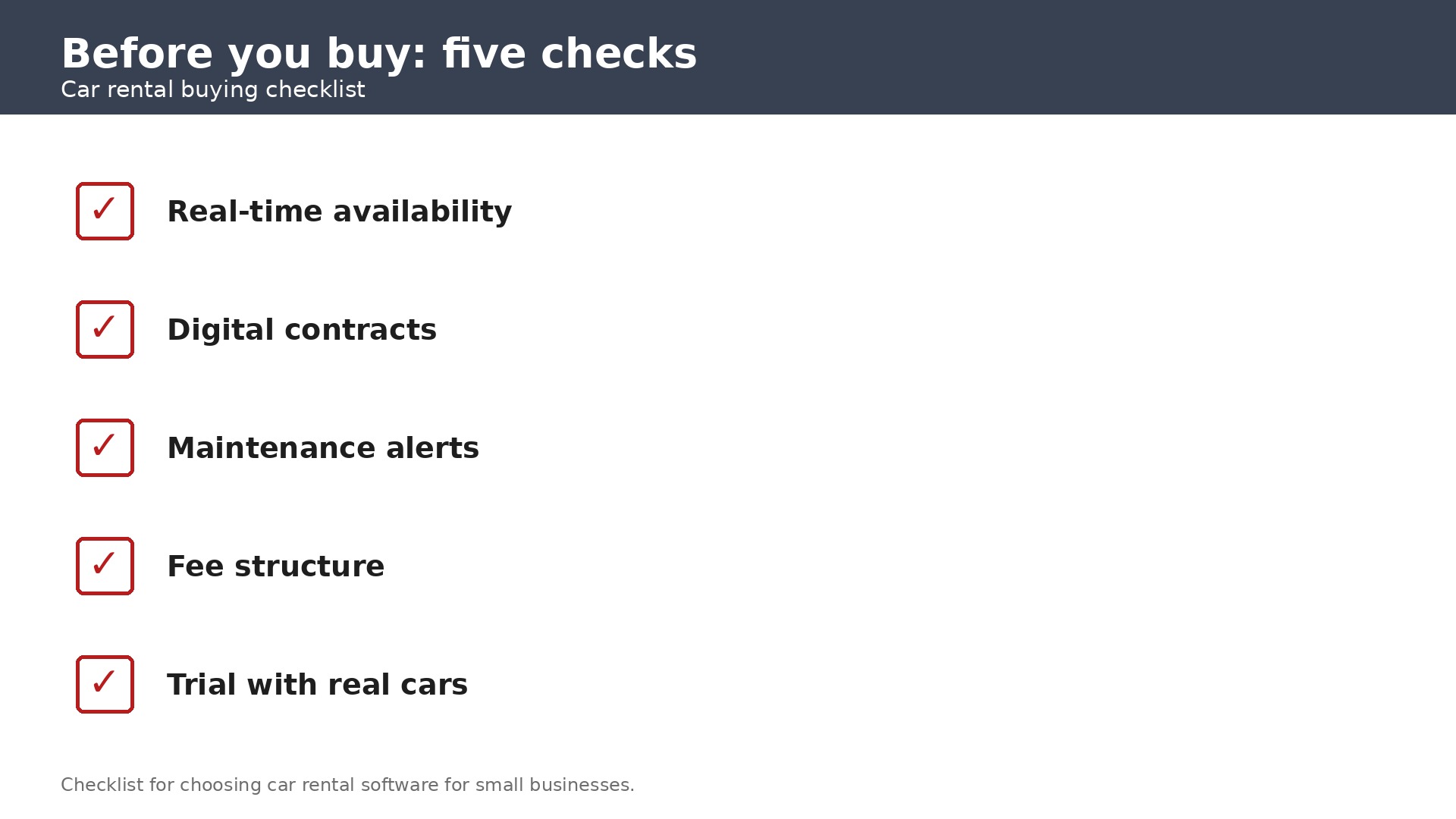
After 90 days on the right system, a small rental business should be able to answer five questions in under a minute. Which cars are out, which are due back, and which need service. What the utilisation rate was last month and which cars earned the least. How many bookings came direct and how many came through a channel. Which customers are late and what they owe. And what the fleet will earn next month at current booking pace. If the software cannot answer those questions, it is a booking form, not a management system.
The first month is the hardest, because the fleet data is empty and the habit is new. Load every car, every rate, and every existing booking on day one, even if it takes an afternoon. A half loaded system tells you nothing, and the team will stop trusting it. By the second month, the reports start to work, because the data is finally there. By the third month, the business has a real picture of utilisation, and that picture is worth more than the subscription cost many times over.
The best car rental software for small businesses earns its keep in the quiet moments, not in the demos. It is the late return flagged before the next customer arrives, the service date that appears before the car breaks down, and the direct booking that arrives without a phone call. Pick the tool that makes those moments easy, and the rest of the features will take care of themselves. A system the counter team actually uses every day beats a powerful system they avoid, so choose the one your team will open first each morning.
Frequently Asked Questions
How much does car rental software cost for a small business?
A 10 car fleet pays $34 to $120 a month. Fleetwire costs $34 a month for 5 vehicles, Car Rental Solutions costs $69.95 a month plus a $197 setup fee, Nomora costs from 40 euros a month, and HQ Rental costs $120 a month for 10 vehicles. RentSyst costs 55 euros a month for 15 vehicles and VEVS costs 80 euros a month. Rent Centric and TSD RENTAL are quote only. Add about 3 percent for card processing before you compare headline prices.
What is the best car rental software for small businesses in 2026?
The best car rental software for small businesses depends on fleet size and rental model. Fleetwire wins for fleets under 15 cars, Car Rental Solutions wins for US independents wanting a website and back office, HQ Rental wins for the most proven platform, and Nomora wins for all inclusive pricing with no per booking fees. Shortlist three tools that match your fleet size, trial them with real cars and real bookings, and pick the one your counter team actually enjoys using.
Do I need car rental software for just five cars?
Yes, if you take online bookings or list on Turo. A five car operation can run on spreadsheets, but the moment a customer books online while another customer is at the counter, the spreadsheet is wrong. Software shows real availability, takes digital contracts, and tracks maintenance, and those three jobs save more time than the $34 a month Fleetwire costs. A small fleet benefits more from software than a large one, because there is no spare staff to fix mistakes.
What is the cheapest car rental software for a small business?
Fleetwire starts at $34 a month for 5 vehicles, which is the cheapest credible option on this list. Nomora starts from 40 euros a month with no per booking fees, and Car Rental Solutions starts at $69.95 a month. Some tools offer a free tier for 2 vehicles, but a free tier is only useful for a hobby fleet. Budget for at least $34 a month and treat it as an operating cost like insurance or cleaning.
How do I avoid double bookings in car rental software?
Use a system with real time availability and a booking engine that closes a car the moment it is reserved. Every tool on this list includes fleet tracking, and the booking engine should sync with Turo and your own website. Test the sync with a real booking during your trial, and never manage availability by hand across two systems. A double booking costs a refund and a review, and it is the easiest failure to prevent.
Should a small car rental business pay per vehicle or a flat monthly fee?
Per vehicle pricing suits a very small fleet, because a 5 car business pays far less than a 50 car business on the same system. Flat pricing suits a growing fleet, because the bill does not rise every time you add a car. Compare the 12 month total for your actual fleet size, and check whether the per vehicle plan includes digital contracts and payments or charges them as extras.