
AI image tools now charge by subscription, by credit, or by image, and the same picture can cost 1 cent on one tool and 13 cents on another. A 10 dollar plan with about 200 images costs about 5 cents per image, while a 30 dollar plan with unlimited slow generation costs far less per image if you generate every day. Ai image generator pricing is the subject of this guide, with real prices, real limits, and real worked examples for a small business.
This guide compares seven leading image tools with the real prices checked in October and November 2026, including free credits, per image costs, commercial terms, and the premium features that burn credits faster than the headline rate suggests. Use the comparison table to find the cheapest tool for your volume.
Prices change often, so treat every figure here as a snapshot from late 2026 and confirm the current price on the vendor site before you buy. The comparisons in this guide stay useful even when a price moves, because the billing model, the caps, and the hidden fees change far more slowly than the headline number.
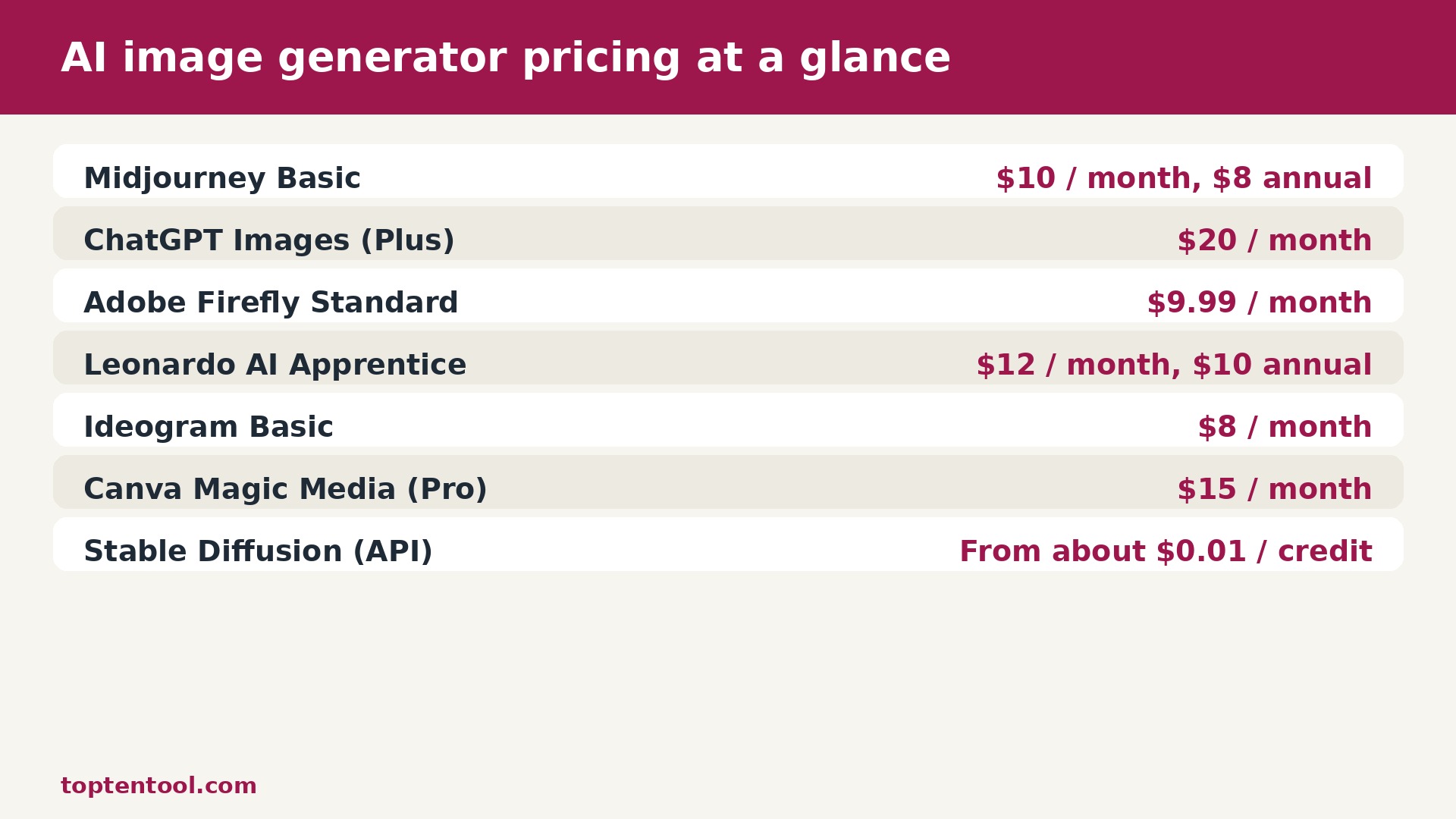
AI image generator pricing at a glance
| Tool | Free tier | Starting paid price | What the price covers | Hidden fees and watch out |
|---|---|---|---|---|
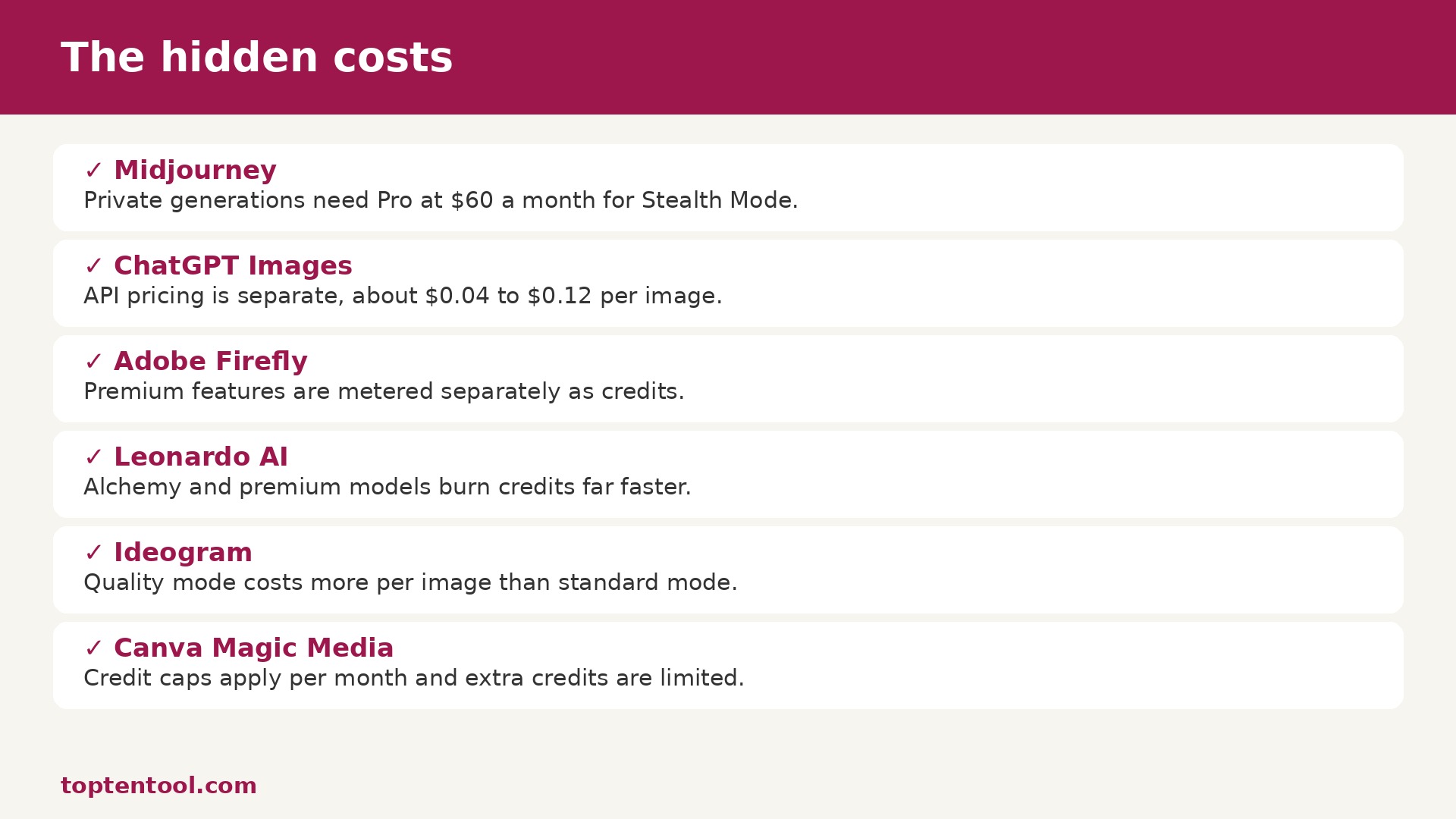
| Midjourney | No free tier | 10 dollars a month for Basic, 8 dollars on annual billing | Basic with about 200 images, Standard at 30 dollars adds unlimited Relax | Private generations need Pro at 60 dollars a month for Stealth Mode |
| ChatGPT Images | Limited image generation on the free ChatGPT plan | 20 dollars a month for ChatGPT Plus | Plus with much higher image limits plus the chatbot itself | API pricing is separate at about 0.04 to 0.12 dollars per image |
| Adobe Firefly | Free plan with 25 credits a month | 9.99 dollars a month for Standard | Standard with generative credits and unlimited standard images on paid plans | Premium features are metered separately as credits |
| Leonardo AI | Free plan with 150 credits a day | 12 dollars a month for Apprentice, 10 dollars on annual billing | Apprentice with 8500 credits, Artisan at 24 dollars with 25000 credits | Alchemy and premium models burn credits far faster |
| Ideogram | Free plan with 10 generations a day | 8 dollars a month for Basic, Plus at 20 dollars a month | Basic with more generations and faster queues | Quality mode costs more per image than the standard mode |
| Canva Magic Media | Free Canva with 50 Magic Media credits | 15 dollars a month for Canva Pro, 120 dollars a year | Pro with Magic Media, brand kit, and design tools in one place | Credit caps apply per month and extra credits are limited |
| Stable Diffusion | Open weights are free to download | Pay as you go from about 0.01 dollars per credit on APIs | API generations with no monthly subscription required | Self hosting needs a GPU, and cloud costs vary by model |
Read the table across, not down, because the cheapest starting price is not always the cheapest total. A tool with a free tier and a low starting price can cost more at scale if it bills per seat or per resolution, while a tool with a higher starting price can cost less if it bills per workspace or per month with no per seat charge.
When you compare AI image generator pricing, start with your real volume from last month, not with the volume you hope to reach next year. The right plan is the one that fits today and still leaves room to grow without a sudden jump in price.
How AI image pricing actually works
Most tools in this category use one of three billing models, which are per seat, per volume, or flat per month. Per seat pricing multiplies with every new team member, per volume pricing multiplies with every new customer or message, and flat pricing stays steady until you hit a cap. The model matters more than the number, because a 20 dollar flat plan can beat a 10 dollar per seat plan once the team reaches three people.
Free tiers are real, but they are limited in ways that matter. A free plan may allow only 50 conversations, 250 contacts, 100 prompts, or 25 credits a month, and it may block the feature you need most, such as automation, private generations, or paid subscriptions. Use the free tier to test the tool with real work, and check the upgrade price on the first day, not the day you hit the limit.
Annual billing saves 15 to 25 percent on most tools, but it locks you in for a year. Monthly billing costs more, yet it lets you leave after one month if the tool does not fit. For a new tool, pay monthly for the first month, then switch to annual only when you are sure the tool will still fit in six months.
The headline price in AI image generator pricing rarely tells the whole story, because seats, volume, and AI use are billed in different ways. Add those three lines together before you compare any two tools side by side.
Midjourney
Midjourney starts at 10 dollars a month for Basic, 8 dollars on annual billing. The free tier is no free tier, and the paid plan covers basic with about 200 images, standard at 30 dollars adds unlimited relax. That combination suits artistic and editorial images where style matters most, and it is worth testing with a real week of work before you commit to a yearly deal.
The watch out with Midjourney is private generations need pro at 60 dollars a month for stealth mode. Check that line against your real volume from last month, because a cap or an extra charge that looks small on the pricing page can add 50 dollars or more to a busy month. Ask the vendor for a written total at your exact volume, including seats, volume, and add ons, before you sign up.
ChatGPT Images
ChatGPT Images starts at 20 dollars a month for ChatGPT Plus. The free tier is limited image generation on the free chatgpt plan, and the paid plan covers plus with much higher image limits plus the chatbot itself. That combination suits conversational prompting and fast edits in chat, and it is worth testing with a real week of work before you commit to a yearly deal.
The watch out with ChatGPT Images is api pricing is separate at about 0.04 to 0.12 dollars per image. Check that line against your real volume from last month, because a cap or an extra charge that looks small on the pricing page can add 50 dollars or more to a busy month. Ask the vendor for a written total at your exact volume, including seats, volume, and add ons, before you sign up.
Adobe Firefly
Adobe Firefly starts at 9.99 dollars a month for Standard. The free tier is free plan with 25 credits a month, and the paid plan covers standard with generative credits and unlimited standard images on paid plans. That combination suits creative teams that need commercially safe images, and it is worth testing with a real week of work before you commit to a yearly deal.
The watch out with Adobe Firefly is premium features are metered separately as credits. Check that line against your real volume from last month, because a cap or an extra charge that looks small on the pricing page can add 50 dollars or more to a busy month. Ask the vendor for a written total at your exact volume, including seats, volume, and add ons, before you sign up.
Leonardo AI
Leonardo AI starts at 12 dollars a month for Apprentice, 10 dollars on annual billing. The free tier is free plan with 150 credits a day, and the paid plan covers apprentice with 8500 credits, artisan at 24 dollars with 25000 credits. That combination suits game art and consistent characters, and it is worth testing with a real week of work before you commit to a yearly deal.
The watch out with Leonardo AI is alchemy and premium models burn credits far faster. Check that line against your real volume from last month, because a cap or an extra charge that looks small on the pricing page can add 50 dollars or more to a busy month. Ask the vendor for a written total at your exact volume, including seats, volume, and add ons, before you sign up.
Ideogram
Ideogram starts at 8 dollars a month for Basic, Plus at 20 dollars a month. The free tier is free plan with 10 generations a day, and the paid plan covers basic with more generations and faster queues. That combination suits posters and logos where text must read correctly, and it is worth testing with a real week of work before you commit to a yearly deal.
The watch out with Ideogram is quality mode costs more per image than the standard mode. Check that line against your real volume from last month, because a cap or an extra charge that looks small on the pricing page can add 50 dollars or more to a busy month. Ask the vendor for a written total at your exact volume, including seats, volume, and add ons, before you sign up.
Canva Magic Media
Canva Magic Media starts at 15 dollars a month for Canva Pro, 120 dollars a year. The free tier is free canva with 50 magic media credits, and the paid plan covers pro with magic media, brand kit, and design tools in one place. That combination suits non designers who want images inside real designs, and it is worth testing with a real week of work before you commit to a yearly deal.
The watch out with Canva Magic Media is credit caps apply per month and extra credits are limited. Check that line against your real volume from last month, because a cap or an extra charge that looks small on the pricing page can add 50 dollars or more to a busy month. Ask the vendor for a written total at your exact volume, including seats, volume, and add ons, before you sign up.
Stable Diffusion
Stable Diffusion starts at Pay as you go from about 0.01 dollars per credit on APIs. The free tier is open weights are free to download, and the paid plan covers api generations with no monthly subscription required. That combination suits developers who want full control and api pipelines, and it is worth testing with a real week of work before you commit to a yearly deal.
The watch out with Stable Diffusion is self hosting needs a gpu, and cloud costs vary by model. Check that line against your real volume from last month, because a cap or an extra charge that looks small on the pricing page can add 50 dollars or more to a busy month. Ask the vendor for a written total at your exact volume, including seats, volume, and add ons, before you sign up.
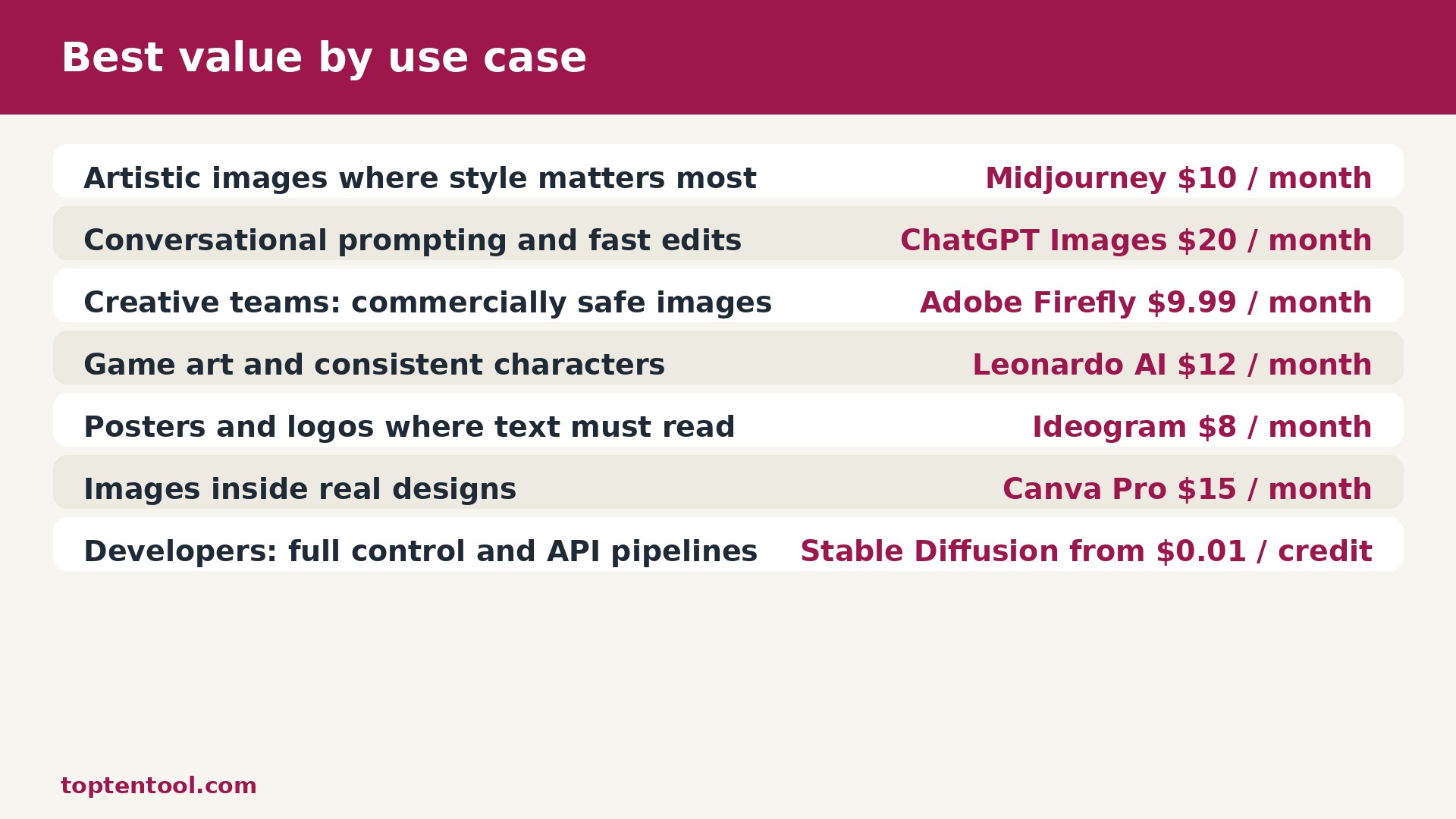
Best Value by Use Case
| Use case | Cheapest pick | Price |
|---|---|---|
| Artistic and editorial images where style matters most | Midjourney | 10 dollars a month for Basic, 8 dollars on annual billing |
| Conversational prompting and fast edits in chat | ChatGPT Images | 20 dollars a month for ChatGPT Plus |
| Creative teams that need commercially safe images | Adobe Firefly | 9.99 dollars a month for Standard |
| Game art and consistent characters | Leonardo AI | 12 dollars a month for Apprentice, 10 dollars on annual billing |
| Posters and logos where text must read correctly | Ideogram | 8 dollars a month for Basic, Plus at 20 dollars a month |
| Non designers who want images inside real designs | Canva Magic Media | 15 dollars a month for Canva Pro, 120 dollars a year |
| Developers who want full control and API pipelines | Stable Diffusion | Pay as you go from about 0.01 dollars per credit on APIs |
The table above picks by job, not by price alone, because the cheapest tool for a solo writer is rarely the cheapest tool for a five person team. Match the use case to your own work first, then read the price, and you will avoid the most common mistake in this category, which is buying a team plan for solo work or a solo plan for team work.
A free tier can be the smartest way to test AI image generator pricing for a small team, as long as you know what happens when you hit the limit. Check the upgrade price on day one, so the free start does not turn into a surprise bill.
1,000 Units, Priced Honestly
Work out the cost at 1000 units, whether that means 1000 conversations, 1000 contacts, 1000 images, or 1000 words of output, because that is the volume where free tiers end and real bills begin. Add the base plan, the per unit charge, and the add ons you will actually use, and write the total down. A tool that costs 20 dollars at 100 units and 200 dollars at 1000 units is not a bad tool, but it is a tool you should choose with open eyes.
Test the worked example with your own numbers. Take last month volume, multiply it by the per unit price, add the base plan, and compare the total across three tools. The result often surprises buyers, because the tool with the highest starting price can be the cheapest at high volume, and the tool with the lowest starting price can be the most expensive once seats and AI charges are added.
Many buyers overpay on AI image generator pricing by choosing a plan for features they will not use for six months. Pick the plan that covers the next 90 days, and upgrade when the work actually needs the next tier.
The Hidden Costs
Per seat charges are the most common hidden cost. A plan that costs 19 dollars per agent a month costs 95 dollars a month for five agents, and 190 dollars for ten. A plan that costs 45 dollars per workspace a month costs the same for two seats or four seats, which makes it far cheaper for a small team that grows.
Per resolution and per credit charges are the second hidden cost. An AI agent that costs 0.99 dollars per resolution adds 99 dollars for 100 resolved conversations, and a premium image model that burns credits twice as fast doubles the real cost per image. Check the cap on your plan and the price of extra units before you launch.
Annual versus monthly billing is the third hidden cost. A plan listed at 12 dollars a month on annual billing can cost 30 dollars a month on monthly billing, which is a 150 percent jump. The annual price is the one vendors advertise, and the monthly price is the one you pay if you want flexibility.
Add ons for WhatsApp, SMS, advanced automation, and premium features are the fourth hidden cost. A chat tool may charge extra for WhatsApp, an email tool may charge extra for SMS, and an image tool may charge extra for premium models. List the add ons you need before you compare prices, or the comparison will miss the real bill.
If you are shortlisting tools by AI image generator pricing, ask each vendor for the total monthly cost at your exact volume, including seats, AI use, and add ons. A written total beats a pricing page every time.
How to Decide by Tonight
Spend the morning listing your real volume, your team size, and the one feature you cannot work without. Spend the afternoon testing two tools with real work, not with a demo, and time how long each task takes. By evening you will know which tool fits, which plan fits, and what the real monthly total will be at your volume.
Ask three questions before you pay. First, what is the total monthly cost at my exact volume, including seats and AI use. Second, what happens when I hit the cap, and how much do extra units cost. Third, how do I export my data if I leave. A vendor that answers all three clearly is a vendor you can trust with your work.
The best value in AI image generator pricing is not always the lowest price, because a tool that saves two hours a week is worth more than a tool that saves ten dollars a month. Measure time saved as carefully as money spent.
What We Would Pick for a Small Business
For most small businesses, the best value is a tool with a genuine free tier, a flat or workspace price, and a clear upgrade path, because that combination keeps the first year cheap and the second year predictable. Avoid quote only tools unless you have enterprise volume, and avoid per resolution pricing unless you have measured your resolution volume first.
Before you sign a yearly deal based on AI image generator pricing, try the monthly price for one month with real work. Annual billing saves money only when you are sure the tool will still fit in six months.
The final test is simple. Run the tool for 30 days with real work, compare the time saved and the money spent with the month before, and keep the tool only if both numbers improved. A good tool pays for itself in hours saved, not just in dollars saved, and that is the number that matters most for a small business.
Read the plan limits as carefully as the headline price. Word caps, contact caps, credit caps, and seat caps are where most bills surprise people. A plan that allows 5000 emails a month is not the same as a plan that allows 5000 contacts, and a plan with 100 AI prompts is not the same as unlimited use. Match the limit to your real volume from last month, not to your hopes for next year.
Support quality matters more than feature count when something breaks at 9 pm. Test support before you need it by asking one real question during the trial and timing the reply. A clear answer in an hour beats a long feature list with no one to call. Check the help centre too, because good docs save more time than good chat support over a year.
Make one person the owner of the move. That person keeps the checklist, answers questions, and decides when a step is done. Without an owner, tasks drift, two people fix the same problem, and nobody fixes the real one. The owner does not need to do every step, but they need to know the status of every step at any moment.
Plan the announcement as carefully as the technical move. Customers, readers, and supporters need to know what changed, what stayed the same, and what they need to do, if anything. A short message sent twice beats a long message sent once. Tell people before the change, not after, and give them a place to ask questions.
Measure the result 30 days after the move. Compare the same numbers you measured before, such as time per task, cost per month, open rate, or sales per week. If the numbers improved, keep going. If they did not, find the one step that failed and fix it before you blame the tool. A move is only a success when the numbers say so.
Keep the old account readable for at least a month after the move. Old comments, old invoices, old posts, and old messages are hard to recreate once the account is closed. Set a calendar reminder for the closing date, check that nothing important is left behind, and only then cancel. A quiet month of overlap costs little and prevents a painful loss.
Start with a small test before you commit the whole team or the whole budget. A one week trial with real work, real customers, and real deadlines tells you more than any demo video. Write down what felt fast, what felt slow, and what needed a workaround. If the test saves time on the second day, the tool is probably a fit. If the test creates new work, the tool is probably not ready for your team yet.
Budget for the second year, not just the first month. Introductory discounts, free trials, and first year deals all end, and the regular price is the price you will live with. Add the cost of extra seats, extra volume, and the add ons you will actually use. A tool that looks cheap at 20 dollars a month can cost 80 dollars a month once the team grows and the limits bite.
Check who owns the data before you sign up. Export a sample file on day one, open it, and confirm that names, dates, amounts, and notes are all there. If export is hard, slow, or missing fields, treat that as a warning. The best tools make it easy to leave, because they know good work keeps customers, not locked doors.
Talk to the people who will use the tool every day, not just the person who pays the bill. A finance lead cares about reports, a support lead cares about speed, and a creator cares about how the page looks to fans. Ask each group for one must have feature and one deal breaker. When those lists agree, the choice is easy. When they conflict, pick the tool that serves the daily user first.
Keep a simple log during the first month. Note the date, the task, the time it took, and any error or surprise. After 30 days the log shows the real cost in hours, not the promised cost in marketing copy. Share the log with the team and ask what to keep, what to change, and what to drop. Small fixes in week two prevent big frustration in month three.
Do not move everything at once if you can move in stages. Pick the smallest group, the quietest week, or the least risky project and move that first. Learn from the first move, fix the template, and then move the next group with a better plan. Staged moves feel slower on paper, but they protect revenue, reputation, and sleep.
Read the plan limits as carefully as the headline price. Word caps, contact caps, credit caps, and seat caps are where most bills surprise people. A plan that allows 5000 emails a month is not the same as a plan that allows 5000 contacts, and a plan with 100 AI prompts is not the same as unlimited use. Match the limit to your real volume from last month, not to your hopes for next year.
Support quality matters more than feature count when something breaks at 9 pm. Test support before you need it by asking one real question during the trial and timing the reply. A clear answer in an hour beats a long feature list with no one to call. Check the help centre too, because good docs save more time than good chat support over a year.
Make one person the owner of the move. That person keeps the checklist, answers questions, and decides when a step is done. Without an owner, tasks drift, two people fix the same problem, and nobody fixes the real one. The owner does not need to do every step, but they need to know the status of every step at any moment.
Frequently Asked Questions
What is the cheapest way to start?
Start on a genuine free tier with real work for two weeks, then move to the lowest paid plan that covers your volume. Pay monthly for the first month, and switch to annual billing only when you are sure the tool fits. That path keeps the first month near zero and avoids a yearly lock in.
Why do two tools with the same price cost different amounts?
Because they bill different things. One tool may bill per seat, another per conversation, and a third per month with no per seat charge. Add seats, volume, and AI charges together at your real volume, and the true total becomes clear.
Are free tiers really free?
Yes, for the limits they state, which are usually 50 conversations, 250 contacts, 100 prompts, or a small number of credits a month. Free tiers block some features, such as automation or private output, so check the limit and the upgrade price before you build your work around a free plan.
Should I pay annually or monthly?
Pay monthly for the first month to test the tool, then pay annually if you are sure it fits and the saving is at least 15 percent. Annual billing saves money only when you stay for the full year, and a tool that does not fit is expensive at any price.
What hidden fees should I check first?
Check per seat charges, per resolution or per credit charges, the monthly billing penalty, and add ons for WhatsApp, SMS, or premium features. Ask the vendor for a written total at your exact volume before you sign up.
How often do prices change?
Prices in this category change often, sometimes twice a year, and vendors rarely warn existing customers in advance. Check the vendor pricing page before you buy, and budget for a 10 to 20 percent rise in the second year.