Vagaro and GlossGenius look almost identical on a pricing page, and they cost almost the same per month, yet a five chair salon pays hundreds of dollars more a year on one of them than the other. The difference is not the subscription. It is the card fee, the per staff charge, and the commission on new clients, and none of those numbers sit on the headline price. The best salon booking software is the one whose total bill stays low when the chairs are full, not the one with the cheapest first month.
We compared 10 tools on published pricing pages, processing rates, marketplace commissions, and the limits that decide what a salon actually pays. Prices in this guide were checked in November 2026, and you should confirm the price on the checkout page before you pay, because vendors change list prices and promotions often.
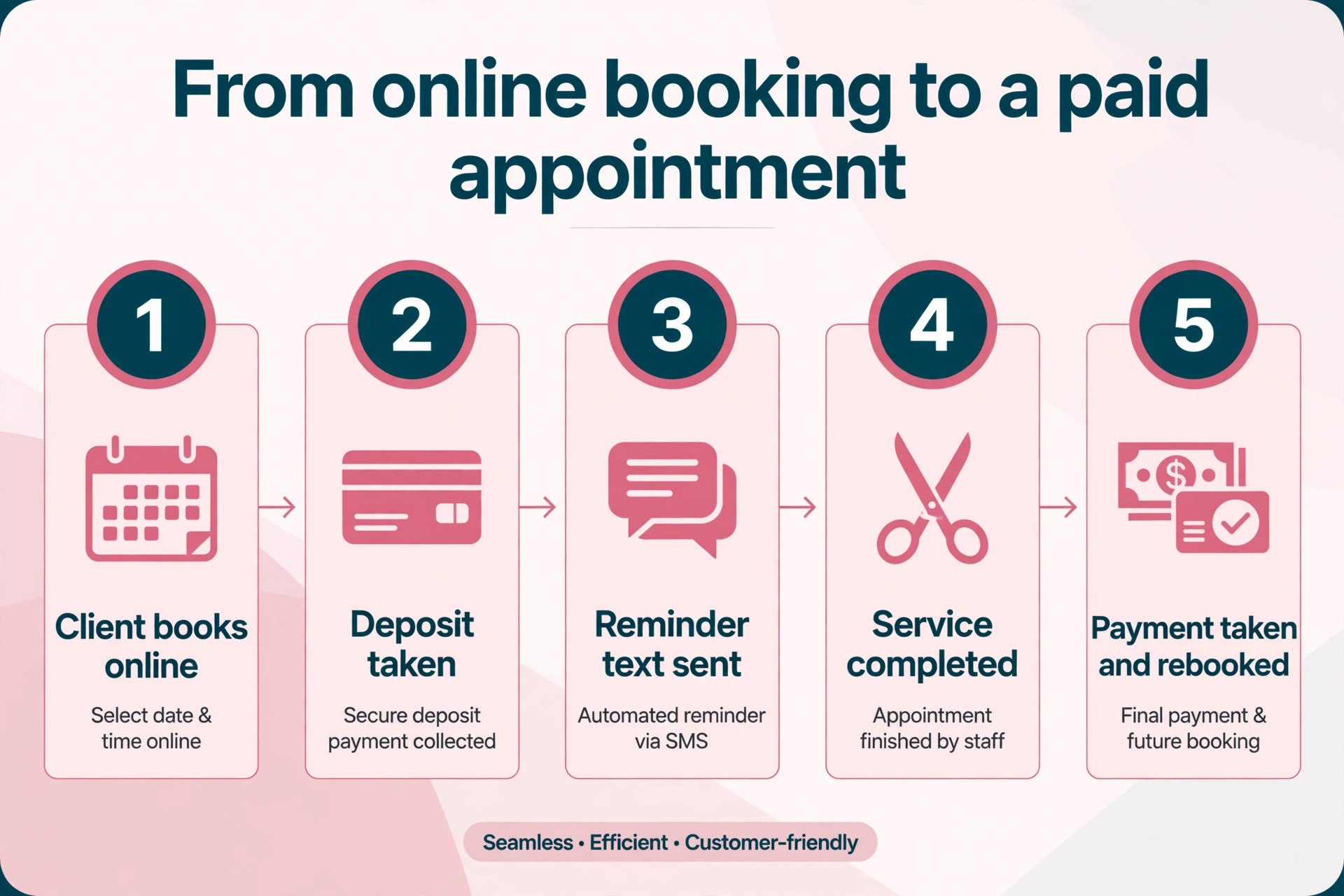
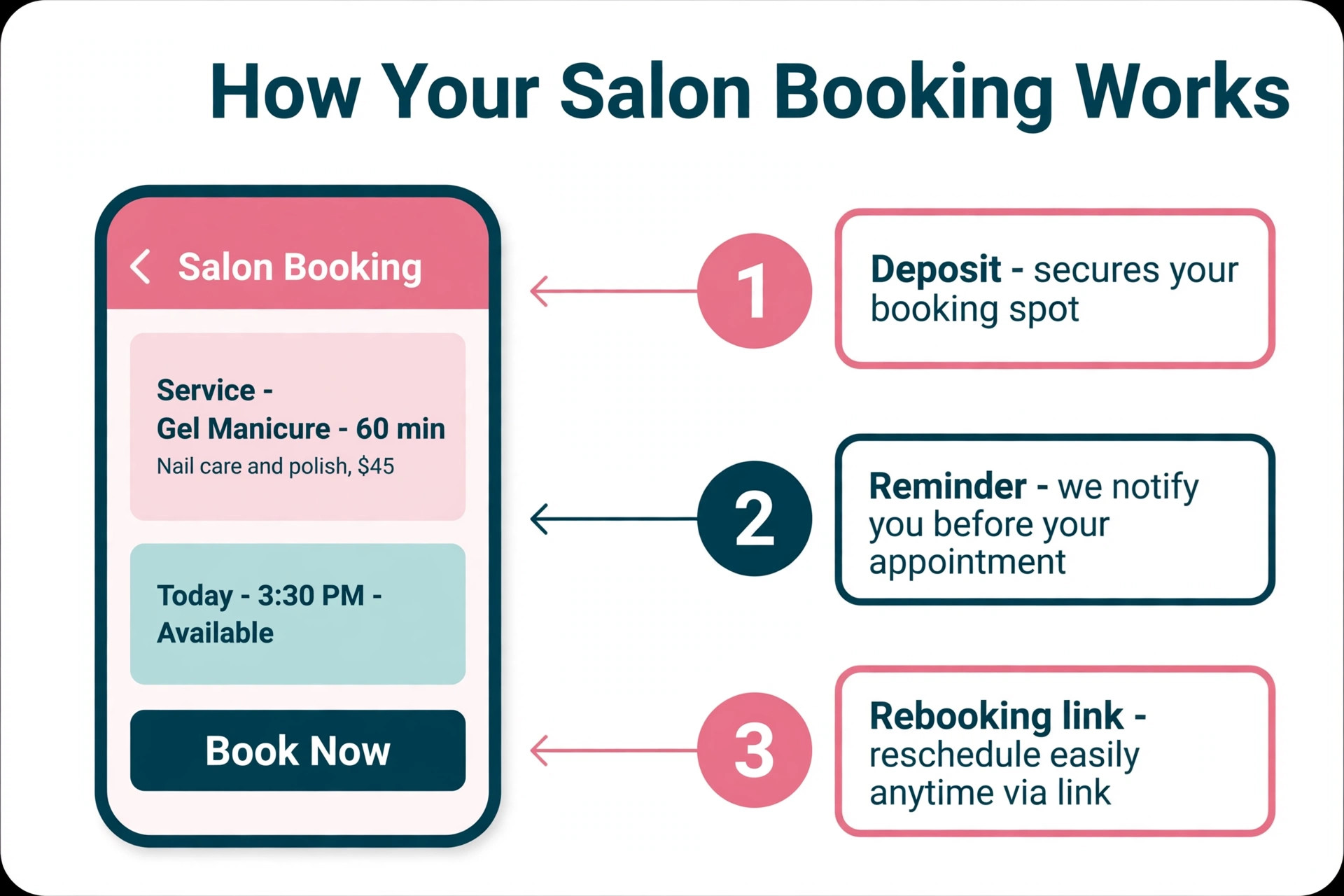
A salon booking system does three jobs at once. It fills the chairs, it takes the money, and it brings the client back. The booking page is the shop window, the payment flow is the till, and the reminders and marketing are the reason a client rebooks instead of drifting to the salon down the street. A tool that does one of those jobs well and the other two badly will cost you more in empty chairs than it saves in subscription fees.
How We Compared the Best Salon Booking Software
We scored each tool on six points, because the subscription price is the smallest part of what a salon pays. Total cost covered the monthly plan plus the card processing rate plus any commission on new clients, modelled for a salon doing 200 appointments a month. Booking experience covered online booking, deposits, no show protection, and whether a client can book without creating an account. Staff pricing covered how the cost grows as you add chairs, because per staff fees compound fast.
We also scored marketing tools, because a booking system that cannot remind, rebook, and promote is only a calendar. Email and SMS reminders, marketing campaigns, and a client marketplace all count here. Payment processing covered the card rate and whether the tool forces you to use its own processor. Ease of use covered setup time, the mobile app for staff, and the quality of support when something goes wrong on a Saturday morning.
Finally, we read the marketplace terms closely, because they are the hidden cost in this category. Fresha takes 20 percent of the first booking from every client its marketplace sends you, with a 6 dollar minimum. Booksy Boost takes 30 percent of a new client first visit, capped at 100 dollars. Those commissions can cost more in a month than the subscription, and they are the reason a cheap plan can be the expensive choice.
The Best Pick for Each Job
| Job | Pick | Why it wins |
|---|---|---|
| A predictable bill as you grow | Vagaro | Price cap no matter how many chairs |
| The lowest card rates | Fresha | 2.29 percent in person |
| New clients finding you | Booksy | Marketplace of 40 million users |
| The clearest flat pricing | GlossGenius | One plan, one card rate, no commission |
| Starting at zero cost | Square Appointments | Genuine free tier |
| Premium client experience | Boulevard | Self booking and deposits built in |
| Growing salons with a busy desk | Mangomint | Front desk automation |
| Barbershops of any size | Squire | Flat rate, no per barber charges |
| A simple scheduler, nothing more | Acuity Scheduling | Cheap and clean |
Use this table as a shortcut, then read the full section for the tool you are leaning toward. The cheapest subscription is not the cheapest tool when the commission takes 20 percent of every new client, and the most expensive tool is not the best choice when you only need online booking and reminders.
The Best Salon Booking Software, Ranked
The 10 tools below fall into three groups. The first group is all in one salon platforms, with booking, payments, and marketing in one subscription. The second group is marketplace tools, which trade a commission on new clients for discovery. The third group is premium and specialist tools, built for high end salons, barbershops, and businesses that need a scheduler rather than a full platform. The best salon booking software for your business depends on how many chairs you run and where your new clients come from.
1. Vagaro
Vagaro is the best all rounder on this list, because its headline feature is a price cap. The subscription costs 30 dollars a month for one bookable calendar, or 23.99 dollars a month as a promotion for the first six months, plus 10 dollars a month for each extra staff calendar, and it tops out at 83.99 dollars a month no matter how many providers you add. A seven chair salon pays the same as a ten chair salon, which is rare in a category where most tools charge per chair.
The feature list is the widest on this list for the price. Online booking, a client app, POS, marketing campaigns, memberships, forms, and payroll reports all sit in the same subscription. Card processing costs 2.6 percent plus 10 cents for small merchants, or 2.29 percent plus 19 cents above 4,000 dollars a month in volume. There is a 30 day free trial, though it requires a card on file.
Vagaro is the right choice for a salon with three to seven chairs that wants every feature for a predictable price. It is the wrong choice when you want the most polished client booking experience, because the interface is functional rather than beautiful, and the client has to create an account to book.
2. Fresha
Fresha is the cheapest seat in the category, and the best pick when card rates matter more than the subscription. The Independent plan costs 19.95 dollars a month for a solo provider, and the Team plan costs 14.95 dollars per bookable team member per month. Card processing costs 2.29 percent plus 20 cents in person, or 2.79 percent plus 20 cents online, which is the lowest in person rate on this list.
The cost to watch is the marketplace commission. Fresha takes 20 percent of the first booking from every client its marketplace sends you, with a 6 dollar minimum fee. A salon that gains ten new clients a month from the marketplace pays that commission ten times, and the total can exceed the subscription by a wide margin. Clients booked directly, or returning clients, pay no commission at all.
Fresha is the right choice when you already have your own clientele and you want the lowest card rates. It is the wrong choice when you depend on the marketplace for new clients, because the commission turns a cheap plan into an expensive one.
3. Booksy
Booksy is the best pick when new clients finding you is the priority, because its consumer marketplace reaches 40 million users looking for beauty and barber services. The Biz plan costs 29.99 dollars a month for a solo provider, plus 20 dollars a month for each additional team member. Card processing costs 2.49 percent plus 10 cents in person, or 2.69 percent plus 30 cents for mobile and manual transactions. There is a 14 day free trial with no card required.
The Boost feature is the cost to model. When Boost is on, Booksy takes 30 percent of a new client first visit, with a 10 dollar minimum and a 100 dollar maximum. When Boost is off, there is no commission at all, but the salon also loses the extra visibility. A salon that turns Boost on for a busy month should budget for the commission as a marketing cost, not as a surprise.
Booksy is the right choice for an independent stylist or barber with an established book who wants discovery on top. It is the wrong choice when the team is large, because 20 dollars per extra member adds up fast past five chairs.
4. GlossGenius
GlossGenius is the best pick when you want pricing you can explain in one sentence. The solo plan costs 24 dollars a month billed annually, or 28 dollars a month billed monthly. Teams cost 48 dollars a month for up to 9 staff, or 148 dollars a month for teams of 10 or more. The card rate is a flat 2.6 percent with no commission, no boost program, and no per booking fee, so the bill is the same every month.
The booking experience is the most polished on this list. Clients can book without creating an account, deposits and no show protection are built in, and the booking page looks like a premium brand rather than a directory listing. There is a 14 day free trial with no card required. The limits are the feature depth, because GlossGenius is simpler than Vagaro or Mindbody, with fewer reports and no marketplace discovery.
GlossGenius is the right choice for a solo provider or a small beauty team that wants a beautiful booking page and a bill with no surprises. It is the wrong choice for a large multi location business that needs deep reporting and enterprise features.
5. Square Appointments
Square Appointments is the only tool on this list with a genuinely free tier, and the best pick for a solo practitioner starting out. The free plan costs nothing and includes online booking, calendar sync, and email reminders for a single location. Plus costs 49 dollars a month per location and adds staff management and advanced features. Premium costs 149 dollars a month per location and adds more.
Card processing costs 2.6 percent plus 15 cents in person, or 3.3 percent plus 30 cents online, which is higher online than most rivals. There is no marketplace commission and no per staff fee on the free tier, so the total cost is the card fee and nothing else. The trade off is that Square Appointments is a scheduler with payments, not a full salon platform, so marketing tools and memberships are thinner than Vagaro or Booksy.
Square Appointments is the right choice when you already run Square POS or retail and you want booking at zero cost. It is the wrong choice when you need deep salon marketing, because you will end up buying a second tool for that job.
6. Mindbody
Mindbody is the best pick for an established wellness business or a multi location salon and spa brand, because it is built for scale rather than for a single chair. The Starter plan costs 79 dollars a month per location, with higher tiers on a quote basis. The platform covers booking, POS, marketing, memberships, and a consumer marketplace, with unlimited users per location.
The marketplace commission is 20 percent on the first booking, capped at 30 dollars. Card processing costs 2.99 percent plus 30 cents, which is the highest rate on this list. There is no free trial on the upper tiers, and the sales process is a demo and a quote rather than a self serve signup. Mindbody is the most expensive tool here for a small salon, and the value only appears when the business has several locations or a large wellness offering.
Mindbody is the right choice for a multi location studio, gym, spa, or salon group that needs one platform across sites. It is the wrong choice for a solo stylist or a small salon, because the price and the complexity are built for a bigger operation.
7. Boulevard
Boulevard is the best pick for a premium salon or spa that treats the client experience as the brand. The booking flow is self serve and elegant, with deposits, intake forms, and a client profile that remembers preferences, products, and history. Pricing starts at 143 dollars a month for up to 5 bookable calendars at one location, or 234 dollars a month for unlimited professionals at one location.
Card processing costs 2.65 percent, or as low as 1 percent with Boulevard Offset, which passes part of the processing cost to the client. There is no marketplace commission and no per booking fee. The price is the highest on this list for a small salon, and there is no free trial, only a bookable demo. The value is the experience, because a client who books, pays a deposit, and arrives to a remembered preference is a client who rebooks.
Boulevard is the right choice for a high volume, multi provider salon where the client experience drives revenue. It is the wrong choice for a budget conscious solo provider, because the entry price buys more polish than a small book needs.
8. Mangomint
Mangomint is the best pick for a growing salon where the front desk is the bottleneck. The platform automates the repetitive desk work, with smart scheduling, automated reminders, online intake forms, and a client app that reduces phone calls. Pricing is 120 dollars a month per location plus 10 dollars a month per user, under simplified pricing effective from August 2026. There is a 14 day free trial with no card required.
Mangomint suits salons with 2 to 20 staff, where the owner is spending too much time on the phone and the desk. The interface is modern and fast, and the automation is the deepest on this list for day to day operations. The limits are the price, because 120 dollars a month is a big step up from the 24 to 30 dollar tools, and the feature set is narrower than Mindbody for a business that also runs fitness or wellness classes.
Mangomint is the right choice when your salon is growing and the front desk cannot keep up. It is the wrong choice when you are a solo provider, because the automation solves a problem you do not have yet.
9. Squire
Squire is the best pick for barbershops of any size, because it charges a flat rate with no per barber charges. Individual barbers pay from 30 dollars a month, and a single location shop pays from 50 dollars a month, with no extra fee as barbers join. That flat structure is the opposite of most salon tools, where each new chair adds 10 to 20 dollars a month to the bill.
The platform covers online booking, a barber marketplace, POS, and client management, with a mobile app built for barbers and their clients. The booking flow is designed around choosing a barber and a service, which fits how barbershop clients actually book. The limits are the niche, because Squire is built for barbershops first, and a full service salon with colour, spa, and retail will find the feature set narrower than Vagaro or Mindbody.
Squire is the right choice for a barbershop that wants predictable pricing as the team grows. It is the wrong choice for a salon that needs deep spa, membership, or retail features.
10. Acuity Scheduling
Acuity Scheduling, now part of Squarespace Scheduling, is the best pick when you want a simple scheduler and nothing more. The Emerging plan costs 16 dollars a month, Growing costs 27 dollars a month for up to 6 calendars, and Powerhouse costs 49 dollars a month for up to 36 calendars. There is a 7 day free trial with no card required.
Acuity covers online booking, intake forms, deposits through Stripe, Square, PayPal, or Venmo, and calendar sync, with no marketplace and no commission. The trade off is that there is no POS, no salon marketing suite, and no client app, so the business needs separate tools for payments and promotion. The strength is the price and the simplicity, because a new appointment based business can be taking bookings in an afternoon.
Acuity is the right choice for a new appointment based business that needs booking without a platform. It is the wrong choice for a salon that wants booking, payments, and marketing in one subscription.
How to Choose the Right Salon Software
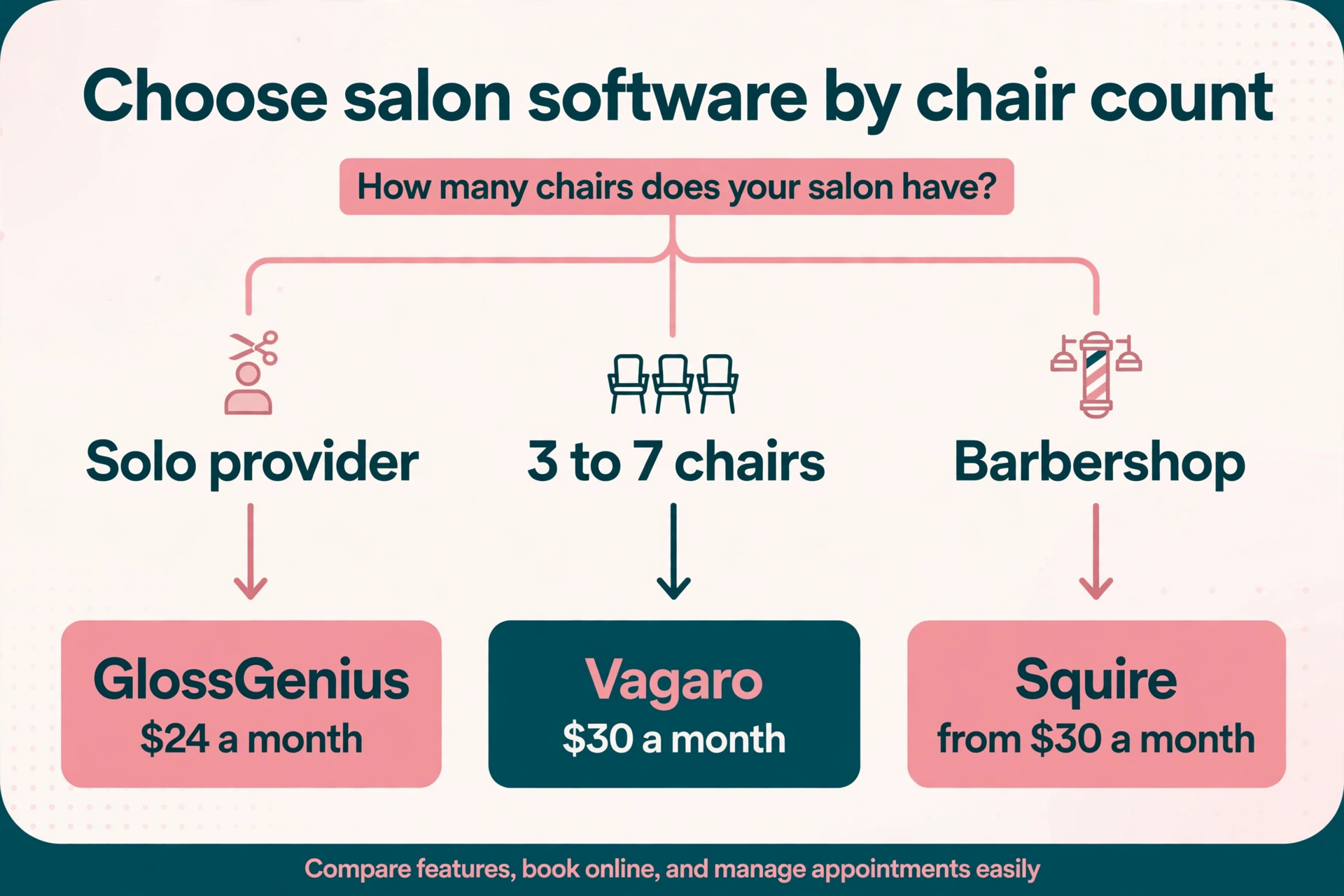
Start with your chair count, because the pricing model changes the answer. A solo provider should compare GlossGenius at 24 dollars a month, Square Appointments at zero dollars, and Fresha at 19.95 dollars, because the differences are the card rate and the booking experience, not the subscription. A three to seven chair salon should compare Vagaro at 30 dollars with its price cap against Booksy at 29.99 dollars plus 20 dollars per extra member, because the per member fee is where Booksy gets expensive.
Next, model the commission, not just the subscription. Count how many new clients a month come from the marketplace, multiply by the average first visit price, and apply the 20 percent Fresha rate or the 30 percent Booksy Boost rate. A salon gaining ten new clients a month at 80 dollars a visit pays 160 dollars in commission to Fresha or 240 dollars to Booksy Boost. That number dwarfs the monthly plan price, and it is the real cost of discovery.
Then check the card rate against your volume. A salon taking 10,000 dollars a month in card payments pays 229 dollars in processing at 2.29 percent with Fresha, 260 dollars at 2.6 percent with GlossGenius or Vagaro, and 299 dollars at 2.99 percent with Mindbody. The 70 dollar gap between the cheapest and the most expensive rate is more than the price of several plans on this list. The best salon booking software is the one whose total bill, subscription plus card fees plus commission, is lowest at your real volume.
The True Cost of a Booking
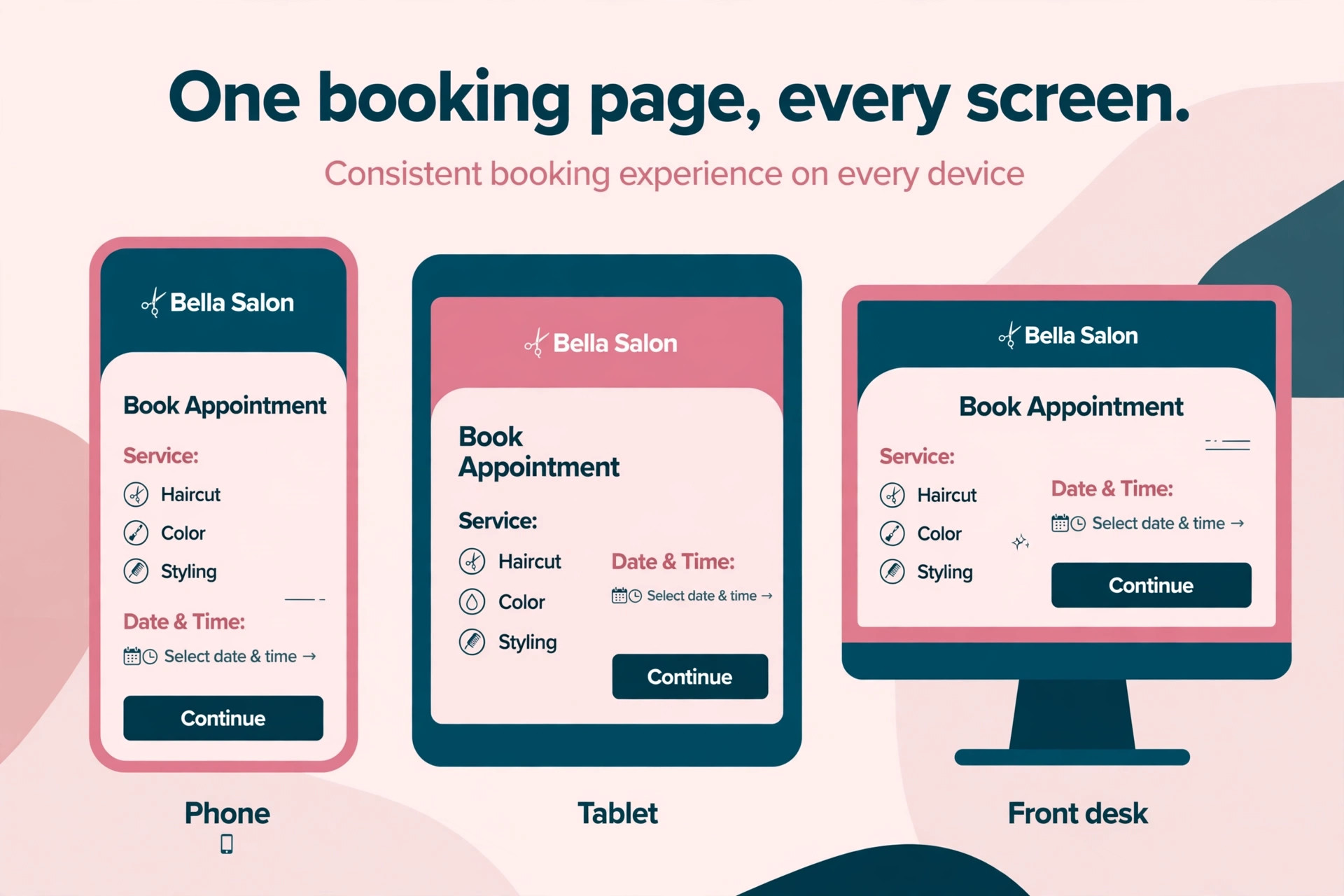
The subscription is the smallest part of the bill, and this is the calculation most salon owners skip. A 30 dollar plan with a 2.6 percent card rate and no commission costs 290 dollars a month in total for a salon taking 10,000 dollars in card payments. A 20 dollar plan with a 2.99 percent card rate and a 20 percent commission on ten new clients costs far more, even though the subscription looks cheaper. Always add the three lines together before you compare.
No show protection is the second hidden saving. A deposit of 20 percent, or a card on file with a cancellation fee, turns a no show from a lost hour into a paid hour. Every tool on this list except Mindbody offers integrated deposits, and the tools that make deposits easy pay for themselves the first time a client cancels late. Turn deposits on for new clients first, then extend them to all bookings once the regulars accept the change.
The third hidden cost is SMS. Reminders by text cut no shows, but SMS credits cost extra on several tools, and the price per message adds up across hundreds of appointments. Check whether reminders are included in the plan or billed separately, and check the per message rate, because a salon sending 500 reminders a month can pay 25 to 50 dollars in SMS fees alone.
Mistakes That Cost Salons Money
The most common mistake is choosing on subscription price alone and ignoring the commission and the card rate. A salon that gains ten new clients a month from a marketplace pays more in commission than in subscription, and a salon that takes 10,000 dollars a month in card payments pays more in processing than in subscription. Add all three lines together before you decide.
The second mistake is skipping deposits. A salon without no show protection loses the full value of every empty chair, and a single no show a week costs more than a month of software. Take a deposit from new clients, keep a card on file, and set a cancellation window that protects the chair without scaring the client away.
The third mistake is letting clients book without an account or a phone number you can reach. A booking with no contact details cannot be reminded, cannot be confirmed, and cannot be rebooked when it cancels. Require a phone number at booking, send a confirmation text, and send a reminder the day before.
- Add subscription, card fees, and commission together before you choose.
- Take deposits from new clients from day one.
- Require a phone number on every booking.
- Send a reminder text the day before each appointment.
- Review your chair utilisation every month and fix the gaps.
Our Verdict
Vagaro is the pick for most readers, because the price cap at 83.99 dollars a month makes the bill predictable as the salon grows, and the 30 dollar entry plan includes the widest feature list for the price. A three to seven chair salon gets booking, POS, and marketing in one subscription, and the total bill stays low when the chairs are full.
GlossGenius is the pick for a solo provider or a small team that wants the clearest pricing and the most polished booking page, with one plan, one card rate, and no commission. Square Appointments is the pick when the budget is zero and you already run Square. The best salon booking software is the one whose total cost, subscription plus card fees plus commission, is lowest at your volume, and whose booking page makes clients want to come back.
Frequently Asked Questions
Which is the best salon booking software for a solo stylist?
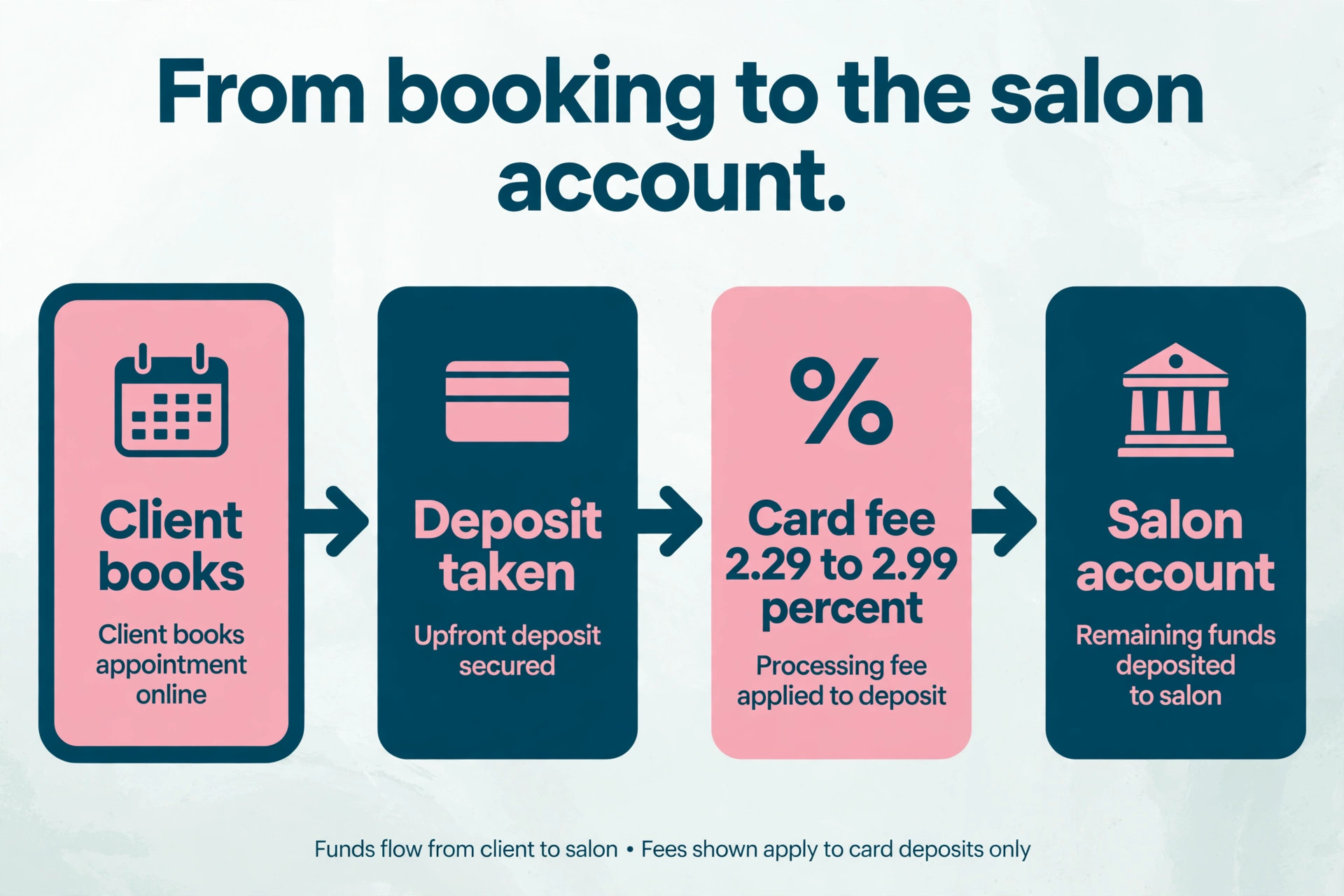
GlossGenius is the strongest pick for a solo stylist, because the plan costs 24 dollars a month billed annually, the card rate is a flat 2.6 percent, and there is no commission on new clients. Square Appointments is the best free alternative, because the free tier includes online booking and reminders at zero cost. A solo stylist who wants new clients from a marketplace should look at Fresha, but should model the 20 percent commission on first bookings before committing.
How much does salon booking software cost per month?
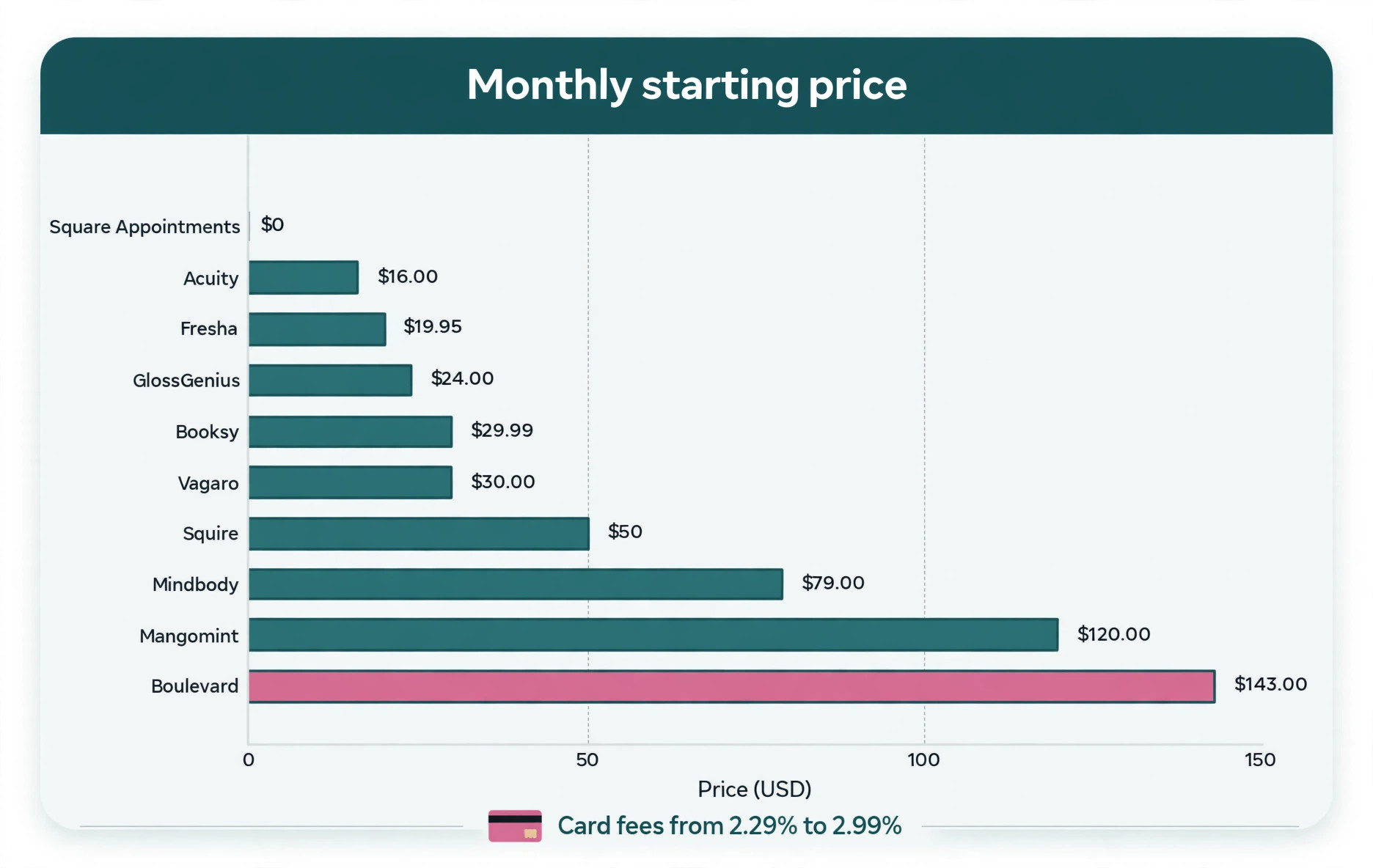
Entry prices run from zero dollars for Square Appointments to 143 dollars a month for Boulevard. Most small salons land between 24 and 30 dollars a month for a solo or small team plan, with Vagaro at 30 dollars, GlossGenius at 24 dollars, and Booksy at 29.99 dollars. Card fees add 2.29 to 2.99 percent of card takings, and marketplace commissions add 20 to 30 percent of a new client first visit, so the real monthly bill is higher than the subscription alone.
What is the best salon booking software with no commission on new clients?
GlossGenius, Vagaro, Square Appointments, and Boulevard charge no commission on new clients. GlossGenius is the clearest of the group, because the plan and the card rate are the whole bill. Fresha charges 20 percent on marketplace sent first bookings, Booksy Boost charges 30 percent, and Mindbody charges 20 percent capped at 30 dollars. When discovery matters, treat the commission as a marketing cost and compare it with what a paid ad would cost for the same client.
Do I need deposits and no show protection?
Yes, for most salons. A deposit of 20 percent or a card on file with a cancellation fee turns a no show from a lost hour into a paid hour, and a single no show a week costs more than a month of software. Every tool on this list except Mindbody offers integrated deposits. Start with new clients, then extend deposits to all bookings once the regulars accept the change.
Can clients book without creating an account?
It depends on the tool. GlossGenius, Square Appointments, and Acuity Scheduling let clients book without an account, which removes friction and raises conversion. Vagaro requires an account, and Fresha requires one too. A booking flow that asks for an account before showing availability loses clients, so test the flow yourself on a phone before you commit to a tool.
Should a barbershop use the same software as a salon?
A barbershop can use salon software, but Squire is built for barbershops and charges a flat rate with no per barber fees, which suits a shop where barbers join and leave often. Booksy is also strong for barbershops, because its marketplace reaches clients looking for barbers specifically. A full service salon with colour, spa, and retail should use Vagaro or Mindbody instead, because the feature set is built for that mix.