TurboTenant is the best overall pick among the best property management software for small landlords, because it covers listings, screening, leases and rent collection on a free plan that works up to 50 doors. Avail is the strongest free alternative when you want a clean rent ledger and a low cost paid tier, and RentRedi is the best paid option at 12 dollars a month when you want unlimited units and a maintenance app for one flat price. We compared 10 tools on what a landlord with 1 to 20 units actually pays, what the free plan really includes, and where the fees hide, so you can stop paying for portfolio software built for someone else.
A small landlord has a different problem from a property management company. You do not need owner statements, trust accounting across 500 doors or a leasing CRM with tour scheduling. You need rent to arrive on time, a lease that holds up, a screening report you can trust, and a maintenance request that does not get lost in a text thread. The software that wins for you is the one that does those four jobs well at a price that makes sense for five doors, not five hundred.
The trap in this category is the price that looks free and the plan that looks cheap. Several tools in this guide offer a free tier, but the tenant pays a fee on every bank payment, or the paid tier charges per unit per month and the bill climbs with every door you add. A landlord with 10 units can pay nothing, 12 dollars a month or 65 dollars a month for software that looks similar on a feature list. The difference is in the fee schedule, and this guide shows it for every tool.
Prices in this guide were checked against vendor pricing pages and current 2026 roundups in November 2026. Free plans change, and several vendors charge the tenant a payment fee that does not appear on the pricing page, so confirm the full cost on the checkout page before you move your rent collection.
How a Small Landlord Should Judge Software
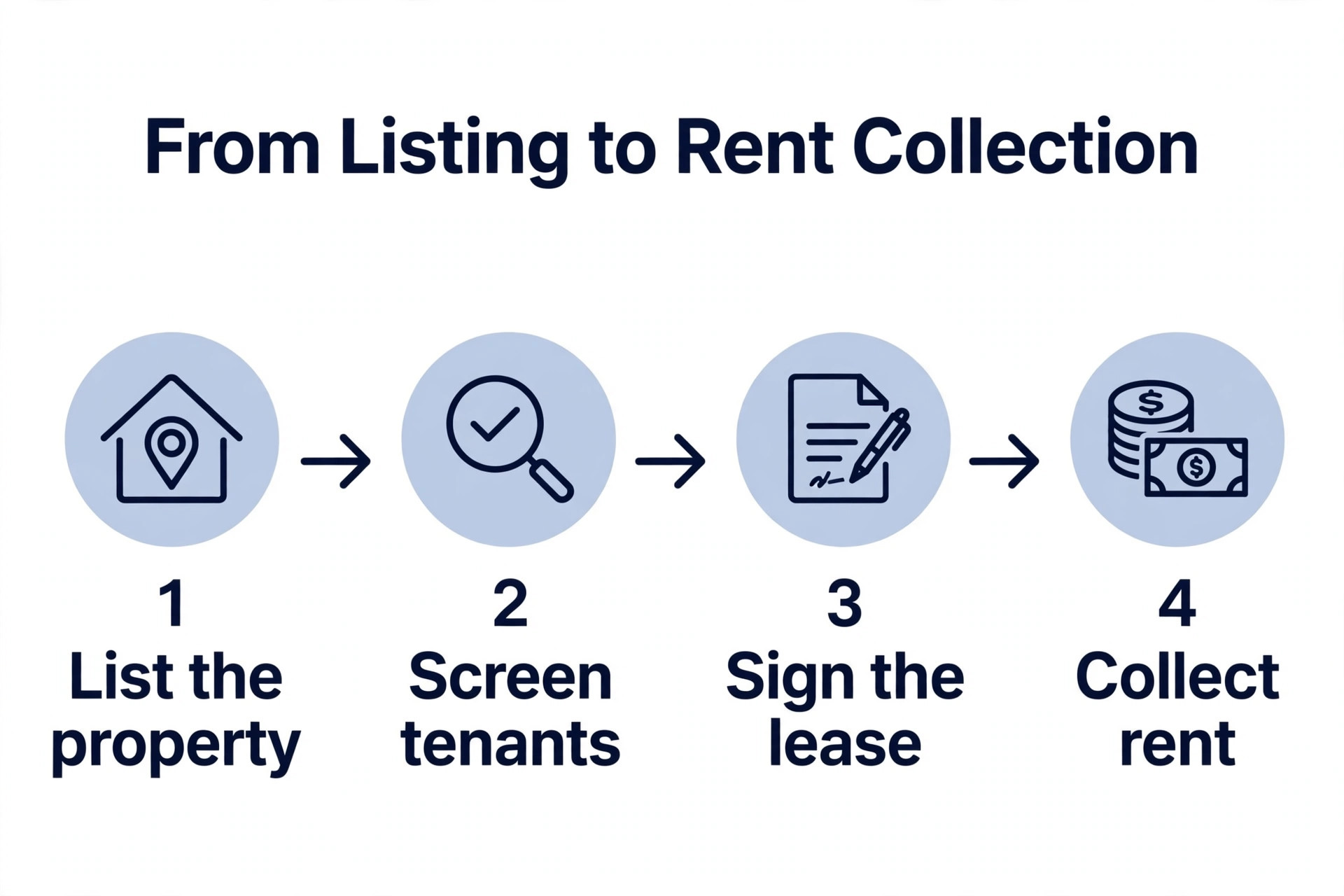
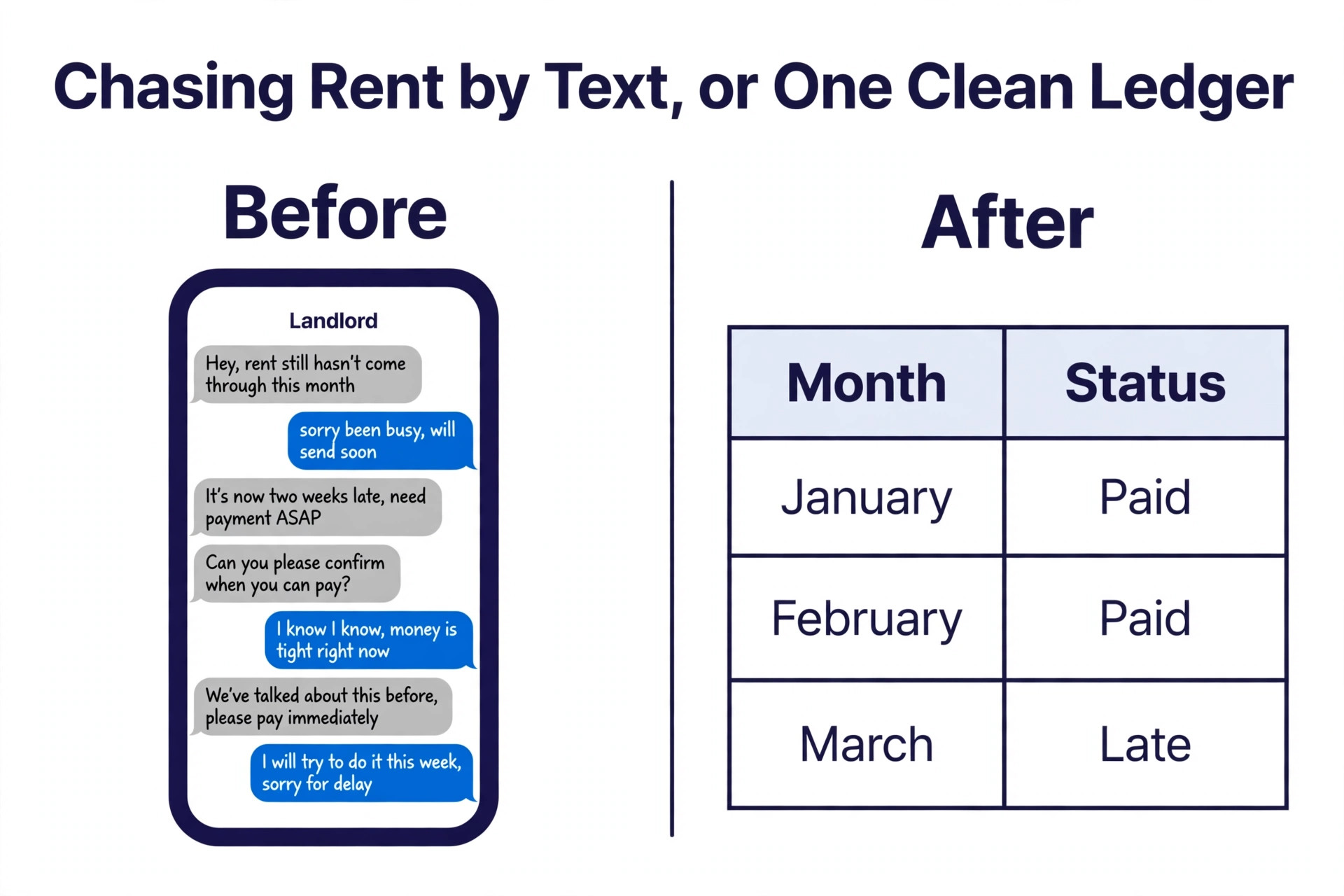
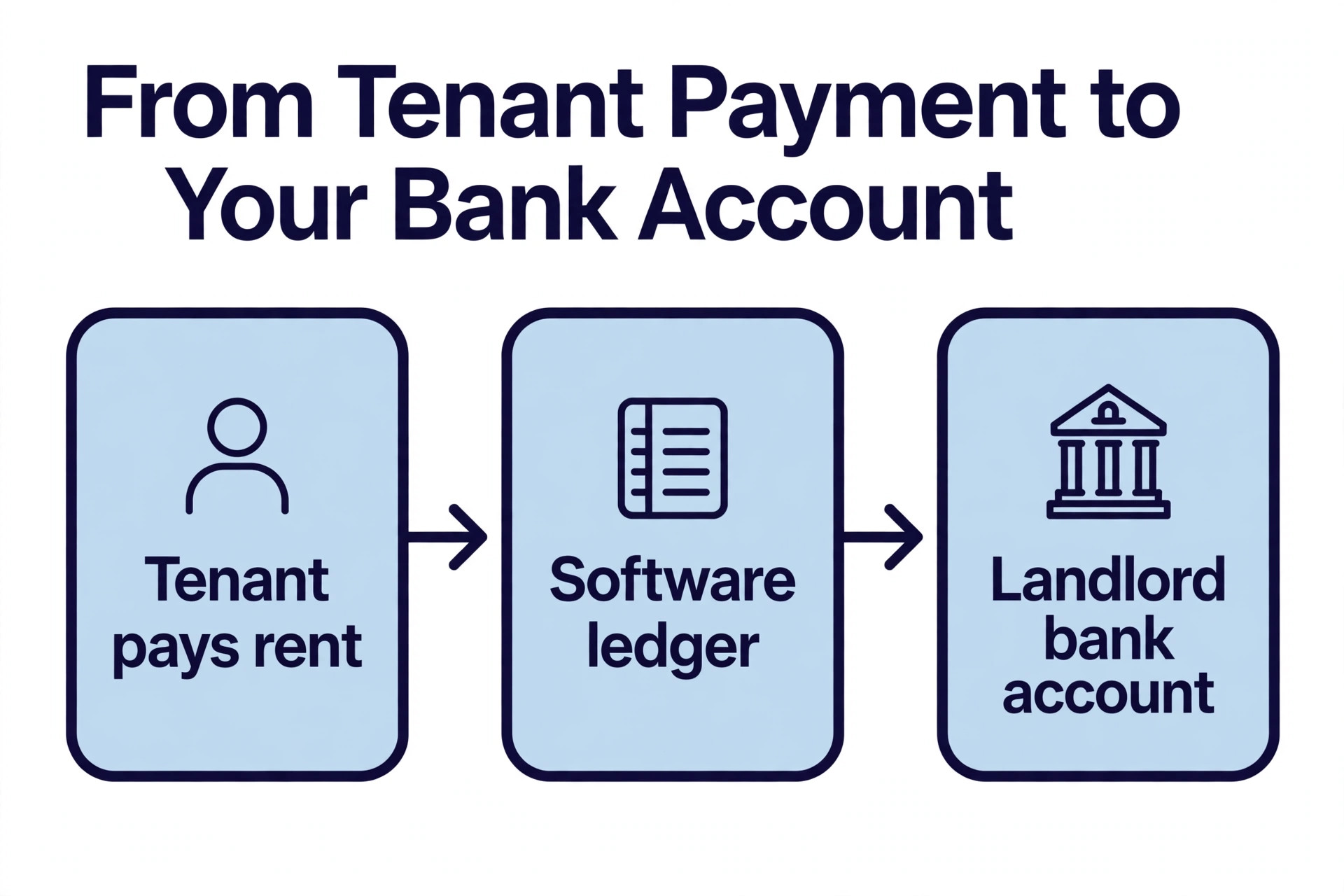
Start with rent collection, because that is the job you will use every month. The software should let a tenant pay by bank transfer or card, send an automatic reminder before the due date, charge a late fee on the schedule you set, and show you a ledger for each tenant that you can read without an accountant. If a tool cannot show you who paid, who is late and how much is outstanding on one screen, it has failed its main job, whatever else it does well. That ledger test is the first filter when you compare the best property management software for small landlords.
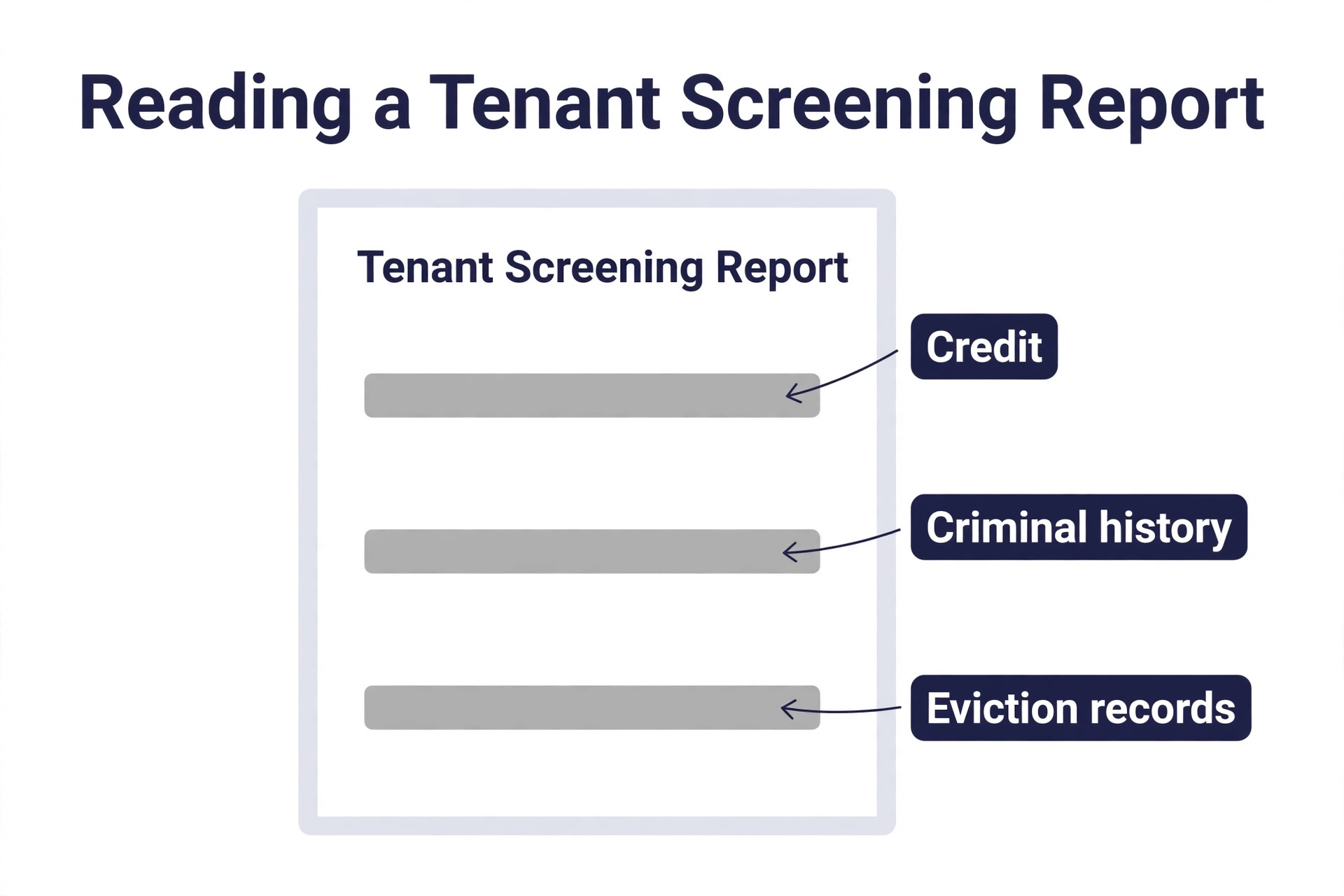
Next comes screening and leasing. A good screening report pulls credit, criminal history and eviction records, and the applicant pays for it, not you. A good lease is state specific, lets the tenant sign on a phone, and stores the signed copy where you can find it in a year. These two features save more time than any dashboard, because a bad tenant costs thousands and a missing lease costs more. Free tools that include both are worth more than paid tools that charge extra for them.
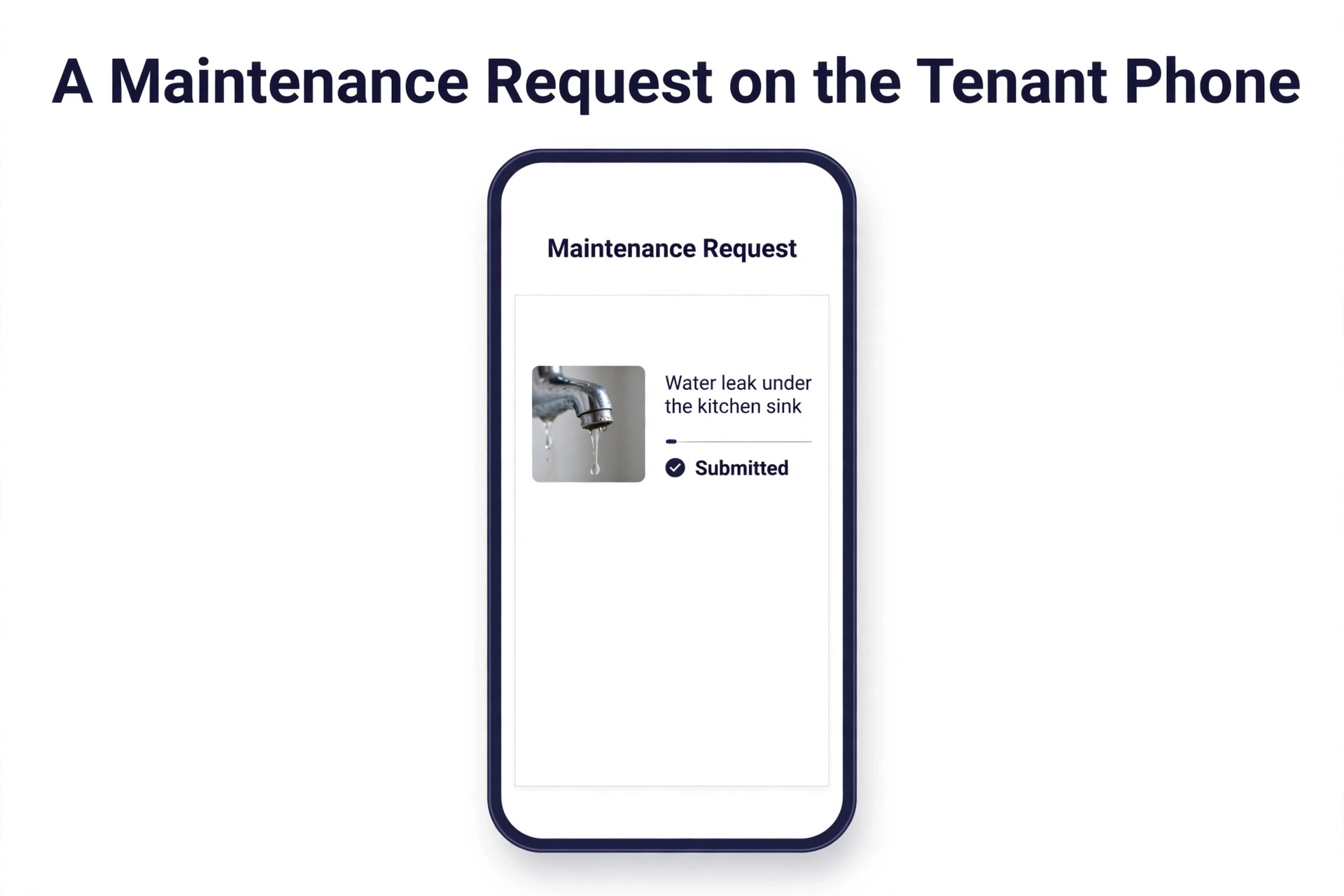
Then check maintenance and communication. Tenants should be able to report a leak with a photo, and you should be able to reply, assign the job and mark it done without leaving the app. A tool that only collects rent is a payment app. A tool that also tracks maintenance is a management system. The difference shows up the first time a water heater fails on a Saturday.
Finally, count the real cost at your unit count. A free plan with a 2.50 dollar tenant fee on every bank payment costs your tenants 30 dollars a year per door, and some of them will ask you to pay it instead. A 12 dollar flat plan with unlimited units costs the same whether you own 3 doors or 30. A 65 dollar plan with per payment fees can cost more than 100 dollars a month once the add ons are counted. Run the numbers at your exact door count before you choose.
The Decision Table for a Small Landlord
| Your situation | Start with | Why |
|---|---|---|
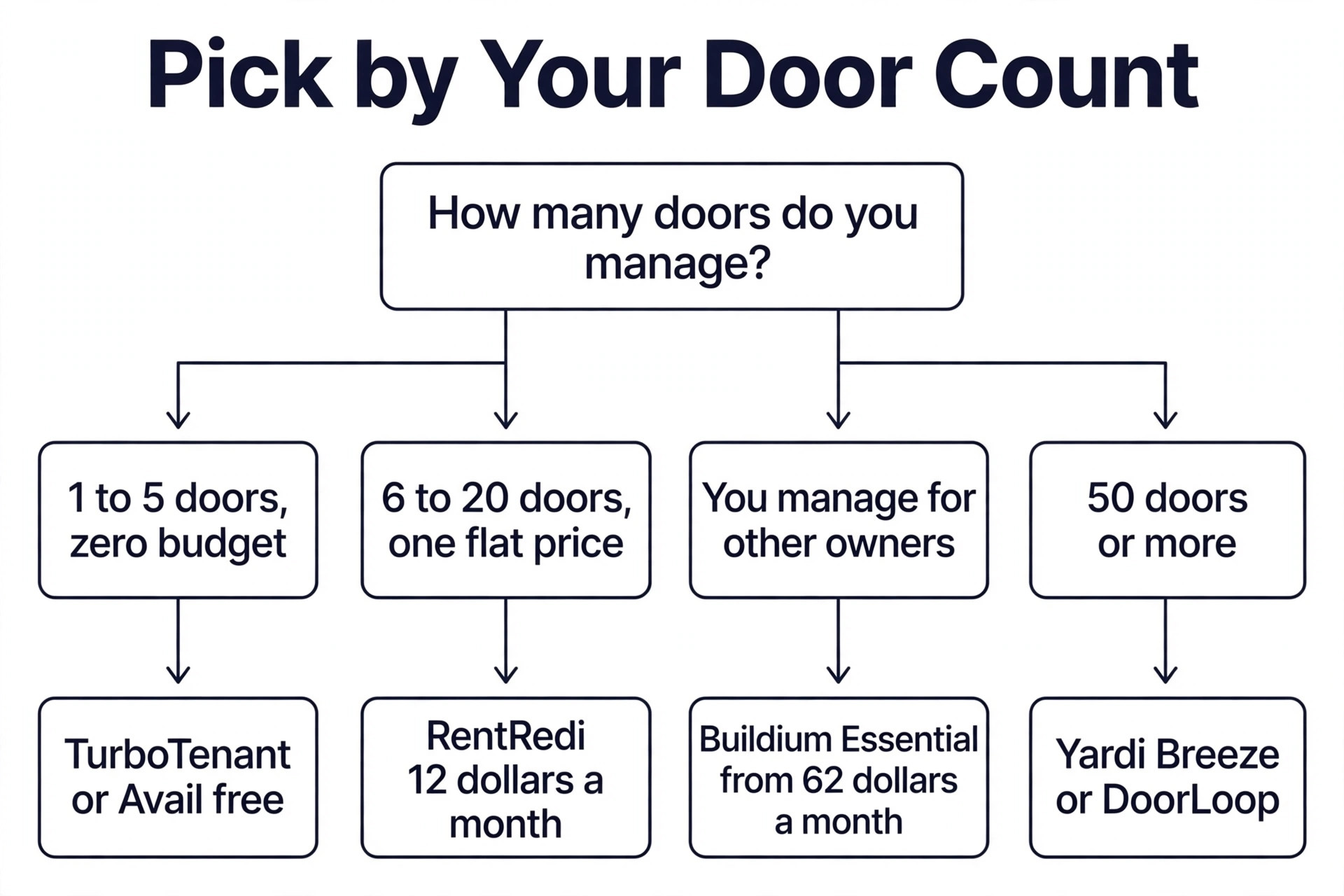
| 1 to 5 doors and a zero budget | TurboTenant or Avail free | Full rent collection and screening for no monthly fee |
| 1 to 5 doors and you want accounting too | Landlord Studio or Avail | Rent ledger plus expense tracking in one place |
| 6 to 20 doors and you want one flat price | RentRedi | 12 dollars a month with unlimited units |
| You manage for other owners | Buildium Essential | Owner statements and accounting from 62 dollars a month |
| You want a local agent for showings | Hemlane | Vetted local agents for showings and inspections |
| You have 50 doors or more | Yardi Breeze or DoorLoop | Per unit pricing that stays fair as you grow |
| You want the cheapest possible start | Innago | Free for landlords with no monthly fee at all |
Use this table to cut the list to two or three tools, then read the sections for those tools and test the free plan or the trial. The best property management software for small landlords is not the one with the longest feature list. It is the one whose pricing model matches your door count and whose free plan covers the jobs you actually do every week.
The Best Pick for Each Job
| Job | Pick | Why it wins |
|---|---|---|
| Best overall for a small landlord | TurboTenant | Free to 50 doors with listings, screening and leases |
| Best free rent ledger | Avail | Free plan plus a clean accounting view |
| Best flat price with unlimited units | RentRedi | 12 dollars a month, no per unit charge |
| Best accounting first tool | Landlord Studio | Free to 3 units, Pro at 12 dollars a month |
| Best for managing for owners | Buildium | Full accounting and owner portal from 62 dollars a month |
| Best for remote landlords | Hemlane | Local agent network for showings and inspections |
| Best per unit value at scale | Yardi Breeze | 1 dollar per unit per month with no onboarding fee |
| Best leasing workflow | DoorLoop | Leasing CRM on the base plan from 199 dollars a month |
The cheapest tool is not always the best value, and the most complete tool is not always the best fit. A free plan that charges your tenants on every payment can cost more in goodwill than a 12 dollar plan costs in cash. Keep that trade off in mind while you compare the best property management software for small landlords, and read the fee notes in each section below before you decide.
The Best Property Management Software for Small Landlords, Ranked
The 10 tools below fall into three groups. The first group is free for landlords, and these are the right starting point for anyone with under 10 doors. The second group charges a low flat monthly price, and these suit landlords who want more automation without a per unit bill. The third group is built for managers and growing portfolios, and these only make sense once the free and flat tools start to limit you.
1. TurboTenant
TurboTenant is the default starting point for a landlord with 1 to 10 units, and the free plan is the reason. It is free for landlords managing up to 50 doors, and it covers rental listings syndicated to major sites, tenant screening, state specific leases with electronic signatures, online rent collection and maintenance tracking. That is a complete management stack for no monthly fee, and no other tool in this guide gives you that much without a subscription.
The catch is the payment fee. On the free plan the tenant pays 2 dollars per bank payment, or the landlord can pay it on the Pro plan, which costs 199 dollars a year. Card payments cost 3.49 percent. Pro adds faster payouts and unlimited e-signatures, but the free plan is genuinely usable without it.
2. Avail
Avail, owned by Realtor.com, is the cleanest free option for a landlord who cares about the rent ledger. The free Unlimited plan covers listings, screening, leases, online rent collection and maintenance tracking with no unit cap, and tenants pay 2.50 dollars per bank payment on the free plan. The paid Unlimited Plus plan costs 27 dollars a month for the first unit and scales with units, which makes it expensive once you pass 10 doors, so most small landlords should stay on the free plan.
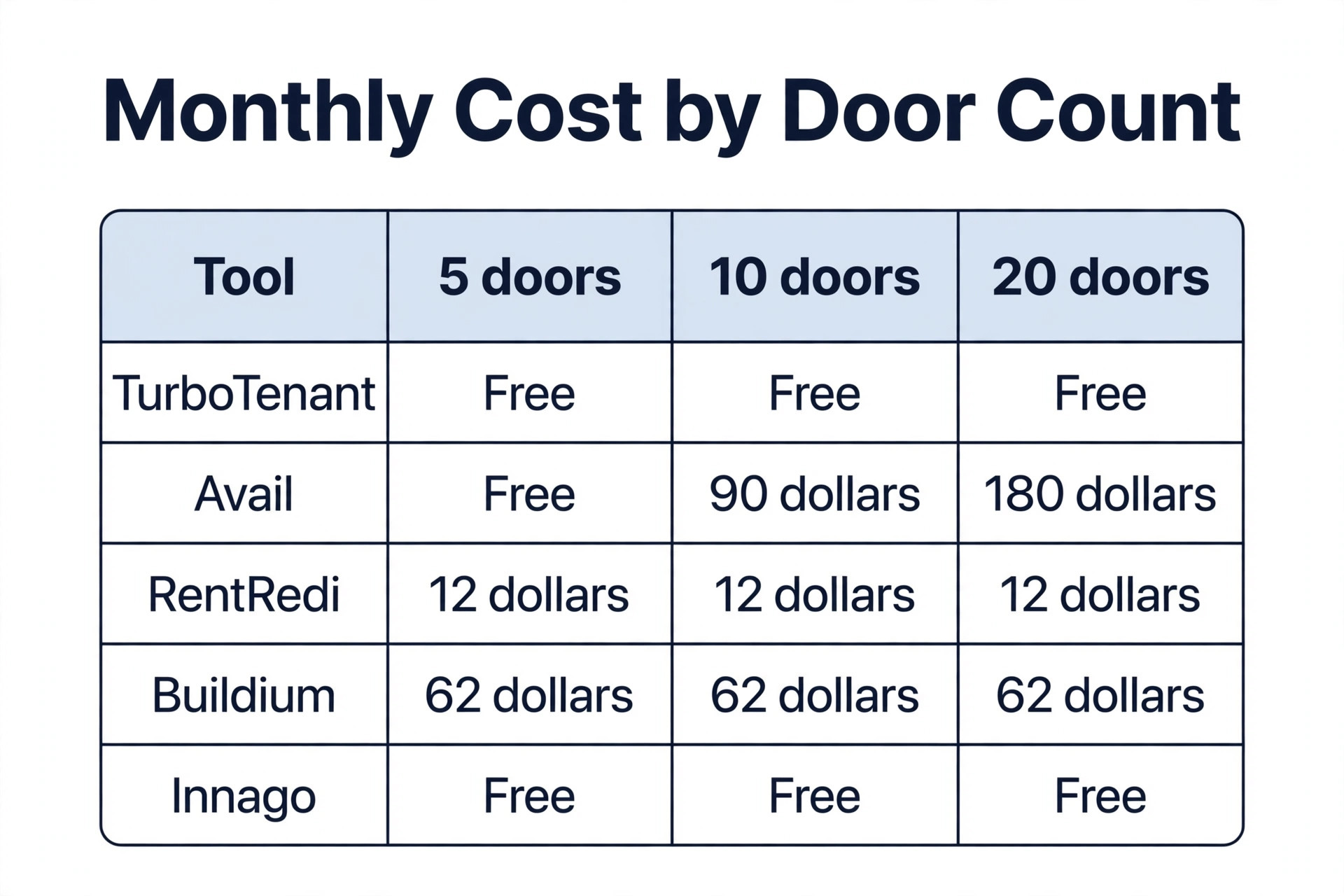
Where Avail wins is accounting. The rent ledger is clear, the payment history is easy to read, and the lease templates are state specific. The weakness is the paid tier, which charges per unit and climbs fast. A landlord with 10 units pays 90 dollars a month on Plus and 20 units pay 180 dollars. Use Avail free, and only pay when you need the faster payouts and the waived tenant fee.
3. Innago
Innago is free for landlords, with no monthly fee at all, and it covers listings, screening, leases, online rent collection and maintenance tracking. There is no paid tier to upsell you into and no unit cap on the free plan. That makes it the cheapest credible option in this guide, and the honest answer for a landlord who wants to pay nothing and still collect rent online.
The trade off is depth. Innago is a smaller company than TurboTenant or Avail, and its reporting and accounting are simpler. It also earns money from tenant paid services, so read the fee schedule before you rely on it. For a landlord with a few doors who wants a free tool without a trial clock or a feature gate, Innago is the pick. For a landlord who wants rich accounting or owner reporting, one of the paid tools below will fit better.
4. RentRedi
RentRedi charges a flat 12 dollars a month billed annually, or 29.95 dollars a month billed monthly, for unlimited units, and that flat price is the whole pitch. There is no per door charge, no tier that unlocks the features you need, and no surprise when you add your sixth door. It covers listings, screening, leases, rent collection, maintenance tracking and a tenant app, and it includes a maintenance coordination feature that lets tenants report issues with photos.
The flat price makes RentRedi the best paid pick for a landlord with 6 to 30 doors. A landlord with 20 doors pays 12 dollars a month, while the same portfolio costs 65 dollars on Buildium Essential or 180 dollars on Avail Plus. The weakness is that RentRedi is built for self managing landlords, not for managers who collect rent for other owners, so there is no owner portal or trust accounting. If you manage your own doors, that limit does not matter. If you manage for others, skip to Buildium.
5. Landlord Studio
Landlord Studio is the accounting first pick. The free GO plan covers up to 3 units with rent collection, expense tracking and reporting, and the PRO plan costs 12 dollars a month and adds more units, document storage and bank feeds. It is built for landlords who want to know whether each property makes money, not just whether the rent arrived, and its income and expense reports map to Schedule E categories, which saves time at tax season.
The trade off is that Landlord Studio is lighter on leasing and screening than TurboTenant or Avail. It handles the money well and the tenant workflow adequately, but a landlord who needs heavy screening or listing syndication should pair it with a free listing tool or pick TurboTenant instead. For a landlord with 3 doors who wants clean books and a low bill, the free plan is the best deal in this guide.
6. TenantCloud
TenantCloud starts at 18 dollars a month, or 16.50 dollars a month billed annually, and it covers listings, screening, leases, rent collection, maintenance and a tenant portal in one place. It suits a small landlord who wants an all in one portal and is willing to pay a modest monthly fee for it, and the interface is cleaner than most tools at this price.
The weakness is the price curve. At 18 dollars a month it costs more than RentRedi for the same doors, and it does not offer a free tier, so you pay from day one. TenantCloud is the right pick when you have tried the free tools and found them too thin, and you want a single portal without jumping to a 62 dollar management suite.
7. Buildium
Buildium is the practical middle of this market and the cheapest of the big management suites. Essential starts at 62 dollars a month for up to 20 units, or 65 dollars in the most recent pricing checks, with Growth from 192 dollars and Premium from 400 dollars. It covers residential, HOA, affordable housing and student rentals with accounting, maintenance tracking, leasing, tenant and owner portals and reporting, and it syndicates listings to 8 named sites. There is no unit minimum, so a 10 unit operator and a 500 unit firm can both start here.
Buildium is built for property managers, not for a landlord with 3 doors. It charges 2.35 dollars per incoming bank payment on Essential, 99 dollars per bank account setup and 5 dollars per e-signature, so the real monthly cost runs higher than the headline price. It earns its fee when you manage for other owners, because the owner statements and trust accounting make that work possible. If you only manage your own doors, RentRedi or TurboTenant will do the same jobs for far less.
8. DoorLoop
DoorLoop starts at 199 dollars a month for up to 79 units on the One plan, billed annually, rising to 400 dollars at 200 units, and it puts a leasing CRM on the base plan. That is its main advantage over Buildium, whose pipeline and tour scheduling are Premium only at 400 dollars a month. DoorLoop covers accounting, maintenance, leasing, tenant and owner portals and reporting, and it is the most modern feeling of the management suites in this guide.
The price is the problem for a small landlord. At 199 dollars a month, DoorLoop costs more than 16 times what RentRedi charges for the same doors, and it only makes sense once you manage enough units that the leasing CRM saves you real time. A landlord with 20 doors should not buy it. A manager with 60 doors who leases constantly should test it against Buildium.
9. Yardi Breeze
Yardi Breeze costs 1 dollar per unit per month with a 100 dollar monthly minimum, and Premier costs 2 dollars per unit for advanced features. A 100 unit portfolio pays 100 dollars a month for Yardi accounting, online payments, tenant portals and reporting, with no separate fees for onboarding, training or support. That makes it the cheapest of the big suites once you pass 50 units, and the Yardi name carries weight with owners and accountants.
For a small landlord with under 20 doors, Breeze is usually the wrong pick, because the 100 dollar minimum means a 10 unit landlord pays 10 dollars per unit, not 1 dollar. It earns its place here for the landlord who is growing, because the per unit price stays fair as the portfolio grows. If you plan to pass 50 doors in the next two years, Breeze is worth a demo now.
10. Hemlane
Hemlane costs 30 to 86 dollars a month depending on the plan, and it earns its fee in one specific situation. You are a remote landlord who needs someone local to show the unit, run an inspection or handle a repair. Hemlane gives you a vetted local agent network in the cities it covers, plus software for listings, screening, leases, rent collection and maintenance. The software alone is not better than TurboTenant, but the agent network is something no other tool in this guide offers.
The limit is coverage and cost. The agent network does not cover every city, and the per listing fees add up. A landlord who lives near the property and shows it personally gets nothing from Hemlane that a free tool does not give. Check whether your city is covered before you sign up, because the software is only half the product.
What About AppFolio
AppFolio is the market leader for professional management companies, and it does not belong on a small landlord shortlist. Core starts at around 1.49 dollars per unit per month with a 50 unit minimum and a monthly minimum spend reported at 280 to 298 dollars. A landlord with three rentals cannot use it at all, and a landlord with 50 units pays close to 300 dollars a month before any add ons. Its 2026 benchmark report found that 81 percent of managers expect to grow their unit counts this year, and firms that embedded AI into core workflows expect 31 percent portfolio growth against 12 percent for those that have not, which shows who the product is built for.
If you manage for owners and you pass 200 units, AppFolio is the tool to test, because it names 27 listing sites, the most of the big suites. Below 50 units it is not an option, and between 50 and 200 units Buildium, DoorLoop and Yardi Breeze all cost less for similar work. Do not let a sales call convince you that a 300 dollar minimum is a small landlord plan.
How to Choose at Your Door Count
The right tool changes with the number of doors, and the cheapest pick among the best property management software for small landlords at 3 doors is not the cheapest at 30. At 3 doors, a free plan from TurboTenant, Avail or Innago costs nothing and covers everything you need, so paying for software is a waste of money. At 10 doors, the free plans still work, but the tenant payment fees add up, and a 12 dollar RentRedi plan starts to look cheap because it removes the per payment friction. At 20 doors, the flat price tools win clearly, because a per unit paid tier like Avail Plus costs 180 dollars a month while RentRedi still costs 12 dollars.
At 40 doors, the question changes from price to reporting. You need to see which properties make money, which tenants are late and which maintenance jobs are open, without opening five screens. Buildium Essential at 62 dollars a month starts to make sense here, especially if you manage for other owners, because the owner statements and the accounting depth save hours a month. At 100 doors, Yardi Breeze at 100 dollars a month is the value pick, and DoorLoop is the pick when leasing speed matters more than accounting depth.
The other factor is who does the work. A landlord who self manages needs a tenant app, a maintenance flow and a rent ledger. A landlord who hires a manager needs an owner portal and a monthly statement. Match the tool to the job you actually do, and the choice gets simple fast.
Mistakes That Waste Money
The most common mistake is paying for a management suite when a free tool would do. A landlord with 4 doors who signs up for Buildium at 62 dollars a month pays 744 dollars a year for owner statements and trust accounting that no owner will ever see, because the owner is the landlord. Test the free plan first, and only pay when you hit a limit you can name.
The second mistake is ignoring who pays the payment fee. A free plan that charges the tenant 2.50 dollars per bank payment looks free to you and costs your tenant 30 dollars a year. Some tenants will pay it without a word. Others will ask you to cover it, or they will pay late because the fee annoys them. Ask who pays, and on which plan the fee disappears, before you move your rent collection.
The third mistake is choosing a tool that charges per unit when you plan to grow. A paid tier that scales with every door will punish you for buying another property, which is the opposite of what software should do. Flat price tools like RentRedi reward growth. Pick the pricing model that matches your plans, not just your current door count.
The fourth mistake is moving your rent collection without testing the tenant experience. Rent a test unit, or set up a test tenant, and pay rent from a phone before you invite real tenants. A payment flow that confuses a tenant on the first of the month creates late payments that are not the tenant fault, and a late fee charged on a confusing flow creates a dispute you will lose.
- Confirm who pays the bank payment fee on the plan you choose.
- Confirm the real monthly cost at your exact door count, including per payment fees.
- Confirm the screening report is paid by the applicant, not by you.
- Confirm you can export tenant records and payment history if you leave.
- Confirm the lease templates cover your state before you send one.
Our Recommendation
TurboTenant is the pick for most small landlords, because the free plan covers listings, screening, leases, rent collection and maintenance up to 50 doors, and the only real cost is a 2 dollar tenant fee on bank payments. Avail is the pick when you want the cleanest rent ledger and you are happy to stay on the free plan, and Innago is the pick when you want a free tool with no paid tier waiting behind it. RentRedi is the pick the moment you want to pay for software, because 12 dollars a month for unlimited units is the best flat price in the category, and it stays 12 dollars whether you own 6 doors or 30.
Buildium is the pick when you start managing for other owners, because the owner portal and the accounting depth are the features that make that work possible, and 62 dollars a month is the cheapest entry to a real management suite. Yardi Breeze is the pick when you pass 50 doors and want per unit pricing from a vendor that will still be around in ten years.
AppFolio is not a pick for a small landlord at any price, because its 50 unit minimum and its 280 dollar monthly floor price it out of the category entirely. That is why it never appears in a serious ranking of the best property management software for small landlords. Start free, pay flat when you outgrow free, and only buy a suite when you can name the owner or the door count that needs it.
Frequently Asked Questions
What is the best property management software for small landlords with 5 units?
TurboTenant is the best pick for a landlord with 5 units, because the free plan covers listings, screening, state specific leases, online rent collection and maintenance tracking up to 50 doors. Avail and Innago are strong free alternatives, and RentRedi at 12 dollars a month is the best paid option when you want unlimited units and a tenant app for one flat price. A landlord with 5 units should not pay for Buildium or DoorLoop, because those tools are built for managers and portfolios, not for five doors.
Is there really free property management software for landlords?
Yes. TurboTenant, Avail and Innago all offer free plans for landlords that cover listings, screening, leases, online rent collection and maintenance tracking. The free plans are funded in part by tenant paid fees, with TurboTenant charging the tenant 2 dollars per bank payment and Avail charging 2.50 dollars, so the software is free to you but not free to your tenant. Landlord Studio also offers a free plan for up to 3 units. Read the fee schedule before you choose, because the tenant fee is the real cost of a free plan.
How much should a small landlord pay for property management software?
A landlord with under 10 doors should pay nothing, because the free plans from TurboTenant, Avail and Innago cover the full job. A landlord with 10 to 30 doors should pay 12 dollars a month for RentRedi or Landlord Studio, because flat pricing stays cheap as you add doors. A landlord who manages for other owners should expect 62 dollars a month for Buildium Essential, and a portfolio over 50 doors should expect 100 dollars a month for Yardi Breeze at 1 dollar per unit. Anything above those figures needs a specific reason, like a local agent network or a leasing CRM.
Can I use AppFolio as a small landlord?
No, not in practice. AppFolio Core requires a 50 unit minimum and a monthly minimum spend reported at 280 to 298 dollars, so a landlord with fewer than 50 units cannot sign up at all, and a landlord with 50 units pays close to 300 dollars a month. AppFolio is built for professional management companies with 200 or more units, and its pricing, its listing syndication and its AI features reflect that. A small landlord should use TurboTenant, Avail, RentRedi or Buildium instead, depending on door count.
Does free property management software include tenant screening?
Yes, on the main free plans. TurboTenant, Avail and Innago all include tenant screening on their free tiers, and the applicant pays for the screening report rather than the landlord. A good screening report pulls credit, criminal history and eviction records. Check which reports are included before you list a unit, because a report that only checks credit is not a full screen.
What is the cheapest property management software for a landlord with 20 units?
RentRedi is the cheapest paid option for a landlord with 20 units at 12 dollars a month billed annually for unlimited units. The free plans from TurboTenant, Avail and Innago cost nothing per month, but the tenant pays 2 to 2.50 dollars per bank payment, which adds up across 20 doors. Buildium Essential costs 62 dollars a month for up to 20 units, and Avail Plus costs 180 dollars a month at 20 units, so the flat price tools win clearly at this size. A landlord with 20 units should start with RentRedi or stay on a free plan.
The best property management software for small landlords is the one that collects rent on time, screens tenants properly and costs a fair price at your door count. Start with a free plan, test the tenant payment flow on your own phone, and only pay when you can name the limit you hit. The software should make a small portfolio easier to run, not turn five doors into a 62 dollar a month subscription.