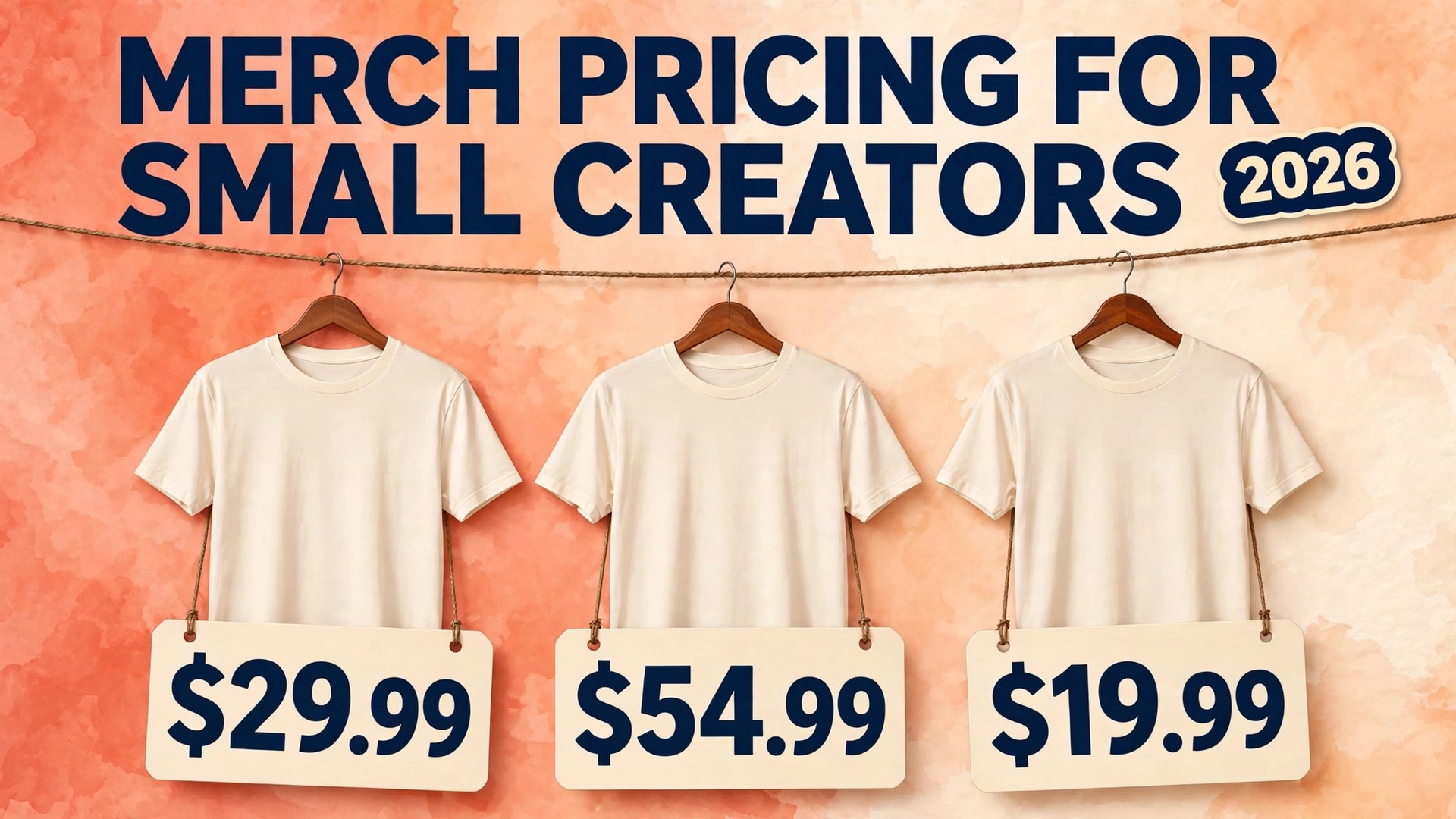
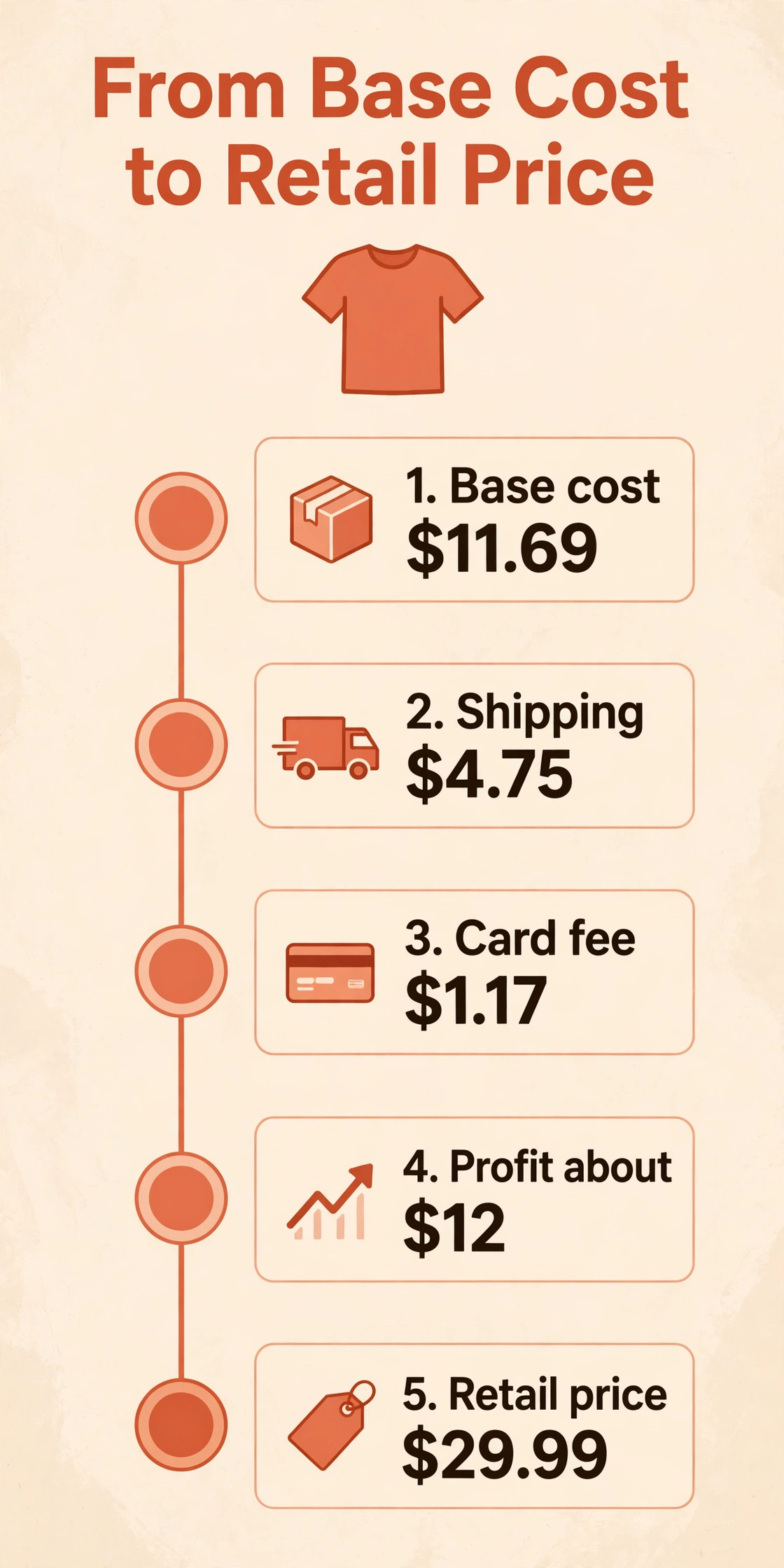
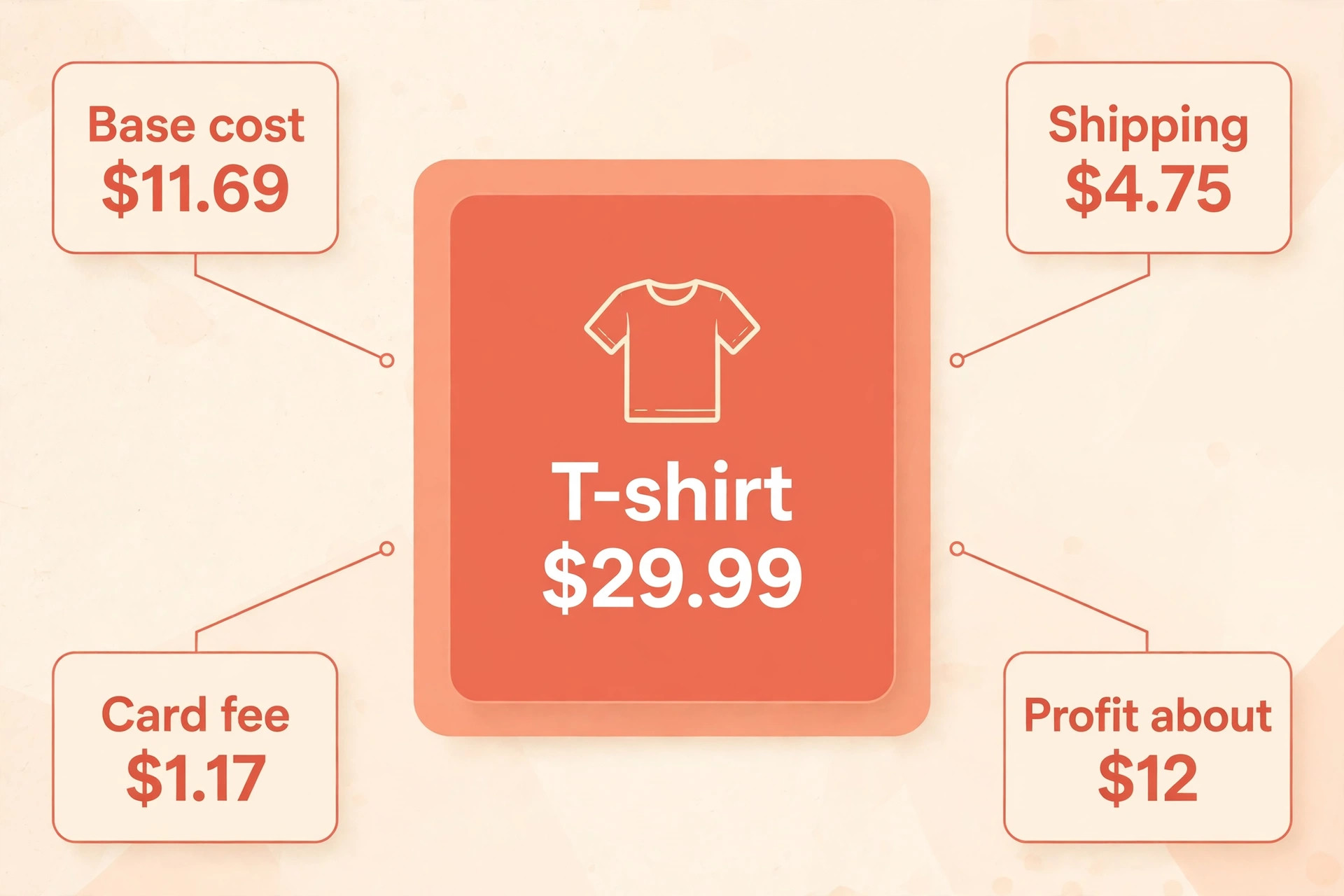
A t-shirt sold for 29.99 dollars through Printful on your own store leaves about 12 to 15 dollars after base cost and payment processing, while the same shirt through Printify can leave 14 to 17 dollars, and through Merch by Amazon it leaves only 4 to 7 dollars in royalty. Those three numbers explain merch pricing for small creators better than any platform homepage, because the gap between them is not a small rounding difference. It is the difference between a merch line that pays for itself and one that eats your time for a few dollars a sale.
This guide compares the real base costs, shipping, fees and subscriptions across the main print on demand platforms, so you can price a shirt, a hoodie, a mug and a hat with numbers you can trust.
Print on demand removes the biggest barrier to selling physical products, because you never buy inventory. A supplier prints each order after the sale and ships it straight to your buyer. The risk moves elsewhere, into margins, because every sale has three cost layers and the platform you choose decides how thick each layer is.
The first layer is the base cost, which covers printing, materials and fulfilment. The second layer is the marketplace or platform fee, if you sell through Etsy, Amazon or a similar marketplace. The third layer is payment processing, usually 2.9 percent plus 30 cents on a self hosted store. A creator who prices from the retail price alone, without subtracting all three layers, will overstate the profit on every sale. This guide works through each layer with real 2026 numbers, checked against vendor pages and current roundups in November 2026.
How Merch Pricing Works
Every print on demand sale starts with the base cost, and in merch pricing for small creators the base cost is where platforms differ most. A standard cotton t-shirt has a base cost of 8 to 14 dollars depending on the provider, the print method, and the number of print areas. A front only print costs less than a front and back print, and a premium blank costs more than a basic blank. The blank itself matters, because a Bella and Canvas 3001 tee, the most quoted blank in this market, costs more than a basic Gildan tee, but it also sells better at a higher retail price.
Shipping is the second cost inside the base layer, and it is easy to miss. Printful charges about 4.75 dollars for US shipping on one shirt, Printify shipping is set by the print provider and often starts near 3.99 dollars, and Gelato charges 4.99 dollars for the first tee and 99 cents for each extra tee. If you offer free shipping to the buyer, you pay that cost. If you charge the buyer for shipping, fewer of them complete the purchase. There is no free choice here, only a trade off you must price in.
The third cost is the platform fee. Marketplaces take a cut, store builders charge a subscription, and some creator platforms take a percentage of memberships or digital sales. Etsy charges a listing fee and a transaction fee on top of payment processing. Amazon takes a larger share through its royalty structure, but it brings its own traffic. A creator platform with no monthly fee usually charges more per item, while a platform with a monthly fee usually charges less per item. The right choice depends on how many units you sell a month.
Merch Pricing for Small Creators by Product
| Product | Printful base | Printify base | Gelato base | Typical retail | Profit at retail |
|---|---|---|---|---|---|
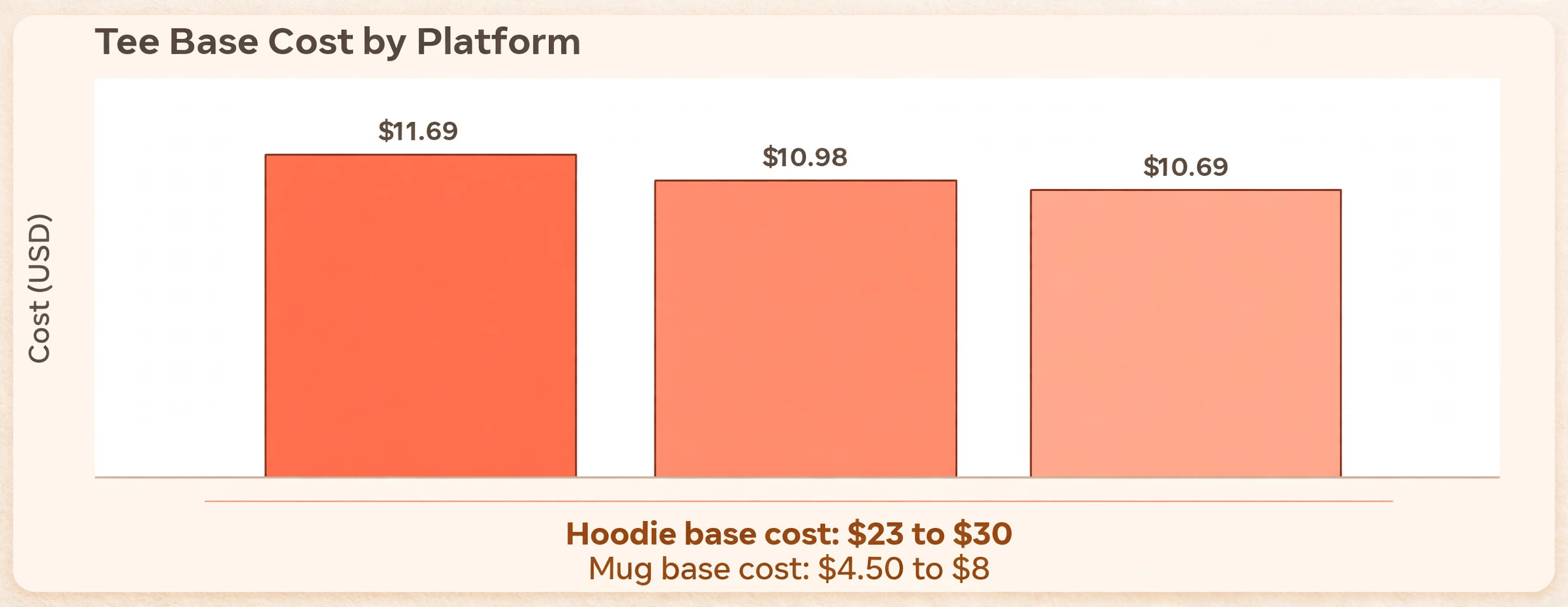
| Bella and Canvas 3001 tee | 11.69 dollars | 10.98 dollars | 10.69 dollars | 29.99 dollars | 14 to 17 dollars |
| Crewneck sweatshirt | 21.95 dollars | 16 to 22 dollars | 19 to 24 dollars | 49.99 dollars | 20 to 28 dollars |
| Hoodie | 27 to 29 dollars | 23 to 28 dollars | 25 to 30 dollars | 54.99 dollars | 20 to 27 dollars |
| 11 ounce mug | 6.95 dollars | 4.50 to 7 dollars | 6 to 8 dollars | 19.99 dollars | 9 to 13 dollars |
| Embroidered dad hat | 14.95 dollars | 11.57 dollars | 13 to 16 dollars | 28 dollars | 9 to 13 dollars |
| Phone case | 8 to 10 dollars | 5 to 9 dollars | 7 to 10 dollars | 24.99 dollars | 11 to 16 dollars |
| Tote bag | 9 to 12 dollars | 7 to 11 dollars | 8 to 12 dollars | 24.99 dollars | 10 to 14 dollars |
| Poster print | 8 to 12 dollars | 6 to 10 dollars | 7 to 11 dollars | 24.99 dollars | 10 to 15 dollars |
Read this table as a range, not a promise. Base costs change by provider, region, size and colour, and the profit column is before shipping and payment processing. A white tee costs less than a black tee on some providers, an extra large size costs more than a medium, and a second print area adds a dollar. The table still shows the pattern that matters. Printify is usually cheapest on base cost, Printful is usually dearest, and Gelato sits between them, with local production that can cut international shipping.
Hoodies earn more dollars per sale than tees, even though they cost more to make. A hoodie with a base cost near 28 dollars and a retail price near 55 dollars leaves about 20 dollars or more before shipping, while a tee leaves about 15 dollars. Mugs look cheap to make, but they are heavy to ship and easy to break, so shipping and replacement eat the margin. Hats earn well per unit, but digitisation fees apply to the first order, from free on Printify to about 6.50 dollars for an image on Printful.
The Main Platforms Compared
The platforms below fall into three groups. The first group is fulfilment only, where you bring your own store and the platform prints and ships. The second group is a storefront, where the platform gives you the shop, the checkout and the fulfilment in one account. The third group is a marketplace, where the platform brings the traffic and takes a larger share. Merch pricing for small creators changes with the group, because a marketplace charges you in margin while a storefront charges you in work.
1. Printful
Printful is the quality first option, and the widely used print on demand provider for creators who prioritise print quality and brand presentation. It runs its own fulfilment centres, so print quality is consistent, fulfilment takes 2 to 5 business days for most US orders, and packaging is better, with branded packing slips and poly mailers instead of bare plastic bags. For a creator building a brand, that consistency is worth real money in fewer complaints and returns.
The base costs sit at the higher end of the market. A Bella and Canvas 3001 tee costs about 11.69 dollars for a size medium with one print, a Gildan crewneck sweatshirt costs 21.95 dollars, and an 11 ounce white mug costs 6.95 dollars. Shipping starts at 4.75 dollars for one shirt in the US. Branding costs extra, with inside labels at 99 cents and outside labels at 2.49 dollars per item. The Growth plan costs 24.99 dollars a month and cuts product prices by up to 33 percent, and it becomes free once your store passes 12,000 dollars a year in sales.
Printful suits a creator with an existing audience who expects quality and will pay a premium retail price. It does not suit a creator competing on the lowest price, because the base cost leaves less margin at a 25 dollar retail price. Use Printful when the brand matters more than the last two dollars of margin.
2. Printify
Printify is the margin optimiser, because it is a marketplace of print providers rather than a single fulfilment company. You compare providers by price, location, quality rating and shipping time, then pick the one that fits each product. That competition drives base costs 15 to 30 percent below Printful on many products, with a standard tee from 7.50 to 11 dollars, a crewneck from 16 to 22 dollars, and a mug from 4.50 to 7 dollars.
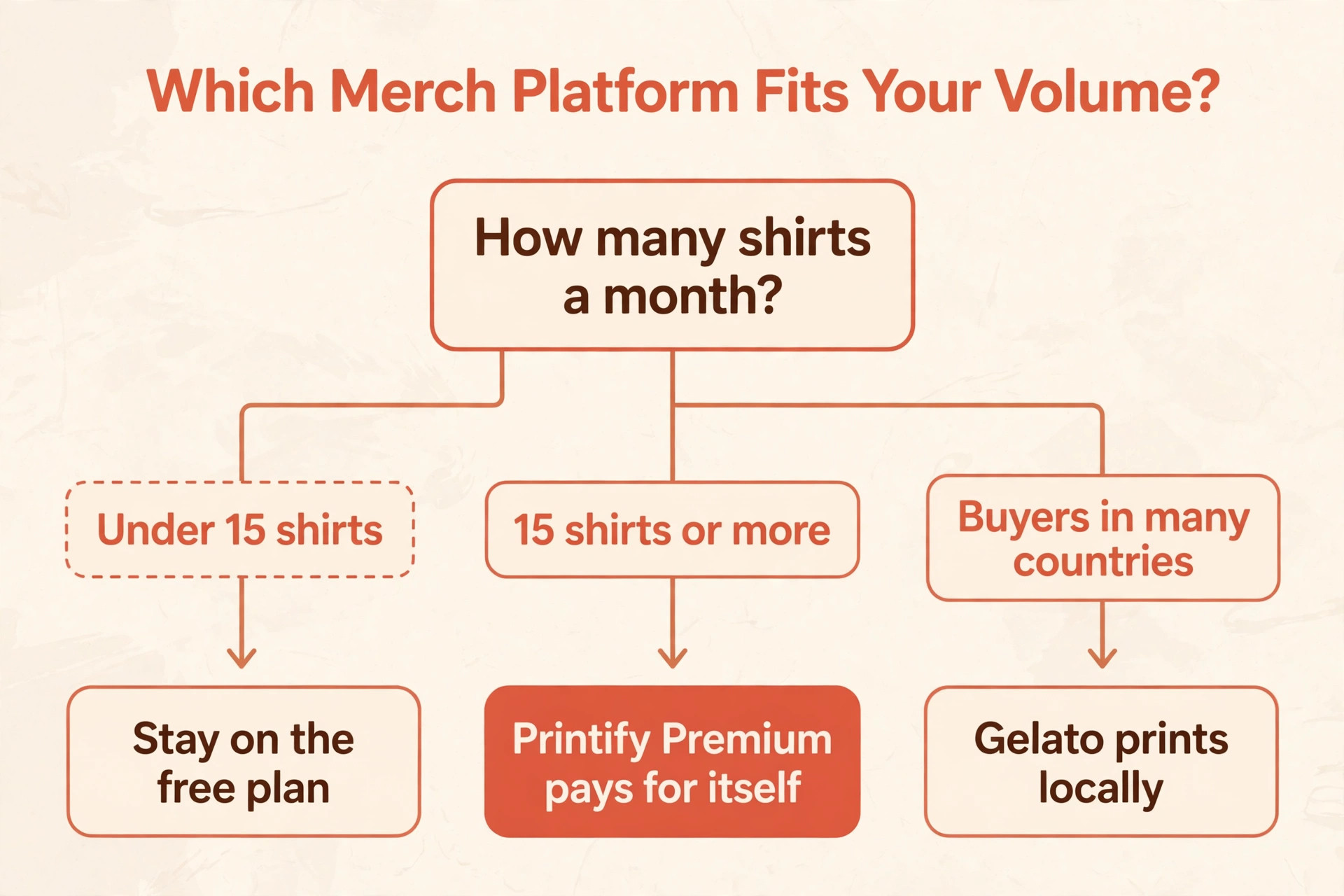
The free plan covers up to 5 stores, and Premium costs 29.99 dollars a month on some pages and 39 dollars a month on others, with 24.99 dollars a month billed yearly in the most recent pricing we checked. Premium cuts base costs by up to 20 percent, so it pays for itself once you sell enough units to save more than the monthly fee, near 12 to 15 shirts a month at a 2 dollar saving per shirt.
The trade off is variability. One provider may print beautifully and ship fast, while another prints the same design with a different colour and a slower dispatch. You must test each provider with a sample order before you trust it with customers. Printify suits a creator who wants the fattest margin and is willing to manage providers.
3. Gelato
Gelato is the best pick for a creator with buyers in several countries, because it prints locally in more than 30 countries. A buyer in Berlin gets a shirt printed in Europe, not shipped from the US, which cuts shipping cost and delivery time and avoids customs delays. That local production is the main reason to choose Gelato over a US only provider.
A Bella and Canvas 3001 tee costs about 10.69 dollars, with US shipping at 4.99 dollars for the first tee and 99 cents for each extra tee. Gelato also offers a paid plan, Gelato Plus, from about 29.99 dollars a month, or 19.99 dollars billed yearly in some roundups, with discounts on products. The catalogue is smaller than Printify, with fewer products and fewer providers to compare, but the products it does carry are well made and the shipping is predictable.
Gelato suits a creator with an international audience, a YouTuber or a podcaster whose listeners live on several continents. It does not suit a creator who needs the widest catalogue or the absolute lowest base cost on a single product. Use Gelato when shipping time and international delivery matter as much as the print itself.
4. Spring
Spring, formerly Teespring, is the simplest creator storefront on this list. You design products, share your storefront link, and Spring handles printing, shipping and customer support. There are no upfront costs, no monthly fees and no listing fees. You earn the margin between the base cost and the retail price you set, and Spring keeps the base cost.
A basic tee has a base cost near 12 to 15 dollars before shipping, a premium hoodie near 26 dollars, and a ceramic mug near 12 dollars. If you price a shirt at 25 dollars, your net margin is about 10 dollars. That is thinner than Printify on your own store, but you pay nothing to start and you do no fulfilment work. Spring is integrated with YouTube, Twitch and TikTok, so a creator can sell from a video page without building a store.
Spring suits a creator who wants merch live today with no store, no subscription and no fulfilment. It does not suit a creator who wants brand control, custom packaging, or the best margin, because the base costs are high and the storefront looks like Spring, not like your brand.
5. Fourthwall
Fourthwall is the modern creator commerce platform, and the best pick for a creator who wants a storefront, memberships and digital products in one account. It is built for YouTubers, streamers and podcasters who want to sell merch next to memberships, without connecting a second platform for payments or fulfilment. The storefront is branded as yours, not as Fourthwall.
The core storefront is free, with no monthly fee and no platform fee on physical products you sell from the catalogue. You keep the difference between your retail price and the listed base cost, which for a Bella and Canvas 3001 tee is about 11.75 dollars. Pro costs 19 dollars a month, or 15 dollars billed yearly, and removes fees on digital products, adds storage and a free domain. Memberships carry a 5 percent fee, and card processing is 2.9 percent plus 30 cents on US transactions.
Fourthwall suits a creator with a community that buys more than merch, because the membership and digital tools share the same checkout. It does not suit a seller who only needs fulfilment for an existing Shopify store, because the storefront is the product.
6. Bonfire
Bonfire runs on campaigns, which makes it different from every other platform here. You design a shirt, set a sales goal and a deadline, and buyers order during the campaign window. Nothing prints until the campaign funds, so there is zero inventory risk and zero upfront cost. That model suits fundraisers, clubs, nonprofits and one off designs.
A premium unisex tee has a base cost near 17.98 dollars, with US shipping at 5.99 dollars for the first tee and 3 dollars for each extra tee. That base cost is higher than Printful or Printify, so the margin per shirt is thinner at the same retail price. Bonfire Pro stores start from 9.99 dollars a month for a permanent storefront, which suits a creator who runs campaigns often.
Bonfire suits a fundraiser, a school, a team or a creator launching a limited design with a deadline. It does not suit a creator who wants an always open store with a wide catalogue, because the campaign model is built for events, not for everyday sales.
7. Merch by Amazon
Merch by Amazon puts your designs in front of the largest ecommerce audience in the world, with Prime shipping and Amazon customer service included. You upload artwork, set a price above the Amazon base cost, and Amazon handles printing, shipping and returns. For a creator with no audience of their own, that traffic is the attraction.
The royalty is the drawback. A shirt sold for 29.99 dollars leaves only about 4 to 7 dollars in royalty, far less than the 12 to 17 dollars you keep on your own store. You need approval to join, and new accounts start with tiered upload limits that grow with sales. You also give up brand control, because the product page looks like Amazon, not like your brand.
Merch by Amazon suits a designer with many designs who wants search traffic without marketing each one. It does not suit a creator building a brand, because the margin is thin and the customer belongs to Amazon.
8. Sellfy
Sellfy is a store builder with built in fulfilment, and the best pick for a creator who sells merch next to digital products. One flat monthly fee covers the store, the checkout and the fulfilment, with no commissions on your sales. That single subscription replaces a store builder, a payment tool and a fulfilment connection.
A Bella and Canvas 3001 tee costs from 11.69 dollars, with US shipping at 3.99 dollars for the first tee and 2 dollars for each extra tee. Starter costs 22 dollars a month billed annually, or 29 dollars month to month, with a cap of 10,000 dollars in annual sales on Starter. Business costs 79 dollars a month, or 59 dollars billed yearly. The catalogue is smaller than Printful or Printify, with about 592 products, but it covers the core merch range.
Sellfy suits a creator who already sells digital products, courses or subscriptions and wants merch in the same store. It does not suit a seller who needs the widest product catalogue or the lowest base cost.
How to Price Your First Products
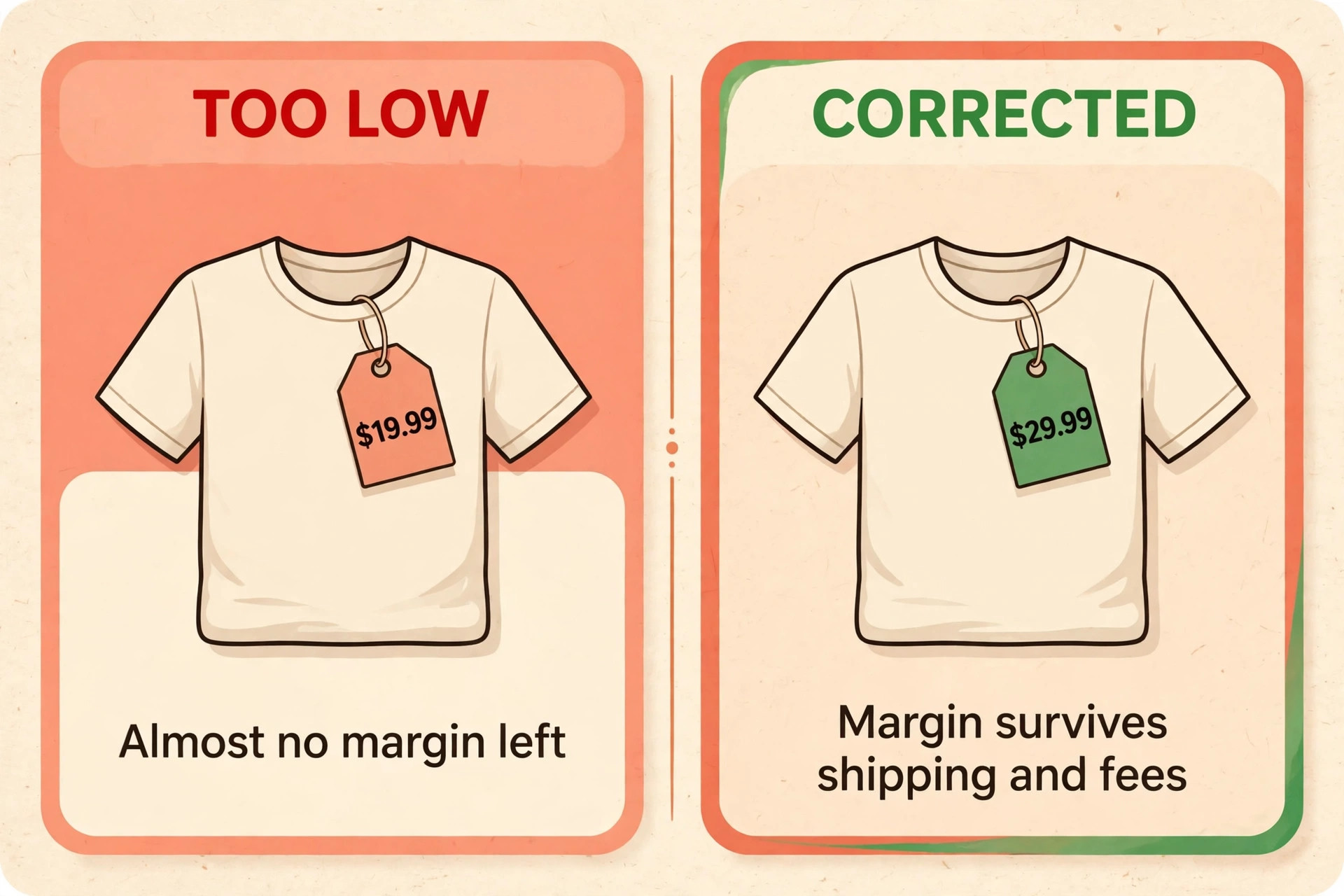
Start with the product that earns the most trust, not the product with the highest margin, because merch pricing for small creators rewards trust first and volume second. For most small creators that is a tee, because buyers know their size, they know the fit, and they will pay 25 to 30 dollars for a shirt they like. Price the tee at 29.99 dollars, not 19.99 dollars, because a 19.99 dollar price leaves almost no margin after base cost, shipping and processing. A creator who prices too low to win the sale loses money on every order and cannot afford to advertise the next one.
Next, price the hoodie as the premium product. A hoodie at 49.99 to 59.99 dollars leaves 20 to 28 dollars before shipping, which is the best dollar margin in a small merch range. Hoodies also sell in colder months and at events, so they carry the range when tee sales slow. A mug at 16.99 to 24.99 dollars looks like easy money, but the shipping cost and the breakage rate make it a poor first product unless your audience already asks for it.
Then work out the break even point for any subscription. Printful Growth at 24.99 dollars a month pays for itself near 11 hats or 5 hoodies a month in one 2026 analysis. Printify Premium at 29.99 dollars a month pays for itself near 12 to 15 shirts a month at a 2 dollar saving per shirt. Below that volume, stay on the free plan.
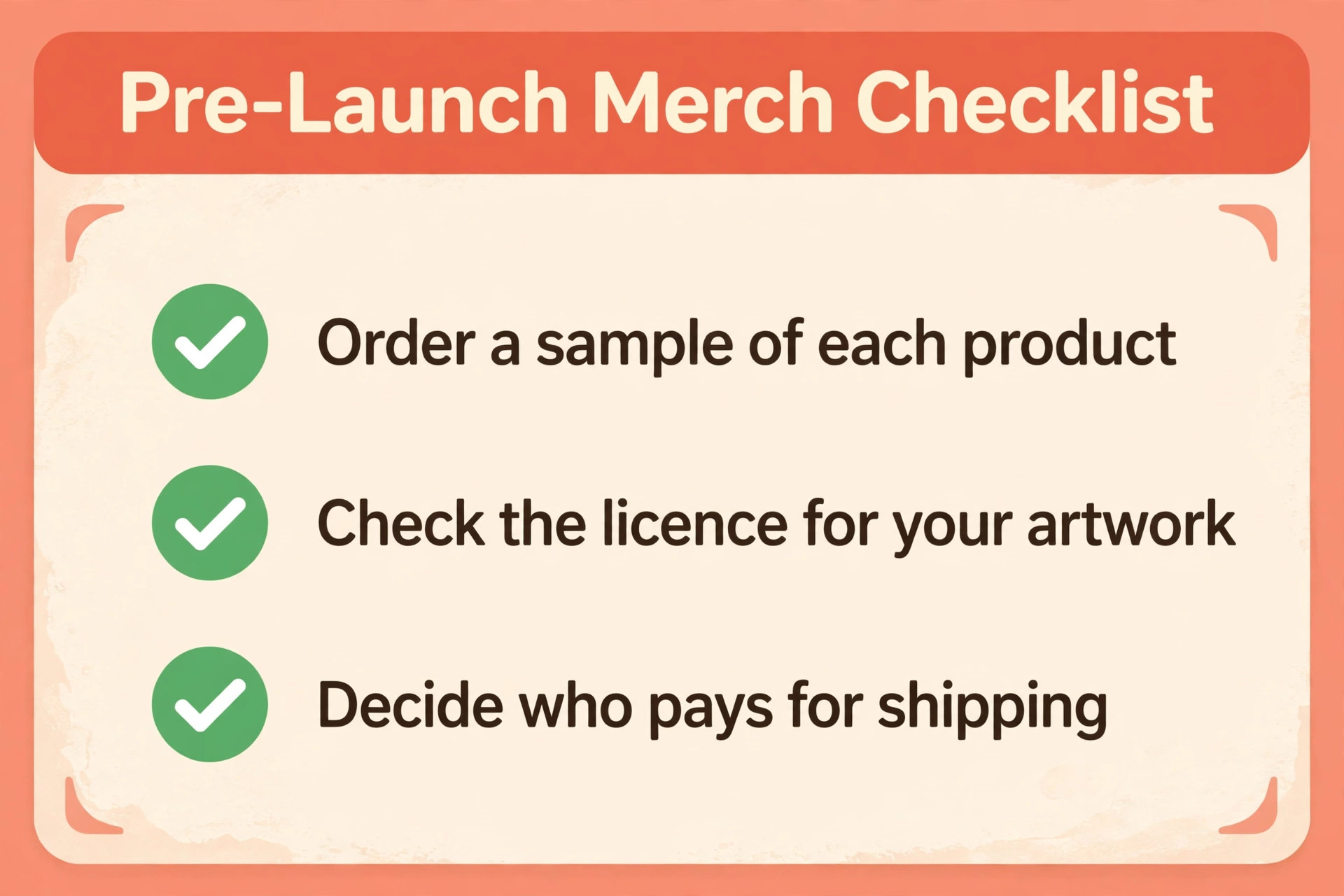
Finally, decide who pays for shipping before you launch. Free shipping increases conversion, but it moves the shipping cost into your margin. A shirt at 29.99 dollars with free shipping leaves about 12 dollars after base cost, shipping and card fees. The same shirt with the buyer paying shipping leaves about 17 dollars, but fewer buyers complete the purchase. Test both for a month and keep the one that earns more total profit.
- Price the tee at 29.99 dollars, not 19.99 dollars, so the margin survives shipping and card fees.
- Price the hoodie at 49.99 to 59.99 dollars as the premium product in the range.
- Work out the subscription break even point in units per month before you pay for a plan.
- Decide who pays for shipping, then test free shipping for a month and compare total profit.
- Add the card fee, 2.9 percent plus 30 cents, to every price calculation.
What to Check Before You Launch
Check the sample before you sell. Order one of each product you plan to sell, wear it, wash it, and photograph it. A print that looks sharp on screen can crack after one wash, a colour can shift on a dark blank, and a size can run small. A sample costs one base cost plus shipping, and it saves you from a hundred returns.
Check the licence for your artwork too. A design that uses a font, a photo or a logo you do not own can get your store closed and your payouts held. Use artwork you made, fonts with a commercial licence, and photos you own or licensed. Keep the licence receipts.
Check the tax and payout terms as well. Some platforms act as the merchant of record and handle sales tax for you, while others leave tax to you. Some pay weekly, some pay after the order ships, and some hold payouts for new accounts. Read the payout schedule before you promise a launch date to your audience.
Check the return policy in the same pass. Print on demand suppliers usually reprint a damaged or misprinted item, but they do not refund a buyer who ordered the wrong size. Decide who bears that cost before the first return arrives, and write it in plain language on the product page. A clear return policy costs you fewer disputes than a generous one you cannot afford.
Mistakes That Eat Your Margin
The most common mistake is pricing from the retail price alone. A creator sees a 25 dollar shirt, subtracts a 10 dollar base cost, and thinks the profit is 15 dollars. The real profit is closer to 10 dollars after shipping and card fees, and closer to 7 dollars if the buyer returns it. Price from the full cost, not from the retail price, and write the full calculation down for each product before you launch.
The second mistake in merch pricing for small creators is launching ten products at once. A creator with ten products and no sales has ten samples to buy, ten product pages to write, and ten designs to promote, while a creator with three products has three of each and can focus. Start with a tee, a hoodie and one more product your audience already asks for, then add products when the first three sell. A small range that sells beats a large range that sits.
The third mistake is paying for a subscription before the volume justifies it. A 29.99 dollar Premium plan that saves 2 dollars a shirt needs 15 shirts a month to break even. A creator selling 5 shirts a month loses 20 dollars a month on that plan, every month, for a discount they do not use. Stay on the free plan until the unit count proves the subscription pays, then upgrade and keep the receipt as proof.
The fourth mistake is ignoring the shipping cost in the retail price. A mug that costs 6.95 dollars to print and 5 dollars to ship is not a 12 dollar product, it is a 12 dollar product plus a 5 dollar shipping bill that someone must pay. If you absorb it, your margin falls by 5 dollars. If the buyer pays it, the total price rises to nearly 25 dollars and the buyer may abandon the cart.
What Merch Should Actually Cost You
Printify is the pick for most small creators on margin, because the provider marketplace gives the lowest base costs and the Premium plan pays for itself near 12 to 15 shirts a month. It suits a creator who will test providers with sample orders and manage the catalogue actively. Printful is the pick when quality and brand presentation matter more than the last two dollars of margin, because its own fulfilment centres give consistent prints and better packaging.
Fourthwall is the pick for a creator with a community, because the storefront, memberships and digital products share one checkout with no monthly fee on the core plan. Spring is the pick for a first launch with no store and no budget, because it is free to start and handles everything. Merch by Amazon is the pick for an extra channel, not a main income, because the royalty of 4 to 7 dollars a shirt is thin next to the 12 to 17 dollars you keep on your own store.
Start with three products, price the tee at 29.99 dollars, order samples, and sell through the platform that fits your audience size today. When the volume grows past 15 shirts a month, move to a paid plan that cuts the base cost, and when the audience grows past one country, move to a provider that prints locally. Merch pricing for small creators is a margin game, and the creator who knows the full cost per sale wins it.
Frequently Asked Questions
How much profit do small creators make per merch sale?
A small creator makes about 12 to 17 dollars per t-shirt sold for 29.99 dollars on their own store, after base cost and card fees but before shipping. The same shirt on Merch by Amazon leaves only 4 to 7 dollars in royalty, while a hoodie sold for 54.99 dollars leaves about 20 to 27 dollars. The exact profit depends on the provider, the blank, the print areas and who pays for shipping, so work out the full cost for each product before you set the price.
What is the cheapest print on demand platform for small creators?
Printify is usually the cheapest on base cost, with a standard tee from 7.50 to 11 dollars depending on the provider, against 11.69 dollars at Printful and 10.69 dollars at Gelato for the same blank. The free plan costs nothing, and Premium costs 29.99 dollars a month on some pages, with 24.99 dollars billed yearly in the most recent pricing we checked. The cheapest base cost is not always the cheapest total cost, because shipping and provider quality vary, so order a sample before you commit.
Do I need to pay a monthly fee to sell merch?
No, most platforms are free to start. Printful, Printify, Spring, Fourthwall, Bonfire and Merch by Amazon all have a free tier with no monthly fee, and you pay only the base cost and shipping when an order is placed. A monthly fee buys lower base costs, and it pays for itself only when you sell enough units. Printful Growth at 24.99 dollars a month and Printify Premium at 29.99 dollars a month both break even near 12 to 15 shirts a month, so stay free until your volume proves the upgrade pays.
How should I price a t-shirt as a small creator?
Price a standard tee at 25 to 30 dollars, with 29.99 dollars as the most common price in the 2026 comparisons we checked. A 19.99 dollar price leaves almost no margin after an 11 dollar base cost, 4 to 5 dollars shipping and card fees. A premium blank or a two sided print justifies the higher end of the range, while a basic blank at a fundraiser can sit at the lower end. Test the price for a month, then keep the price that earns the most total profit, not the most sales.
Is Merch by Amazon worth it for small creators?
Merch by Amazon is worth it as an extra channel, but not as a main income. It brings Amazon traffic and Prime shipping with no upfront cost, but the royalty of 4 to 7 dollars a shirt is far below the 12 to 17 dollars you keep on your own store. You also need approval to join, and new accounts start with tiered upload limits. Use it for designs that benefit from search traffic, and keep your main merch range on a storefront where you keep the margin and the customer.
What costs do creators forget when pricing merch?
In merch pricing for small creators, the costs most often forgotten are shipping, card fees, sample costs, label and branding fees, and returns. Shipping runs 3.99 to 5.99 dollars per shirt in the US, card fees run 2.9 percent plus 30 cents per order, Printful charges 99 cents for an inside label and 2.49 dollars for an outside label, and a reprint or a return can erase the profit on several good sales. Add all of those costs to the base cost before you set the retail price, and keep a simple sheet that shows the full cost per product.
A merch range that earns money is a range priced from the full cost, not from hope. Start with three products, order the samples, and price the tee at 29.99 dollars. When the orders grow, the subscription that cuts the base cost will pay for itself, and when the audience grows, the provider that prints locally will save you shipping time and money.