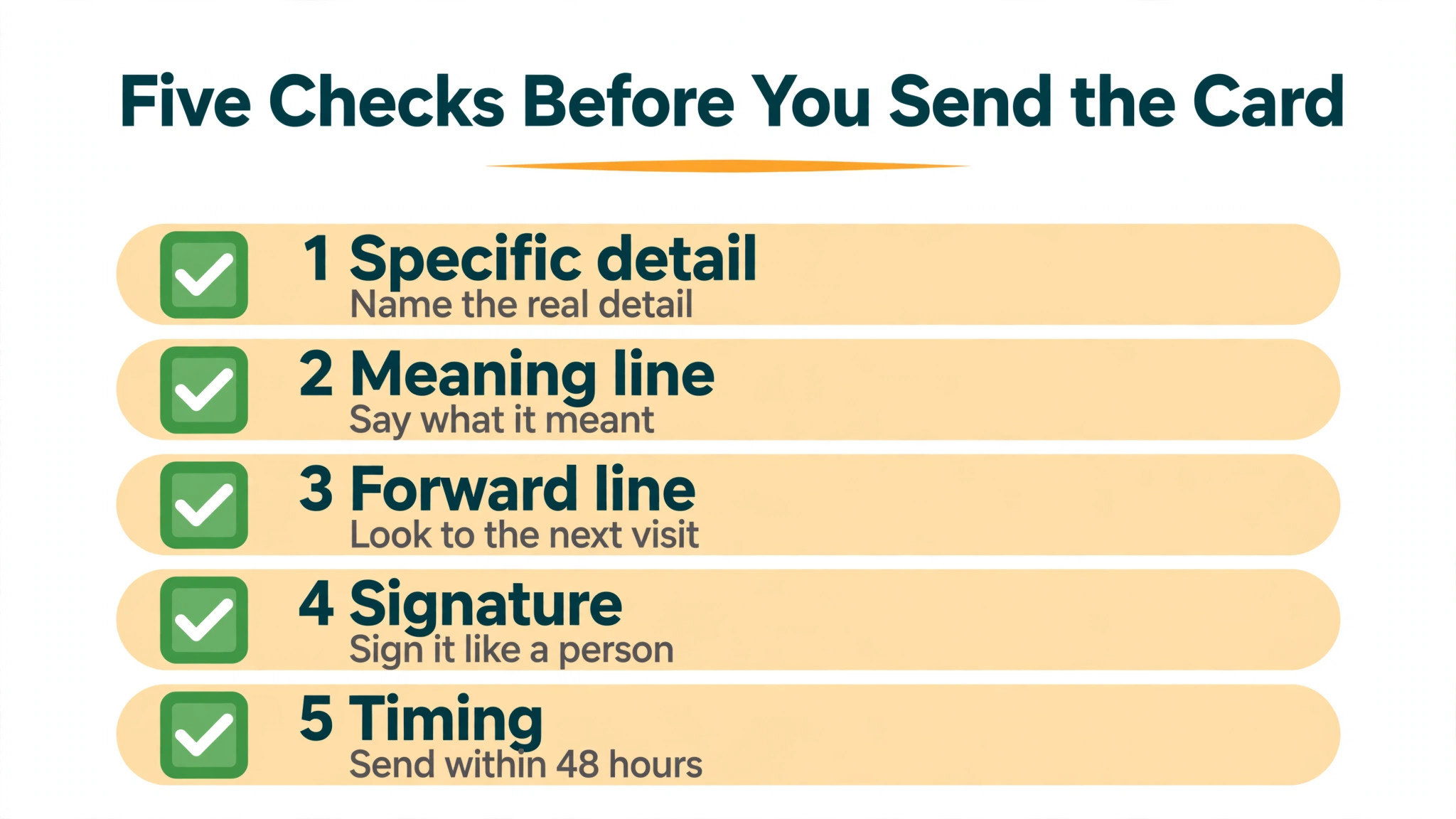
The best thank you card is short, specific, and sent within 48 hours. That is the whole secret, and most businesses get all three parts wrong. They write a long generic note, they praise the customer in vague terms, and they send it three weeks after the purchase, when the moment has already passed. Learning how to write a thank you card for customers is really about fixing those three habits, and the rest of this guide shows you how to do it with examples you can adapt today.
A thank you card is the cheapest retention tool a small business owns. It costs less than a dollar to print and post, it takes five minutes to write, and it is one of the few pieces of business mail a customer actually reads to the end. Unlike a discount code or a loyalty email, it asks for nothing. That is exactly why it works. A customer who feels noticed comes back, and a customer who comes back tells other people.
What a Good Thank You Card Does
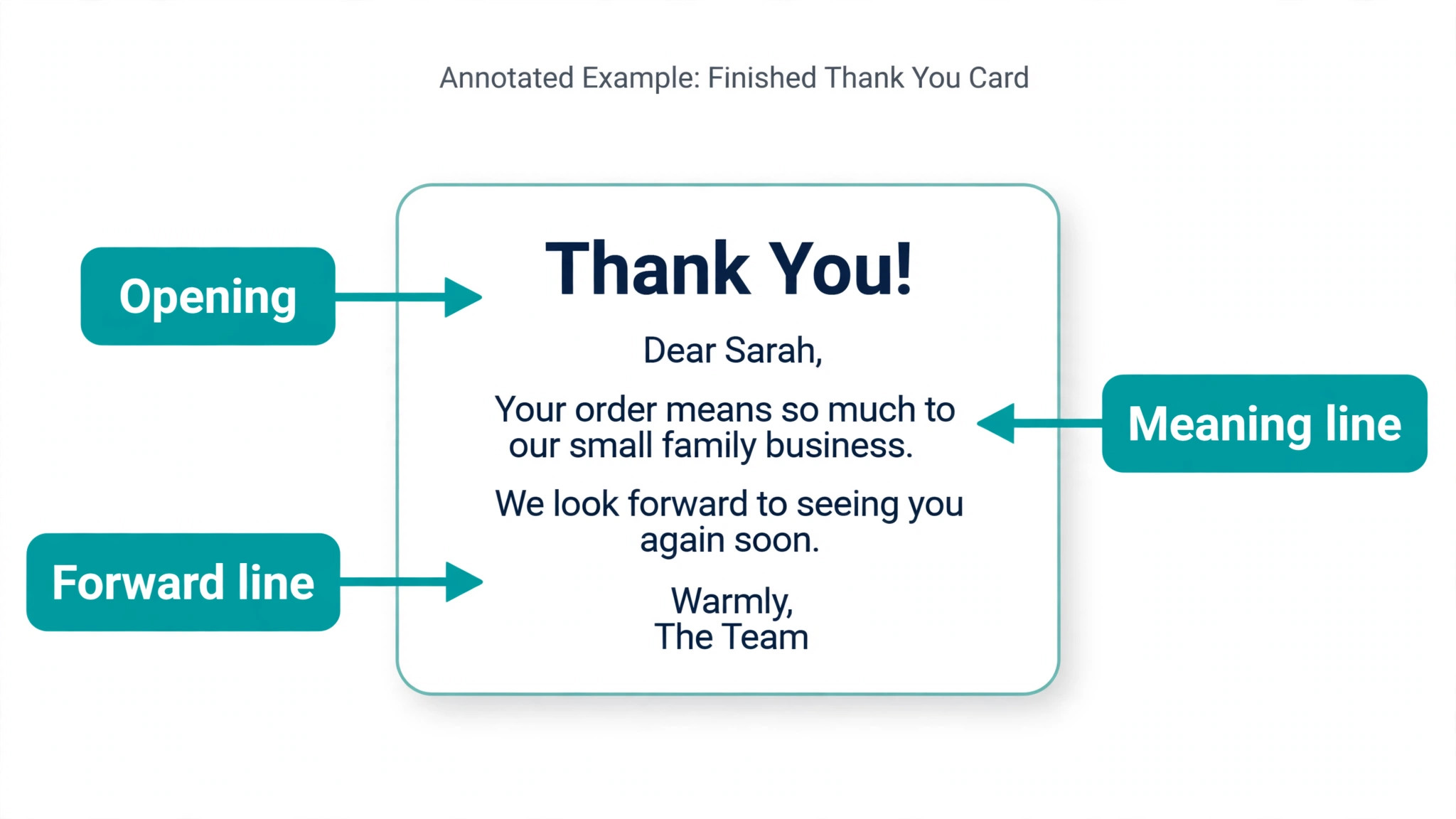
A good card does three jobs at once. First, it names the specific thing the customer did, so the reader knows the note is really for them. Second, it says what that thing meant to the business, which turns a transaction into a relationship. Third, it looks forward, with one line about the next visit, the next order, or the next time you will see each other. Cards that skip any of these three jobs read as form letters, and form letters get thrown away.
Tone matters as much as structure. Write the way you talk to a regular at the counter, not the way a press release talks to the public. Short sentences beat long ones. One real detail beats three adjectives. If you would not say a sentence out loud to the customer, do not write it in the card. The examples later in this guide follow that rule, and you can lift the wording directly.
That structure is the core of how to write a thank you card for customers that gets read instead of binned.
Best Pick by Job
| Job | Pick | Why it wins |
|---|---|---|
| Handwritten card | Blank card plus pen | Feels personal, costs the least |
| Printed batch | Vistaprint | Cheap per card at volume |
| Designed card | Canva | Templates plus print ordering |
| Email version | Paperless Post | Tracked delivery, no postage |
| Luxury feel | Minted | Thick stock, premium designs |
When to Send a Thank You Card
Timing is the part most guides skip, and it is the part that decides whether the card lands. For a first purchase, send the card within 48 hours. The customer still remembers the visit, the product is still new, and the note feels like a natural end to the experience rather than a marketing afterthought. For a referral, send it the same week the new customer arrives, because the referrer should hear the thanks while the introduction is still fresh.
For a loyal customer, the calendar matters more than the clock. A card on the anniversary of their first purchase, or at the end of a year of regular visits, carries more weight than a card sent at a random moment. For a service recovery, speed matters most of all. A card that arrives two days after a problem was fixed says the business took the complaint seriously. A card that arrives a month later says the business has a reminder system and not much else.
The 8 Steps
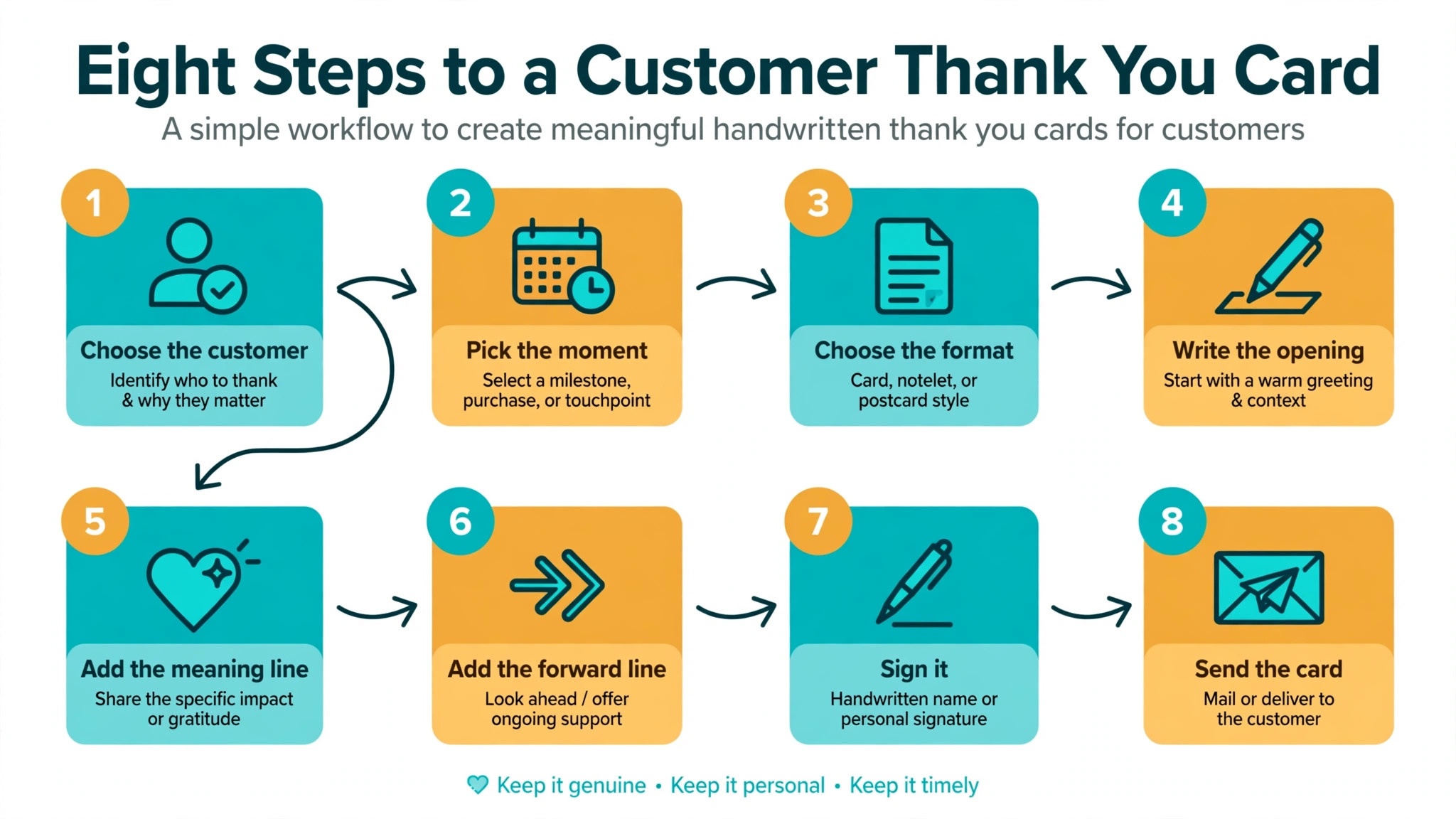
Step 1. Decide Who Gets a Card and Why
Not every customer needs a card, and sending one to everyone is how thank you notes turn into junk mail. Start with the customers who changed something for the business. First time buyers who spent real money, customers who referred a friend, regulars who have visited ten times, and anyone who left a thoughtful review all qualify. Each of these people did something specific, and that specific thing is what the card will talk about.
Write the reason down before you write the card. A single line in your own words is enough, such as the customer who drove across town for a Saturday appointment, or the regular who brings her sister every month. That line becomes the opening of the card, and it is the difference between a note that feels personal and a note that feels printed. If you cannot name the reason, the customer does not need a card yet, and your time is better spent on someone you can name.
Step 2. Pick the Format
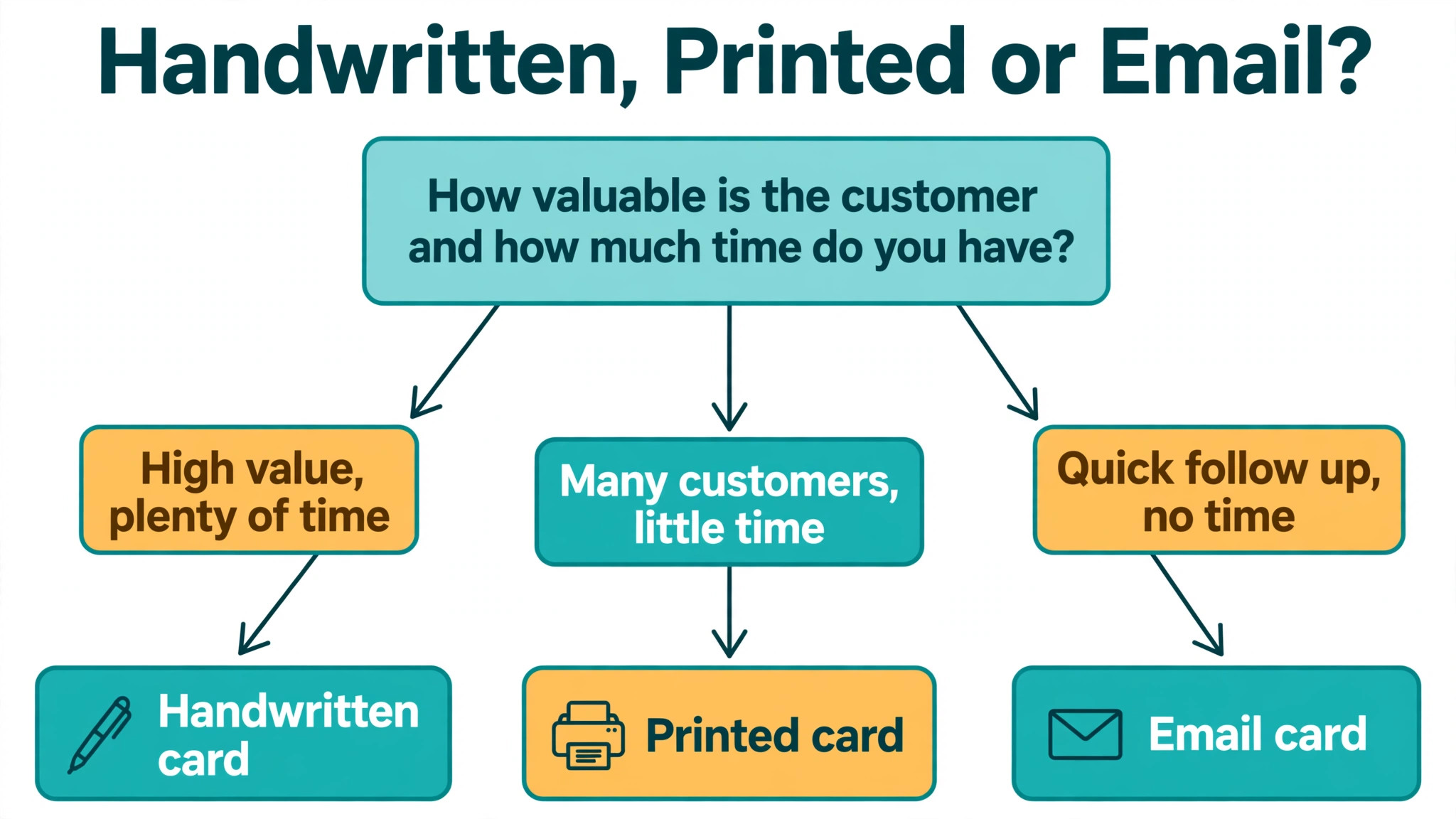
The format should match the relationship. A handwritten card on plain stock is the right choice for a high value customer, a referral, or anyone you know by name, because the handwriting itself is the message. It says a person sat down and wrote this, and no other format says that as clearly. Keep a box of blank cards and a good pen at the counter so the habit is easy.
A printed card suits volume. If you send twenty cards a month, a printed design with your logo and a short handwritten line inside gives you the best of both worlds, and it costs a few cents per card at volume. Email works when speed matters more than touch, such as a thank you sent the same evening as an online order, or a note to a customer in another country. The rule is simple. The closer the relationship, the more physical the card should be.
Step 3. Open With the Specific Thing
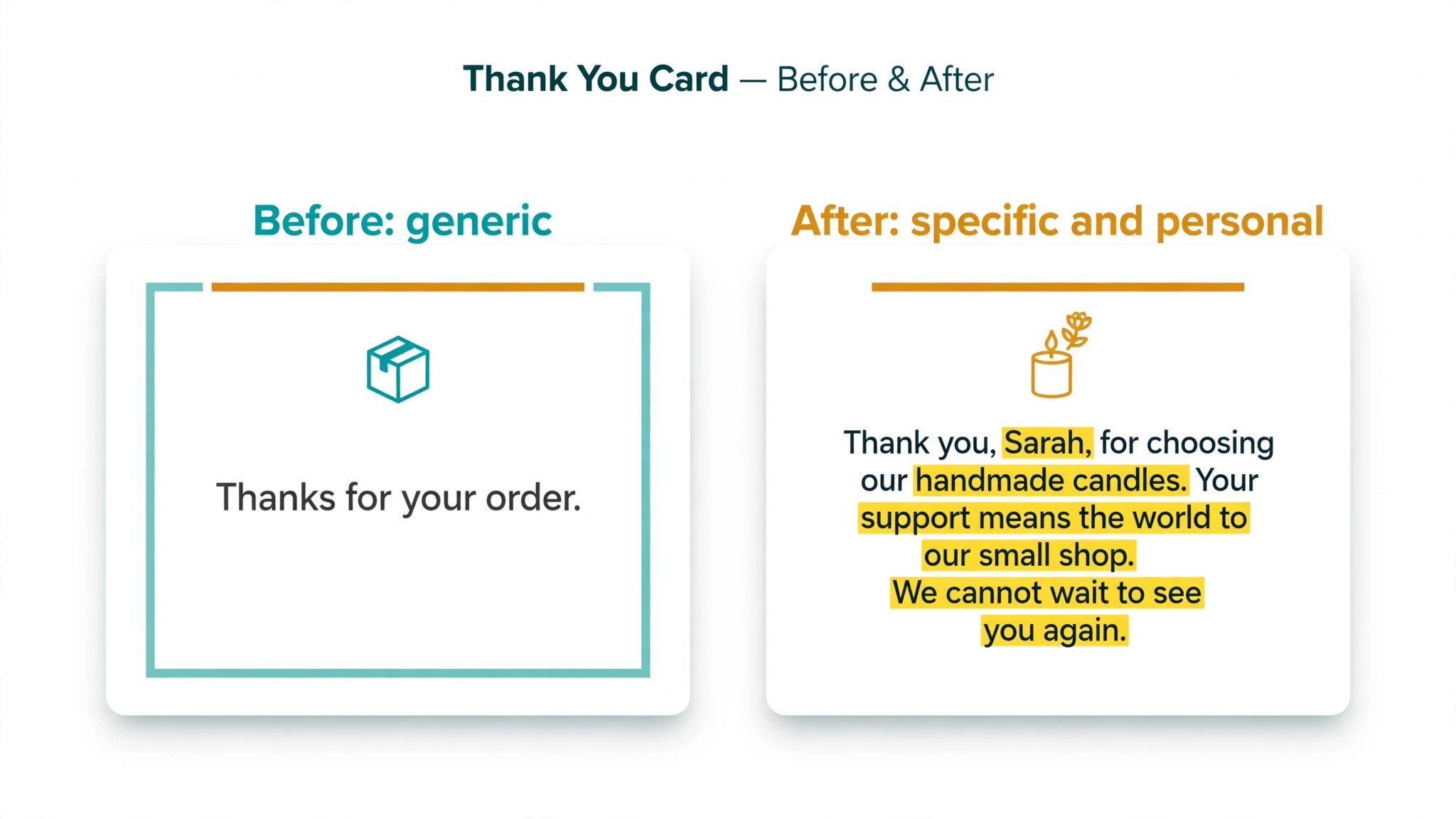
The first line of the card is the whole test. A weak opening says thank you for your business, which could have been written to anyone. A strong opening names the thing, such as thank you for choosing the oak dining table on Saturday, or thank you for sending your brother to us last week. The reader knows in the first five words that the card is theirs, and that knowledge is what makes them read the second sentence.
Keep the opening to one sentence and put the detail in it. The product, the date, the visit, or the referral all work. What does not work is a compliment about the customer in general terms, because general praise sounds like flattery and flattery sounds like a sales pitch. If you struggle to write the opening, go back to step one and find the reason again. A clear reason writes its own first line, and a vague reason writes a vague card.
Step 4. Say What It Meant to You
The second line is where most cards go flat. They repeat the thanks instead of explaining it. Saying thank you twice is not more grateful than saying it once. What the reader wants to know is what their purchase or referral actually did for the business. A sentence like your order helped us through our slowest month, or your referral brought us our first customer from your neighbourhood, gives the thanks a weight that a second thank you never will.
Honesty is the only rule here. Do not invent a story about what the order meant. If the truth is simple, write the simple truth. Your visit made our Saturday is a fine sentence, and it is better than a long paragraph about how much the business values its customers. Small businesses have an advantage here that big companies do not. The owner can say what the order meant in plain words, and the customer believes it because it came from a person.
Step 5. Add One Forward Looking Line
A thank you card that only looks backward reads like a goodbye. One forward looking line turns it into an invitation. The line should be concrete and easy to act on, such as we have new stock arriving on Friday if you want first pick, or your usual table is free next Tuesday. A vague line like we hope to see you again soon is the weakest version of this, because it asks the reader to do the work of imagining the next visit.
The forward line is also where a gentle offer belongs, if you want to include one. A small gesture, such as a coffee on us next time, or ten percent off your next visit, works when it reads as a gift rather than a coupon. Keep it to one line and keep it separate from the thanks, so the card never reads as a discount dressed up as gratitude. The thanks is the point. The offer is a footnote.
Step 6. Keep It Short
A thank you card is not a letter. Three to five sentences is the right length, and five short paragraphs on a small card look worse than three good lines. Every extra sentence dilutes the ones before it, and a card that rambles makes the reader wonder whether the writer actually knows them or is filling space. Write the card, then read it once and cut the weakest sentence. The card will be better for it.
Short also means honest about the space. A small card with three lines in large handwriting looks generous. The same card crammed edge to edge with tiny writing looks like homework. If you have more to say than fits on the card, the extra words probably belong in an email or a conversation, not in a thank you note. Say the one thing well and stop.
Step 7. Sign It Like a Person
The signature is the last thing the reader sees, and it should sound like a person, not a department. Sign with your first name, or with your first name and the business name underneath, and skip the formal closings that belong in a legal letter. Warmly, with thanks, and best wishes all work. Sincerely is fine but stiff, and a printed signature under a printed logo is the one choice that undoes everything the card was trying to do.
If more than one person served the customer, two signatures are better than one. A short note signed by the owner and the person who actually did the work tells the customer that the whole business noticed. Keep the signature legible. A thank you card signed with a scribble nobody can read is a small failure at the finish line, so write your name clearly even if the rest of the card is in cursive.
Step 8. Send It Fast
Speed is the final step and the easiest one to get wrong. A card that arrives two days after the purchase feels thoughtful. The same card arriving three weeks later feels like a system, and a system is not a thank you. Build the habit into the day. Write the card at the end of the shift, while the visit is still fresh, and post it the next morning. A stack of cards written on Friday and posted on Monday is fine. A stack written at the end of the month is not.
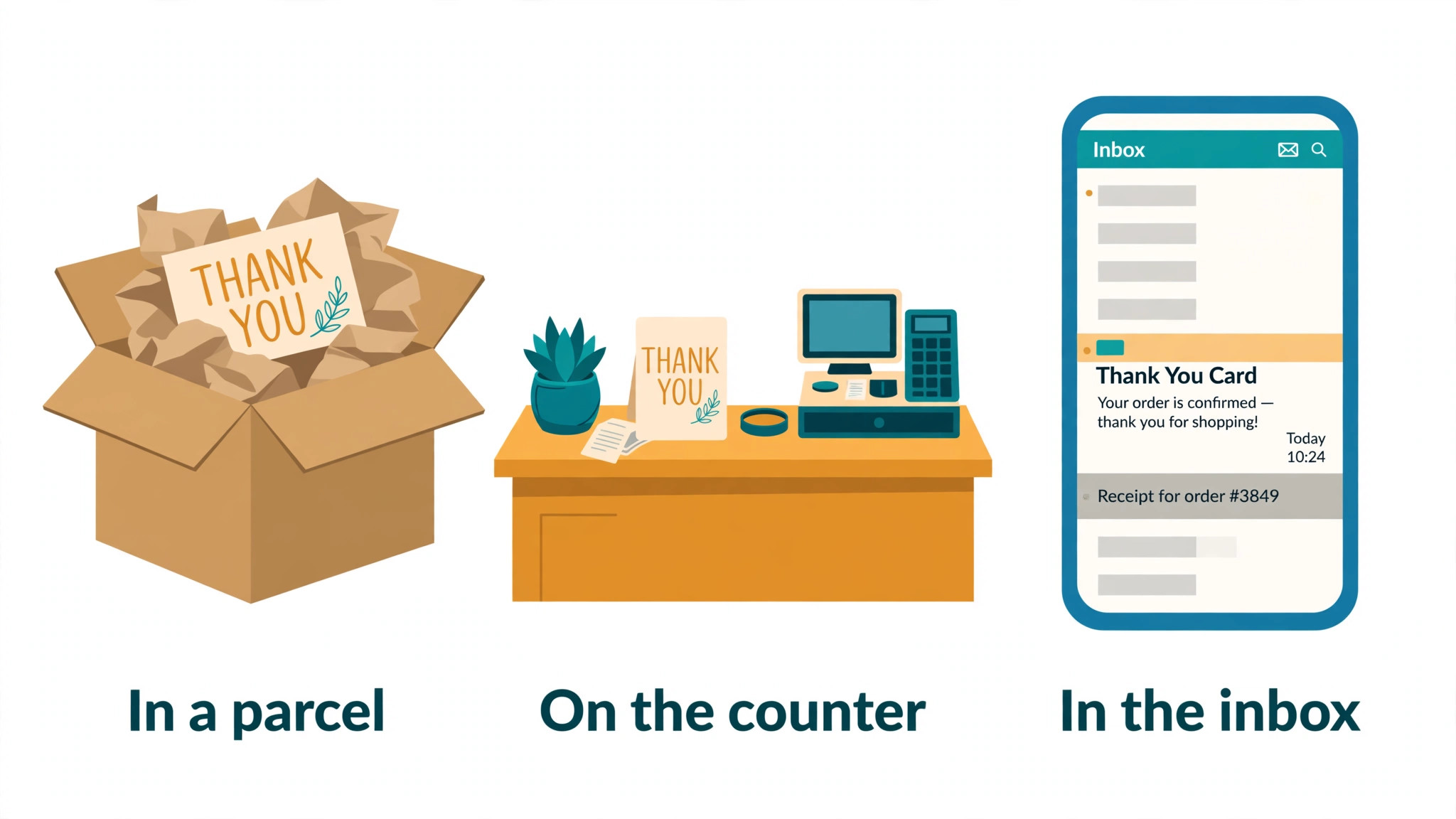
For online orders, the same rule applies. Send the email version the evening of the order, or slip a printed card into the parcel before it ships. The parcel insert is one of the most effective versions of this whole practice, because the customer opens the box and finds a note from a person at the exact moment they are happiest with the purchase. That timing is worth more than any design choice in this guide.
Five Example Cards You Can Adapt
The examples below follow the structure in the steps above. Each one names the specific thing, says what it meant, and looks forward in one line. Change the details to fit your business and send them as they are.
Example 1. First Purchase
Thank you for choosing the oak dining table on Saturday. It was the first piece of furniture we sold from the new workshop, and your order helped us through our slowest month. We have new stock arriving on Friday if you want first pick, and your usual chair is waiting whenever you are ready.
This card works because the first sentence names the product and the day, the second sentence says what the order meant, and the third looks forward with a concrete invitation. Nothing in it could have been written to a different customer, and that is the test every card in this section passes.
Example 2. Referral
Thank you for sending your brother to us last week. He booked his first appointment on Thursday, and he told us you had been talking about the shop for months. That kind of trust is the best advertising a small business can get, and we do not take it lightly. His next visit is on us, and so is your coffee when you come with him.
Referral cards matter more than purchase cards, because the referrer risked their own reputation to send someone to you. The card should say that you know this, and the offer at the end should reward the referrer, not the new customer, because the referrer is the one who did the work.
Example 3. Loyal Regular
Thank you for your tenth visit this year. You have been coming since we opened, and regulars like you are the reason the shop is still here. We are holding your usual table for Saturday, and the new menu launches that morning if you want to be the first to try it.
Loyalty cards work best on round numbers and anniversaries, because the number itself is the specific detail. Ten visits, one year, or a fiftieth order all give the card a reason to exist. Send it on the day the milestone happens, not at the end of the month, so the timing matches the message.
Example 4. Service Recovery
Thank you for telling us about the late delivery last week. You were right to raise it, and we have changed how we pack Friday orders so it does not happen again. Your replacement arrived on Tuesday, and we would like to cover your next delivery as well. Please let us know if anything about the replacement needs attention.
A recovery card has a different job from the others. It must admit the fault, say what changed, and make a concrete offer, in that order. Customers forgive mistakes that are owned quickly, and they rarely forgive a mistake that is thanked away. Keep the tone plain and skip any sentence that sounds like an excuse.
Example 5. Holiday Card to a Good Customer
Thank you for a great year. You visited twelve times, you brought two friends, and you made the shop a better place to work. We are closed over the holidays, but we open again on the second of January, and your first coffee of the year is on us. Happy holidays from all of us.
Holiday cards only work when they are specific, and most holiday cards are not. The example above works because it counts the visits and names the referrals. If you cannot fill a holiday card with real details, send a shorter version of the first purchase card instead, because a generic holiday card says less than no card at all.
Handwritten, Printed, or Email
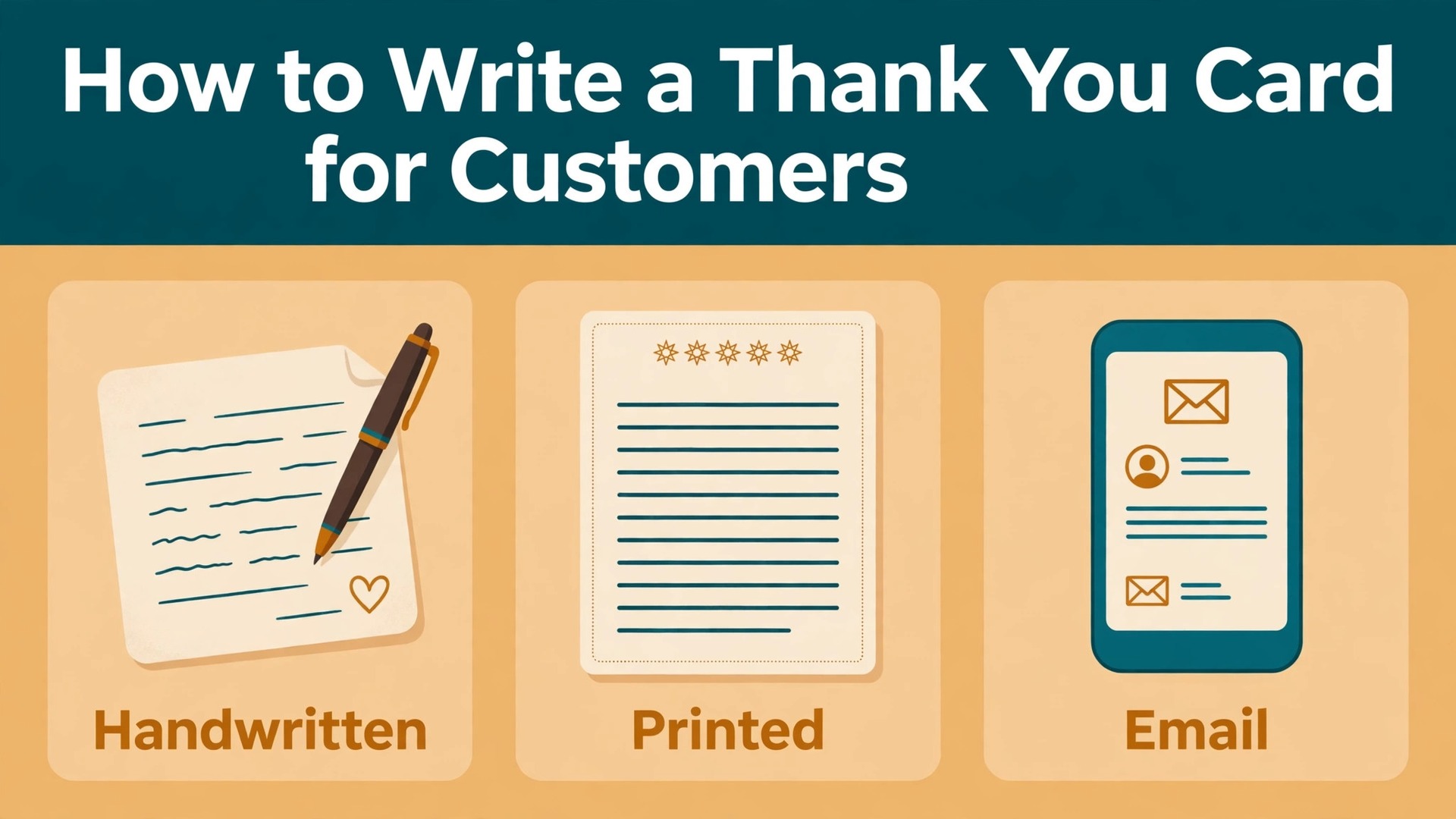
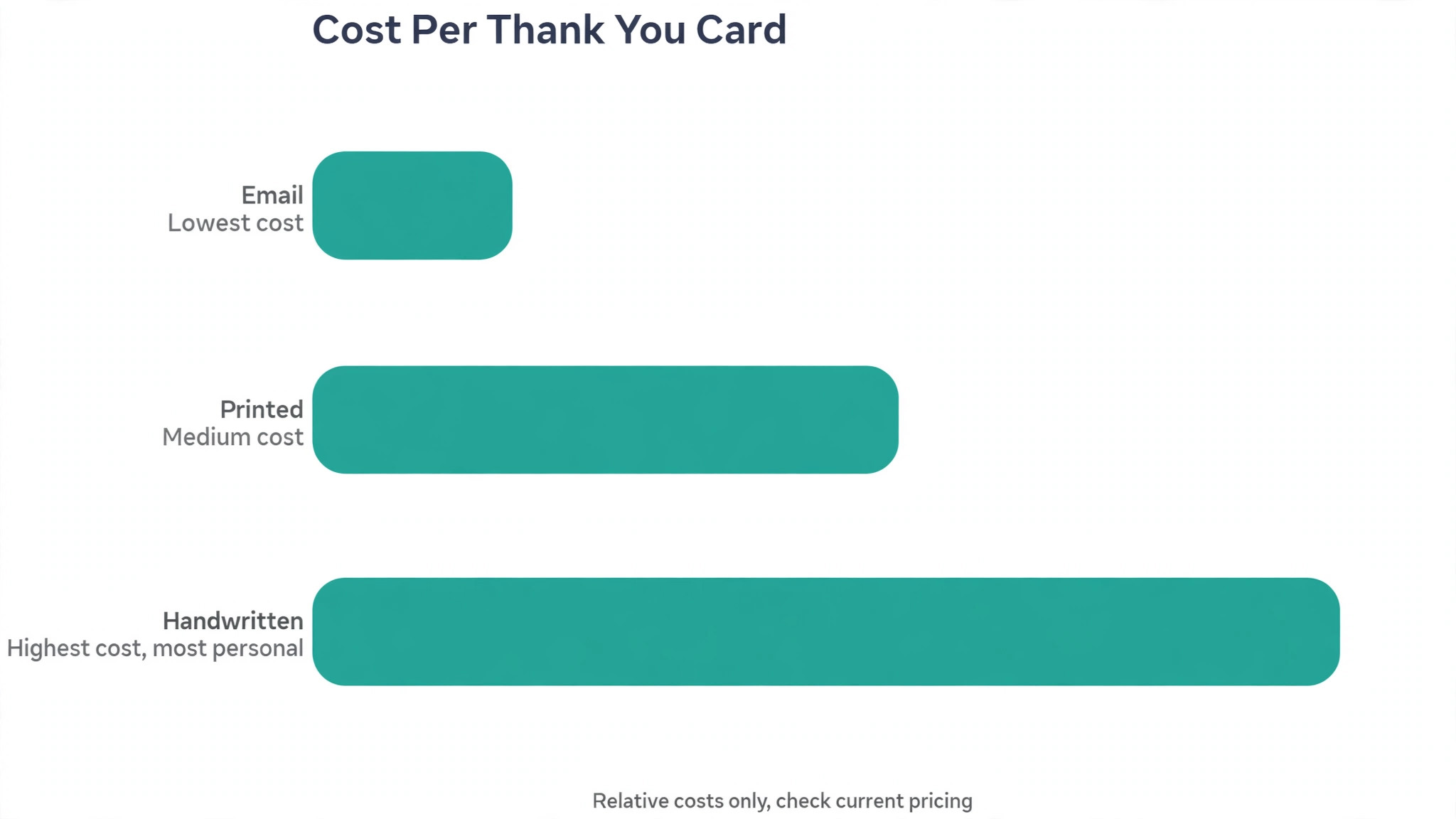
The format decision deserves its own section, because it is where most businesses either overspend or underinvest. A handwritten card costs the least money and the most time, and it carries the most weight. A printed card costs a few cents each at volume and scales to twenty cards a month without much effort. An email costs nothing and arrives in seconds, but it lands in an inbox full of other mail, and it disappears with one swipe.
Choose by the value of the relationship, not by the cost of the card. A customer who spent five hundred dollars deserves a handwritten note. A customer who spent fifteen dollars deserves a printed card with one handwritten line. An online buyer in another country deserves an email the same evening, because a posted card would arrive after the excitement has faded. The format is a signal about how much the business noticed, and customers read that signal accurately.
One more comparison helps. A handwritten card is the only format that proves a person spent time on it, and that proof is the whole point of the exercise. If you can only do one version of this practice, do the handwritten one for your ten best customers and skip the rest. Ten real cards beat a hundred printed ones, and the customers who receive them will remember the difference long after they forget the design.
Whatever format you choose, the writing is what the customer keeps, and that is why how to write a thank you card for customers matters more than which printer you use.
Tools That Make It Easy
You do not need a tool to write a thank you card, but the right tool makes the habit easier to keep. The five below cover design, printing, and email, and each one suits a different volume. Learning how to write a thank you card for customers is a writing skill first, and these tools handle the production so the writing gets done.
Canva
Canva is the easiest place to design a card that looks professional without a designer. The template library includes thank you cards in every size, the editor lets you drop in your logo and colours in minutes, and the print ordering service ships the finished cards to your door. The free plan covers the design, and Canva Pro at 18 dollars a month or 144 dollars a year adds premium templates and the Brand Kit. Print prices vary by size and quantity, and 500 business card sized cards cost from 45 dollars.
Vistaprint
Vistaprint is the volume choice. Its standard cards start at 14 dollars and 99 cents for 100, and 500 cards cost 24 dollars and 99 cents for a one sided standard design, with a second side adding about 7 dollars. The template library is large, the editor is simple, and the paper options range from standard 14 point stock to premium 18 point and ultra thick 32 point. If you send more than twenty cards a month, Vistaprint is the cheapest way to keep the habit going without cutting corners on quality.
Minted
Minted is the premium choice, and it shows in the paper. The cards use thick stock and designs from independent artists, which gives the card a weight and finish that a budget printer cannot match. Prices are higher than Vistaprint and vary by design and quantity, so Minted suits the ten best customers rather than the whole list. Use it for the cards that matter most, where the feel of the card is part of the message.
Paperless Post
Paperless Post is the email option for owners who want the speed of email with the feel of a card. The designs are stronger than a plain email template, delivery is tracked so you know the card was opened, and the free tier covers occasional sends. It suits online businesses, distant customers, and same day thanks after a virtual meeting. The trade off is the one that applies to all email. It is easy to send and easy to ignore, so use it where a posted card cannot arrive in time.
Adobe Express
Adobe Express covers the same ground as Canva at a lower price, with Premium at 9 dollars and 99 cents a month. The template library includes thank you cards, the editor is fast, and the free plan is enough for occasional designs. It suits owners who already use Adobe Express for social graphics and want the card in the same workspace. Export a print ready PDF and send it to a local printer, or share the design by email the same day.
Mistakes That Undo a Good Card
The most common mistake is the generic card. Thank you for your business, with no name, no product, and no date, tells the reader the card was printed in a batch and signed in a hurry. A card like that does less than no card at all, because it proves the business does not actually remember the customer. If you cannot name the specific thing, wait until you can, and send the card then.
The second mistake is the late card. A thank you that arrives three weeks after the purchase reads as a reminder system, not gratitude, and the customer knows the difference. Build the writing into the end of the day, not the end of the month. The third mistake is the sales pitch disguised as thanks. A card that spends two lines on gratitude and five lines on a new product launch is an advertisement, and the customer will treat it as one. Keep the offer to one line at the end, or leave it out entirely.
How to Write a Thank You Card for Customers at Scale
A thank you habit only survives if it fits into the working week. The simplest system is a Friday list. Each Friday, write down the five customers from that week who did something worth thanking, write their cards in one sitting, and post them on Monday morning. The batch takes half an hour, and it turns a good intention into a routine that actually happens.
Keep the supplies where the work happens. A box of blank cards, a good pen, and a list of names at the counter means the card gets written while the visit is fresh, instead of waiting for a quiet moment that never arrives. A simple sheet that records who received a card and when stops you sending the same customer two cards in one month, and it shows you who has not heard from you in a while. The system is the habit, and the habit is what customers remember.
Frequently Asked Questions
How long should a thank you card for customers be?
Three to five sentences is the right length. One sentence names the specific thing, one says what it meant, one looks forward, and a short greeting and sign off fill the rest. Longer cards dilute the message, and a card that rambles makes the reader doubt the writer knows them at all.
Should a thank you card be handwritten or printed?
Handwritten is best for high value customers, referrals, and anyone you know by name, because the handwriting proves a person spent time on it. Printed cards suit volume, and a printed design with one handwritten line inside gives you the best of both worlds. Email works when speed matters more than touch, such as a same day thanks after an online order.
When should I send a thank you card after a purchase?
Send it within 48 hours for a first purchase, the same week for a referral, and within two days of fixing a problem for a service recovery. A card that arrives two days after the purchase feels thoughtful, while the same card arriving three weeks later feels like a system. Learning how to write a thank you card for customers starts with timing, because even a perfect card fails when it arrives too late.
What should I write in a thank you card to a loyal customer?
Name the milestone, such as a tenth visit or a year of regular orders, say what that loyalty meant to the business, and invite them back with a concrete detail. A loyal customer already knows you value them, so the card should prove it with specifics rather than repeating it in general terms.
Can I include a discount in a thank you card?
Yes, but keep it to one line at the end, and make it read as a gift rather than a coupon. A coffee on us next time, or ten percent off your next visit, works when the thanks comes first and the offer comes last. If the discount is the main point of the card, it is an advertisement, and the customer will read it as one.
Do thank you cards really bring customers back?
A card on its own will not save a bad product or a rude visit, but it strengthens a good experience, and a good experience is what brings customers back. The card works because it asks for nothing, it arrives when the customer still remembers the visit, and it proves a person noticed. That combination is rare in business mail, and customers remember it.
The Verdict
Write the card the same day, name the specific thing, say what it meant, and stop after five sentences. Handwrite it for your best customers, print it for the rest, and email it only when speed matters more than touch. That is how to write a thank you card for customers in a way that actually brings them back, and it costs less than a dollar and five minutes per card.