You have a sale starting Friday, a stack of flyers on the counter, and no plan for getting them into the right hands. That is the moment most flyer campaigns fail, and it has nothing to do with the design. Learning how to promote a sale with flyers starts with that missing workflow, not with a prettier design. The flyers are fine. The workflow is missing. A sale flyer only earns money when the offer is sharp, the design can be read in three seconds, the print run matches the distribution plan, and every copy goes somewhere a real customer will see it. Miss one link and the whole stack becomes recycling.
This guide gives you that workflow from start to finish. You will set one goal and one offer, design a flyer that survives a three second glance, choose the right size and paper, print at the right quantity, distribute through the channels that actually reach your customers, and track the result so the next sale costs less and earns more. The method works for a shop sale, a restaurant special, a salon promotion, a gym offer or a local event. The numbers in it come from printer and design guides published in 2026, and wherever a price varies by city or quantity, the guide says so rather than inventing a figure.
One fact is worth keeping in mind before you start. Print still earns attention that digital often does not. Research cited by Vistaprint found that flyers are seen by 78 percent of people who receive them and read carefully by 23 percent, rising to 33 percent when the flyer includes an offer or coupon. Those are other people numbers, not a promise for your shop, but they explain why a well placed flyer still pulls customers through a door in a way a social post often does not.
How to Promote a Sale with Flyers: The Full Workflow
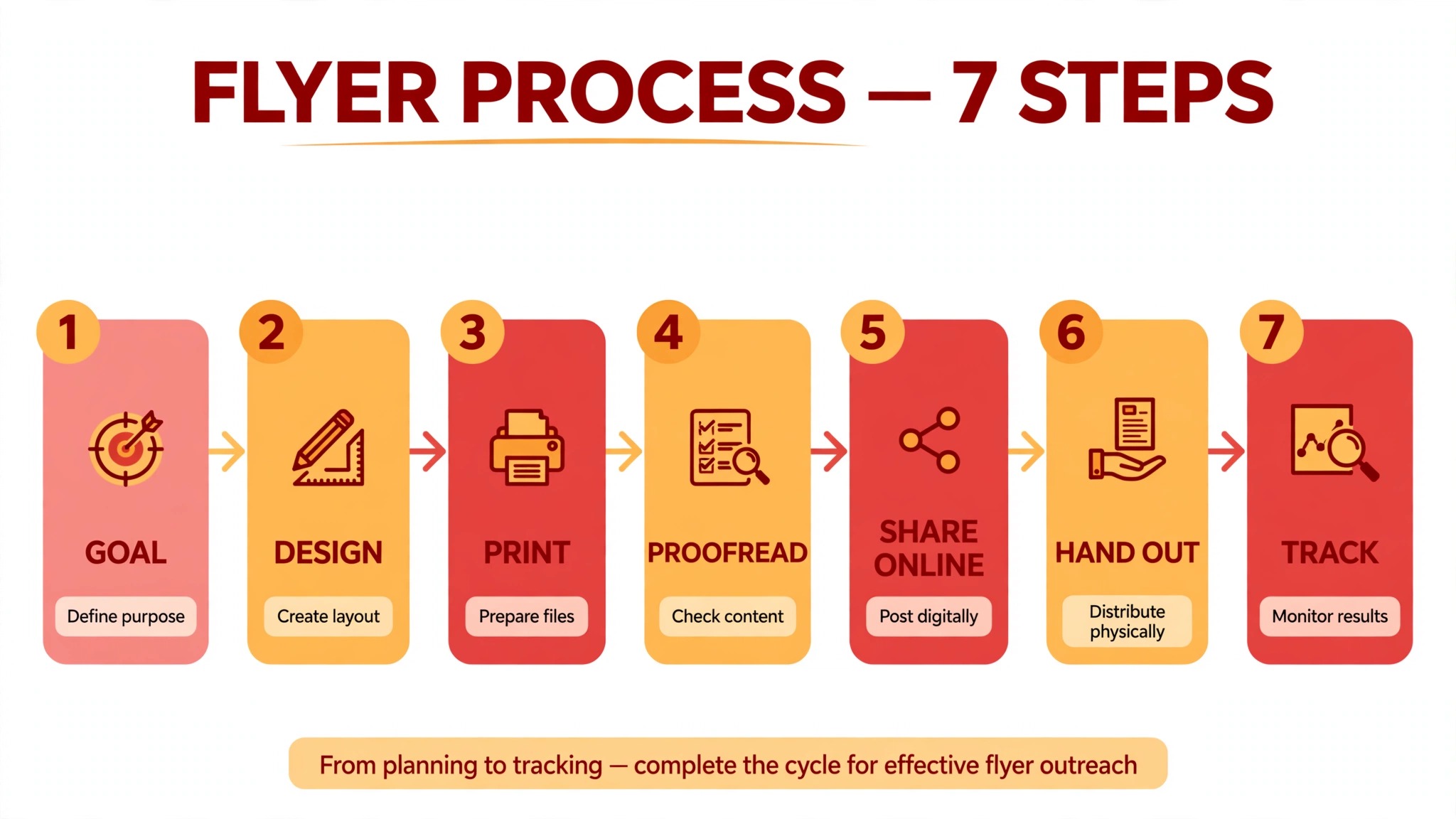
The workflow has seven steps, and the order matters. Set the goal and the offer first. Design second. Print third. Distribute fourth. Follow up fifth. Measure sixth. Repeat what worked seventh. Most sellers start at step two, design a pretty flyer, and then discover the offer is vague, the print run is too small for the area, and nobody knows where the flyers went. Starting at step one prevents all three problems, because the offer decides the design, and the distribution plan decides the print run.
Step one is the goal. A flyer can do one job well, and you must pick which one before you write a word. The usual jobs are driving foot traffic into a shop, filling seats at an event, collecting leads for a service, launching a product, or bringing past customers back for a second visit. Each job changes the flyer. A foot traffic flyer leads with the discount and the address. A lead capture flyer leads with a free estimate or consultation and a QR code to a booking form.
A return visit flyer goes in the bag with a purchase and carries a bounce back offer with an expiry date. Pick one job, write it at the top of your planning page, and judge every later decision against it.
Step two is the offer. The offer is the headline, and it must pass three tests. It must be specific, it must be valuable, and it must expire. Specific means one product or one deal, not a vague promise of great savings. Valuable means the customer can feel the saving in money terms, such as 20 percent off, buy one get one free, or 10 dollars off a 50 dollar spend. Expiring means a real last date, printed large, such as ends Sunday. An offer with no deadline is an offer nobody acts on, because there is no reason to act today.
Test the offer on one regular customer before you print anything. If they do not understand it in five seconds, rewrite it.
Step three is the design, covered in full later in this guide. Step four is the print decision, which is quantity, paper and printer. Step five is distribution, which is where most of the work lives. Step six is the follow up, which is answering the replies the flyer generates and redeeming the coupons at the till. Step seven is measurement, which is counting redemptions and asking new customers how they heard about the sale. The rest of this guide walks each step in order, with the checklists and tables you need at each stage.
Setting the Offer and the Goal
A sale flyer fails most often at the offer, not at the design. The offer decides whether a stranger stops, reads and acts, and most offers are too vague, too complicated or too weak to earn that stop. Start with the customer, not with your stock. Ask what would make a person who has never visited your shop walk in this week. A percentage off the whole shop is simple but expensive for you. A discount on one hero product is cheaper for you and clearer for the customer. A bundle, such as a meal for two at a set price, is often the best of both, since it raises the average spend while giving the customer a clear saving.
Match the offer type to the goal you picked. The table below shows the five common sale goals, the offer type that fits each one, and the call to action that belongs on the flyer.
| Goal | Best offer type | Call to action on the flyer |
|---|---|---|
| Drive foot traffic | Percentage off one category | Bring this flyer for 20 percent off |
| Fill an event | Early bird ticket price | Scan to book before Friday |
| Collect leads | Free estimate or first visit deal | Scan to book a free consultation |
| Launch a product | Introductory price for one week | Try it this week for 15 dollars |
| Win back past customers | Bounce back offer in the bag | 10 dollars off your next visit by March 31 |
Price the offer honestly before you commit to it. Work out the margin on the discounted item, the number of redemptions you can afford, and the break even point. A 20 percent discount that brings 50 new customers who each spend 40 dollars is a good deal. The same discount on a product with a 25 percent margin is a loss on every sale, and no amount of foot traffic fixes that.
Set the dates with the same care. A sale that runs for two weeks gives the flyer time to circulate, but a sale that runs for two months has no urgency. Seven to fourteen days is the sweet spot for most local sales. Print the end date in large type, and print the start date too if the sale has not begun, so early readers know when to come. If the sale is tied to an event, print the event date, time and address at the top of the flyer, above the offer, since a customer who misses the date misses the sale entirely.
Designing a Flyer That Gets Read in Three Seconds
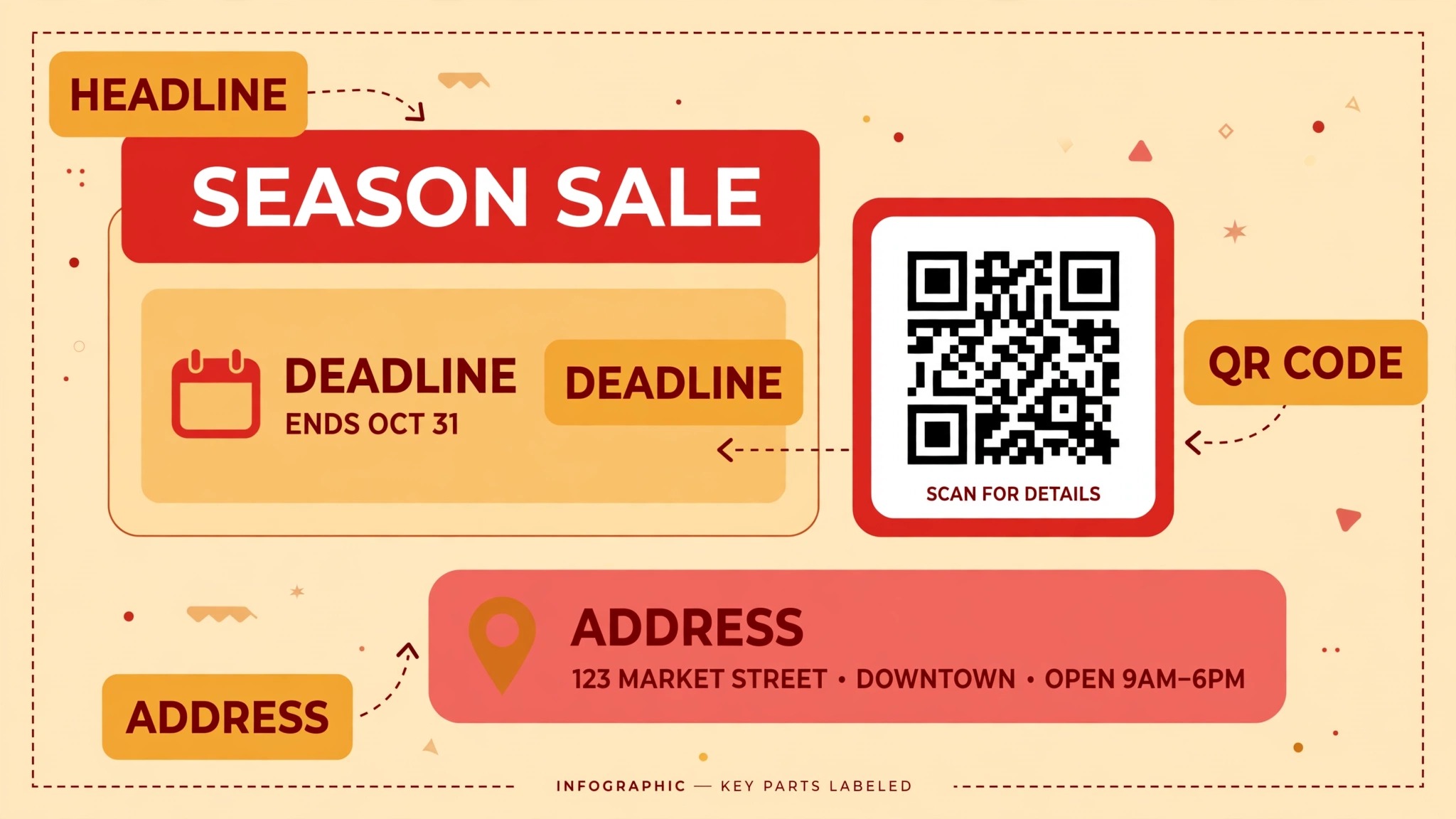
A flyer is read in a glance, not studied like a brochure. A person holding it decides in about three seconds whether to keep reading or throw it away, and the design must survive that test. Knowing how to promote a sale with flyers means knowing this hierarchy. The headline carries the offer. The image shows the product or the feeling. The details answer where, when and how. The call to action tells the reader what to do next.
Write the headline first and make it the biggest text on the page. Lead with the discount, the bundle or the price, then back it up with one reason it is worth acting on, such as limited stock, seasonal timing or a best seller. Keep the headline under eight words. Twenty percent off winter coats beats a clever slogan every time, because the customer understands it instantly. Put the deadline in the headline or directly beneath it, since urgency is part of the offer. Avoid more than one headline, since two headlines compete and neither wins.
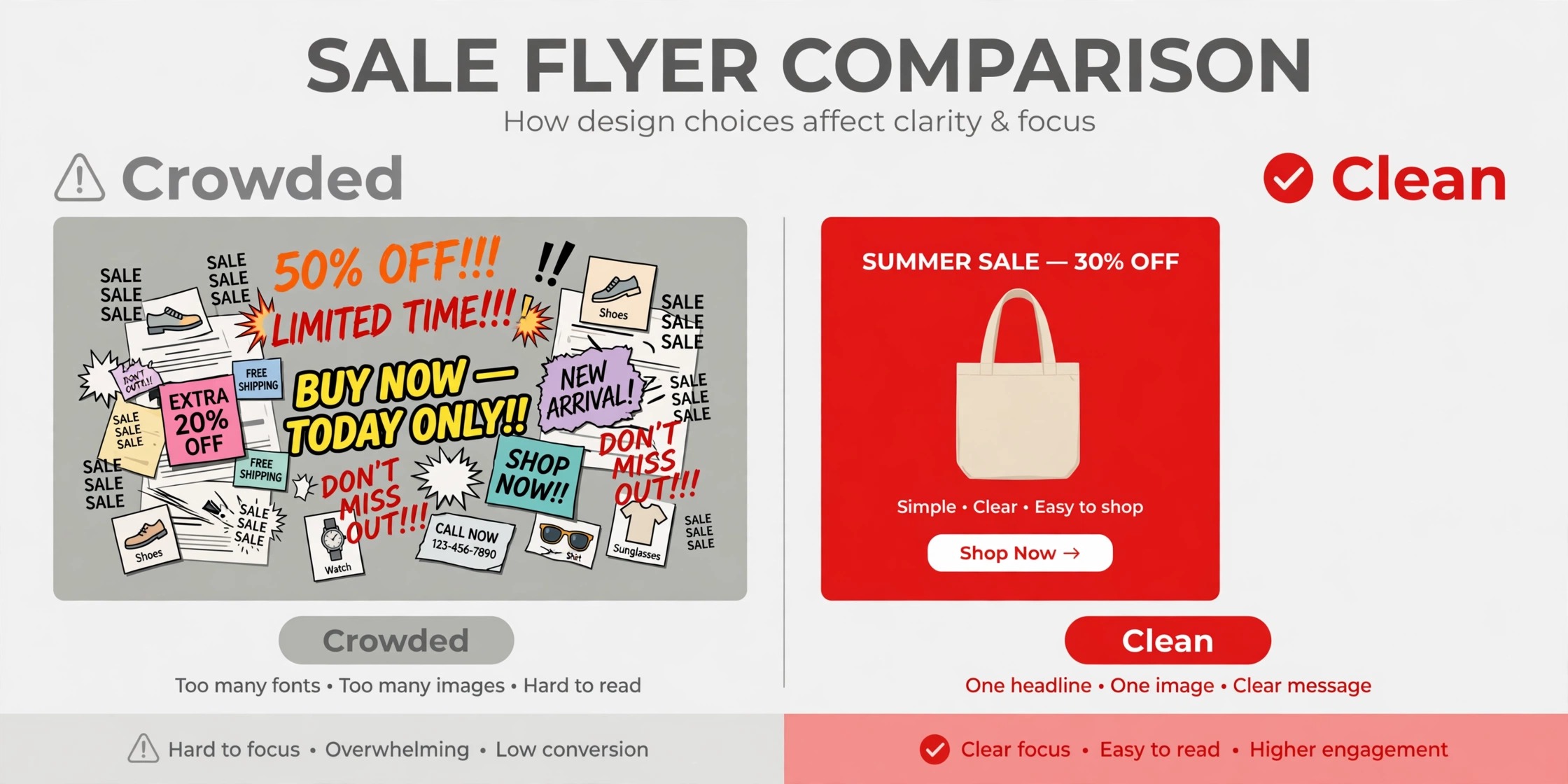
Choose one strong image and let it dominate. One hero photo of the product, the dish, the room or the result beats a collage of six small photos that nobody can see clearly. Use a real photo of your own product where you can, since customers trust a shop they can see. Keep text off the face of the product in the photo, and keep the total text on the flyer low. A flyer with 50 words gets read. A flyer with 200 words gets folded and forgotten. If the offer needs explaining, the explanation belongs on the landing page the QR code points to, not on the paper.
Size and layout follow the job. The common sizes are letter at 8.5 by 11 inches for detailed information, half sheet at 5.5 by 8.5 inches for handouts, postcard at 4 by 6 inches for quick messages and mail, and A5 at 148 by 210 millimetres as the most common size outside North America. A smaller flyer is cheaper to print and easier to hand out, while a larger flyer carries more information.
For a sale, half sheet or A5 is usually the right balance, since the offer needs little space and the flyer must travel in a hand or a bag. Keep all important text inside a safe margin away from the trim edge, since printers cut the paper and text near the edge can be clipped.
Printing: Quantity, Paper and Printer
Print quality is decided before the printer runs, in the file you send. A print ready file uses 300 DPI images at final size, CMYK colour mode rather than RGB, which is for screens, and a bleed of 0.125 inches or 3 millimetres where the design runs to the edge. Most printers want a print ready PDF. Export the PDF from your design tool, open it, and check every page at full size on screen before you send it. Then order a single proof print and check it in real life before committing to a large run, since colours and text size look different on paper than on a screen.
Paper choice changes both cost and feel. Paper weight is measured in grams per square metre, and 130 to 170 gsm suits most flyers. Lighter paper feels cheap and tears easily. Heavier paper feels premium and survives a bag or a pocket. Matte finish looks classy and is easy to read in bright light, while gloss makes colours pop and suits food and fashion photos.
Choose the printer by run size and deadline. A home printer suits a tiny run of under 50 copies for a test or a very local drop, but the quality and the cost per copy are poor at scale. A local print shop suits runs of a few hundred with a fast turnaround and a person you can talk to about paper and finishing. An online printer such as Vistaprint suits larger runs, since the price per unit falls as the quantity rises, and you get an estimate of the delivery date at checkout.
Ordering one large run is usually cheaper per unit than repeatedly printing small batches, but only if you can distribute the whole run before the sale ends.
Quantity is the decision most sellers get wrong, and the rule is simple. Work backwards from distribution, not forwards from budget. Count the places the flyers will go, multiply by the copies each place needs, and add 10 percent for spares and reprints. A hundred flyers for a street of twenty shops is a waste. A thousand flyers with only one person to hand them out is a bigger waste. The distribution plan in the next section gives you the numbers to work from. If the plan needs 800 copies and your budget covers 500, shrink the distribution area rather than printing fewer copies for the same area, since thin coverage everywhere is worse than dense coverage in one neighbourhood.
Distributing the Flyers Where Customers Actually Are
Distribution is the step that decides whether the sale happens, and it deserves half your total effort. A flyer that stays in a box earns nothing, and a flyer handed to the wrong person earns almost nothing.
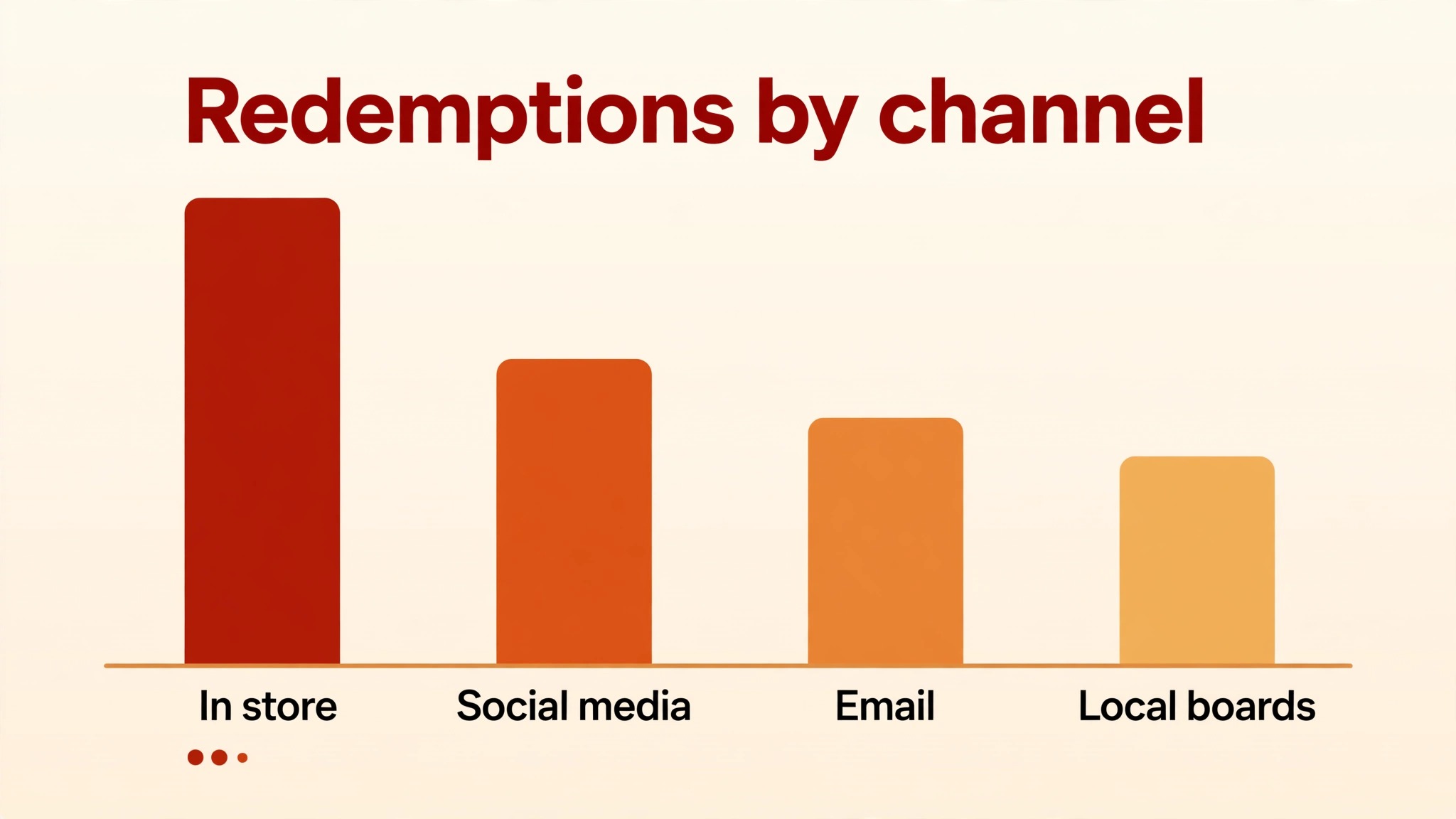
Any guide to how to promote a sale with flyers that skips distribution is selling you a design lesson, not a sales plan. Start with the places your customers already go. Your own counter is the best distribution point you own, since every buyer is already a customer. Put a stack by the till, hand one to every buyer with their change, and put one in every bag.
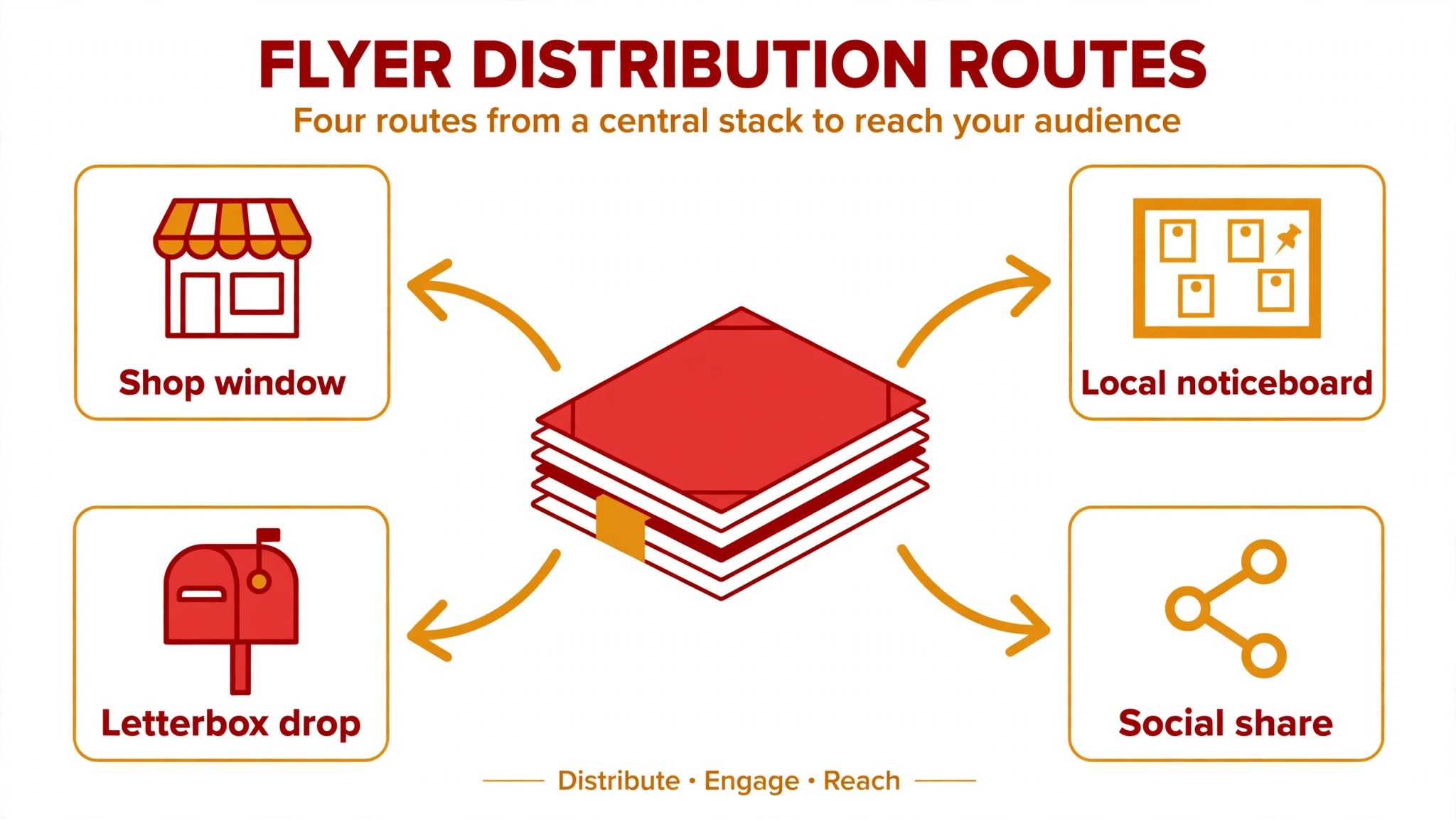
Community boards are the second channel. Grocery stores, libraries, community centres, coffee shops and laundries often have a board where local businesses can post, and most ask only that you get permission first. Ask the manager, post the flyer straight, and check back in a few days to replace any that fell down.
Hand to hand distribution works for events and for streets with heavy foot traffic, but it needs a person who smiles and a pitch of five words. Stand where your customers walk, not where you feel comfortable. Offer the flyer with one sentence, such as sale this weekend, 20 percent off, and let people take it or leave it. Two hours of good hand to hand work beats a full day of standing in the wrong place.
Door to door reaches a wide area but takes the most time, so use it only for a sale that justifies the effort, such as a grand opening or a big seasonal event. Check local rules on solicitation first, since some areas restrict it. Direct mail is the most targeted option and the most expensive, since you pay postage per flyer, but it lets you reach specific streets without walking them yourself.
Partner businesses multiply your reach for free. A salon can display flyers for a nearby clothing shop, and the clothing shop can return the favour. A cafe can hold a stack for a gym, and the gym can hold a stack for the cafe. The partnership works when the businesses share customers but do not compete. One good partner location can outperform ten random boards, because the customers there already trust the business that displays your flyer.
The Digital Twin: QR Codes and Tracking
Every printed flyer should carry a digital twin, and the cheapest twin is a QR code. A QR code on the flyer sends the reader to one page, and that page should match the flyer exactly. If the flyer promises 20 percent off winter coats, the page must show 20 percent off winter coats, not your homepage. A reader who lands on a generic page and cannot find the offer will leave, and the flyer has wasted its one chance. Build the landing page before you print, and test the QR code with three different phones before the print run.
Tracking is what turns a flyer campaign from a guess into a system. The simplest tracking is a coupon code printed on the flyer, different from any code you use online. When a customer redeems it at the till, you know the sale came from the flyer. A second method is a short memorable web address that only appears on the flyer, such as your site address followed by a short word for the sale.
A third method is to ask every new customer one question at the till. How did you hear about the sale. Keep a tally sheet by the register and mark each answer. Three methods sound like a lot, but any one of them is enough, and the tally sheet alone will tell you more than most small businesses ever learn about their marketing.
Use a different code or address for each distribution channel when you can, so you learn which channel earned the sale. A code for the counter stack, a code for the partner cafe, and a code for the door drop will show you within a week which channel is worth repeating. This is how to promote a sale with flyers as a system rather than a one off gamble, since the second sale starts with the numbers from the first one. Keep the codes short and easy to say aloud, since staff will be typing them at the till under pressure.
One caution about QR codes. Print them large enough to scan from a comfortable distance, at least 2 by 2 centimetres, and leave a quiet white border around the code so phones can read it. Test the code after printing, not only on screen, since a code that scans on a bright monitor can fail on matte paper in dim light. If the code points to a page that needs a form filled in, keep the form to three fields at most. A flyer reader is standing up, possibly holding shopping, and a ten field form is a reason to give up.
The 14 Day Timeline
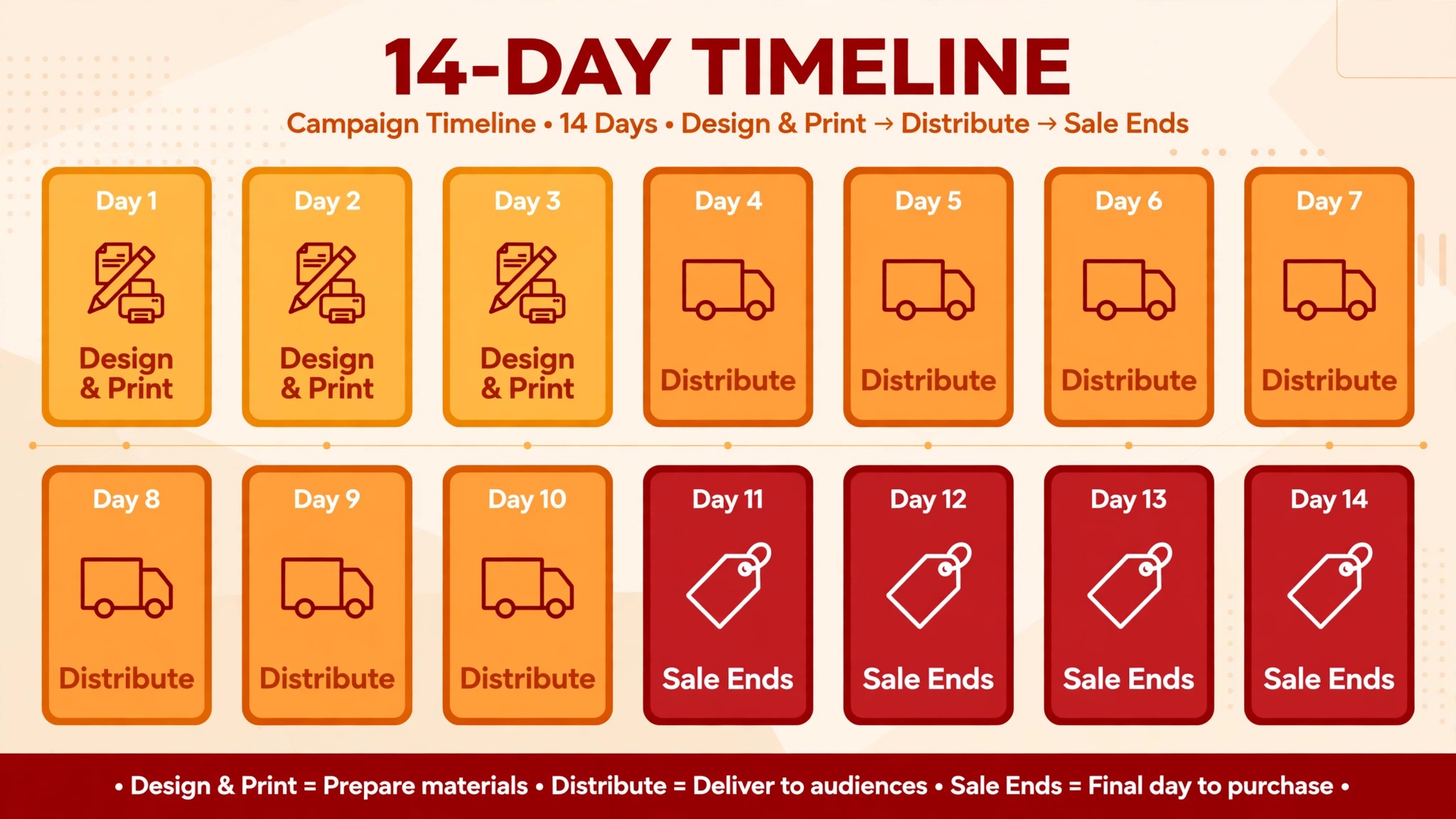
A flyer campaign needs two weeks from decision to sale day, and the timeline below shows where each day goes. Rushing it into three days is possible, but the offer, the design and the proof print all suffer, and a rushed flyer looks rushed. Start fourteen days before the sale and the work stays calm.
| Day | Task | Output |
|---|---|---|
| Day 14 | Pick the goal, the offer and the dates | One written offer with a deadline |
| Day 13 | Test the offer on three regular customers | Offer rewritten in their words |
| Day 12 | Design the flyer in Canva or Adobe Express | First draft, headline and image set |
| Day 11 | Proofread, check the QR code, fix spelling | Final file ready for print |
| Day 10 | Order a single proof print | Proof in hand, colours checked |
| Day 9 | Approve the proof and order the full run | Print order placed |
| Day 7 | Brief staff on the offer, the cap and the code | Staff can explain the offer in one sentence |
| Day 5 | Flyers arrive, count them, pack by channel | Bundles labelled per location |
| Day 4 | Counter stack, partner stacks and boards go up | First flyers in customer hands |
| Day 2 | Hand to hand and door drops begin | Distribution tally started |
| Day 0 | Sale opens, tally sheet at the till | Every redemption counted |
| Day 7 | Sale ends, count redemptions by code | Result written down for next time |
Two days in that table deserve emphasis. Day 11, the proofread, is where most errors are caught, and it must be done by a person who did not design the flyer, since the designer reads what they meant to write rather than what is on the page. Check the price, the dates, the address, the phone number and the spelling of every word on the image. A wrong phone number on 1,000 flyers is a thousand wasted flyers.
Day 7, the staff briefing, is where the sale is won or lost at the till. Staff must know the offer, the cap, the code and the expiry date before the first customer arrives with a flyer.
If your sale is smaller, compress the timeline rather than skipping steps. A one week version keeps every step but gives each one a day instead of two. What you must never skip is the proof print and the staff briefing, since those two steps catch the errors that cost the most. This is the part of how to promote a sale with flyers that separates a smooth sale week from a week of corrections and apologies.
Mistakes That Waste the Whole Print Run
The first mistake is a vague offer. A flyer that says big savings this weekend tells the customer nothing, and nothing is not a reason to visit. The offer must name the saving in money terms and name the product it applies to. If the offer cannot be understood in five seconds, it will not be understood at all, since nobody gives a flyer more than five seconds on first sight.
The second mistake is too much text. A flyer is not a brochure, and every extra line makes the important lines harder to find. Keep the total under 50 words, put the details on the landing page, and let white space do the work of guiding the eye. A crowded flyer looks like hard work, and customers avoid hard work. If you cannot cut a line, ask whether a customer needs it before they arrive, or whether it can wait until they are in the shop.
The third mistake is printing before the distribution plan exists. A thousand flyers with no plan for where they go will sit in a box while the sale ends. Count the locations, count the copies per location, and print to the plan. If the plan needs 400 copies, print 450, not 2,000, since the extra copies are money in the recycling bin. The plan also decides the size. A flyer for a counter stack can be larger than a flyer for a letterbox, since the counter flyer is picked up by hand and the letterbox flyer must survive the post.
The fourth mistake is forgetting the staff. A customer who arrives with a flyer and meets a staff member who has never seen it will feel tricked, even when the offer is honoured. Brief every person on the till, print a copy of the flyer for the staff room, and write the redemption code where staff can see it. The staff are the last step of the flyer, and a confused till undoes all the work that came before it.
The fifth mistake is measuring nothing. A sale that ends without a count of redemptions teaches you nothing, and the next sale repeats the same guesses. Keep the tally sheet by the till, count the codes, and write down what worked before you forget. The second time you promote a sale with flyers, the numbers from the first time are the most valuable thing you own.
Your Flyer Promotion Checklist
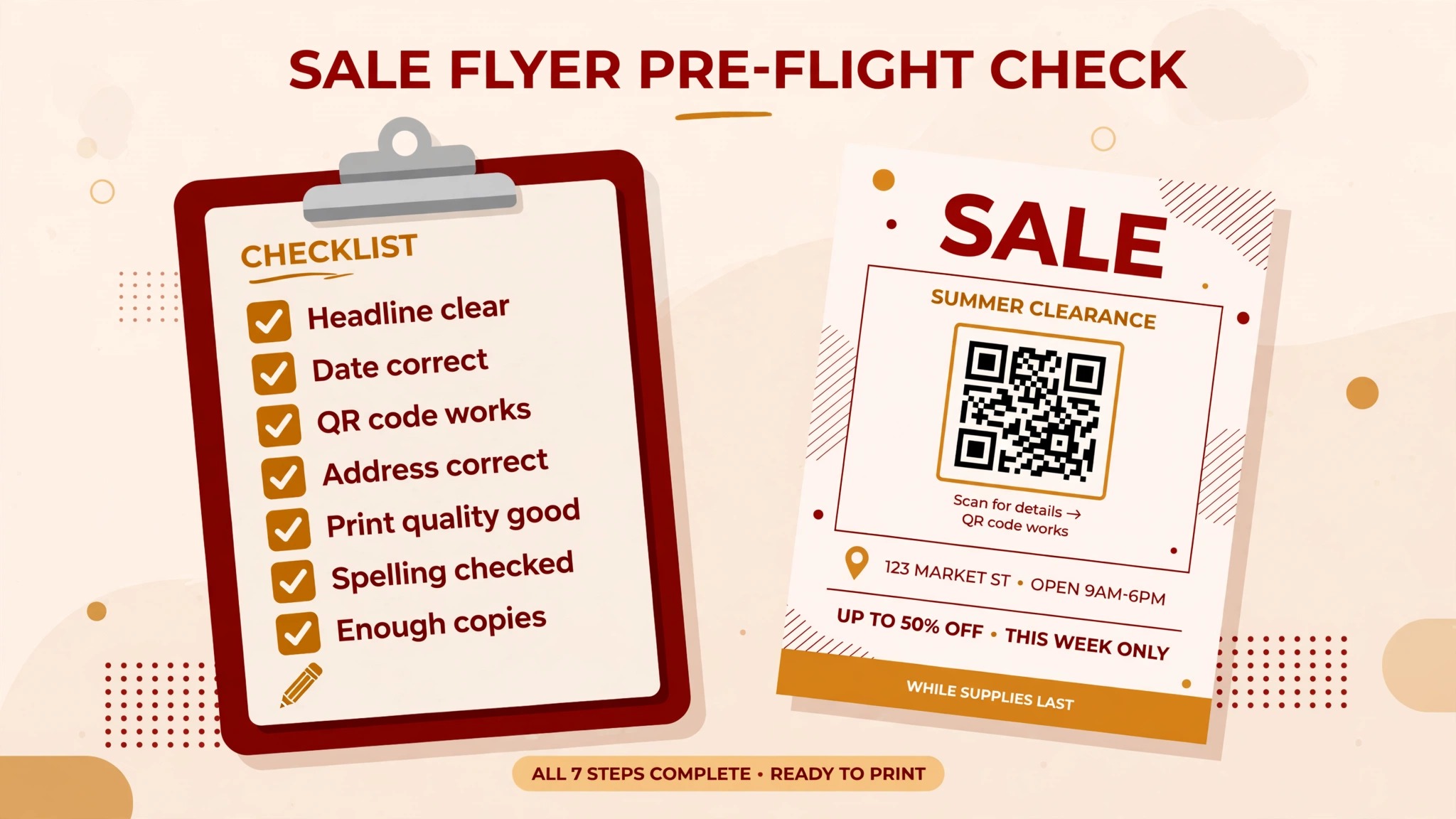
Work through this list in order before the print run is ordered.
- Write one goal, one offer with a deadline, and one call to action, and test the offer on a regular customer.
- Design the flyer with one headline, one image, the dates, the address and the QR code, then proofread it with a fresh pair of eyes.
- Export a print ready PDF at 300 DPI in CMYK with bleed, and order a single proof print first.
- Count the distribution locations, multiply by copies per location, add 10 percent, and print to that number.
- Brief every staff member on the offer, the cap, the code and the expiry date.
- Put the tally sheet and the redemption code at the till before the sale opens.
- Count redemptions by code on the last day and write down what to repeat next time.
Frequently Asked Questions
How many flyers should I print for a local sale?
Work backwards from distribution. Count the places the flyers will go, multiply by the copies each place needs, and add 10 percent for spares. A counter stack, five partner locations and ten community boards might need 400 to 600 copies. Printing 2,000 copies with no plan for where they go wastes money, since thin coverage everywhere is worse than dense coverage in one neighbourhood.
What size should a sale flyer be?
Half sheet at 5.5 by 8.5 inches or A5 at 148 by 210 millimetres suits most sales, since the offer needs little space and the flyer must travel in a hand or a bag. Letter size at 8.5 by 11 inches suits a flyer with more detail, such as an event with a schedule. Postcard size at 4 by 6 inches suits a quick message and direct mail. Keep important text inside a safe margin away from the trim edge.
How much does it cost to print flyers?
The cost depends on quantity, size, paper and printer, so no single figure is honest for every city. The pattern is stable. The price per unit falls as the quantity rises, and a local print shop or an online printer such as Vistaprint is cheaper for runs of a few hundred or more. Get a quote for your exact quantity and paper before you set the budget, and order a single proof first.
How do I track whether my flyers worked?
Print a coupon code on the flyer that appears nowhere else, and count redemptions at the till. A short web address that only appears on the flyer works the same way. The simplest method is to ask every new customer how they heard about the sale and keep a tally sheet by the register. Use a different code per channel when you can, so you learn which channel earned the sale.
Where is the best place to distribute sale flyers?
Your own counter is the best place, since every buyer is already a customer. Partner businesses that share your customers but do not compete are next, followed by community boards in grocery stores, libraries and coffee shops. Hand to hand works on busy streets for events, and door drops suit a grand opening or a big seasonal sale.
Can I design a sale flyer for free?
Yes. Canva and Adobe Express both offer free plans with flyer templates, and both let you export a print ready PDF. Start from a template close to your offer, swap in your own photo, headline and dates, and keep the text under 50 words. Check the export settings before you send the file to the printer, since the file must be 300 DPI in CMYK with bleed.
How far in advance should I start a flyer campaign?
Fourteen days is comfortable for most local sales. That leaves time to test the offer, design the flyer, proofread it, order a proof print, brief the staff and distribute before the sale opens. A small sale can be compressed into one week, but never skip the proof print or the staff briefing, since those two steps catch the errors that cost the most.
The Last Word Before You Print
A flyer is a promise printed on paper, and a sale is kept or broken at the till. Get the offer sharp, the design readable in three seconds, the print run matched to a real distribution plan, and the staff briefed before the first customer arrives. Then count what happened and do it better next time. That loop, repeated sale after sale, is how to promote a sale with flyers as a system rather than a gamble, and it is why the humble flyer still earns its place in a small business.