
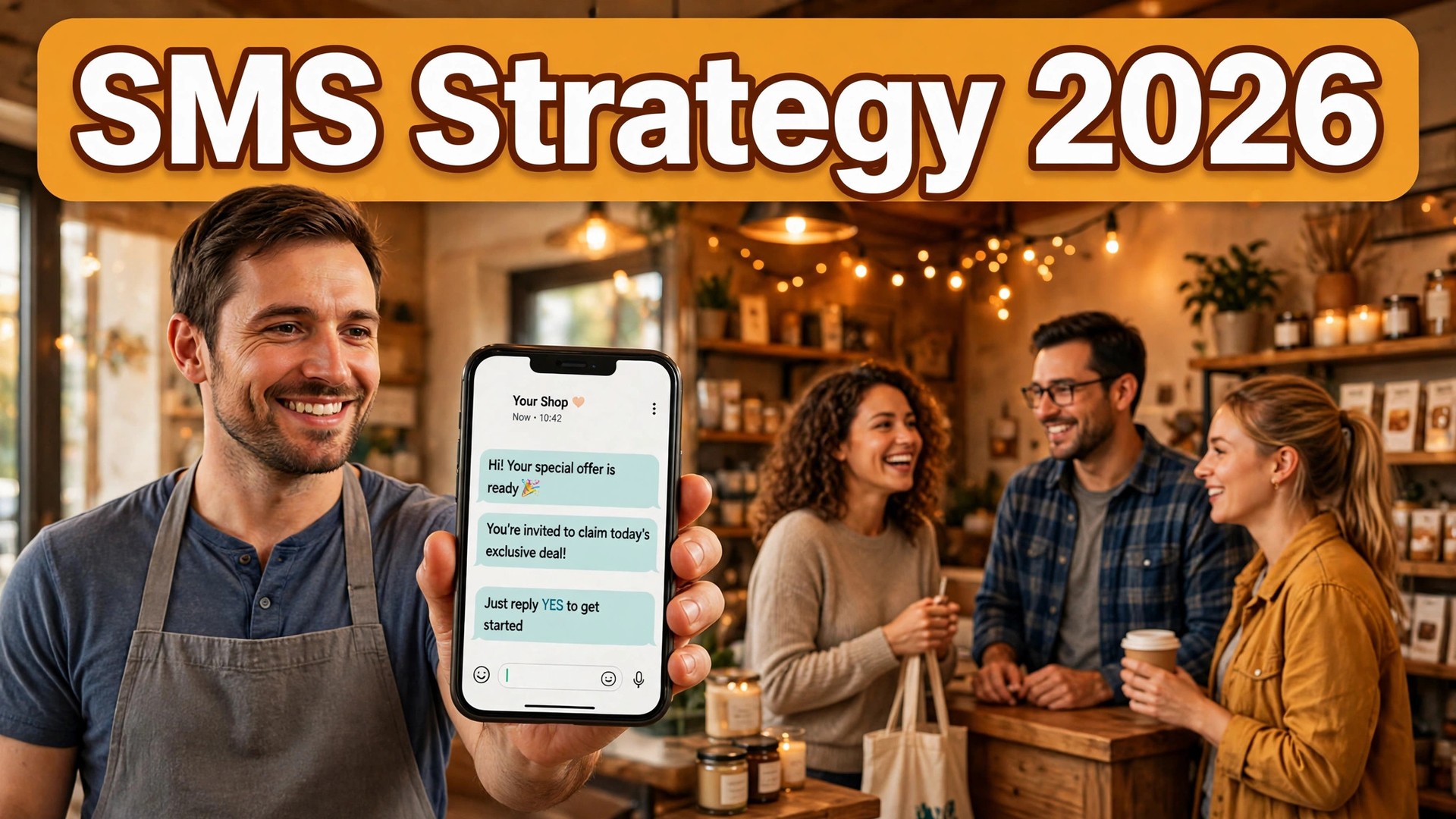
A text message is the one marketing channel your customer will actually read, and the numbers are not close. SMS open rates sit between 90 and 98 percent, against 20 to 30 percent for email, according to multiple 2025 benchmark studies, and about 95 percent of texts are read within 3 minutes of delivery, according to the Omnisend 2026 ecommerce marketing report. A customer who ignores your email, scrolls past your social post, and deletes your flyer will still read your text, because a text arrives on the screen they check all day. A small business sms marketing strategy turns that attention into repeat orders, and this guide lays out the first 90 days of it.
The risk is just as real as the reward. A text is personal, and a business that texts too often, or texts without permission, will be blocked, reported, and remembered for the wrong reason. The businesses that win with SMS are the ones that treat it as a privilege, not a megaphone, and they send fewer messages, with more value, to people who asked for them. This guide gives you that discipline, with the list building, the message types, the timing, and the numbers to watch.
A small business sms marketing strategy in 2026 works because SMS is the fastest growing marketing channel, and the growth is driven by small businesses, not by big brands. Message volume grew 40 percent year over year in 2025, according to the Omnisend 2026 report, which analysed 321 million SMS messages from 150,000 brands. About 84 percent of consumers have opted in to receive texts from at least one business, according to 2025 survey data, which means your customers are already comfortable getting texts from businesses they like. The question is not whether they will read your texts. It is whether you will earn the right to send them.
What Works in SMS Marketing in 2026
The first thing that works in 2026 is speed. About 95 percent of texts are read within 3 minutes of delivery, and about 90 percent of SMS conversions happen within 15 minutes of send time or not at all, according to 2025 benchmark reporting. That speed makes SMS the best channel for anything time sensitive, such as a same day offer, an appointment reminder, a delivery update, or a flash sale with a real deadline. An email about a sale that ends tonight will be read tomorrow, and a text about the same sale will be read in three minutes.
The second thing that works is the reply. SMS response rates average around 45 percent, against about 6 percent for email, according to 2025 benchmark studies, and click through rates sit between 18 and 35 percent, against 2.5 to 3.5 percent for email. A text is a conversation, not a broadcast, and a customer who replies to your text is a customer you can help, book, or sell to in the same thread. A small business that answers replies within minutes will win orders that a business that sends one way blasts will never see.
The third thing that works is automation tied to behaviour. Automated SMS messages generate five times more revenue per send than broadcast campaigns, according to the Omnisend 2026 report, because an automated message arrives at the moment the customer cares, such as right after they abandon a cart, right after they book, or right before their appointment. A message sent within 5 minutes of a customer action boosts click through rates to 36 percent, against a 9.2 percent industry average, according to 2025 benchmark reporting. The trigger matters more than the wording, because a perfect message sent at the wrong time is a message that is ignored.
The fourth thing that works is brevity. Messages under 70 characters outperformed longer texts by 34 percent in conversion rate in B2B SMS campaigns, according to 2025 benchmark reporting, and the lesson applies to small business texts too. A text is not an email, and a customer will not read a paragraph on their lock screen. One idea, one offer, one link, and one clear next step is the whole message, and anything more than that belongs in the link, not in the text.
The fifth thing that works is the opt in. About 84 percent of consumers have opted in to at least one business list, but they opted in because the business offered something worth it, such as a discount, an early warning, or a useful reminder. A list built on a real offer is a list that reads, clicks, and buys, and a list built by adding every customer without asking is a list that opts out, complains, and gets the number blocked. The opt in is the whole strategy, and everything else follows from it.
Set Up the List, the Tool, and the Rules Before You Send
Set up the foundation in the first week, because a strategy built on a bought list and a personal phone will get you blocked. Start with a proper SMS tool, not your personal phone, because a business SMS tool handles opt ins, opt outs, scheduling, and compliance, and a personal phone handles none of those. Choose a tool that supports automated messages, such as a welcome text, an abandoned cart text, and an appointment reminder, because those three automations will earn more than any broadcast you send.
Register your business number properly. In the United States, business texting runs through 10DLC registration, which is the system carriers use to verify that a business is real before it can send marketing texts, and an unregistered number will be filtered or blocked. Your SMS tool will walk you through the registration, and you should complete it before you send a single marketing text, because a blocked number is hard to unblock, and a filtered message is a message nobody sees.
Build your list the honest way, and start with the customers you already have. Put a signup form on your website, with a clear offer, such as 10 percent off the first order for joining the text list. Put a sign at the counter, with the same offer, and a short code customers can text to join. Add a checkbox at checkout, with the words checked, that says the customer agrees to receive marketing texts, because a checkbox a customer ticks is consent, and a box you tick for them is not.
Write down your rules before you send anything, and stick to them. Send no more than two marketing texts per week, and no more than one per week in the first month, because a new list needs to learn that your texts are worth reading, and a business that texts daily will be blocked in the first week. Send only between 9 in the morning and 8 in the evening, in the customer timezone, because a text at midnight is a text that earns a complaint. Always include a way to opt out, such as reply STOP to stop, because the law requires it, and because a customer who can leave easily is a customer who will stay longer.
The Weekly Plan for Your Small Business SMS Marketing Strategy
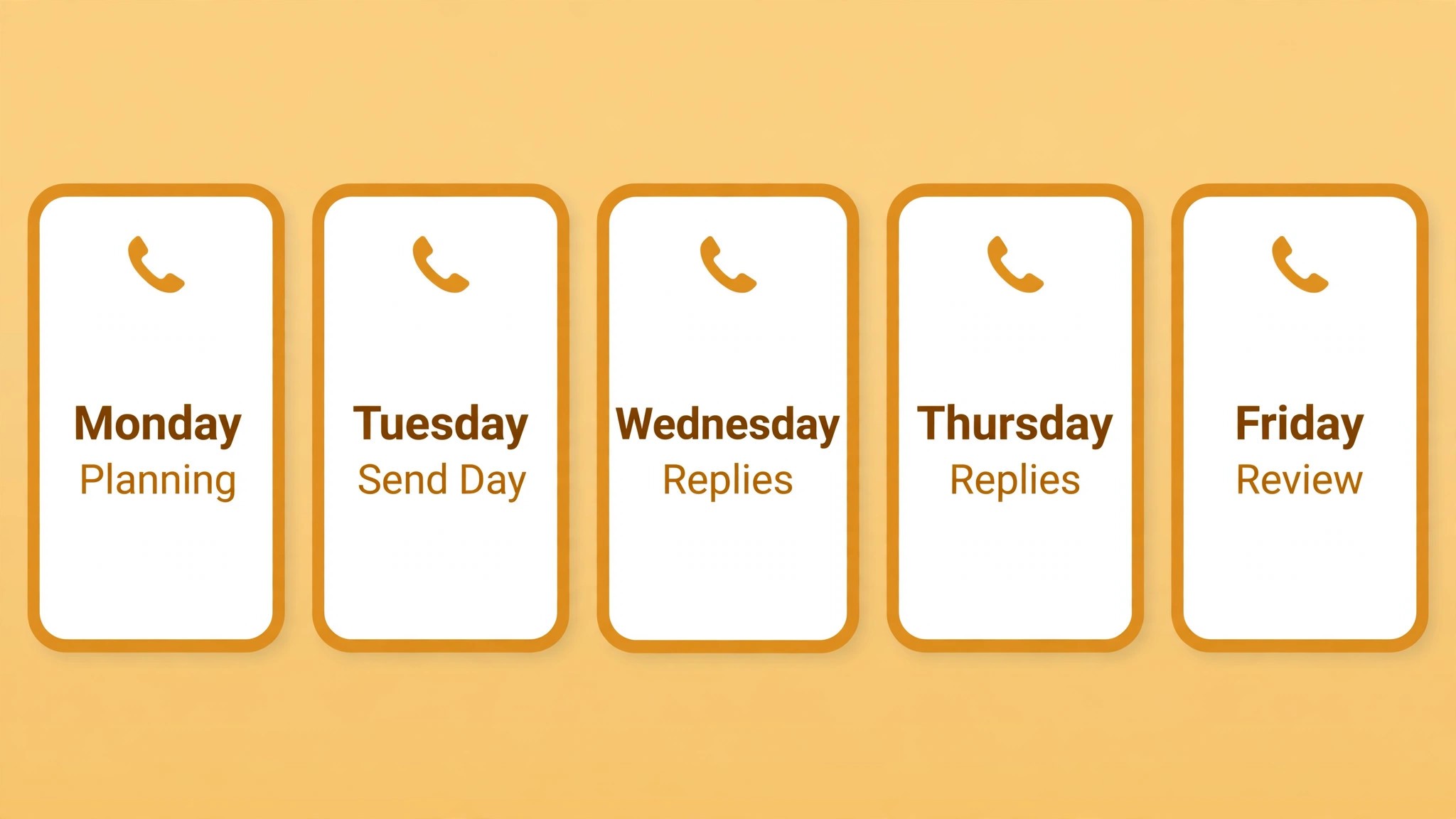
A small business sms marketing strategy needs a plan a busy owner can actually keep, and this one takes about two hours a week once the automations are running. Send one marketing text per week in the first month, and two per week from day 31, and spend the rest of the time on list building, replies, and review. The automations run every day without you, and the broadcasts are the only part that needs your time.
Monday is the planning day. Spend 30 minutes reviewing last week numbers, which the measurement section below covers, and planning the one or two texts for the week. Pick a real reason to text, such as a new product, a restock, a weekend offer, or a useful reminder, because a text without a reason is a text that earns an opt out. Write the text, read it out loud, and cut it until it fits in two short sentences, because a text that needs three sentences is a text that should be an email.
Tuesday is the send day for the first text of the week. Send it between 10 in the morning and 2 in the afternoon, because that is when customers are awake, active, and able to act, and avoid early morning and late evening, because those are the times that earn complaints. Watch the replies for the first hour, and answer every reply within minutes, because a customer who replies to a text expects an answer in minutes, not in days, and a fast answer is often the sale.
Wednesday and Thursday are the reply and list building days. Spend 20 minutes a day answering replies, following up with customers who clicked but did not buy, and adding new signups to the list. Check the counter sign, the website form, and the checkout checkbox, and confirm they are all working, because a broken signup form is a list that stops growing without anyone noticing. Ask every new customer in person whether they would like to join the text list, because a personal ask converts far better than a sign.
Friday is the second send day from day 31, and the review day in the first month. Send the second text of the week, or spend 30 minutes reviewing the numbers and planning next week, because a strategy that is never reviewed is a strategy that repeats its mistakes. Check the opt out rate, the click rate, and the replies, and write down what worked and what did not, because the data is the plan for next week.
| Day | Task | Time |
|---|---|---|
| Monday | Review last week, plan one or two texts | 30 minutes |
| Tuesday | Send the first text, answer replies for an hour | 45 minutes |
| Wednesday | Answer replies, check signup forms, grow the list | 20 minutes |
| Thursday | Follow up with clickers, add new signups | 20 minutes |
| Friday | Send the second text from day 31, review numbers | 30 minutes |
| Weekly total | One to two texts, replies, list building, and review | About 2 hours |
Message Types That Earn Repeat Orders
Use six message types, and rotate them through the month, so the list never feels like a sales channel. The first type is the welcome text, which every new subscriber gets within 5 minutes of joining, because a message sent within 5 minutes of a customer action earns far higher clicks than a message sent later. A welcome text should thank the customer, deliver the promised offer, and say how often you will text, such as one text a week with offers and updates. A welcome text that does those three things sets the expectation, and a list that knows what to expect is a list that stays.
The second type is the offer text, which is the workhorse of the list. An offer text should carry one offer, one deadline, and one link, and nothing else. A bakery texts that sourdough is fresh today and the first 20 customers get 10 percent off, with a link to order. A salon texts that two slots opened on Friday, with a link to book. Offer texts earn orders, because a customer who gets a real offer with a real deadline can act on it in seconds. Send no more than one offer text per week, because a list that gets offers every day stops believing them.
The third type is the reminder text, which is the most useful message a small business can send. An appointment reminder the day before, a delivery update when the order ships, a pickup reminder when the order is ready, and a service reminder when a regular job is due. Reminder texts earn loyalty, because a customer who never misses an appointment and never forgets a pickup is a customer who trusts you.
Local service businesses that sent post service follow up texts 24 to 48 hours after a service saw 12 to 15 percent review conversion rates, against 3 to 4 percent from email, according to 2025 benchmark reporting, which shows how much more a text is read than an email.
The fourth type is the abandoned cart text, which is the highest earning automation for a shop that sells online. A customer who adds items to a cart and leaves is a customer who was ready to buy, and a text sent within an hour, reminding them of the cart and offering help, will bring many of them back. Keep the text short, friendly, and helpful, with a link back to the cart, and do not offer a discount in the first reminder, because a discount in the first message trains customers to abandon carts on purpose. Save the discount for the second reminder, a day later, if the first one did not work.
The fifth type is the win back text, which goes to customers who have not bought in 60 to 90 days. A win back text should say you miss them, offer something real, and ask whether anything went wrong, because a customer who left over a problem will tell you if you ask, and a customer who left because they forgot will come back if you remind them. Send win back texts once a month, to the customers who have gone quiet, and do not send them to customers who opted out, because a text to someone who left is a text that earns a complaint.
The sixth type is the useful text, which carries no offer at all. A tip, a reminder about a seasonal job, a warning about a change that affects your customers, or a thank you after a busy week. Useful texts earn trust, because a list that only ever gets offers is a list that feels sold to, and a list that gets something useful is a list that feels looked after. Send one useful text for every two offer texts, because the ratio is what keeps the list alive.
List Building That Grows Without Annoying Anyone
A list grows when the offer to join is clear, the ask is easy, and the first text delivers on the promise. Put the signup form on your website, on the homepage and at checkout, with a clear offer and a clear frequency, such as join our text list for 10 percent off your first order, one text a week. A form that hides the frequency will earn signups that opt out in the first week, and a form that states it will earn signups that stay.
Put a sign at the counter, with a short code and a keyword, such as text JOIN to your number for 10 percent off today. A customer who is already in your shop is a customer who already likes you, and a sign at the counter is the cheapest list building tool a small business has. Train your staff to mention it once, at the end of the sale, with a simple line, such as would you like 10 percent off your next visit by joining our text list, because a personal ask converts far better than a sign alone, and a staff member who asks every customer will grow the list every day.
That personal ask is the cheapest part of a small business sms marketing strategy, and it is the part most owners skip.
Add a checkbox at checkout, online and in person, that the customer ticks themselves, with clear words that say they agree to receive marketing texts. A checkbox a customer ticks is consent, and a box you tick for them is not, and the difference matters, because the law in the United States requires express consent before a business can send marketing texts, and a complaint from a customer who never consented is a complaint that can cost real money.
Offer something worth joining for, and make the first text deliver it at once. A discount on the first order, early access to a sale, a free gift with the next visit, or a useful reminder service, such as a text when a favourite product is back in stock. A list built on a real offer is a list that reads, clicks, and buys, and a list built by adding every customer without asking is a list that opts out, complains, and gets the number blocked. Never buy a list, because a bought list is a list of people who never asked to hear from you, and texting them is the fastest way to be reported.
Numbers to Track, and What Good Looks Like
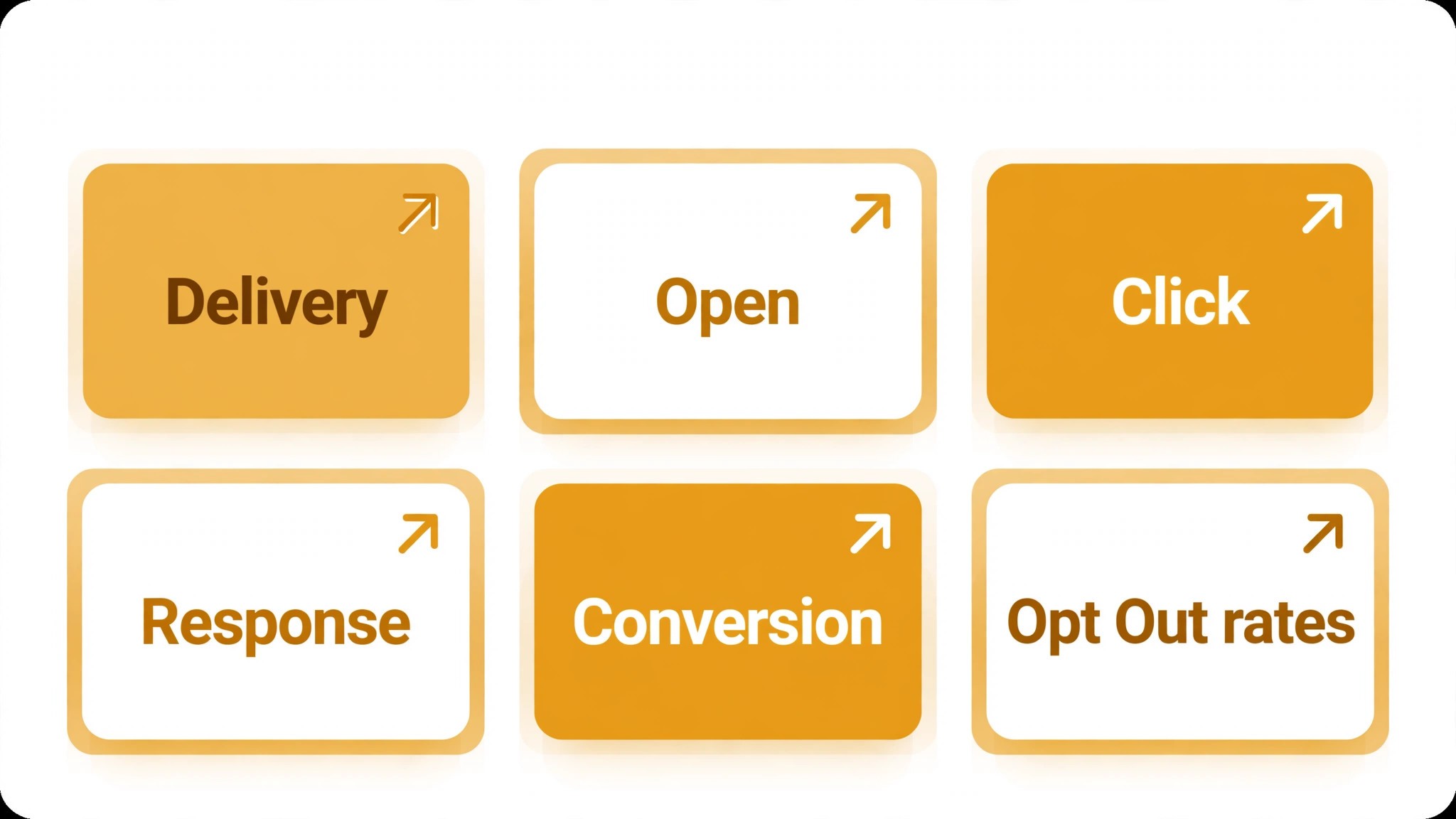
Track these numbers after every send, and compare them week to week, not text to text, because single texts jump around, and weekly numbers show the trend. The numbers that matter are delivery rate, open rate, click through rate, conversion rate, opt out rate, and revenue per text, because those six tell you whether the strategy is working, and where it is failing.
| Metric | Where to find it | Good for a small business |
|---|---|---|
| Delivery rate | SMS tool, delivery report | Above 98 percent |
| Open rate | SMS tool, benchmark comparison | 90 to 98 percent |
| Click through rate | SMS tool, link clicks | 18 to 35 percent |
| Response rate | SMS tool, replies received | 30 to 45 percent |
| Conversion rate | SMS tool, orders traced to a text | 10 to 20 percent of clickers |
| Opt out rate | SMS tool, STOP replies | Under 1 percent per send |
| Revenue per text | SMS tool, orders divided by texts sent | Rising week to week |
A good first month for a small business is 100 subscribers, four texts sent, a click through rate above 15 percent, an opt out rate under 1 percent per send, and the first orders you can trace to a text. A good second month is 250 subscribers, eight texts sent, a click through rate above 20 percent, at least one automated message live, and at least one order per text. A good third month is 500 subscribers, 12 texts sent, a click through rate above 20 percent, three automations live, and at least two orders per text that you can trace.
If the numbers are below those levels, the fix is usually a shorter message, a clearer offer, or a better send time, not more texts. A text that earns opens but no clicks is a text with a weak offer or a weak link, and a text that earns clicks but no orders is a text that links to a weak page or a slow checkout. Fix the message, fix the offer, and fix the link, in that order. If the opt out rate rises above 1 percent per send, stop and cut the frequency at once, because a rising opt out rate is the list telling you it is tired, and a tired list will not come back.
Common Mistakes to Avoid
The first mistake is texting without permission, because the law in the United States requires express consent before a business can send marketing texts, and a customer who never consented will report the number. Build the list with a form, a counter sign, and a checkout checkbox, and never add a customer without asking, never buy a list, and never text a number you got from a receipt. Consent is the whole foundation of a small business sms marketing strategy, and a list without it is a liability, not an asset.
The second mistake is texting too often, because a text is personal, and a business that texts daily will be blocked in the first week. Send one marketing text per week in the first month, and two per week from day 31, and no more, because a list that gets two useful texts a week will read them both, and a list that gets seven will read none of them. If the opt out rate rises above 1 percent per send, cut the frequency at once, because the list is telling you it is tired.
The third mistake is sending long texts, because a text is not an email, and a customer will not read a paragraph on their lock screen. Keep every message under 160 characters where you can, and under 70 characters where the offer is simple, because messages under 70 characters outperformed longer texts by 34 percent in conversion rate in 2025 benchmark reporting. One idea, one offer, one link, and one clear next step is the whole message.
The fourth mistake is sending at the wrong time, because a text at midnight is a text that earns a complaint, and a text at 6 in the morning is a text that earns a block. Send only between 9 in the morning and 8 in the evening, in the customer timezone, and send offer texts between 10 in the morning and 2 in the afternoon, when customers are awake, active, and able to act. A message sent within 5 minutes of a customer action earns far higher clicks, so let the automations handle the timing, and let the broadcasts follow the clock.
The fifth mistake is never answering replies, because SMS is a conversation, and a customer who replies to your text expects an answer in minutes, not in days. Watch the replies for the first hour after every send, answer every reply within minutes, and treat a reply as a sale in progress, because it often is. A small business sms marketing strategy that sends texts and ignores replies is a strategy that throws away its best leads.
The sixth mistake is sending the same message to everyone, because a new subscriber, a loyal customer, and a customer who has not bought in 90 days need different messages. Segment the list by behaviour, such as new subscribers, repeat buyers, and quiet customers, and send each group the message that fits them, because a message that fits earns a click, and a message that does not fit earns an opt out. Behaviour driven targeting can lift conversions by up to 41 percent for ecommerce brands, according to 2025 benchmark reporting, which is the reward for segmenting.
Frequently Asked Questions
How often should a small business send marketing texts?
For a small business sms marketing strategy, one text a week in the first month is the right pace. Send one marketing text per week in the first month, and two per week from day 31, and no more. A list that gets two useful texts a week will read them both, and a list that gets seven will read none of them. If the opt out rate rises above 1 percent per send, cut the frequency at once, because the list is telling you it is tired.
Do I need permission to send marketing texts to customers?
Yes. The law in the United States requires express consent before a business can send marketing texts, and a customer must agree to receive them, usually by ticking a checkbox, texting a keyword to join, or filling in a signup form. Never add a customer without asking, and never buy a list, because a text to someone who never consented is a text that can earn a complaint and a penalty.
What is a good SMS open rate for a small business?
SMS open rates sit between 90 and 98 percent, against 20 to 30 percent for email, according to multiple 2025 benchmark studies, so an open rate in that range is normal, not exceptional. Judge your texts by click through rate and conversion rate instead, because almost every text is opened, and the difference between a good text and a bad one is whether the customer clicks and buys.
What time of day should I send marketing texts?
Send only between 9 in the morning and 8 in the evening, in the customer timezone, and send offer texts between 10 in the morning and 2 in the afternoon, when customers are awake, active, and able to act. Avoid early morning and late evening, because those are the times that earn complaints, and avoid midnight entirely, because a text at midnight is a text that earns a block.
How long should a marketing text be?
Keep every message under 160 characters where you can, and under 70 characters where the offer is simple, because messages under 70 characters outperformed longer texts by 34 percent in conversion rate in 2025 benchmark reporting. One idea, one offer, one link, and one clear next step is the whole message, and anything more than that belongs in the link, not in the text.
Verdict
A small business sms marketing strategy works when the business treats a text as a privilege, not a megaphone, and sends fewer messages, with more value, to people who asked for them. Start with a proper SMS tool, register your number, and build the list with a clear offer, a website form, a counter sign, and a checkout checkbox. Send one text a week in the first month, and two a week from day 31, with one idea, one offer, and one link in each.
Set up the three automations first, the welcome text, the reminder text, and the abandoned cart text, because they earn more than any broadcast, and they run while you sleep. Answer every reply within minutes, because a reply is a sale in progress. Measure delivery, open, click, conversion, and opt out rates after every send, and cut the frequency at once if opt outs rise above 1 percent. Expect the first orders in the first month, a list of 500 subscribers in 90 days, and a channel that your customers actually read, because a text is the one message they will not ignore.