

LinkedIn is the one social platform where a small business can reach buyers without paying for attention first, and the numbers explain why. LinkedIn has more than 1 billion members, and about 80 percent of B2B social media leads flow through it, according to industry reporting on the platform. A small business that posts useful work on LinkedIn is not shouting into a feed of holiday photos. It is putting its expertise in front of the people who hire, buy, and refer, and it is doing it on a platform built for exactly that. A small business linkedin marketing strategy turns that attention into leads, and this guide lays out the first 90 days of it.
The mistake most small businesses make on LinkedIn is to treat it like a noticeboard. They post a product photo, a link to their website, and a line that says contact us, and then they wonder why nobody responds. LinkedIn rewards a different pattern, which is a person sharing useful work, in their own words, and a page that proves the business is real. This guide gives you that pattern, with the setup, the weekly plan, the post types, the outreach steps, and the numbers to watch.
A small business linkedin marketing strategy in 2026 works because the platform has shifted toward fewer, better posts. Metricool 2026 LinkedIn Study found that users are posting less often, about 2.34 posts per week in 2026 against 2.60 in 2025, while engagement per post is rising, up 13.82 percent year over year. Company pages show the same pattern. They post about 2.74 times a week, and their engagement sits at 1.74 percent, up 11 percent on the year before. The message for a small business is plain. You do not need to post five times a week to stay relevant. You need to post two or three times a week, with something worth reading.
What Works on LinkedIn in 2026
The first thing that works in 2026 is the personal profile, not the company page. Metricool 2026 study puts personal profile engagement at 2.60 percent against 1.74 percent for company pages, and other 2026 benchmark analysis puts personal profiles at roughly three times the engagement rate of company pages. The reason is simple. People follow people, and a post from a founder, a manager, or a specialist carries a face and a voice, while a post from a logo carries neither. A small business that posts only from its company page is speaking through a mask, and a small business that posts from the owner profile is speaking as a person.
The second thing that works is the document post, the native PDF carousel that readers swipe through inside LinkedIn. Socialinsider 2026 benchmark study of 1.3 million posts from company pages puts the average LinkedIn engagement rate at 5.20 percent, up 8 percent year over year, and native document posts lead the formats at an average engagement rate of 7.00 percent, up 14 percent year over year.
For a small company page with 1,000 to 5,000 followers, Socialinsider data shows native documents averaging about 525 impressions, ahead of multi image posts at 490, video at 355, image at 315, text at 300, and link posts at 235. A checklist, a before and after, or a short guide in a swipeable document is the highest performing format a small business can publish.
The third thing that works is length. AuthoredUp analysis of 372,126 personal profile posts found median impressions rising with post length, from 575 for posts under 400 characters, to 1,106 at 1,301 to 2,000 characters, to 1,174 at 2,001 to 2,500 characters, and 1,400 at 2,501 to 3,000 characters. Longer posts earn more reach, because they carry more value, and the algorithm rewards the time readers spend on them. A short post that says nothing new earns nothing. A long post that teaches something earns reach.
The fourth thing that works is size. Small accounts outperform large ones on a percentage basis, and that is good news for a small business. Metricool 2026 study found engagement rising 38.83 percent for tiny company pages under 2,000 followers, and 23.17 percent for small pages between 2,000 and 10,000 followers, while both groups posted less often.
Benchmark analysis for small businesses puts a realistic starting goal at 2 to 4 percent engagement, and accounts with 1,000 to 5,000 followers average about 4.2 percent. A small page is not a disadvantage on LinkedIn. It is an advantage, because a small audience can be a real community, and a large audience is usually a crowd.
The fifth thing that works is consistency without volume. Company pages post about 2.74 times a week, and personal profiles about 3.05 times a week, according to the Metricool 2026 study. Three posts a week, every week, beats seven posts one week and silence the next, because the algorithm and the audience both learn when to expect you. A small business linkedin marketing strategy that posts three times a week for 90 days will outperform a business that posts daily for two weeks and quits.
Set Up the Page and the Profile Before You Post
Set up the foundation in the first week, because a strategy built on a weak page will not convert, no matter how good the posts are. Start with the company page, and confirm it looks like a real business. Add a clear logo, a banner image that shows what you do, and a tagline that says who you serve and what you do for them in one sentence. Write the About section as a sales page, not a history lesson, with the services you sell, the customers you serve, and a way to contact you in the first three lines.
Set up the owner profile next, because the owner profile will carry most of the reach. Use a clear headshot, not a logo, and write a headline that says who you help and how, not just your job title. A headline that reads owner at a plumbing company tells nobody anything. A headline that reads I help Austin homeowners fix water heaters without the wait tells a reader exactly who you are for. Fill in the experience section with results, not duties, and add a featured section with your best post, your best case study, and a link to book a call.
Connect the two accounts properly. The company page should list the owner as an employee, and the owner profile should link to the company page. When the owner posts, they should tag the company page, and when the company page posts, the owner should share it with a personal comment, because a share with a comment earns far more reach than a share with nothing. Set up the analytics too, because LinkedIn page analytics show follower growth, post impressions, and engagement, and you will need those numbers to judge what works.
Choose your first 20 topics in week one, and choose them from real customer questions, not from a list of generic tips. Open your inbox, your messages, and your call log, and list the 20 questions customers ask you most often. Those 20 questions are your first 20 posts, and they are better topics than any content calendar template, because they are questions real customers asked, in their own words, and the post that answers them will match the search a future customer runs.
A small business linkedin marketing strategy also needs a small bank of ready posts, so a busy week never becomes a silent week. Write four extra posts in week one, one teaching post, one proof post, one opinion post, and one behind the scenes post, and keep them in a document for the weeks when work runs long. A bank of four posts is the difference between a strategy that survives a busy month and a strategy that stops at the first rush, and the posts in the bank should be evergreen, answering questions that stay true all year, so they are as useful in December as they were in January.
The Weekly Plan for Your Small Business LinkedIn Marketing Strategy
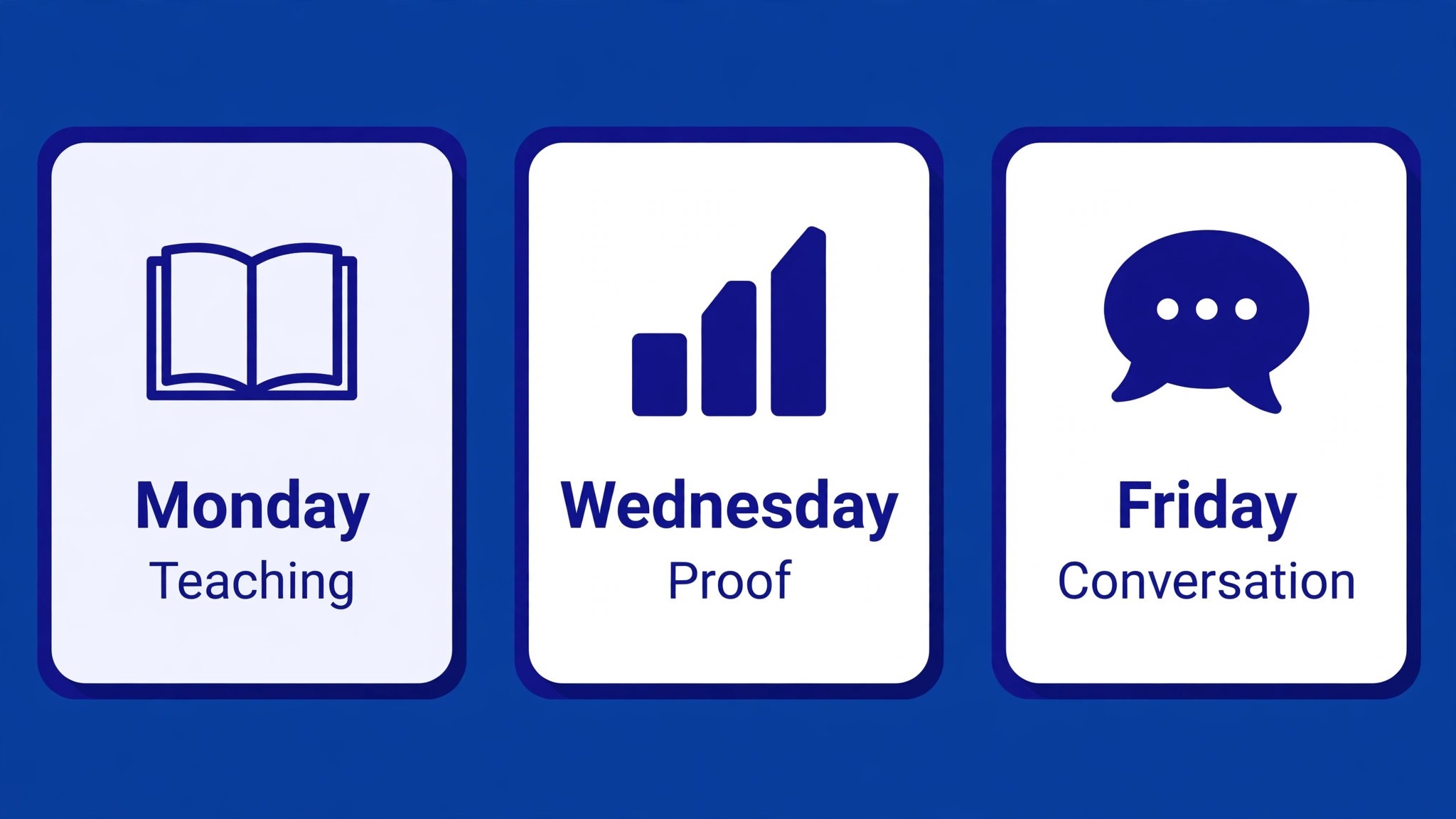
A small business linkedin marketing strategy needs a plan a busy owner can actually keep, and this one takes about three hours a week. Post three times a week, on the same days each week, so your audience learns when to expect you. Monday is the teaching post, Wednesday is the proof post, and Friday is the conversation post, and the three together cover the whole job of marketing, which is to teach, to prove, and to listen.
Monday teaching post. Publish a document post or a long text post that answers one customer question fully, in 1,500 to 2,500 characters, with a clear structure a busy reader can scan. Start with the answer in the first two lines, because LinkedIn shows only the first two lines before the see more link, and a reader who finds the answer in two lines will click to read the rest. Follow with the detail, the numbers, and the steps, and end with a question that invites a reply. Spend 60 minutes writing it, and 10 minutes engaging with the replies.
Wednesday proof post. Publish a case study, a before and after, a customer result, or a short video of real work, because proof is what turns readers into buyers. Show the problem, show what you did, and show the result with a real number, such as the time saved, the money saved, or the days the job took. Spend 45 minutes making it, and 10 minutes replying to comments, because a proof post that nobody answers is a post that nobody believed.
Friday conversation post. Publish a short post that asks your audience something, shares an opinion, or tells a lesson from the week, because conversation is what the algorithm rewards most. A question about a common mistake in your trade, an opinion about a change in your industry, or a lesson from a job that went wrong will earn more comments than any product post, and comments are the signal LinkedIn weighs heaviest. Spend 30 minutes writing it, and 30 minutes replying to every comment, because the replies are the marketing.
Spend the rest of the week on outreach and engagement, not on more posting. Spend 20 minutes a day, Monday to Friday, commenting on posts from customers, suppliers, and local businesses, because a useful comment on someone else post puts your name in front of their audience, and it costs nothing. Spend 30 minutes a week on connection requests, which the outreach section below covers in detail. Spend 30 minutes on Monday reviewing last week numbers, and planning the week around the post that performed best.
| Day | Task | Time |
|---|---|---|
| Monday | Write and publish the teaching post, review last week numbers | 70 minutes |
| Tuesday | Comment on 5 posts from customers and local businesses | 20 minutes |
| Wednesday | Publish the proof post, reply to comments | 55 minutes |
| Thursday | Send connection requests and follow up on conversations | 30 minutes |
| Friday | Publish the conversation post, reply to every comment | 60 minutes |
| Weekly total | Three posts, engagement, outreach, and review | About 3 hours |
Post Types That Earn Leads
Use five post types, and rotate them through the month, so the feed never feels repetitive. The first type is the teaching post, which answers one customer question with a direct answer, the detail, and a next step. A roofer writes how much a roof repair costs, gives a range, explains what changes the price, and ends with a call for a free inspection. A bookkeeper writes the three numbers every small business should check on Monday morning, and explains each one in two sentences. Teaching posts earn saves and shares, because readers keep useful answers.
The second type is the proof post, which shows real work with a real result. A landscaper posts before and after photos of a garden, with the days the job took and the cost range. A consultant posts a screenshot of a client result, with the numbers blurred where they need to be, and explains what changed. Proof posts earn enquiries, because a reader who sees a result like theirs believes you can do it for them too. Use real photos, real numbers, and real customer words wherever you can, because stock photos and vague claims earn nothing.
The third type is the document post, the native PDF carousel, which is the highest performing format on the platform. Turn a teaching post into a five to seven page document, with one idea per page, a clear heading on each page, and a final page that tells the reader what to do next. A checklist, a comparison table, or a step by step guide works well as a document, because readers swipe through it, and the swipe is an engagement signal. Keep each page simple, with one idea and one visual, because a crowded page is skipped.
The fourth type is the opinion post, which states a clear view about your trade and invites disagreement. An accountant writes that most small businesses do not need a full time bookkeeper, and explains what they need instead. A designer writes that a logo is the least important part of a rebrand, and explains what matters more. Opinion posts earn comments, because people respond to a view, and they earn followers, because people follow a person with a view. Keep the opinion honest and specific, because a vague opinion earns nothing and a dishonest one costs trust.
The fifth type is the behind the scenes post, which shows the business as it really is. A photo of the team on a job, a short video of a workshop, or a post about a mistake you made and what you learned from it. Behind the scenes posts earn trust, because a business that shows its real work is a business a customer can believe in. Use them once or twice a month, not every day, because a feed of nothing but behind the scenes is a feed with no expertise in it.
Outreach That Turns Readers Into Conversations
Posting alone will not bring leads fast enough, and outreach is the part of a small business linkedin marketing strategy that turns readers into conversations. Send 10 connection requests a week, to people who fit your customer profile, and write each request by hand. A request that says I saw your post about hiring a plumber, and I help Austin homeowners with water heater repairs, will be accepted far more often than a request with no message at all. Never send a sales pitch in the connection request, because a pitch in the first message is the fastest way to be ignored.
After a request is accepted, wait a day, then send a short message that offers something useful, not a sales pitch. Share a post they might find helpful, ask a question about their business, or comment on something they posted. The goal of the first message is a reply, not a sale, because a conversation that starts with value is a conversation that can lead to a sale, and a conversation that starts with a pitch is a conversation that ends at once.
Follow up with the people who engage with your posts, because they have already told you they are interested. If someone comments on your teaching post, reply to them, then send a connection request if you are not already connected, then send a message that continues the conversation. If someone likes three of your posts in a week, they are warm, and a message that asks whether they would like the checklist from the post is a natural next step. Track these people in a simple list, with their name, their business, and the last thing you sent them, because a small business that follows up wins against a bigger business that does not.
Join two or three LinkedIn groups in your trade or your town, and comment there once a week, because groups put your name in front of people who are already talking about your topic. Answer questions in the group with useful answers, not with a link to your website, because a useful answer earns trust and a link earns nothing. Post your teaching posts in the group when the group rules allow it, and only when the post answers a question the group is asking.
Numbers to Track, and What Good Looks Like
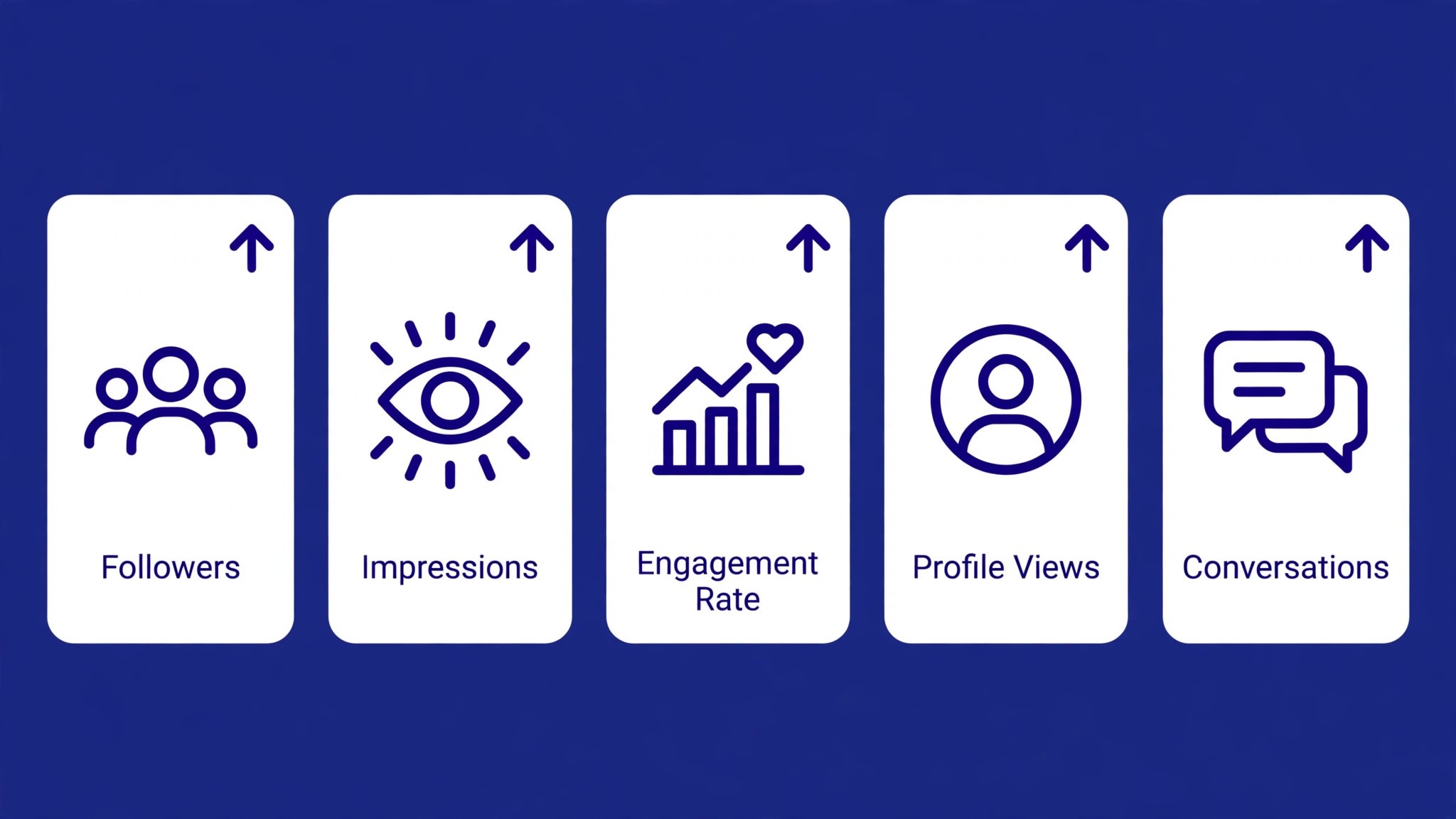
Track these numbers every Monday, and compare them week to week, not day to day, because daily numbers jump around, and weekly numbers show the trend. The numbers that matter are followers, impressions, engagement rate, profile views, and conversations started, because those five tell you whether the strategy is working, and where it is failing.
| Metric | Where to find it | Good for a small business |
|---|---|---|
| Follower growth | Page analytics, followers | 10 to 20 new followers per month in the first 90 days |
| Impressions per post | Post analytics | 300 to 500 per post on a small page, rising with document posts |
| Engagement rate | Post analytics, engagements divided by impressions | 2 to 4 percent, with document posts higher |
| Profile views | Profile analytics | Rising week to week, with a spike after each teaching post |
| Comments per post | Post analytics | At least 3 comments on a conversation post |
| Conversations started | Your inbox, tracked weekly | At least 2 new conversations per week by day 60 |
| Enquiries from LinkedIn | Ask every new customer how they found you | At least 1 per week by day 90 |
A good first month for a small business is 12 posts, at least one post with more than 500 impressions, an average engagement rate above 2 percent, and the first conversation that started from a post. A good second month is 24 posts, at least one post with more than 1,000 impressions, at least two conversations per week, and the first enquiry that mentions LinkedIn. A good third month is 36 posts, at least three posts with more than 1,000 impressions, at least one enquiry per week that you can trace to LinkedIn, and a follower count that has grown by 30 to 60 people.
If the numbers are below those levels, the fix is usually a clearer first two lines, a stronger document post, or more replies to comments, not more posts. A post that earns no comments is a post that asked for nothing, and a page that earns no profile views is a page that posts without a person behind it. Fix the first two lines, fix the format, and fix the follow up, in that order.
Common Mistakes to Avoid
The first mistake is posting links to your website, because LinkedIn suppresses link posts, and the data shows it. Socialinsider data puts link posts at about 235 average impressions for a small page, the lowest of any format, against 525 for native documents. Post the value on LinkedIn, and put the link in the first comment, or in the final page of the document, because a post that keeps readers on LinkedIn earns reach, and a post that sends them away earns nothing.
The second mistake is posting only from the company page, because the company page earns about half the engagement of a personal profile. Post from the owner profile first, tag the company page, and let the company page share it with a comment. A small business linkedin marketing strategy that hides the owner behind a logo is a strategy that throws away its best asset, which is the person.
The third mistake is posting without a question or a next step, because a post that asks for nothing gets nothing. End every teaching post with a question, end every proof post with an invitation to message you, and end every document with a final page that tells the reader what to do next. A post that ends without telling the reader what to do wastes the attention it just earned.
The fourth mistake is sending sales pitches in connection requests and first messages, because a pitch in the first message is the fastest way to be ignored and reported. Offer something useful first, ask a question, and let the conversation lead to the sale. The businesses that win on LinkedIn are the ones that help first and sell second, and the ones that lose are the ones that sell first and help never.
The fifth mistake is giving up after a month, because LinkedIn compounds slowly, and the business that posts for 90 days and quits learns nothing, while the business that posts for a year owns the conversation in its trade. Expect the first signs in 30 days, the first conversations in 60 days, and the first enquiries in 90 days, and keep posting through the quiet weeks, because the quiet weeks are when most competitors quit.
The sixth mistake is copying a competitor post, because a copy will never outperform the original, and a reader who has seen both will trust the original more. Write about your own work, your own customers, and your own lessons, because your experience is the one thing no competitor can copy.
Frequently Asked Questions
How often should a small business post on LinkedIn?
Post three times a week, on the same days each week, with one teaching post, one proof post, and one conversation post. Company pages average about 2.74 posts a week, and personal profiles about 3.05, according to the Metricool 2026 study, so three posts a week matches the platform norm. Posting daily is not needed, and posting once a month is too slow to build an audience.
What is a good LinkedIn engagement rate for a small business?
Aim for 2 to 4 percent, measured as engagements divided by impressions, which benchmark analysis puts as a realistic starting goal for small businesses. Small pages often do better, with accounts of 1,000 to 5,000 followers averaging about 4.2 percent. Company pages average lower than personal profiles, so measure the owner profile and the company page separately, and do not compare one against the other.
Should a small business post from the company page or a personal profile?
Post from the personal profile first, because personal profiles earn roughly three times the engagement of company pages, and Metricool 2026 study puts personal engagement at 2.60 percent against 1.74 percent for company pages. Tag the company page in the post, and let the company page share it with a comment. The company page still matters, because it is where a buyer checks that the business is real, but the profile is where the reach comes from.
What type of LinkedIn post gets the most engagement?
Native document posts, the PDF carousels readers swipe through, lead the formats, with Socialinsider 2026 data putting them at a 7.00 percent average engagement rate, up 14 percent year over year, and about 525 average impressions for a small page. Turn your best teaching posts into five to seven page documents, with one idea per page, and a final page that tells the reader what to do next.
How long does LinkedIn marketing take to work for a small business?
Expect the first signs in 30 days, the first conversations in 60 days, and the first enquiries in 90 days. A good first month is 12 posts, at least one post with more than 500 impressions, and an average engagement rate above 2 percent. A good third month is 36 posts, at least one enquiry per week traced to LinkedIn, and a follower count up by 30 to 60 people.
Verdict
A small business linkedin marketing strategy works when the owner posts as a person, teaches something useful three times a week, proves it with real work, and follows up with the people who respond. Start with the page and the profile, choose 20 topics from real customer questions, and publish one teaching post, one proof post, and one conversation post each week. Turn the best teaching posts into document carousels, because they earn the most reach, and reply to every comment, because the replies are the marketing.
Send 10 connection requests a week, written by hand, and follow up with the people who engage, because outreach is what turns readers into conversations. Measure followers, impressions, engagement rate, profile views, and conversations every Monday, and fix the first two lines, the format, or the follow up when the numbers are low. Expect conversations in 60 days and enquiries in 90, and keep posting through the quiet weeks. LinkedIn rewards the small business that shows up every week with something useful, and it rewards that business with the buyers its competitors never meet.