

A small tour company with three guides and two vans loses money in the gaps between bookings. A family books a walking tour online while the guide is already full, a reseller sells seats the company does not have, and a payment fails because the booking system and the payment processor do not talk. The best tour operator software for small tour companies closes those gaps, and the difference shows up in the number of seats that are actually sold, which is the number that decides whether a small operator earns money or just covers fuel.
Small tour companies need software that handles bookings, itineraries, payments, and distribution without a full time office team. A day tour operator needs timeslots and capacity, a multi day operator needs itineraries and deposits, and every operator needs a booking page that works on a phone. The 8 tools below were picked because they serve companies with roughly 1 to 20 departures a week, publish prices a small company can check, and cover the core jobs of online booking, capacity, payments, and channel distribution.
This guide compares the 8 platforms on real 2026 pricing, including the commission models that decide the true cost. Some tools charge a flat monthly fee, some charge a percentage of every booking, and some charge both. We state which model each tool uses, because a company with 200 bookings a month pays very different amounts under each one. Prices come from vendor pages and current roundups checked in November 2026.
How we chose the best tour operator software for small tour companies
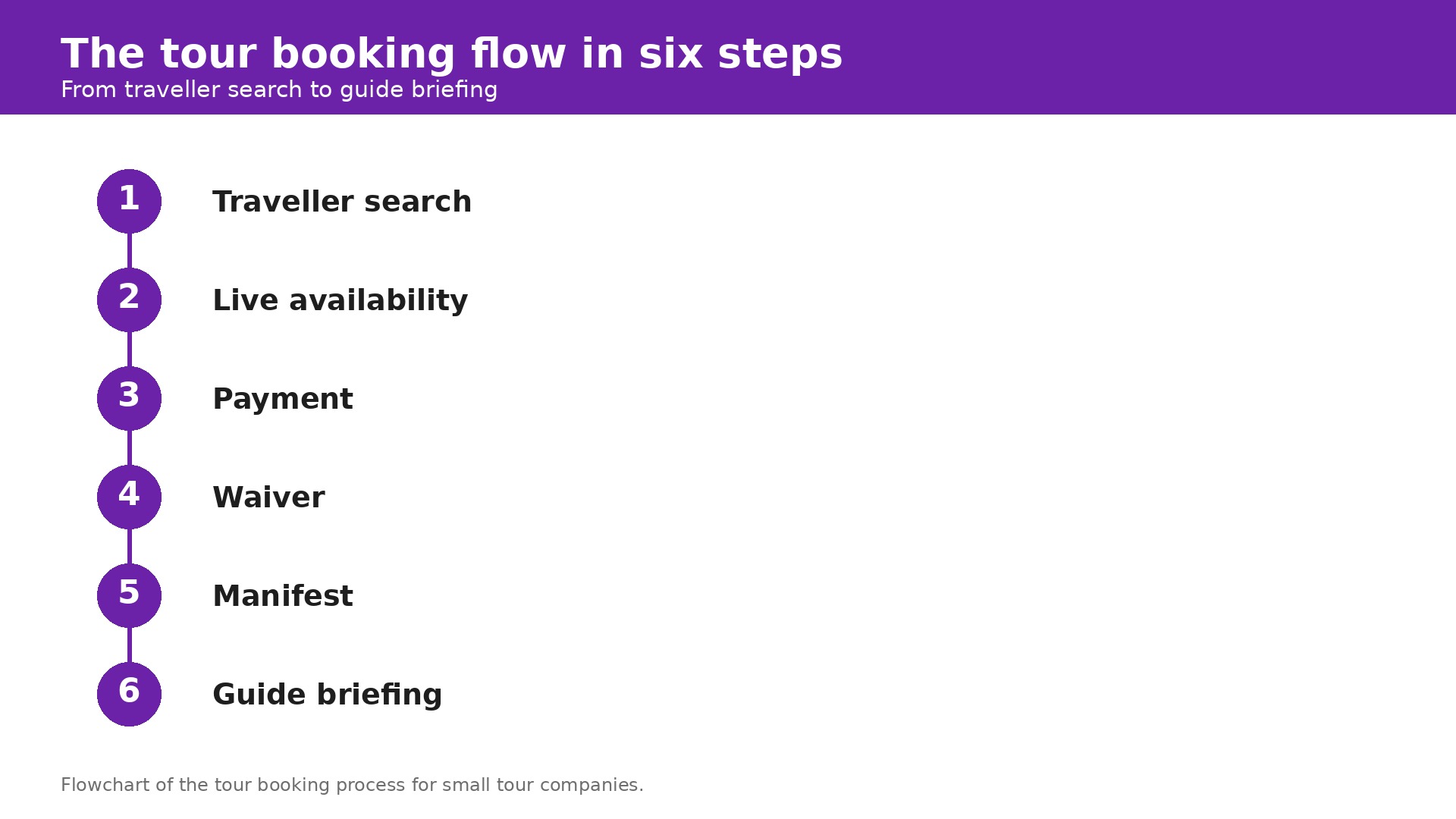
We judged every tool on the four jobs that decide whether a small tour company runs smoothly. First, online booking must show real availability and take a reservation without a phone call, because a traveller who cannot book on a phone books elsewhere. Second, capacity and resource management must prevent overbooking, because a seat sold twice is a refund and a review. Third, payments must work online and at the meeting point, with deposits and partial payments handled in the flow. Fourth, distribution must reach resellers and online travel agencies without double selling the same seats.
Pricing models counted as much as headline prices. A tool that charges 6 percent of every booking is cheap at low volume and expensive at high volume, while a flat $49 a month tool is the opposite. We state the model for every tool and show what a company with 100 bookings a month pays under each one. Tools that hide pricing behind a sales call scored lower, and tools with a free trial scored higher, because an operator should be able to test checkout on a phone before committing.
We also weighted tour type fit. A day tour operator needs timeslots, a multi day operator needs itineraries, and a mixed operator needs both. No single tool wins for every tour type, so this guide states the best fit for each tool plainly. Features such as waivers, guide scheduling, and review collection were treated as useful extras, not as reasons to pick a platform on their own.
The best tour operator software for small tour companies at a glance
The table below gives the whole field in one view. Use it to cut the list to three candidates, then read the full reviews of those three before you book a demo. Note that a commission percentage looks small until you multiply it by monthly revenue, so the starting prices below are the entry point, not the final bill.
| Tool | Starting price | Best for | Watch out |
|---|---|---|---|
| FareHarbor | $0 a month plus about 6 percent commission | No monthly fee simplicity | Commission grows with revenue |
| Rezdy | From $49 a month | Reseller and B2B distribution | 3 percent fee on OTA bookings |
| Checkfront | From $99 a month | Flexible small operators | 3 percent online booking fee reported |
| Bókun | From $49 a month plus 1.5 percent direct | Viator and TripAdvisor distribution | 1.5 percent fee on direct bookings |
| Bookeo | From $39.95 a month | Small direct first operators | Thinner distribution than Rezdy |
| Peek Pro | Quote only, about 6 percent commission | US operators wanting a full platform | No published price, commission model |
| Xola | Quote only | Operators wanting a modern booking flow | No published price, sales led |
| Rezgo | $0 a month plus 4.9 percent per booking | Flexible transaction based booking | Percentage fee grows with revenue |
The 8 tools, reviewed in detail
Each review below states the price and the pricing model first, then the strengths, then the honest limits. Read the pick it when and skip it when lines as the verdict. If a tool matches your tour type and your booking volume, it belongs on your shortlist even if it sits low in this list.
1. FareHarbor
FareHarbor charges no monthly fee and no setup fee. Instead, a commission of about 6 percent applies per online booking, typically added to the guest checkout price, and payment processing is bundled into that rate. A free demo is available, and the platform is the default choice for US tour and activity operators who never want a software bill.
FareHarbor is the easiest booking system to start on. There is no monthly fee, no setup fee, and no subscription to cancel, which removes the risk for a new operator entirely. The platform covers online reservations, walk in sales, staff schedules, customer details, and reseller connectivity in one place, and the point of sale tools are among the best in this category. For a low volume operator, the zero monthly bill is a genuine advantage.
The 6 percent commission grows with revenue, so a busy operator pays far more than a flat subscription. On $10,000 a month of online bookings, the commission is $600, which is more than ten times the Rezdy Foundation plan. The commission also applies to every online booking, so a company that grows will eventually pay more than it would on a flat plan. The pricing is not published as a rate card, so owners must confirm the rate in a quote.
Pick it when you run a low volume tour company, take many walk up bookings, and want no monthly software bill at all. Skip it when you take more than about $2,000 a month in online bookings, because the commission will exceed a flat subscription.
2. Rezdy
Rezdy starts at $49 a month on the Foundation plan, with Accelerate at $99 a month and Expansion at $249 a month. Direct bookings from the operator website carry 0 percent commission, while OTA channel bookings carry about 3 percent. Offline and agent bookings cost $1, $0.85, or $0.70 by plan. A 21 day free trial needs no credit card.
Rezdy is the operator choice when distribution, not just direct booking, drives the business. The channel manager connects to thousands of resellers including Viator, Klook, and Google Things to Do, with live availability sync so the company never double books. Plans include unlimited products and users, and the 0 percent commission on direct bookings means the operator keeps every dollar from its own website. For a company that sells through resellers, the distribution depth is the reason to pick it.
The 3 percent fee on OTA bookings adds up, and card processing sits on top of the subscription. The platform is also stronger on distribution than on multi day itinerary tools, so a multi day operator may find gaps. The interface is functional rather than beautiful, and the setup takes longer than the simplest tools.
Pick it when you sell through resellers and online travel agencies and want 0 percent commission on your own direct bookings. Skip it when you only sell direct and never use resellers, or you need deep multi day itinerary tools.
3. Checkfront
Checkfront starts at $99 a month on the widely listed plan, with some listings showing $125 to $295 a month and 0 percent commission on direct and OTA bookings. Other listings report a 3 percent online booking fee, so owners should confirm the current plan and fee before budgeting. A free demo is available, and the platform joined the Rezdy group, which may change plan structures.
Checkfront is the value pick for small operators who need flexibility more than flash. Daily, multi day, timeslot, and flextime booking types come standard, with advanced resource management for equipment, digital waivers, seasonal pricing, and OTA links included. The platform handles mixed inventory well, such as tours alongside equipment rentals or accommodation in a single transaction. For a small operator with varied products, the flexibility is the selling point.
The pricing is confusing, with listings showing $99 a month, $125 to $295 a month, and different fee structures, so owners must confirm the current plan in writing. The platform joined the Rezdy group, which creates uncertainty about future plan changes. The interface is also older than the newest tools.
Pick it when you run mixed inventory such as tours plus rentals or lodging and want flexible booking types in one system. Skip it when you need a single clear published price, or you only run simple day tours.
4. Bókun
Bókun starts at $49 a month, with a 1.5 percent fee on direct bookings and 0 percent on Viator bookings. The platform is owned by TripAdvisor, and the channel manager depth is the main selling point. Owners should confirm the current plan structure before budgeting, because the fees differ by channel.
Bókun wins for operators who live on Viator and TripAdvisor distribution. The 0 percent commission on Viator bookings is a genuine saving, because Viator is where many travellers find tours, and the channel manager connects to a wide range of resellers with live availability sync. For an operator whose main sales channel is Viator, the economics are hard to beat. The platform also handles multi day tours and itineraries well.
The 1.5 percent fee on direct bookings means the operator pays on its own website sales, which Rezdy does not charge. The platform is also owned by TripAdvisor, so an operator that wants independence from one distribution giant may prefer a neutral tool. The pricing is less transparent than the flat fee tools.
Pick it when you sell mainly through Viator and TripAdvisor and want 0 percent commission on those bookings. Skip it when you sell mainly direct and want 0 percent commission on your own website.
5. Bookeo
Bookeo starts at $39.95 a month, with plans from $40 to $110 a month and zero per booking commission on all plans. The platform covers booking calendars, automated communication, staff scheduling, and waitlists, and the bill is the same at 100 bookings or 500 bookings. Owners should confirm the current tier structure before budgeting.
Bookeo is the most predictable bill on this list. The flat monthly fee with zero per booking commission means a busy month costs the same as a quiet month, which makes budgeting simple. The booking calendar, automated messages, and staff scheduling cover the core jobs for a small operator, and the platform is easy to learn. For a direct first operator who wants cost certainty, it is the best pick.
The distribution tools are thinner than Rezdy or Bókun, so an operator who sells mainly through resellers will find less depth. The feature set is also simpler than the bigger platforms, with less depth in multi day itineraries and resource management. A company that grows into a reseller heavy model may need to move.
Pick it when you sell mainly direct from your own website and want one flat bill with zero commission, no matter how busy the month gets. Skip it when you sell mainly through resellers and online travel agencies.
6. Peek Pro
Peek Pro does not publish a rate card. The typical model is a 6 percent customer paid booking fee, similar to FareHarbor, with the rate confirmed in a quote. Owners should expect a sales conversation and a written quote before they can compare it against anything else. A free demo is available.
Peek Pro is a full platform for US tour and activity operators, with online booking, point of sale, waivers, and reporting in one system. The 6 percent fee is paid by the customer at checkout, which keeps the operator bill low, and the platform is proven with high volume operators. The mobile check in and ticket scanning tools are strong, and the interface is clean.
The quote only pricing and the commission model make long term costs opaque, and a busy operator pays far more in commission than on a flat plan. The platform is also US focused, so international operators may find fewer local integrations. The 6 percent fee is the same as FareHarbor, so the choice between them comes down to features rather than price.
Pick it when you run a US tour or activity business with high volume and want a full platform with a customer paid fee. Skip it when you need a published price or a flat subscription that does not grow with revenue.
7. Xola
Xola does not publish pricing and sells by quote. Owners should expect a sales conversation and a written quote before they can compare it against anything else. The platform is sold as a modern booking system for tour and activity operators, with a free demo available.
Xola is built for operators who want a modern booking flow that converts well on mobile. The checkout is fast, the gift card and package tools are strong, and the platform handles tours, activities, and rentals in one system. For an operator whose main problem is a booking page that loses customers, the conversion focus is a real advantage.
The quote only pricing makes it impossible to compare without a sales call, and the platform is built for operators with real volume, so a very small company may find the price opaque and the setup heavy. The distribution tools are thinner than Rezdy, so a reseller heavy operator should look elsewhere.
Pick it when you want a modern, high converting booking flow and are comfortable getting a quote. Skip it when you need a published price or deep reseller distribution.
8. Rezgo
Rezgo charges no monthly fee and takes 4.9 percent per online booking. The platform covers point of sale, resource management, payment integrations, and guest manifests in one system. There is no subscription to cancel, and the fee applies only when a booking is made.
Rezgo is the flexible transaction based option on this list. With no monthly fee, a new operator can start without any software bill, and the platform covers the core jobs of booking, resources, and payments well. The point of sale tools are strong, and the guest manifest features help a guide know exactly who is coming. For a seasonal operator with quiet months, the zero monthly bill is a genuine advantage.
The 4.9 percent fee grows with revenue, so a busy operator pays far more than a flat $49 subscription. On $10,000 a month of online bookings, the fee is $490, which is ten times the Rezdy Foundation plan. The platform is also thinner than the bigger tools on distribution, so a reseller heavy operator will find gaps.
Pick it when you run a seasonal tour business with quiet months and want no monthly bill, paying only when bookings arrive. Skip it when you take steady high volume online bookings, because the percentage fee will exceed a flat subscription.
Choosing by Your Main Job
The best tour operator software for small tour companies depends on booking volume and sales channel. Match your job to the pick below and you will shortlist faster than reading every review in order.
| Your job | Best pick | Why it wins |
|---|---|---|
| Low volume, no monthly bill | FareHarbor | $0 a month plus about 6 percent per booking |
| Reseller and OTA distribution | Rezdy | From $49 a month, 0 percent on direct bookings |
| Viator heavy operator | Bókun | From $49 a month, 0 percent on Viator |
| Direct first, predictable bill | Bookeo | From $39.95 a month, zero commission |
| Mixed tours plus rentals | Checkfront | Flexible booking types from $99 a month |
| Seasonal, quiet months | Rezgo | $0 a month plus 4.9 percent per booking |
Your Real Yearly Spend
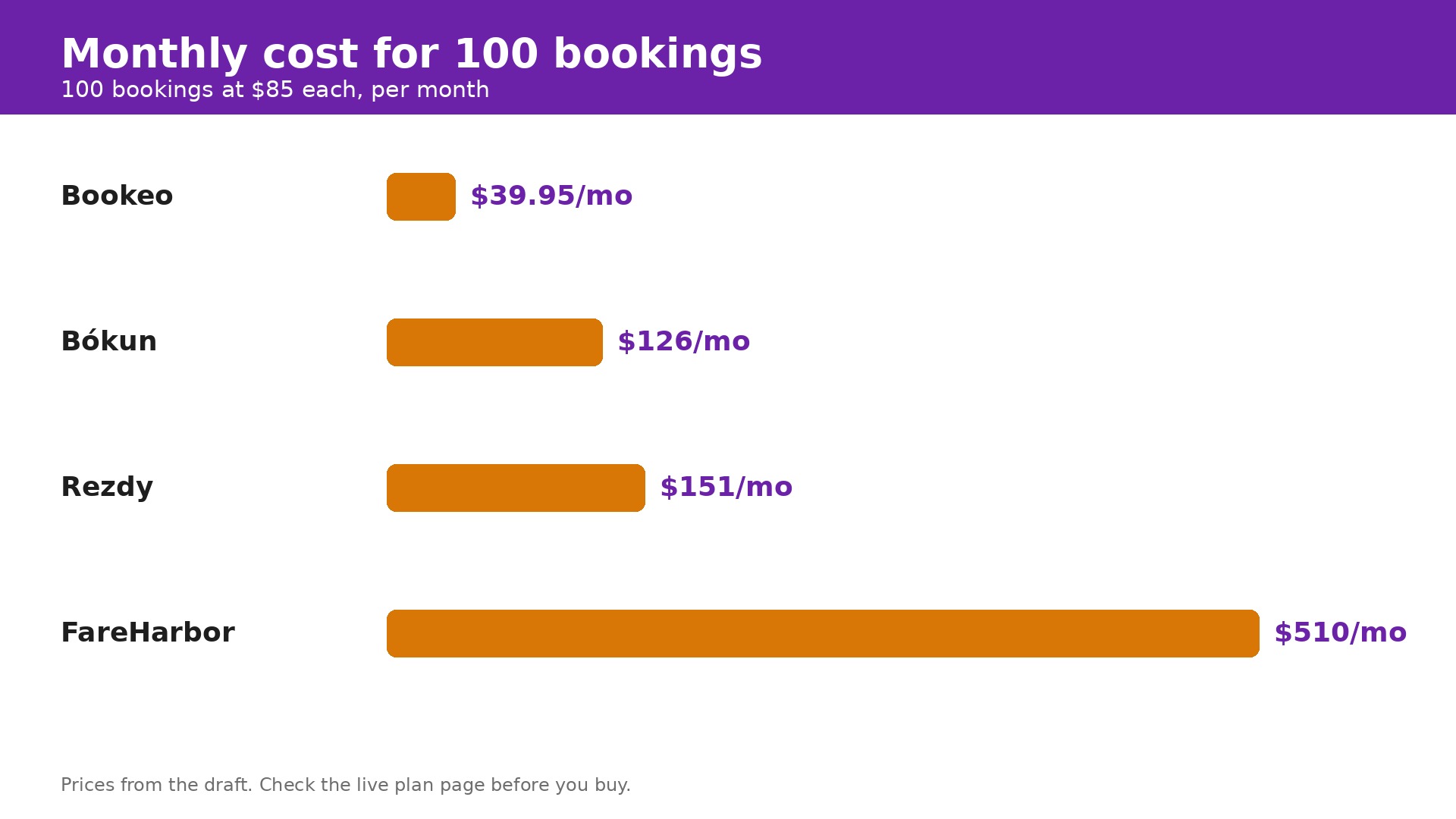
A small tour company with 100 bookings a month at $85 each earns $8,500 a month in online revenue. On FareHarbor at 6 percent, the cost is $510 a month. On Rezdy Foundation at $49 a month plus 3 percent on OTA bookings, the cost is about $49 plus $102 if 40 percent of bookings come through OTAs, which is $151 a month. On Bookeo at $39.95 a month with zero commission, the cost is $39.95 a month. On Bókun at $49 a month plus 1.5 percent on direct bookings, the cost is about $49 plus $77, which is $126 a month.
The pricing model decides the bill, so always calculate the cost at your real booking volume and channel mix.
The hidden costs are the card processing and the OTA fees. Most flat fee platforms pass Stripe processing of about 2.9 percent plus 30 cents through separately, while FareHarbor bundles processing into its 6 percent. Always ask for a 12 month total that includes subscription, commission, and processing, then compare that number across vendors.
The math that justifies the spend is the direct booking saving. Every booking that comes through the operator website instead of an OTA saves the OTA commission, which is often 20 percent or more. On a $85 tour, that is $17 saved per booking. Ten direct bookings a month save $170, which covers almost any tool on this list. A system that also prevents one overbooking a month pays for itself many times over.
Five Traps That Cost You
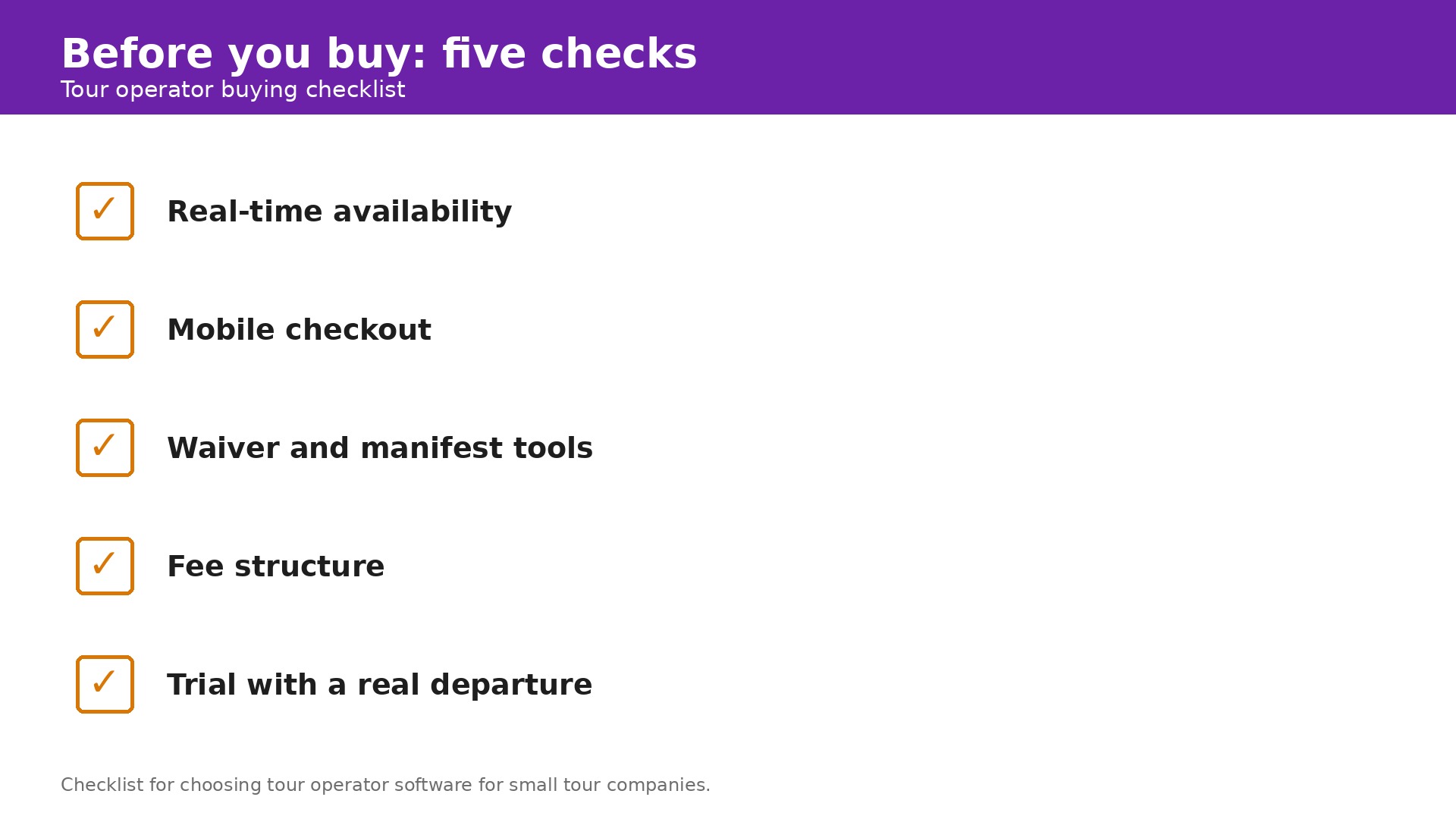
- Picking a commission tool when a flat fee tool is cheaper at your volume. Calculate the cost at your real monthly bookings, not at ten bookings, because a 6 percent commission is $510 a month on $8,500 of revenue while a flat plan is $49.
- Ignoring the channel mix. A tool that charges 0 percent on direct bookings but 3 percent on OTA bookings is cheap for a direct first operator and expensive for a reseller heavy one. Model the cost at your real mix before you commit.
- Buying a day tour tool for a multi day business. Timeslots and itineraries are different jobs, and a tool built for one will frustrate an operator who needs the other. Shortlist by tour type, not by feature list.
- Skipping the mobile checkout test. Most travellers book on a phone, so test the booking flow on your own phone before you commit. A beautiful desktop site that breaks on mobile loses bookings every day.
- Forgetting waivers and manifests. A guide who does not know who is coming, or who has not signed a waiver, creates a safety and a legal problem. Check the waiver and manifest tools before you commit, because they matter more than a pretty booking page.
What good looks like after one season
After one season on the right system, a small tour company should be able to answer five questions in under a minute. Which departures are full, which have space, and which need a second guide. What the direct booking share was last month and which channel earned the most. How many seats were sold through resellers and what commission they cost. Which guides worked which departures and what they are owed. And what the company will earn next month at current booking pace. If the software cannot answer those questions, it is a booking form, not a management system.
The first month is the hardest, because the departure data is empty and the habit is new. Load every tour, every timeslot, and every existing booking on day one, even if it takes an afternoon. A half loaded system tells you nothing, and the team will stop trusting it. By the second month, the reports start to work, because the data is finally there. By the end of the season, the company has a real picture of which tours earn money and which ones lose it, and that picture is worth more than the subscription cost many times over.
The best tour operator software for small tour companies earns its keep in the quiet moments, not in the demos. It is the overbooking that never happens, the direct booking that arrives without a phone call, and the manifest that tells the guide exactly who is coming. Pick the tool that makes those moments easy, and the rest of the features will take care of themselves. A system the guides actually use every day beats a powerful system they avoid, so choose the one your team will open first each morning.
Frequently Asked Questions
How much does tour operator software cost for a small company?
A small tour company pays $0 to $99 a month plus commission, depending on the model. Bookeo starts at $39.95 a month with zero commission, Rezdy starts at $49 a month with 0 percent on direct bookings, Bókun starts at $49 a month plus 1.5 percent on direct, and Checkfront starts at $99 a month. FareHarbor charges $0 a month plus about 6 percent per booking, Rezgo charges $0 plus 4.9 percent, and Peek Pro and Xola are quote only. Always calculate the cost at your real booking volume before you compare.
What is the best tour operator software for small tour companies in 2026?
The best tour operator software for small tour companies depends on booking volume and sales channel. FareHarbor wins for low volume operators who want no monthly bill, Rezdy wins for reseller distribution, Bókun wins for Viator heavy operators, and Bookeo wins for direct first operators who want a flat bill. Shortlist three tools that match your volume and channel mix, trial them with a real departure, and pick the one your team actually enjoys using.
Should a small tour company pay a commission or a flat monthly fee?
A commission model suits a low volume or seasonal operator, because the bill is zero when there are no bookings. A flat fee suits a busy operator, because the bill does not rise when bookings rise. On $8,500 a month of online revenue, a 6 percent commission is $510 a month while a flat plan is $49. Calculate the cost at your real monthly revenue and choose the model that is cheaper at your volume.
Can tour operator software prevent overbooking?
Yes, if the channel sync is real time. Every tool on this list except the pure booking page tools includes live availability, so a seat sold on Viator closes instantly on the operator website and on every other reseller. Test the sync with a real booking during your trial, and never manage capacity by hand across two systems. An overbooking costs a refund and a review, and it is the easiest failure to prevent.
Do I need tour operator software for just one weekly tour?
Yes, if you take online bookings or sell through resellers. A single weekly tour can run on email and a spreadsheet, but the moment a traveller books online while another books through Viator, the spreadsheet is wrong. Software shows real availability, takes payments, and sends manifests to the guide, and those three jobs save more time than the $39.95 a month Bookeo costs.
How do I get more direct bookings for my tour company?
Build a booking page that works on a phone, push guests to it from your website and your social profiles, and offer a small incentive for booking direct, such as a free upgrade or a discount on a second tour. Tools such as Rezdy and Bookeo charge 0 percent on direct bookings, so every direct booking saves the OTA commission, which is often 20 percent or more. A direct booking on a $85 tour saves $17, and ten direct bookings a month save $170.