
A small clinic pays between $99 and $829 a month for best dental practice management software for small clinics, and the spread has little to do with quality. The tools in this list charge in different ways and cap different things, so two tools at the same monthly price can cost very different amounts over a year.
Start with the job, not the tool. Write down the three tasks you do every week, the number of people who need a login, and the monthly volume you already handle. Those three numbers decide the right tool faster than any demo, because they expose which pricing model fits you and which free plan will run out first.
Prices in this guide were checked against vendor pricing pages and current 2026 guides in November 2026. Where sources disagree, the draft shows both figures and says so plainly, so you can confirm the current price on the checkout page before you pay. All prices below are in US dollars per month unless stated otherwise, and annual billing is noted where it changes the monthly figure.
How This List Was Built
We started from the tools small operators actually shortlist, then checked each price on the vendor pricing page or in a current 2026 guide. A tool made this list only if it serves small teams, publishes enough detail to compare fairly, and has real users behind it. Quote only tools are included where they are a serious option, and the draft says plainly when a price is a quote rather than a published figure.
Each tool below gets the same treatment. The entry price, the free plan limit, the strongest feature and the catch that matters most. The glance table gives the short version, the full reviews give the detail, and the decision table at the end matches each tool to the job it does best. Nothing here is a paid placement, and no vendor supplied the ranking.
Quote only tools are marked as such throughout this guide. A quote is not a price, so treat it as a starting point and ask for the figure in writing at your size, at the size you expect in a year, and with the add ons you need included. That written quote is the only number you can compare fairly with a published price.
Best Dental Practice Management Software For Small Clinics Compared at a Glance
Use this table as a shortcut. Then read the full reviews below for the limits and the yearly maths that decide the real bill.
| Tool | Entry price | Free plan |
|---|---|---|
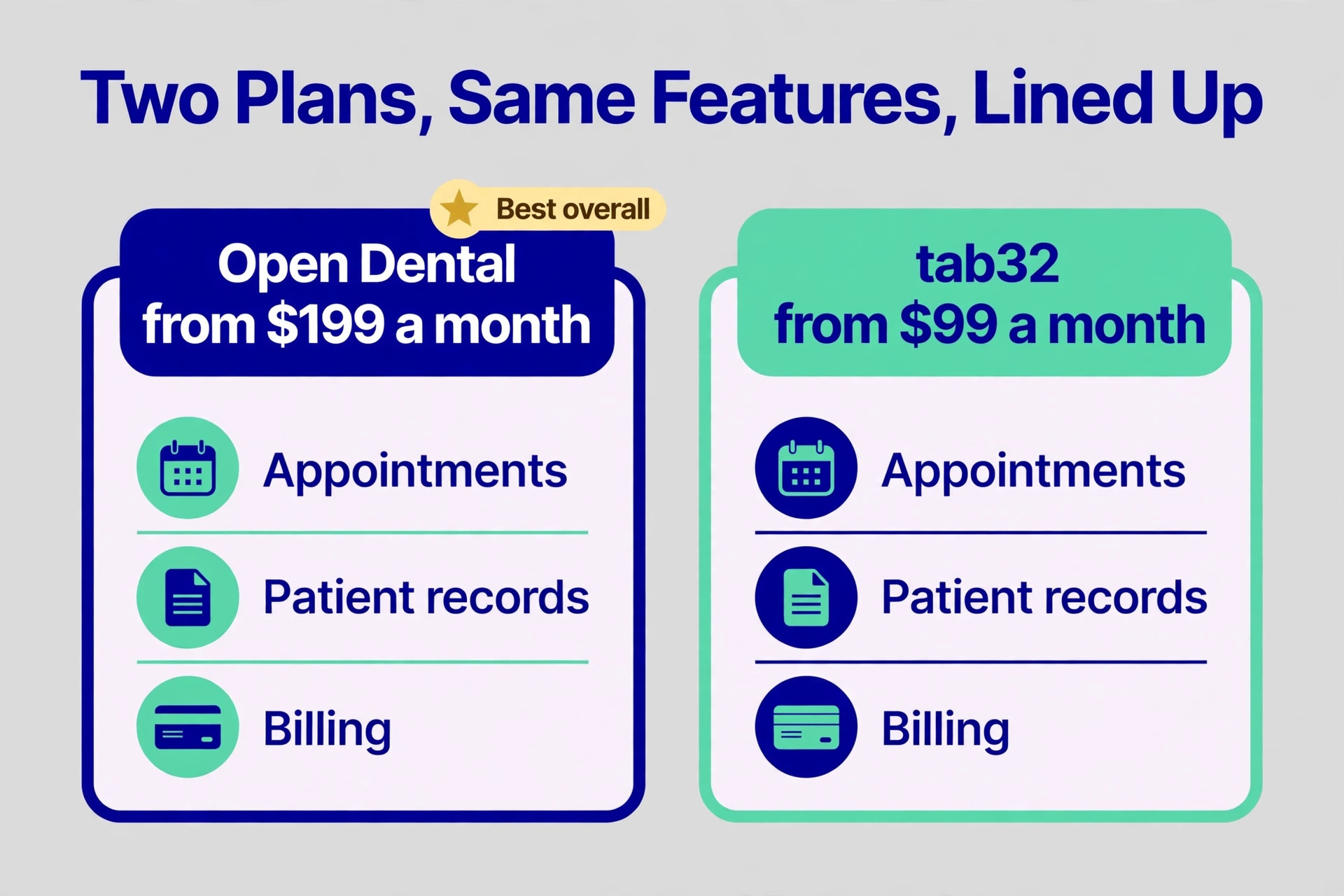
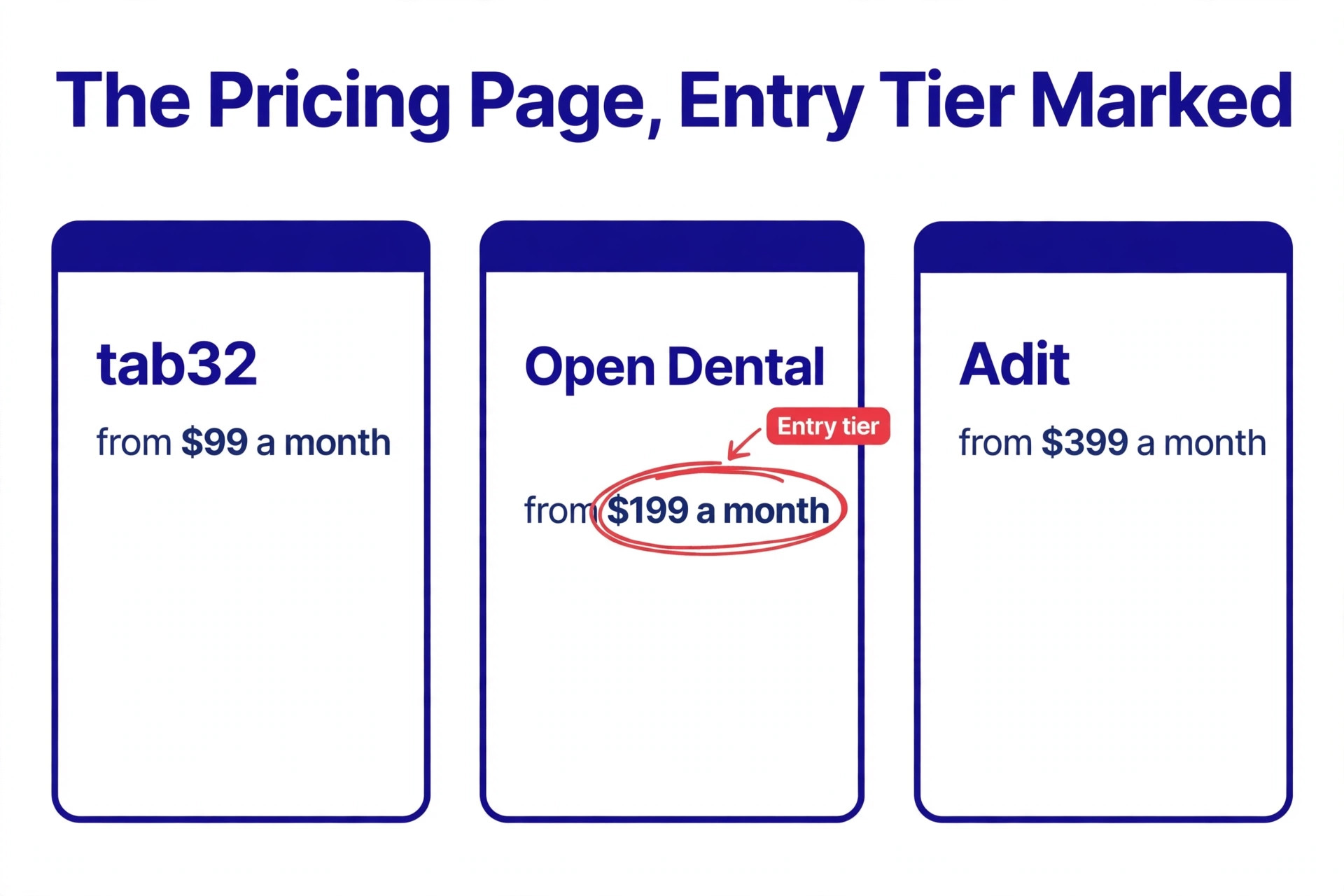
| Open Dental | From $199 a month | No |
| Dentrix | Quote only | No |
| Eaglesoft | Quote only | No |
| Curve Dental | Quote only | No |
| tab32 | From $99 a month | No |
| Dentrix Ascend | Quote only | No |
| CareStack | From $829 a month | No |
| Adit | From $399 a month | No |
Every Tool, Reviewed
The tools below are ordered by value for a small team, starting with the strongest all rounder and ending with the specialist tools that suit a narrower job. Each review gives the entry price, the free plan limit, the strongest feature and the catch to watch. This section is the heart of the guide to best dental practice management software for small clinics, so read the two or three tools that match your size before you skim the rest.
1. Open Dental
Open Dental is the pick for cost conscious solo and small group practices. It is open source with flat pricing and no per seat fees, and it bridges to more than 200 imaging tools, which makes it the most flexible system here. Pricing starts at $199 a month for the first year, then drops to $149 a month.
One guide lists Open Dental at $179 a month flat, so confirm the current first year and renewal price on the vendor site.
At the entry tier, a year costs roughly $2,388 before processing fees and add ons, so model that figure against your monthly volume before you commit. Ask support a real question during the trial, since the speed and quality of the answer tells you what help looks like later. Ask whether the price changes when you add a second location, since multi site pricing can surprise a growing business. Run the numbers for a busy month rather than a quiet one, because most pricing models grow with volume. Ask support a real question during the trial, since the speed and quality of the answer tells you what help looks like later.
2. Dentrix
Dentrix is the pick for established practices that want the industry standard. It is the most widely used system in North America, most dental schools teach on it, and most front desk staff have used it somewhere. Pricing is priced by quote, with third party estimates from about $300 to $500 a month.
Patient communication tools are add ons, and the desktop roots mean the cloud move needs a separate plan.
At the entry tier, a year costs roughly $3,600 before processing fees and add ons, so model that figure against your monthly volume before you commit. Confirm which integrations are included, since a missing link to your calendar or payment tool can add hours of manual work each week. Ask what happens to your data when you cancel, since a short deletion window can turn a trial exit into a scramble. Confirm the support hours in your time zone, because a tool with daytime only support can leave a night shift stranded. Confirm which integrations are included, since a missing link to your calendar or payment tool can add hours of manual work each week.
3. Eaglesoft
Eaglesoft is the pick for group practices that buy Patterson equipment. It is strong in multi location environments where offices need shared data and standardized workflows, with broad imaging integration. Pricing is priced by quote, with third party estimates from about $200 to $400 a month.
It needs on site servers and IT maintenance, which adds cost and hassle for a clinic that wants no hardware.
At the entry tier, a year costs roughly $2,400 before processing fees and add ons, so model that figure against your monthly volume before you commit. Look at the onboarding help before you buy, since a guided setup can save a week of trial and error. Count the seats you will actually pay for, because a low monthly price can still grow fast once every team member needs a login. Confirm the minimum term on the annual plan, because a discount that locks you in for a year is only a bargain if the tool fits. Check whether the price includes tax, because some vendors quote before tax and the invoice tells a different story.
4. Curve Dental
Curve Dental is the pick for cloud first offices with no IT staff. It runs fully in the browser with no server to maintain, which suits a new practice that wants to open without an IT bill. Pricing is priced by quote.
No published price means a sales call before you can budget, and the feature set is narrower than Dentrix on reporting.
Pricing is by quote, so the only way to compare it is to get a written figure at your size and put it beside the published prices here. Check the data export format, because a CSV you can open anywhere beats a backup file only the vendor can read. Talk to a current user if you can, since a five minute conversation can surface the catch that no pricing page mentions. Check the contract term before you sign, because a yearly plan can lock in a price that a monthly plan would not. Look at the onboarding help before you buy, since a guided setup can save a week of trial and error.
5. tab32
tab32 is the pick for startups and cost sensitive clinics. It is cloud native with native digital imaging and automated reminders included in year one, at the lowest published entry price here. Pricing starts at $99 to $125 a month in year one.
Higher tiers rise with features, so a growing practice should price the Summit tier before it commits.
At the entry tier, a year costs roughly $1,188 before processing fees and add ons, so model that figure against your monthly volume before you commit. Check whether your existing data imports cleanly, since a messy import can cost more staff time than the subscription saves. Ask how the tool handles a failed payment, since a missed card can lock your team out at the worst moment. Test the mobile app with the people who will use it daily, because a weak app means the tool gets ignored in the field. Check the data export format, because a CSV you can open anywhere beats a backup file only the vendor can read.
6. Dentrix Ascend
Dentrix Ascend is the pick for existing Dentrix users moving to the cloud. It keeps a practice inside the Henry Schein ecosystem, with built in communication tools and more than 250 API partners. Pricing is priced by quote, with estimates from about $399 to $799 a month.
It is the dearest path for a small clinic, so a practice with no Dentrix history should compare Curve and tab32 first.
At the entry tier, a year costs roughly $4,788 before processing fees and add ons, so model that figure against your monthly volume before you commit. Export your data during the trial as well, so you know how hard it is to leave if the tool stops fitting. Look for a public status page, since a tool that hides its outages is a tool that will surprise you later. Confirm the cancellation terms before you enter card details, so a tool that does not fit can be left without a penalty. Check whether your existing data imports cleanly, since a messy import can cost more staff time than the subscription saves.
7. CareStack
CareStack is the pick for small groups that want everything consolidated. It bundles practice management, imaging, billing and patient communication in one cloud system, with no server to run. Pricing is reported at $829 a month for the Essentials tier.
At $829 a month it costs four times Open Dental, so the consolidation has to save real staff time to pay for itself.
At the entry tier, a year costs roughly $9,948 before processing fees and add ons, so model that figure against your monthly volume before you commit. Check the free plan limit in writing, because a cap on members, clients or responses is the limit that forces most upgrades. A free trial is the fastest way to test it, so run your real workflow through it for two weeks before you pay. Test the reporting views with your real numbers, since a demo with sample data can hide a weak report builder. Export your data during the trial as well, so you know how hard it is to leave if the tool stops fitting.
8. Adit
Adit is the pick for practices that want phones and practice management together. It bundles a phone system with practice management, scheduling and patient communication, which suits a front desk that lives on the phone. Pricing is reported at $399 a month.
The bundle only pays off if you use the phone features, so a practice with a separate phone system should price the parts separately.
At the entry tier, a year costs roughly $4,788 before processing fees and add ons, so model that figure against your monthly volume before you commit. Check whether the price includes tax, because some vendors quote before tax and the invoice tells a different story. Read the pricing page for add ons, since the feature you need most is often one tier above the entry plan. Test the search inside the tool, since a library you cannot search is a library you will stop using. Check the free plan limit in writing, because a cap on members, clients or responses is the limit that forces most upgrades.
Which Tool Fits Which Job
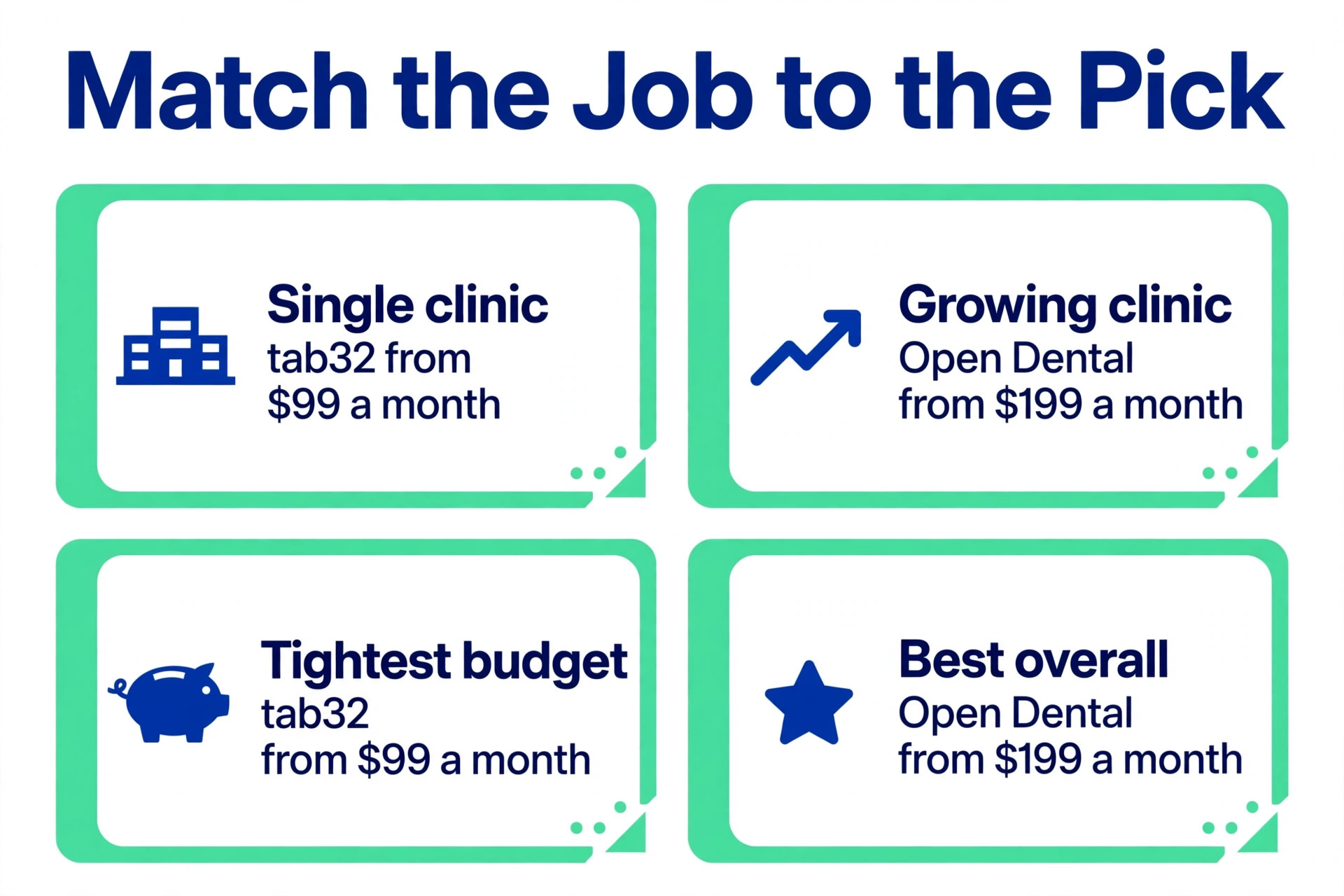
This table turns best dental practice management software for small clinics into a shortlist. Find the row that matches your situation, then read that tool full review before you buy, because the pick is only right if the limits fit your volume.
| Situation | Pick | Why |
|---|---|---|
| Tightest budget | tab32 | Lowest entry price here |
| Best overall | Open Dental | Strongest balance of price and features |
| Most complete | Dentrix | Deepest feature set for its job |
| Best for growth | Dentrix | Scales best as volume grows |
If two tools tie on price, pick the one whose free plan covers your volume, because a free plan you can stay on beats a cheap plan you outgrow in three months. If two tools tie on features, pick the one with the clearest pricing page, because transparent pricing usually means transparent support too. The decision table is a starting point, not a verdict, so trial the top two before you commit. Run the top two on a trial for two weeks with real work, because a demo with sample data hides the limits that matter most.
The Real Monthly Bill
The sticker price is only part of best dental practice management software for small clinics. Card rates, per seat charges, per client fees and add ons decide the yearly bill, and the table below shows the entry price and the free plan for the five most compared tools in this guide.
| Tool | Entry price | Free plan |
|---|---|---|
| Open Dental | From $199 a month | No |
| Dentrix | Quote only | No |
| Eaglesoft | Quote only | No |
| Curve Dental | Quote only | No |
| tab32 | From $99 a month | No |
Multiply the entry price by twelve before you compare, because a $29 a month plan costs $348 a year and a $159 a month plan costs $1,908 a year. Then add the processing rate on your real monthly volume, since a free plan at 4.99 percent can cost more than a paid plan at 2.75 percent once your revenue grows. A plan that looks cheap on the pricing page can still be the dearest option in this list once the maths is done properly.
Worked example. One user on Open Dental pays $2,388 a year at the entry tier, while the same user on tab32 pays $1,188 a year. The gap is $1,200 a year, and the question is whether Open Dental adds enough to earn it. Run the same maths for your own seat count, because a $30 gap per user becomes a $300 gap once ten people need a login.
Price conflicts we found. Open Dental is listed at $199 a month for the first year and $149 a month after in one 2026 guide, and at $179 a month flat in another. The $179 figure appears to be an older flat rate, so confirm the current first year and renewal price on the vendor site.
Why There Is No Free Plan Here
No tool in this list offers a free plan, which is normal for this category. The vendors sell through trials and demos instead, and most offer a 14 day or 30 day trial with no card required. Use that trial on real work, because a demo with sample data hides the limits that matter most, and a trial that covers a full busy week tells you more than any sales call.
Quote only pricing is common here too. Get the figure in writing at your size, at the size you expect in a year, and with the add ons you need included, because a verbal estimate is not a budget. Compare that written quote with the published prices in this guide, and confirm the renewal price as well as the first year price before you sign.
Five Ways Buyers Overspend
The most common mistake is paying for a tool when the free plan already covers the job. The next three are just as costly, and all four are easy to avoid once you know to look for them.
- Paying for a tool when the free plan already covers the job. Trial the free plan for a full month before you enter card details, and count what you actually use. If the free tier handles your volume, the money stays in your pocket.
- Buying seats for readers. Keep the paid workspace small, share records by link where the tool allows it, and only pay for the people who do the work. A team that invites everyone to a paid workspace can double its bill overnight.
- Ignoring the cap until it bites. Count your monthly volume before you buy, and pick the plan whose cap covers that number with room to spare. A cap that looks generous on the pricing page can run out in the third week of a busy month.
- Skipping the export test. Export your data during the trial, so you know how hard it is to leave if the tool stops fitting. A tool that locks your data in is a tool that owns your business, not the other way round.
- Forgetting the processing rate. A free plan with a high card rate can cost more than a paid plan with a low rate once your revenue grows. Work out the rate on your real monthly volume before you compare the subscriptions, because the rate is often the bigger number.
Your First Month With the Winner
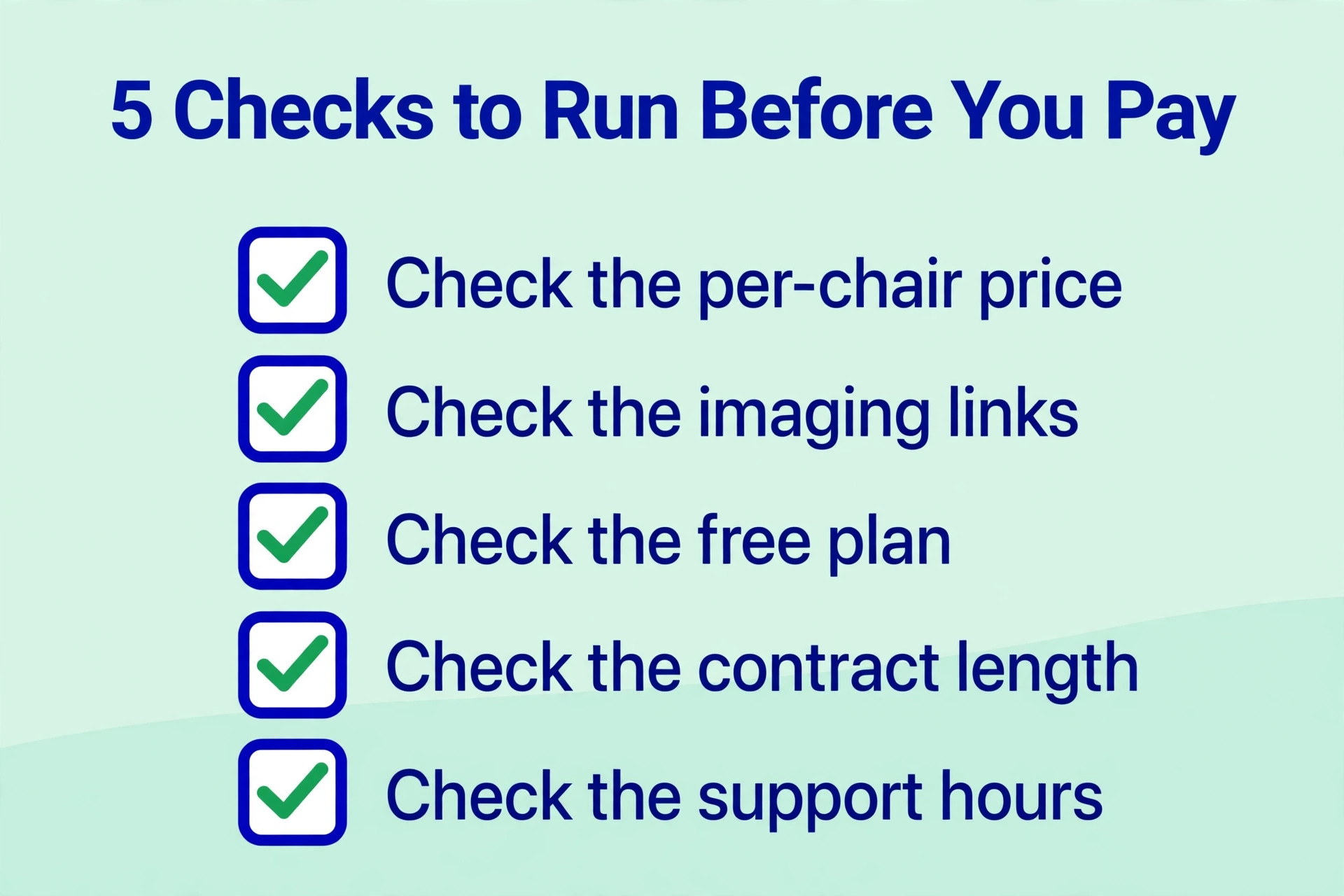
Work through these five checks before you pay. They take an afternoon, and they catch most of the surprises that make buyers regret a purchase.
- Write down the three tasks you do every week, and test those exact tasks in the trial. Test them with real data, not the demo data, so the trial shows the true workflow.
- Count the people who need a login, and price the plan for that number rather than for yourself alone. A plan that is cheap for one person can be dear once ten people need a login.
- Run the numbers for a busy month, and check the cap that forces the next upgrade. A cap that fits a quiet month can run out in the third week of a busy one.
- Export your data during the trial, and confirm the export includes everything you entered. A clean export is the proof that you can leave if the tool stops fitting.
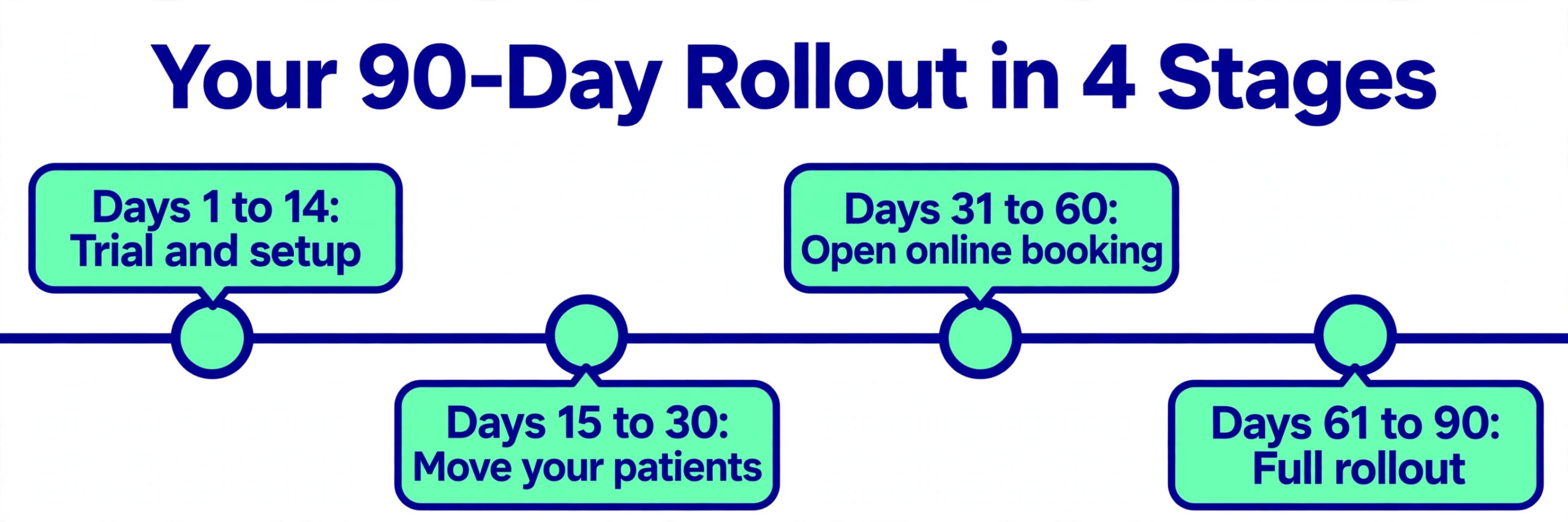
- Set a 90 day review date, and decide then whether the tool earns its price. By then you will know the real monthly cost and the limits you actually hit.
Start with one location, one team or one roster before you roll the tool out everywhere. A pilot with real data shows whether the setup is as quick as the demo promised, and it gives your team a chance to learn the workflow without the pressure of a full migration. If the pilot goes well, the wider rollout is a copy of what already works.
Set a review date for 90 days after you start. By then you will know the real monthly cost, the features you actually use, and the limits you hit. If the tool is not earning its price by then, switch while the data is still easy to move, because the cost of staying with the wrong tool grows every month.
Train the people who will use the tool daily, not just the person who bought it. A short session that walks through the three most common tasks saves more support tickets than any help article, and it stops the team from drifting back to spreadsheets and group chats.
Our Verdict
For most readers, best dental practice management software for small clinics comes down to Open Dental. It covers the core job at a fair price, it is quick to set up, and its limits are clear enough to plan around. Start there unless one of the rows in the decision table points you elsewhere, because the most popular pick is popular for a reason.
tab32 is the pick when budget leads the decision, because it keeps the entry price low without cutting the core features. Dentrix is the pick when depth matters more than price, because it goes further on the feature that defines this category. Both are strong choices in best dental practice management software for small clinics, and the wrong one is the tool you buy without trialling first. Trial the top two side by side for two weeks and the choice usually makes itself.
Start free where a free plan exists, count your volume for a month, and only pay when a paid feature earns its place. A tool you use every day is worth paying for, and a tool you pay for and ignore is the most expensive tool in this list. If the winner stops fitting in a year, the export test you ran in the trial makes the next move easy, so keep that habit for every tool you buy.

Frequently Asked Questions

What is the cheapest dental practice management software for small clinics?
The cheapest option in this guide to best dental practice management software for small clinics is tab32, which starts at $99 to $125 a month in year one. That makes it the lowest cost way to start, though the free plan limit decides whether it stays cheap as you grow. Check the cap before you commit, because a low entry price can still grow fast once volume rises, and the yearly total is the number that matters for your budget. The dearest entry in this list costs $829 a month, so the range from free to that figure shows how much the pricing model matters.
How much does Open Dental cost?
Open Dental starts at $199 a month for the first year, then drops to $149 a month. That covers the entry tier, and higher tiers add more capacity and features, so price the tier that fits your volume rather than the entry tier alone. Annual billing usually cuts the monthly figure, so compare the yearly total before you decide, and confirm the current price on the pricing page before you pay. If the entry tier feels tight, check the next tier before you buy, because the upgrade that removes the cap is often the tier you will need within a year.
Is there a free dental practice management software for small clinics?
Yes. several tools here offer a free plan or a free start. The free plans are genuinely usable for a small volume, and the paid plans earn their money when you need more capacity, longer history or admin controls. Trial the free plan for a full month before you pay, and count what you use so you know when an upgrade becomes worth it. The free plans differ in what they cap, so compare the limit that matters to you, whether that is members, clients, bookings or responses, before you pick one.
Which dental practice management software for small clinics is best for a small clinic?
Open Dental is the best fit for a small clinic, because it covers the core job at a fair price without a long setup. tab32 is the budget alternative, and Dentrix suits a clinic that needs more depth. The decision table above matches each tool to its job, so start there and trial the top two before you decide. A small clinic should also check the support hours and the contract term, since a tool that fits today can still become a poor fit as the team grows.
What should I check before I buy dental practice management software for small clinics?
Check the pricing unit first, then the free plan cap, then the add ons. Confirm which integrations are included, test the mobile app with the people who will use it daily, and export your data during the trial. Those five checks catch most of the surprises that make buyers regret a purchase, and they take less than an afternoon to run. A written quote helps too, because quote only tools can vary the price by size, and a quote at your size is the only figure you can budget on.
Can I switch to another dental practice management software for small clinics later without losing my data?
Yes, if you plan the move. Export your data during the trial of the new tool, map the fields before you import, and run both tools in parallel for a month. The tools in this guide all export the core records, though the ease of the export varies, so test it before you commit to a migration. A migration that looks clean in a demo can still miss a field you rely on, so keep the old system running until the new one has handled a full busy week.
A good choice in best dental practice management software for small clinics is the one that fits your volume, your budget and your workflow, not the one with the longest feature list. Trial the free plan, count what you use, and pick the plan whose limits match the way you actually work.