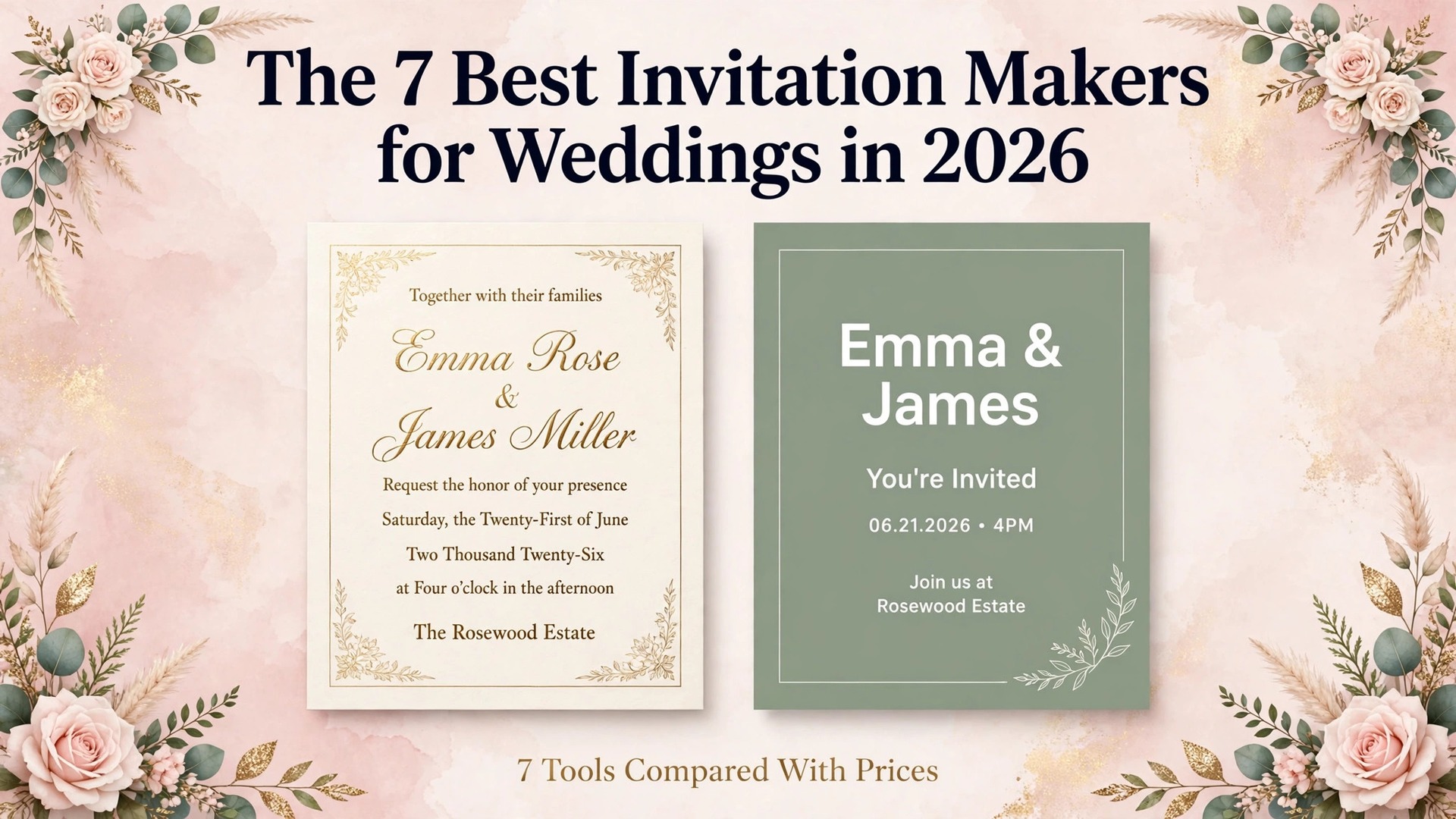
A 100 guest digital invitation send costs $19 on Greenvelope and about $90 for a Premium send on Paperless Post, while 100 printed Minted invitations start near $234. That spread is the first thing to understand about the best invitation makers for weddings in 2026, because these tools do not sell the same product. Some sell a designed digital send with RSVP tracking built in. Some sell paper. Some sell a free wedding website with invitations attached. Picking the wrong type costs more than picking the wrong brand, so this guide sorts the seven tools by what they actually do, what they charge for a typical 100 guest wedding, and where each one falls short.
Our Quick Take
If you want one recommendation, start with Greenvelope for a formal digital send, Joy if you want a free website and invitations in one place, and Minted if printed invitations are the point of the purchase.
Greenvelope charges a flat one time price set by guest count, starting at $19 for up to 20 guests and $99 for up to 100, with animated envelope openings, RSVP tracking with meal choices and custom questions, and no ads shown to guests. Joy sends unlimited digital invitations at no cost and pairs them with a free wedding website, guest list manager, and registry. Minted sells artist designed printed invitations from $2.34 per card at a quantity of 100, with free recipient addressing, and its online invitations and wedding website are free.
The rest of the list fills clear gaps. Paperless Post has the deepest designer template library, with collaborations from names like Kate Spade and Rifle Paper Co, and charges in Coins per guest, so a 100 guest Premium send runs about $90. Canva gives total control over the artwork and costs nothing to start, but it has no built in RSVP system, so you pair it with a form or a separate tracker. Zola ties invitations to a registry and vendor marketplace. Evite is the budget pick for casual celebrations, with a free tier that covers up to 750 guests with ads and a Pro plan at $249.99 a year that removes them.
The 7 Tools at a Glance
Use this table to narrow the list before you read the detail. Prices are the published figures we found during research in late 2026, and they move, so confirm the current figure on the vendor page before you pay.
| Tool | Best for | Starting price | Built in RSVP |
|---|---|---|---|
| Greenvelope | Formal digital sends | $19 per mailing | Yes |
| Paperless Post | Designer templates | Free designs, Coins for premium | Yes |
| Minted | Printed invitations | $2.34 per card at 100 | Basic |
| Canva | Full design control | Free, Pro about $13 a month | No |
| Joy | Free website plus invites | Free digital sends | Yes |
| Zola | Registry plus stationery | Free digital, print from $99.50 for 50 | Yes |
| Evite | Casual budget sends | Free with ads | Yes |
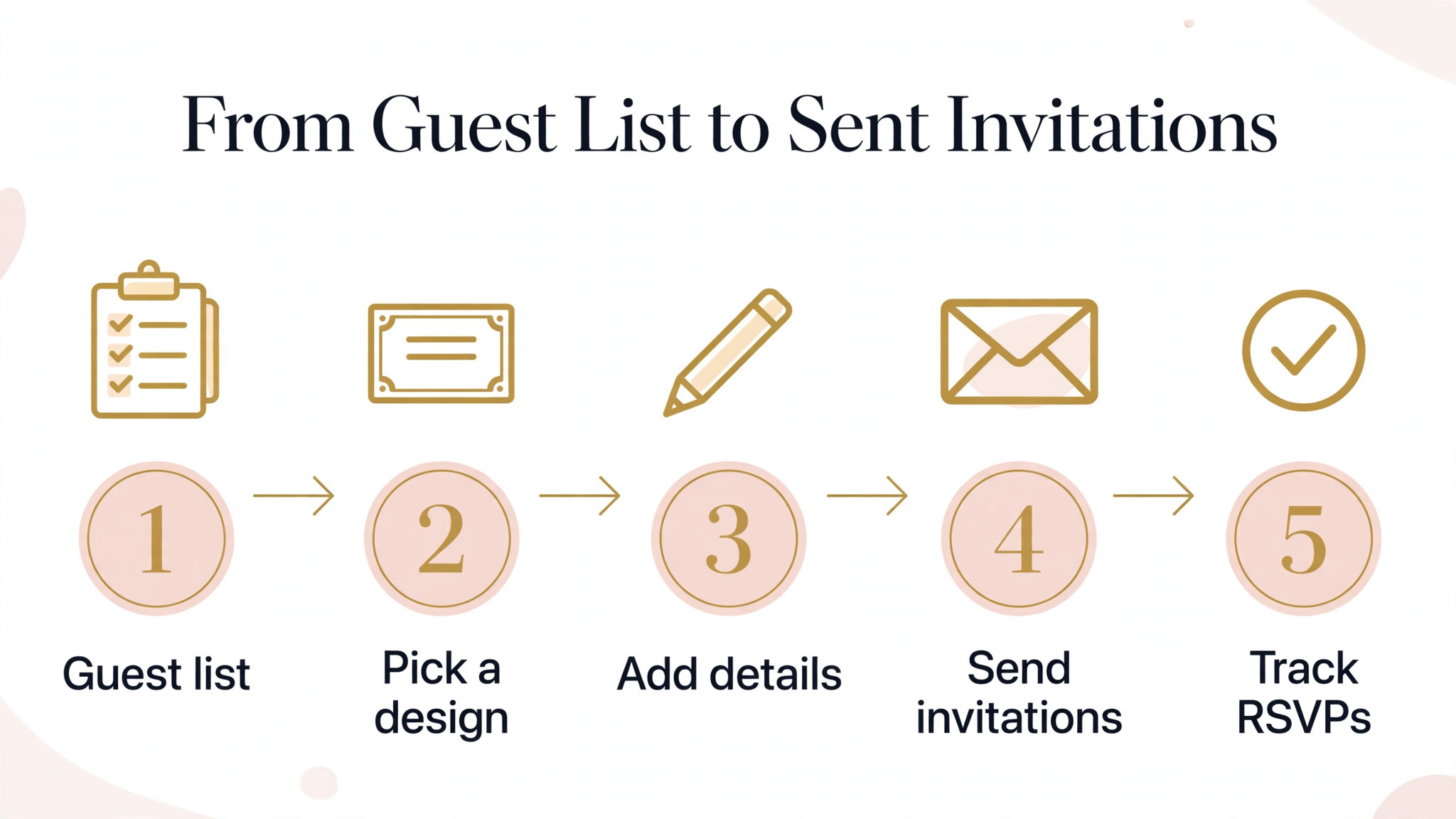
The table hides one important split. Greenvelope, Paperless Post, Joy, Zola, and Evite send the invitation and collect the reply inside the same product. Minted and Canva make the invitation itself, and the sending and tracking happen somewhere else. That split decides how much work you do after you pick a design, and it matters more than the price of any single card.
What the Best Invitation Makers for Weddings Must Get Right
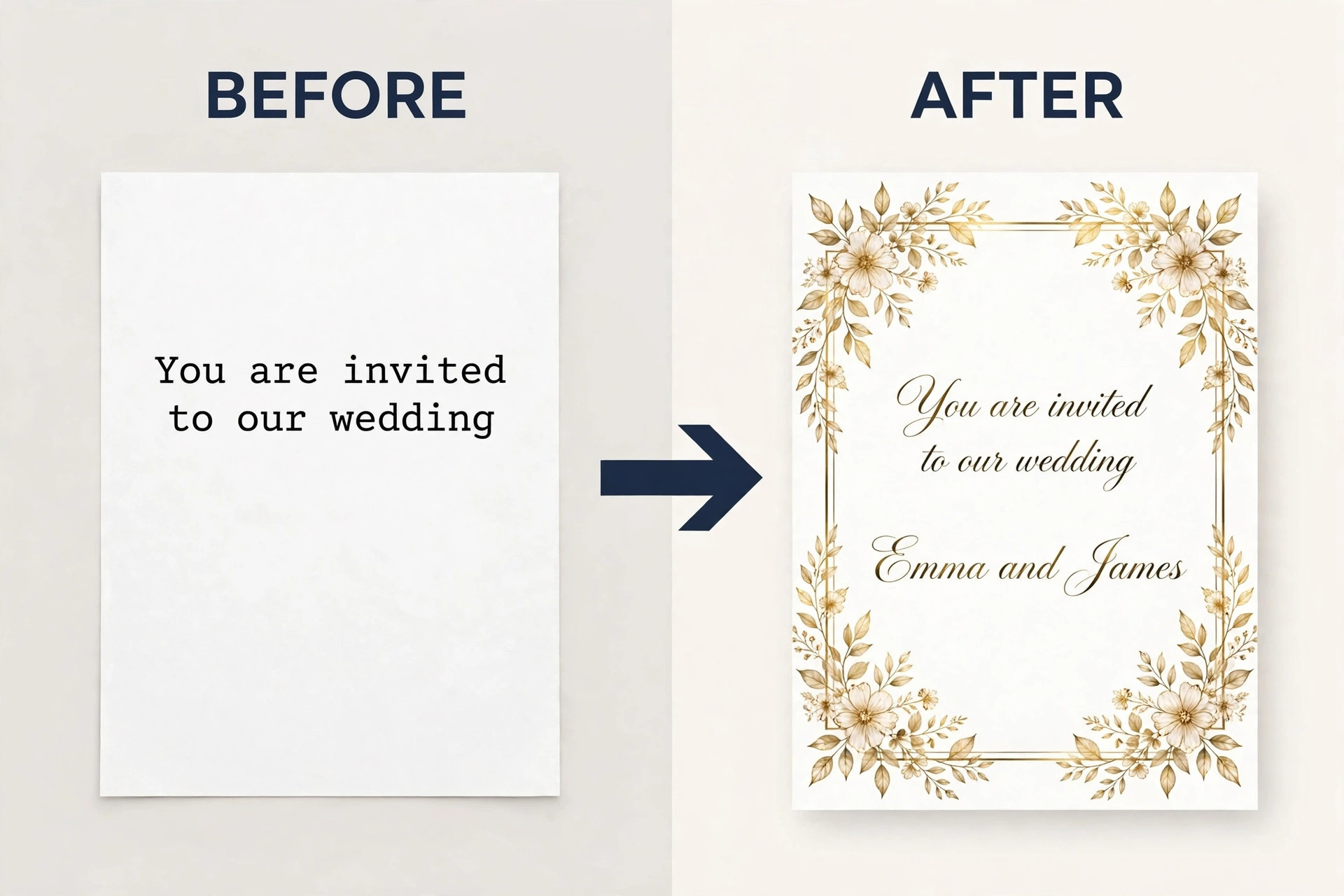
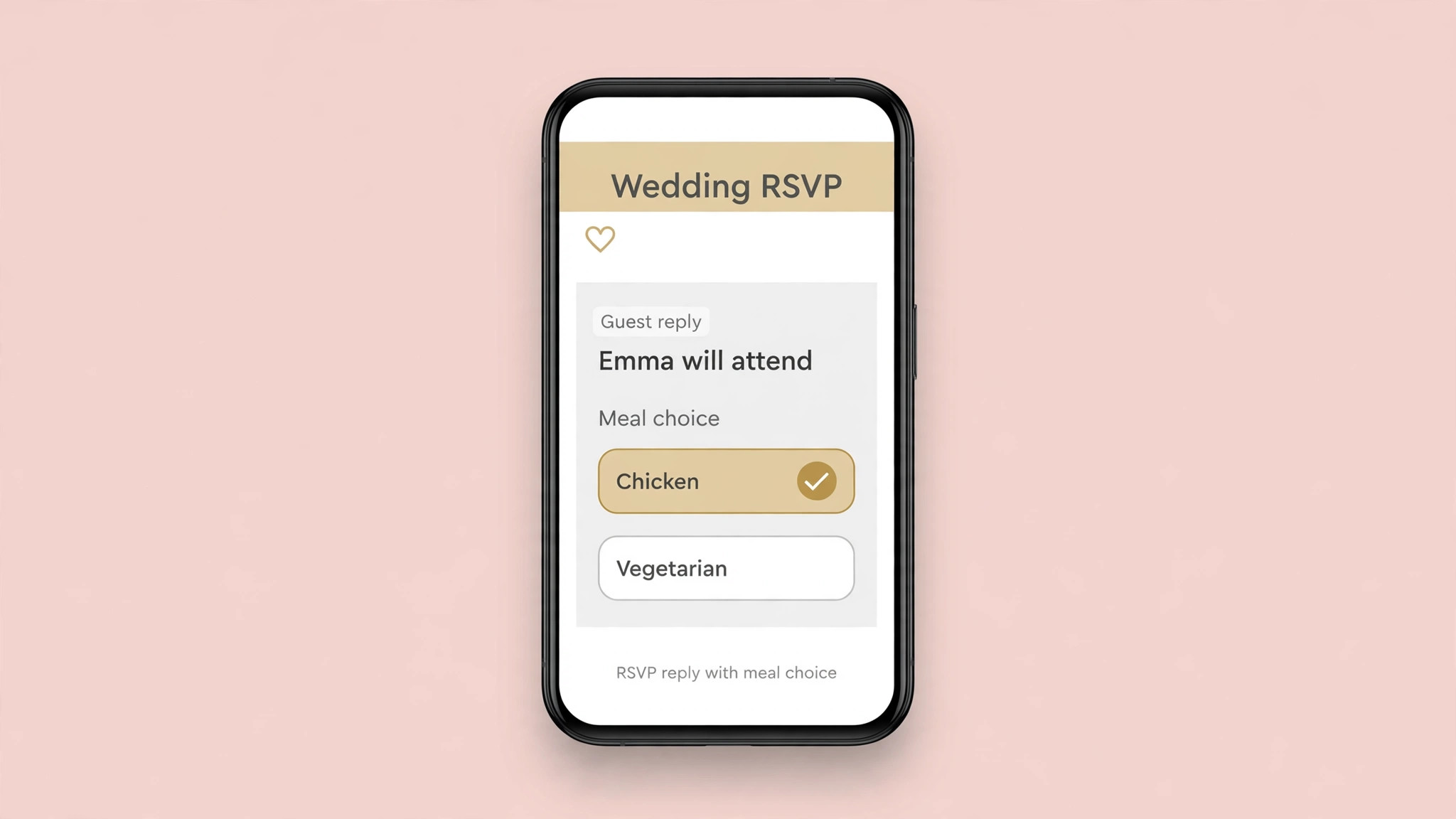
A wedding invitation has five jobs, and a tool that fails any of them creates work you pay for later. First, the design has to look like a wedding invitation, not a party flyer, which means typography, spacing, and paper texture in the digital preview all matter. Second, the RSVP flow has to capture meal choices, plus ones, and dietary notes without a follow up email chain. Third, guests should reach the reply in one tap, with no account and no app download, because every extra step loses replies.
Fourth, the price has to be clear before you build the guest list, since per guest pricing turns a 200 person wedding into a different purchase than a 60 person one. Fifth, the invitation has to match the rest of the stationery, from save the dates to thank you cards, or you end up redesigning the same look twice.
Test each tool against those five jobs rather than against its marketing page. A free tool that cannot collect meal choices is not free once you spend a weekend chasing replies in a spreadsheet. A beautiful tool that charges per guest can cost more than printed cards once the list grows past 150 people. The sections below judge each maker on the same five jobs, with the published price beside each verdict.
The 7 Tools in Detail
1. Greenvelope
Greenvelope is the strongest choice for a formal digital wedding invitation, and it earns that place on pricing transparency as much as on design. The price is a flat one time amount set by guest count, with no subscription and no Coins or credits to buy. The published ladder runs $19 for up to 20 guests, $99 for up to 100, $249 for up to 250, $374 for up to 500, and $499 for up to 1,000. You know the total before you start, and a larger guest list never turns into a surprise bill.
The product itself pairs premium designs with an animated envelope opening, built in RSVP tracking with custom questions, and an ad free experience for guests. Seating charts and event day tools are part of the package, which is why it handles 500 guest weddings without strain. Greenvelope holds a 4.9 star Trustpilot rating across 10,344 reviews as of July 2026, the strongest public rating in this group. The trade off is the absence of a free tier beyond a 10 person trial, so couples who want to test the full send before paying cannot do so at real scale. It is also digital only, so couples who want printed keepsakes need a second vendor for paper.
2. Paperless Post
Paperless Post is the design leader in this group, and it has been since it pioneered the animated digital envelope. Its template library is the deepest available, with designer collaborations from Kate Spade, Rifle Paper Co, and Oscar de la Renta, and the paper textured designs are the closest a screen gets to a physical invitation. For a formal wedding where the invitation sets the tone for the whole event, that library is a real advantage rather than a nice extra.
Pricing runs on Coins, a credit currency you buy in bundles and spend per recipient, and that is where couples should slow down. Paperless Post offers free designs for up to 50 recipients, and paid feature sets run 2 to 8 Coins per recipient. Its own pricing calculator returns about $0.96 for Basic, $1.20 for Premium, and $1.52 for All Access per guest at 50 guests, and about $0.90 for Premium at 100 guests, so a 100 guest Premium send is about $90. A Pro subscription at about $15.99 a month unlocks more, but Coins for premium stamps and backdrops still add up.
The RSVP tools are advanced, with guest tagging, meal choices, and surveys, and the brand recognition is genuine. The weakness is cost control on a large list, since every premium feature adds Coins per guest.
3. Minted
Minted is the pick when printed invitations are the point. Its invitations come from independent artists, with letterpress and foil options, wax seals, and matching suites that cover invitations, RSVP cards, programs, place cards, menus, and thank you cards in one design. A Minted wedding website can share the same design, and building one earns a $50 credit toward stationery. Recipient addressing is printed free, which saves either a handwriting weekend or a calligraphy bill.
Printed pricing is per order, with a minimum order of 10 and a per card price that falls as quantity rises. At a quantity of 100, classic invitations start at $2.34 per card and petite invitations at $2.00, so 100 classic invitations start near $234 before foil or paper upgrades. All in one invitations, which combine the envelope, invite, and RSVP postcard in a single piece, start at $185 for 50.
Minted also offers online invitations at no cost, sent by text or email, with RSVPs that take a tap and need no app or account, plus reminders and guest messaging. The online product is genuinely free, but it is simpler than the paid digital platforms, and the printed line is where Minted earns its place. Couples who want paper should budget for the suite, not just the invitation, since matching pieces add up fast.
4. Canva
Canva is the pick for couples who want total control over the artwork and are comfortable handling sending and replies separately. The template library is huge, the editor lets you change every element, and the free tier covers a large share of wedding designs. Pro costs about $13 a month and unlocks high resolution exports, background removal, and the full template set. For a couple with a clear visual idea and a designer friend, Canva produces invitation art that looks like it came from a studio.
The limit is that Canva is a design tool, not an invitation platform. There is no built in RSVP system. The usual workaround is a free Canva form linked to a sheet, which collects replies but does not track who was invited, who opened the message, or who needs a reminder. High resolution exports sit behind Pro, and the invitation still has to be printed or sent by email or message by hand. Canva works best as the art department inside a wider plan, paired with Joy or a spreadsheet for tracking, or paired with a print shop for paper. Used alone, it trades a low price for a weekend of manual work.
5. Joy
Joy is the strongest free option in this group, and it wins on breadth rather than on any single feature. The platform offers a free wedding website, guest list tools, registry, and RSVP collection at no cost, with hundreds of free digital and printed save the dates, invitations, and ecards that can match the Joy site or stand alone. Once the guest list is added, you can send an unlimited number of digital invitations and messages at no cost, which makes it the cheapest way to run a full digital send.
Printed invitations start from $1.74 each, and 50 printed invitations run from about $132, which puts Joy among the cheaper print options too. The guest list manager is one of the easiest we found in research, with address collection built in, and the invitation designs coordinate with the website designs so the whole suite looks planned. The trade off is a smaller margin of customization than Minted or Canva, with fewer options to change shape, color scheme, and layout. Couples who want a highly personal design will feel the limits. Couples who want everything in one account, free, with a professional result will not.
6. Zola
Zola is the pick for couples who already plan to use it for a registry and a wedding website, because the invitation feature is built to sit inside that stack rather than stand alone. The platform pairs a free wedding website with a registry, vendor tools, and printed stationery, and the invitation designs coordinate with the site. Free digital save the dates are included, 50 printed save the dates run from $49, and 50 printed invitations run from $99.50, which is competitive with the cheaper print vendors in this group.
Digital invitations on Zola use hybrid pricing. Basic designs are free, and premium designs run about $1 to $2.50 per guest, so a 150 guest premium send lands near $150 to $375 before print. That is reasonable inside a Zola wedding, where the registry and website already live in the same account, but it is harder to justify as a standalone purchase when Joy sends the same digital invitations free. The stationery range covers the full suite, including day of pieces, and the vendor marketplace helps couples who are still booking suppliers. Choose Zola when the whole planning stack matters. Choose a dedicated invitation tool when only the invitation matters.
7. Evite
Evite is the budget pick, and it suits casual celebrations and couples who want a simple send without a formal feel. The free tier covers up to 750 guests with ads, which is the largest free guest allowance in this group, and the designs cover a wide range of styles at a friendly tone. RSVP tracking is built in, and the send works by email and text with a shareable link. For a backyard wedding, a rehearsal dinner, or a shower, Evite does the job at no cost.
The Pro plan costs $249.99 a year and removes ads, which is a steep jump for a single wedding when Joy and Minted offer ad free digital sends free. The designs also lean casual, so a black tie wedding will look underdressed beside a Greenvelope or Paperless Post send. Evite earns its place for couples who want speed and a low price for a relaxed event, and for anyone sending invitations to a large casual guest list where a per guest charge would be painful. It is the wrong tool for a formal wedding where the invitation is part of the occasion.
Digital or Printed, and When to Use Both
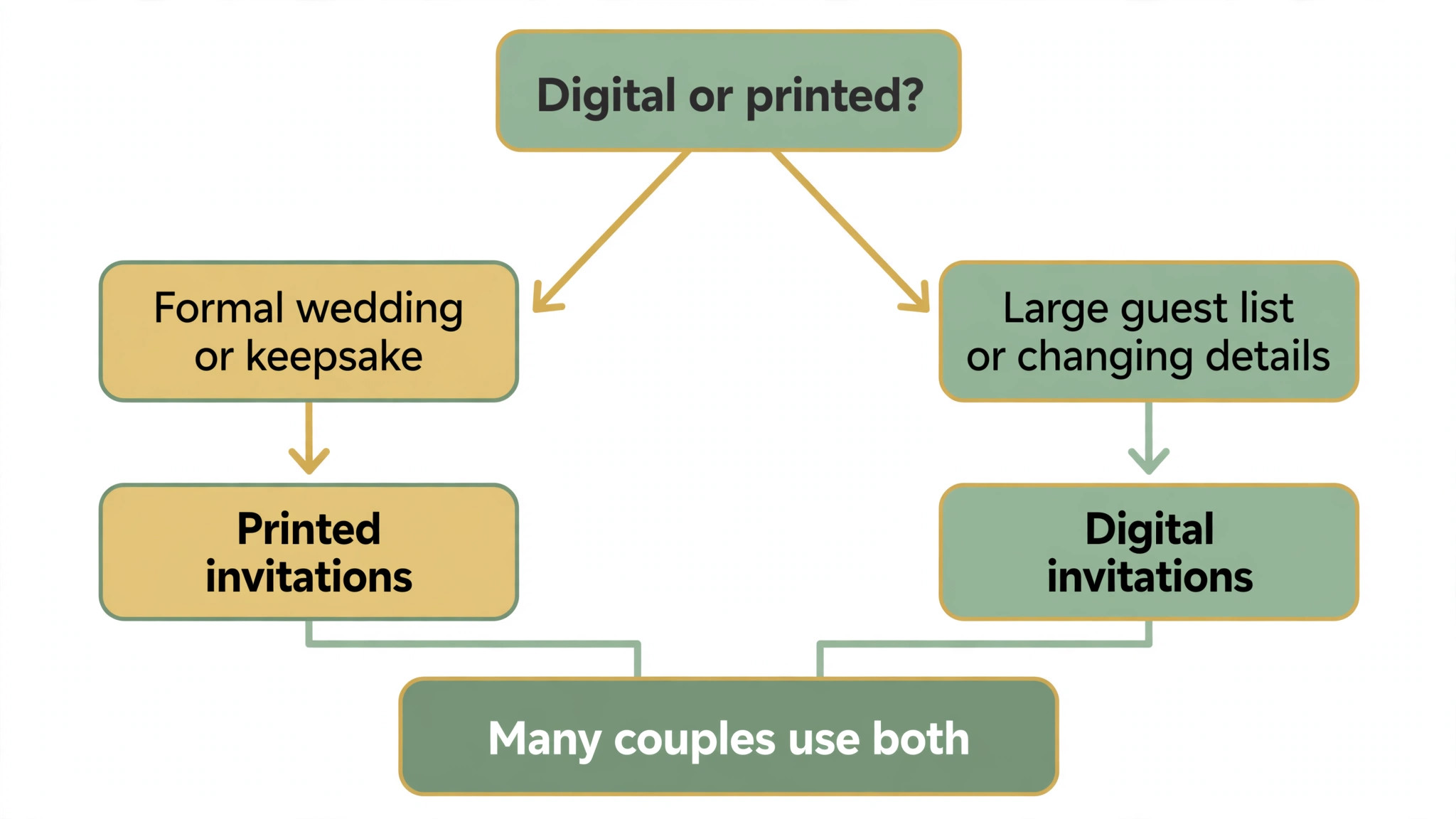
The choice between digital and printed invitations is really a choice about what the invitation has to do. A digital send is faster, cheaper, and easier to track, and it lets you update details after the send goes out. A printed invitation is a keepsake, and for many families it is still the signal that the wedding is formal and real. Our research for the best invitation makers for weddings in this guide kept coming back to the same answer, which is that most couples in 2026 use both, with a digital send for speed and a printed card for close family and the wedding party.
Digital works best when the guest list is large, spread across countries, or likely to change. A digital RSVP that arrives in one tap gets answered faster than a card that needs a stamp, and the host sees the reply the same day. Digital also wins when the date, venue, or schedule might move, since an update message costs nothing. The weakness is tone. A digital invitation can feel light for a formal event, and older guests may not check email or text promptly.
Print works best when the wedding is formal, when the invitation is part of the gift to the guest, and when the guest list is small enough that the per card price stays reasonable. A printed suite also photographs well and survives as a keepsake, which a screen cannot do. The weakness is cost and time. Printing takes weeks, postage adds up, and every change after printing means a reprint or an insert card. A sensible split is printed invitations for family and the wedding party, plus a digital send for everyone else, using matching designs from Minted or Joy so the two halves look like one suite.
How Much a Wedding Invitation Send Really Costs
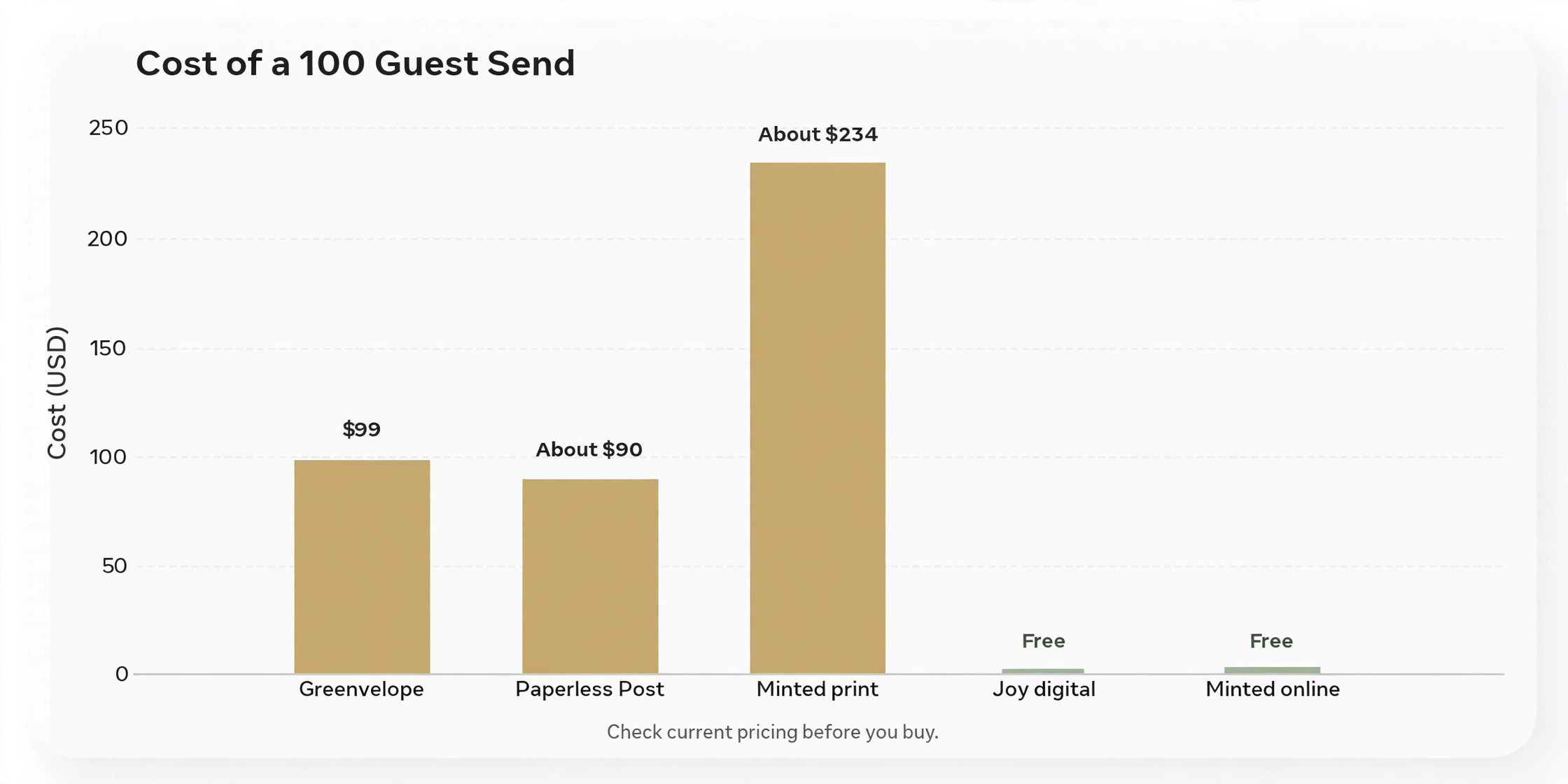
The sticker price of a tool is only part of the cost, so work from a real guest count. For a 100 guest wedding, Greenvelope costs $99 for the mailing, Paperless Post costs about $90 for a Premium send, Joy and Minted online invitations cost nothing for the digital send, and 100 printed Minted classic invitations start near $234 before upgrades. For a 150 guest wedding, Greenvelope rises to $249, Paperless Post rises past $130 at Premium rates, and 150 printed Minted invitations cost less per card than 100 but still pass $300 once paper and foil are added. The digital tools scale with the guest list, while print scales with quantity and finishes.
Postage and extras decide the real total. Printed invitations need stamps for the outer envelope and the RSVP envelope, and a 100 guest wedding often needs 60 to 70 invitation sets rather than 100, since couples and families share one. Envelope addressing, either free from Minted or paid elsewhere, saves hours of handwriting. Digital sends have their own extras, like a custom URL on Minted at $15 a year, a Pro subscription on Paperless Post, or a Canva Pro month for high resolution exports. Add those lines to the budget before you compare tools, because a free tool with three paid extras can cost more than a flat priced one.
| Guest count | Greenvelope | Paperless Post Premium | Minted print, classic |
|---|---|---|---|
| 100 guests | $99 | About $90 | From about $234 |
| 150 guests | $249 | About $135 | From about $300 |
| 250 guests | $249 | About $225 | From about $500 |
These figures use the published prices found in research and exclude postage, envelopes, and upgrades. Confirm the current price on the vendor page, since Coins rates and print prices move with paper and postage costs.
Picking by Guest List Size
Guest count changes the answer more than taste does, so size the tool to the list before you fall for a template. For a wedding under 50 guests, almost any tool works, and the cheapest path is usually free. Joy sends the digital invitations free and prints cards from $1.74 each, Minted online invitations are free, and Paperless Post covers its free designs up to 50 recipients. At this size the per guest price barely matters, so choose on design and on how much you like the RSVP flow. The best invitation makers for weddings at this size are the ones that stay out of your way and let you send the invitations in an evening.
For a mid size wedding of 50 to 150 guests, pricing models start to separate. Greenvelope at $99 for up to 100 guests is the cheapest paid digital send in this band, and Paperless Post Premium at about $90 for 100 guests is close. Joy stays free for digital sends at any size in this band, which makes it hard to beat on price alone. Printed invitations at this size run about $200 to $350 on Minted before upgrades, which is affordable for many couples but no longer a small line in the budget. This is the band where a test send matters most, because the RSVP tools get their first real workout and a weak tracker shows up fast.
For a large wedding past 200 guests, flat pricing wins and per guest pricing hurts. Greenvelope charges $249 for up to 250 guests and $374 for up to 500, which stays reasonable as the list grows. Paperless Post at Premium rates passes $180 at 200 guests and keeps climbing with every premium feature. Evite free tier covers up to 750 guests with ads, which is a real option for a large casual celebration, though the ads and casual templates limit it for formal weddings.
Printed invitations past 200 guests need a serious budget, often $500 or more, so most large weddings print cards for family and send digital invitations to the rest. Whatever the size, confirm the total for your exact guest count before you commit, since one tier boundary can change the price by $100 or more.
Mistakes That Waste Money
The same five mistakes show up in nearly every wedding invitation story, and all of them are easy to avoid once you know them. Most of them come from choosing the best invitation makers for weddings on looks alone, before checking the RSVP tools and the per guest price.
- Ordering printed invitations before the guest list is final. Every added guest after printing means a rush reorder at a higher per card price, and every removed guest is money thrown away.
- Choosing a per guest priced tool for a large wedding without doing the multiplication. A price that looks small at 50 guests doubles and triples by 200, and a flat priced mailing is cheaper past that point.
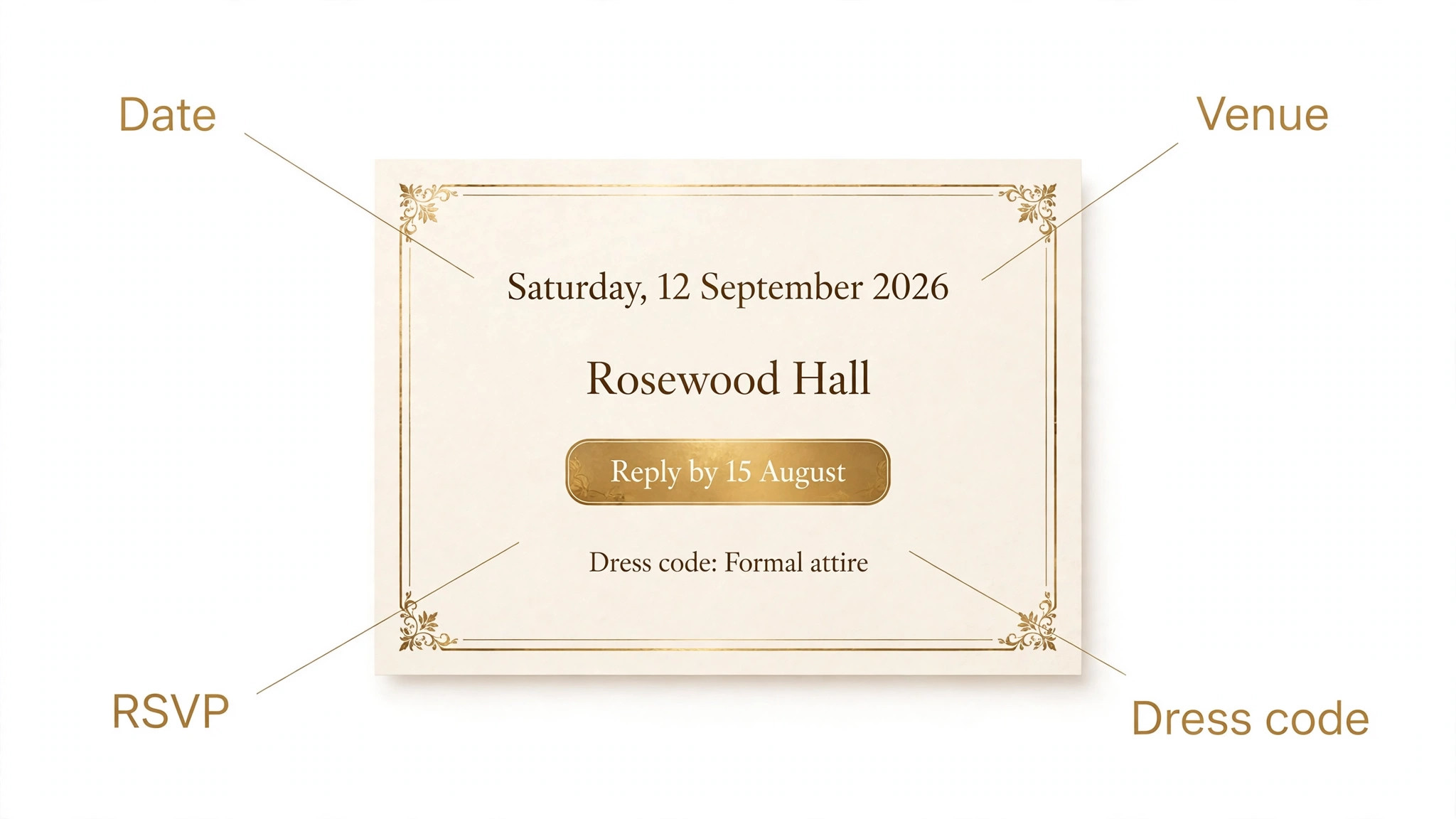
- Forgetting the RSVP deadline in the design. An invitation without a clear reply by date gets slow replies, and slow replies delay the caterer count, the seating chart, and the final numbers.
- Designing the invitation before the wedding website exists. Guests will look for the site address on the card, and a missing or wrong link sends them to a search engine instead of your registry and travel details.
- Skipping a test send. Send the invitation to yourself and two friends first, open it on a phone, and tap every button. A broken RSVP link found by a guest is far worse than one found by you.
Best Pick by Job
Match the job to the tool and the choice gets simple. The best invitation makers for weddings are not ranked by a single score, since a free suite beats a premium platform for one couple and loses to it for the next, so use the job you actually need done as the filter.
| Job | Best pick | Why it wins |
|---|---|---|
| Formal digital wedding | Greenvelope | Flat price, no ads, deep RSVP tools |
| Designer look on screen | Paperless Post | Deepest designer template library |
| Printed keepsake suite | Minted | Artist designs, free addressing |
| Full design control | Canva | Edit every element, low cost |
| Free website plus invites | Joy | Unlimited free digital sends |
| Registry plus stationery | Zola | One account for planning and paper |
| Casual budget celebration | Evite | Free up to 750 guests with ads |
Frequently Asked Questions
These are the questions couples ask most once they have a shortlist, and the answers use the prices and limits from the tools above.
How much do wedding invitations cost in 2026?
A digital send for 100 guests costs $19 to about $90 on the paid platforms in this guide, and nothing on Joy or Minted online invitations. Printed invitations start near $2.00 to $2.34 per card at a quantity of 100 on Minted, so 100 printed cards run about $200 to $234 before foil, paper upgrades, and postage. The cheapest realistic total for most couples is a free digital send plus printed cards for close family only.
Are digital wedding invitations acceptable for a formal wedding?
Yes, when the design and the wording are formal. The best invitation makers for weddings in the digital group, led by Greenvelope and Paperless Post, were built for formal events, with animated envelopes, paper textures, and proper RSVP wording. What makes a digital invitation feel informal is a casual template or a missing dress code, not the fact that it arrived by email. For very formal weddings, many couples still print cards for older relatives and send digital invitations to everyone else.
When should wedding invitations be sent?
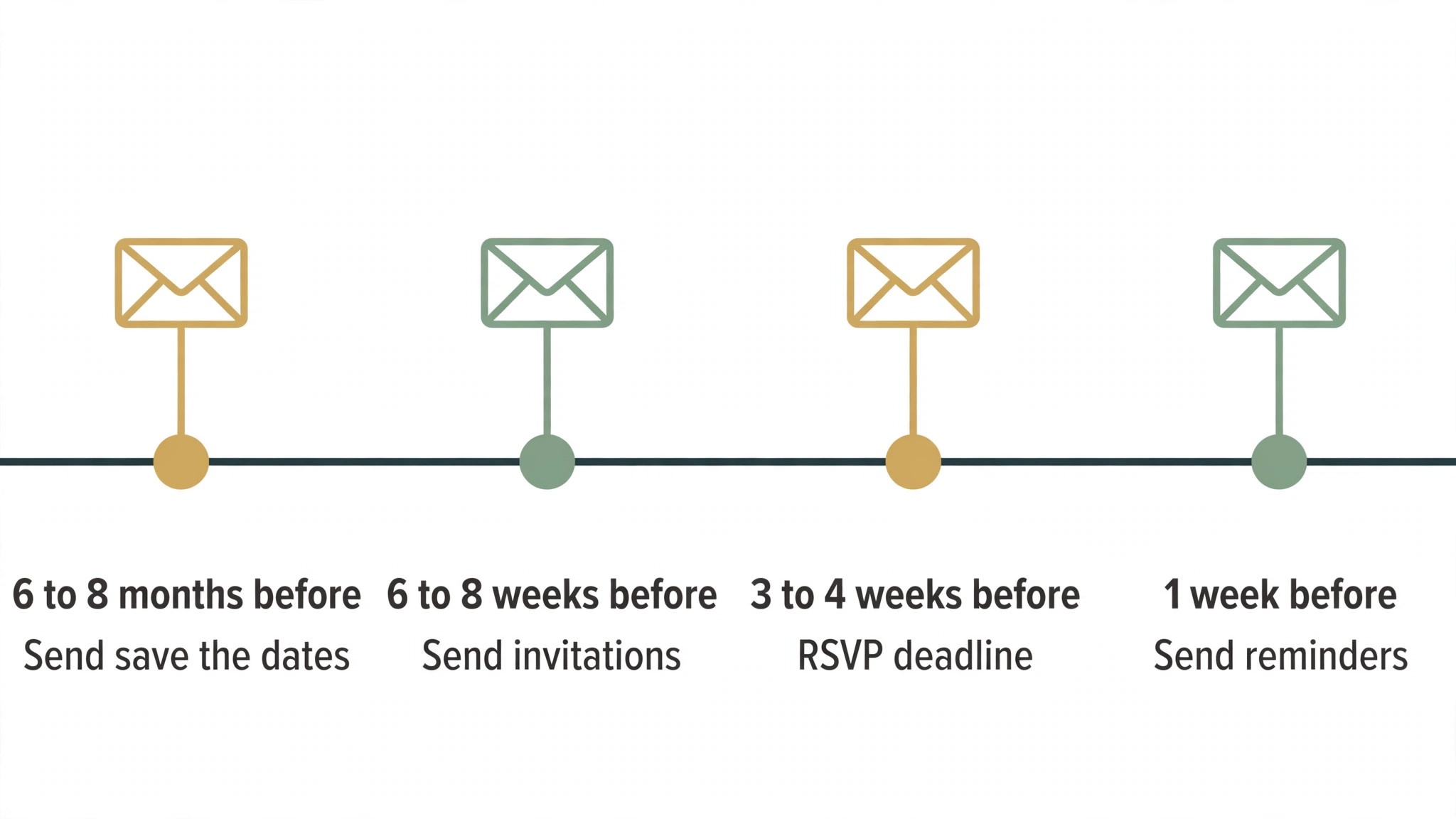
Send save the dates six to eight months before the wedding, and invitations six to eight weeks before, with an RSVP deadline three to four weeks before the day. Destination weddings need invitations three months ahead so guests can book travel. Digital invitations can go slightly later than printed ones because there is no postage delay, but do not use that as an excuse to send them late, since guests still need time to plan.
Which tool is best for RSVP tracking?
Greenvelope has the deepest RSVP tracking in this group, with meal choices, plus ones, custom questions, and per guest delivery indicators. Paperless Post is close behind with guest tagging, meal choices, and surveys. Joy tracks RSVPs well inside its free suite and ties replies to the guest list automatically. Canva has no RSVP tracking at all, so it only works when paired with a form or a separate tracker.
Can I match printed and digital invitations?
Yes, and it is the easiest way to keep the suite looking planned. Minted sells matching printed and online invitations in the same artist designs, and Joy matches its printed cards to its free website designs. Canva can also produce matching art for print and screen if you design both from the same template. Pick the design first, then order both formats from it, rather than designing each format separately.
Do I need a wedding website as well?
Most couples do, because the invitation cannot carry travel details, hotel blocks, the registry, and the schedule in one card. Joy, Zola, and Minted all include a free wedding website, and the invitation links straight to it. The website also collects RSVPs that arrive after the deadline and answers the questions guests would otherwise ask by text. Build the site before you send the invitations so the link on the card works on day one.
What We Would Book
Start with the type of invitation, not the brand. If the wedding is formal and digital, Greenvelope is the strongest single purchase, with a flat price and the deepest RSVP tools. If the budget is zero, Joy gives you a free website, free digital sends, and cheap print in one account. If paper is the point, Minted is the clear pick, and its free online invitations cover the guests who do not need a card. The best invitation makers for weddings all do one thing well, and the right one is the tool whose strength matches the job your wedding actually needs.
Order a sample before you commit to print, send a test digital invitation to yourself first, and set the RSVP deadline three weeks before you need the final numbers. Those three habits save more money and stress than any discount code, and they work whichever tool you choose.