
PushPress is the best overall pick among the best gym management software for small studios, because the free plan is genuinely usable and the paid plans stay honest about what they include. Mindbody is the better choice when class discovery matters more than price, and Gymdesk is the cheapest paid plan that still covers the full job. We compared 10 platforms on the numbers that decide a small studio budget, the monthly fee, payment processing, the branded app, and what each plan actually includes, so you can stop comparing homepages and pick the software that fits your member count and your way of teaching.
A small studio is not a small version of a big gym. A 40 member Pilates studio, a 120 member CrossFit box and a 200 member martial arts school run on different rhythms, and the software that fits one can waste money for another. The studio with 40 members needs simple scheduling and clean billing, and it should not pay for enterprise reporting it will never open. The studio with 200 members needs failed payment recovery and retention automation, because five lost members a month is a real revenue leak at that size. The tool that wins is the one that matches the member count you have now and the count you expect in a year.
Prices in this guide were checked against vendor pricing pages and independent 2026 roundups in November 2026. Gym software pricing changes often, several vendors quote rather than publish, and a headline price rarely includes the branded app, SMS credits or payment processing, so confirm the full monthly total on the vendor page before you commit.
What a Small Studio Actually Needs From Its Software
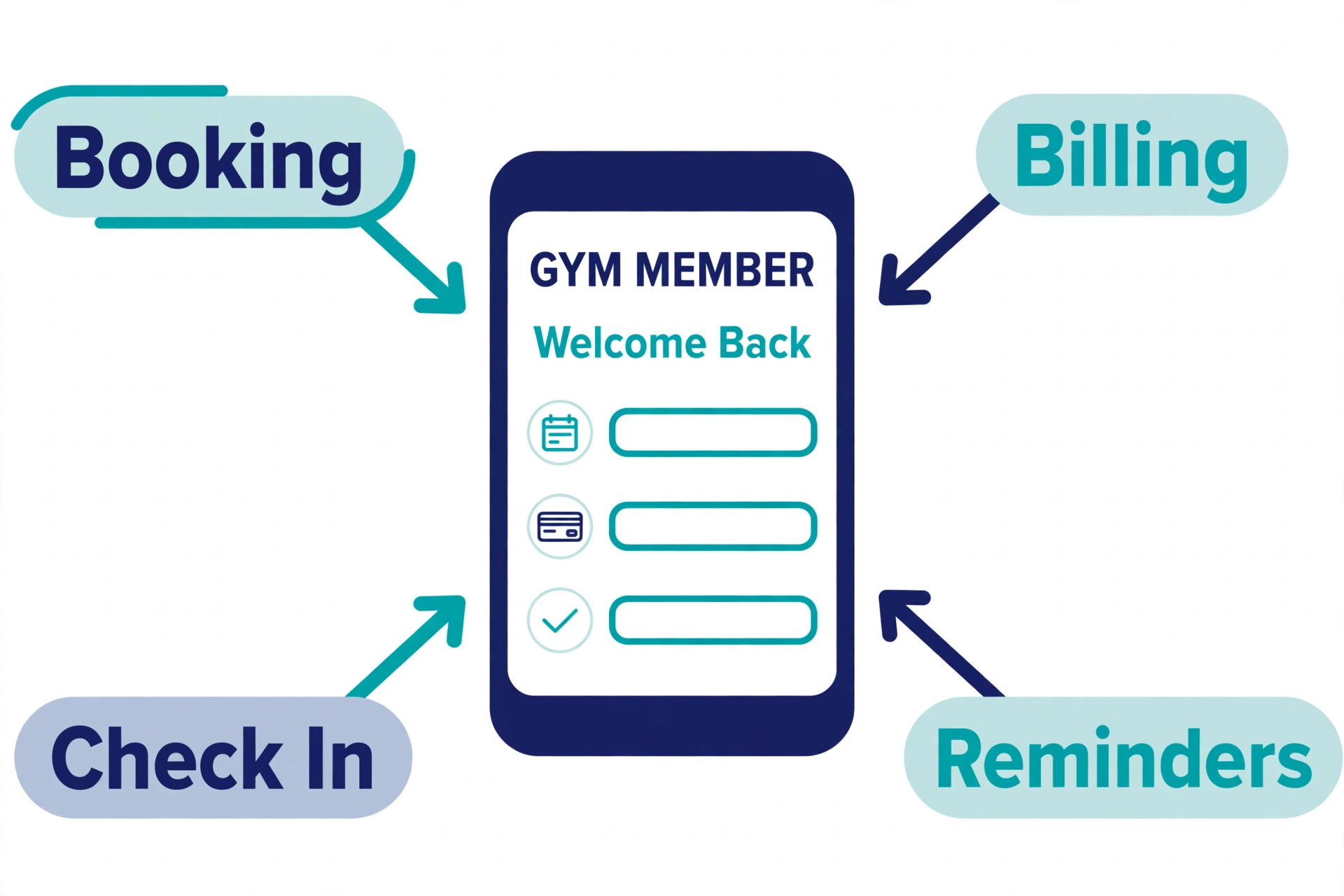
Every studio needs the same four jobs done well, and everything else is optional until the member count grows. The first job is scheduling, classes, appointments and bookings that members can reserve without calling the front desk. The second job is billing, memberships, class packs and drop ins charged on time, with failed payments chased automatically. The third job is check ins, knowing who showed up and who stopped coming, because attendance is the earliest warning that a member is about to cancel. The fourth job is communication, reminders and announcements that reach members without the owner sending each message by hand.
The features that separate the tools on this list sit on top of those four jobs. A branded member app matters when the studio wants its own name on the phone screen, but it is a paid add on almost everywhere, and the price runs from about 39 dollars a month to about 100 dollars a month. Marketing automation matters when the studio runs trials and needs follow up sequences, and Mindbody and Zen Planner charge hundreds extra for it.
Workout programming matters for CrossFit boxes and strength gyms, and only PushPress and Wodify treat it as a core feature rather than an afterthought. Among the best gym management software for small studios, the winner is the platform that covers your four core jobs at a price your member count supports, not the one with the longest feature list.
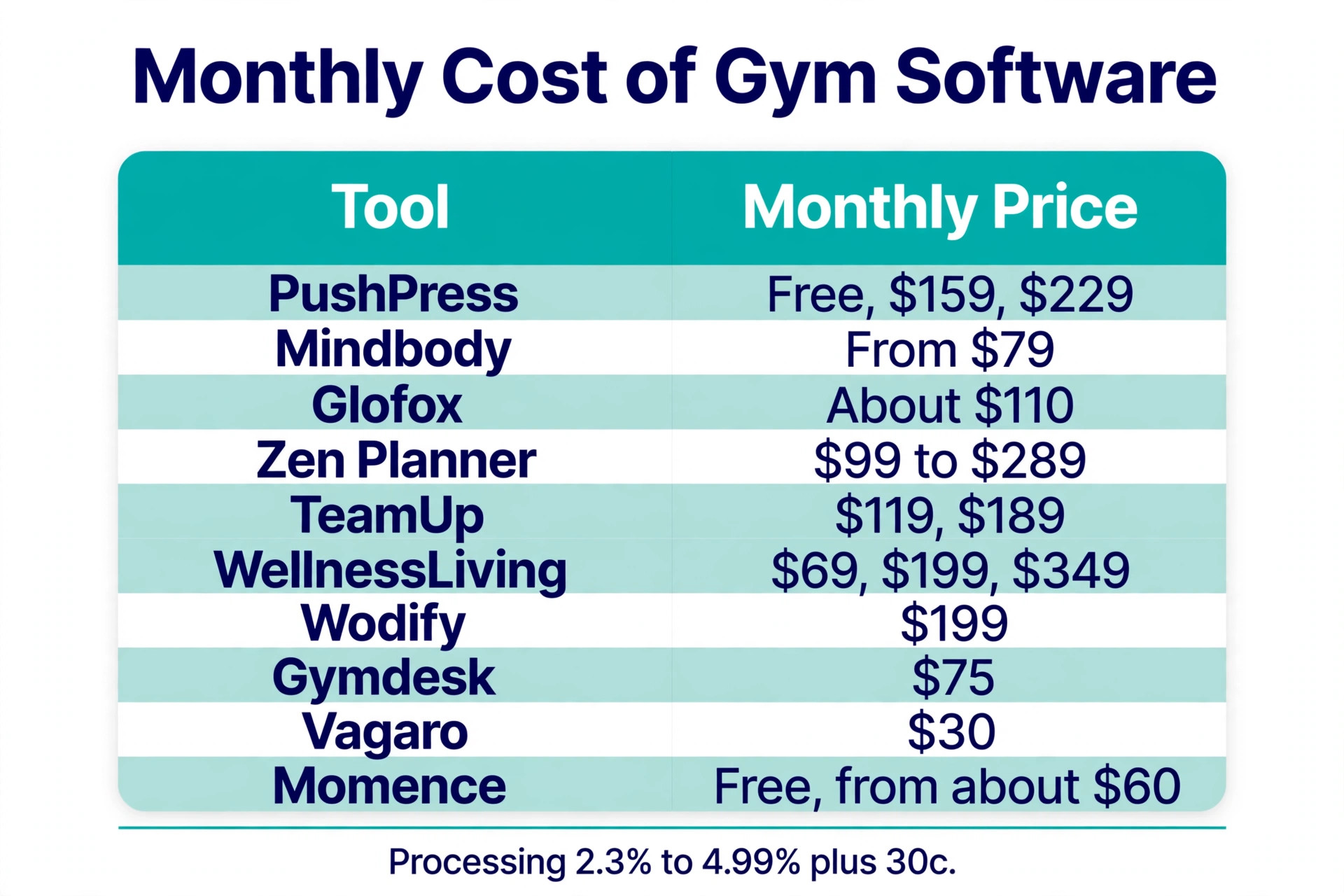
Payment processing deserves its own line in the budget, because it costs more than the software on many plans. Processing runs from about 2.3 percent to 4.99 percent plus 30 cents per transaction, and the free plan from PushPress charges the highest rate at 4.99 percent plus 30 cents. A studio taking 15,000 dollars a month in card payments pays about 750 dollars in processing on a 5 percent rate and about 450 dollars on a 3 percent rate, a difference of 300 dollars a month that dwarfs the software fee. Always compare the software price and the processing rate together, because a free plan with expensive processing is often the most expensive choice.
The Best Pick for Each Job
| Job | Pick | Why it wins |
|---|---|---|
| Start free and grow | PushPress | Free plan plus paid from 159 dollars a month |
| Class discovery | Mindbody | Consumer marketplace no rival matches |
| Branded app on a budget | ABC Glofox | Strong member app with Stripe flexibility |
| Martial arts and belts | Zen Planner | Belt and rank tracking built in |
| Cheapest full paid plan | Gymdesk | 75 dollars a month with every feature |
Use this table as a shortcut, then read the full section for the tool you are leaning toward. The cheapest option is not the best value when it cannot recover failed payments, and the most expensive option is not the best choice when your studio has 40 members and a simple class schedule.
The Best Gym Management Software for Small Studios, Compared
The 10 tools below fall into three groups. The first group is built for class based studios and boutique fitness, where scheduling and the member app decide the day. The second group is built for membership driven gyms, CrossFit boxes and martial arts schools, where recurring billing and programming decide the month. The third group is the budget tier, where a low monthly fee covers the essentials and the studio accepts fewer extras.
1. PushPress
PushPress is the gym first platform that lets a studio start free, and the free plan is the most honest free product in this category. The free Core plan handles class scheduling, attendance tracking, membership billing basics and check ins, which is enough to open the doors, and it stays free until the studio is ready to pay. Paid plans run from Pro at 159 dollars a month to Max at 229 dollars a month, with lower processing rates and deeper reporting as you climb. The trade off on the free plan is processing, which runs 4.99 percent plus 30 cents per transaction, the highest rate on this list.
What PushPress does best is match the way a CrossFit box or functional gym actually operates. Workout programming and tracking are core features rather than add ons, the member app is solid, and the billing workflows were built for recurring memberships rather than adapted from a salon or spa product. The platform covers gyms in the United States, the United Kingdom, Canada and Australia, and the free plan covers up to 10 active members in some reports and up to 50 in others, so confirm the current limit when you sign up. For a new box with a tight budget, PushPress is the lowest risk start in this guide.
2. Mindbody
Mindbody is the biggest name in boutique fitness software, and its consumer marketplace is the reason studios pay its prices. No other platform puts classes in front of as many people searching for a workout, and for a studio in a competitive city that discovery can fill classes that would otherwise run half empty. Behind the marketplace sits full club management, scheduling, memberships, point of sale, marketing automation and staff management, with feature depth no rival matches for boutique studios.
The pricing is where a small studio needs to slow down. The entry plan starts at 79 dollars a month per location, which looks reasonable until the add ons arrive. Marketing automation needs a higher tier, the AI assistant needs a still higher tier, and a branded app plus SMS marketing pushes real monthly costs to 500 dollars or more before processing, which runs 2.99 percent plus 30 cents. Mindbody earns its price at scale, when the marketplace fills classes and the studio uses the full marketing stack. A studio under 100 members should model the full stack before committing, because the headline price is rarely the real price.
3. ABC Glofox
ABC Glofox, now part of ABC Fitness, is the boutique studio pick for owners who want their own branded app without paying Mindbody prices. The member app is the best in this category in several 2026 comparisons, with clean booking, class packs and push notifications under the studio name, and the automation behind it is reliable enough that owners stop thinking about reminders and follow ups. Glofox also lets studios keep Stripe as the payment processor, which gives more flexibility than platforms that lock you into their own processing.
Pricing is quote only, which is the main frustration. Reported figures put the entry point near 110 dollars a month, with higher tiers by quote and a branded app included in the upper plans. That puts Glofox in the same price band as Mindbody Starter but with a better app and a simpler stack, and the quote process is short, usually a single form and a call. For a boutique studio with 30 to 300 members that wants a polished branded experience and does not need the Mindbody marketplace, Glofox is the strongest choice on this list.
4. Zen Planner
Zen Planner serves the membership model gym, which means CrossFit boxes, martial arts schools and strength facilities where recurring billing is the business. Plans start at 99 dollars a month for the Studio tier and scale with active member count, reaching 289 dollars a month at the top Studio band. Belt and rank tracking is built in, which matters for martial arts schools, and the platform handles attendance, billing, retail and reporting in one place. Add ons change the total, with a website from 99 dollars a month, the Engage marketing system from 249 dollars a month, and a branded app at 39 dollars a month.
The strength of Zen Planner is focus. It does not try to be a spa booking tool or a salon platform, and every workflow assumes members pay monthly and attend classes. The weakness is the same focus, because a studio that also sells appointments, workshops and retail will find some workflows thinner than WellnessLiving or Vagaro. For a martial arts school or a membership driven box that wants billing and retention handled properly, Zen Planner is a steady pick that scales with the member count.
5. TeamUp
TeamUp prices by active customer count, which aligns the software cost with the revenue it manages. The United States pricing page shows 119 dollars a month for up to 100 active customers and 189 dollars a month for 101 to 200 customers, with an optional custom branded app at 99 dollars a month. That model suits independent gyms and studios that bill hundreds of members, because the studio pays more only as it earns more, and there is no charge for frozen or inactive members. Everything is included in the plan rather than gated behind tiers, which makes the bill predictable.
TeamUp covers memberships, classes, courses and appointments together, which suits studios that run more than one format. The interface is clean and the setup is fast, and the platform handles multi discipline studios better than the CrossFit focused tools. The trade off is that TeamUp has no free plan and no marketplace discovery, so a new studio pays from day one and finds its own members. For an established independent gym with 100 to 300 members, TeamUp is one of the most honest pricing models in this guide.
6. WellnessLiving
WellnessLiving suits studios that sell classes, appointments and retail together, which covers most yoga studios, Pilates studios and wellness centres. Pricing is published and clear, with Starter at 69 dollars a month, Business at 199 dollars a month and BusinessPro at 349 dollars a month. The Starter tier covers one staff member, and the higher tiers add staff, automation and reporting, with a branded app available as a paid add on. That transparency is a genuine advantage in a category where half the vendors hide prices behind a sales call.
The platform is broad rather than deep, and that is both its strength and its limit. A studio that sells a class pack on Monday, a massage on Tuesday and a retail product on Wednesday will find all three in one system, while a CrossFit box that needs workout programming will find it thinner than PushPress or Wodify. The demo only trial is a drawback, because you cannot test the product without booking a call. For a wellness studio that needs appointments plus classes in one place at a published price, WellnessLiving is a solid pick.
7. Wodify
Wodify is built for performance gyms, CrossFit boxes and jiu jitsu schools that treat programming and athlete tracking as central to the business. The platform covers class scheduling, memberships, billing, retail and white labelled member apps, and its performance tracking lets coaches see athlete progress across workouts rather than just attendance. Published pricing starts at 199 dollars a month per location for the Essentials plan, with higher packages by quote, and Wodify Payments processes cards from as low as 2.7 percent plus 30 cents. A promotional price of 99 dollars a month appeared on the pricing page in 2026 but was tied to an August deadline, so treat 199 dollars as the real starting point.
Wodify costs more than PushPress for a similar audience, and the extra money buys depth rather than breadth. The retail tools are stronger, the performance data is richer, and the platform handles multi location gyms more comfortably. A single location box with 80 members will get more value from PushPress free or Pro, while a growing gym with retail sales and competitive athletes will use what Wodify adds. Check the current Essentials price before you budget, because the promotional pricing on the page has caused confusion in 2026 roundups.
8. Gymdesk
Gymdesk is the simplest deal on this list, and that simplicity is the point. The price is 75 dollars a month with Gymdesk Payments for up to 50 active members, and it scales to 200 dollars a month through 400 active members, with every feature included at every level and no long term contract. There is no feature gating, no tier puzzle and no add on catalogue to decode, and the 30 day free trial needs no credit card. A branded app is available as an add on at about 100 dollars a month for studios that want it.
What Gymdesk does best is stay out of the way. Scheduling, billing, check ins, waivers and reporting all work, and the platform counts active members only, so frozen members cost nothing. The trade off is depth, because Gymdesk does not match PushPress on workout programming or Mindbody on marketing automation, and there is no consumer marketplace. For a small gym under 150 members that wants one flat price, every feature, and no surprises, Gymdesk is the best budget pick among the best gym management software for small studios.
9. Vagaro
Vagaro is the value pick for appointment led fitness businesses, which means personal training studios, small Pilates studios and coaches who sell sessions rather than classes. The list price is 30 dollars a month for one bookable calendar, with a promotional rate of 23.99 dollars a month for the first six months, and a catalogue of 14 add ons covers marketing, messaging and payments. Processing runs 2.29 to 2.6 percent in person and 3.5 percent plus 19 cents on recurring card on file charges, which is worth checking if most of your revenue is recurring.
Vagaro is not a gym platform in the same sense as the others, and that is the honest limit. It does not know what a class pack, a workout program or a belt rank is, and a CrossFit box would outgrow it in weeks. But a personal training studio with one or two coaches, a booking calendar and a need for client reminders will find Vagaro covers the whole job for a third of the price of a gym platform. Use it when appointments are the business, and pick a gym platform when classes and memberships are the business.
10. Momence
Momence is the boutique studio platform that bundles classes, events and on demand content in one product, which suits yoga and Pilates studios that sell workshops and video libraries alongside live classes. There is a free plan to start, and paid plans start from about 60 dollars a month, with pricing by quote on the higher tiers. The free tier carries higher payment fees, with reports of 5 percent plus 4 percent on some transactions, so the free plan is a trial rather than a permanent home for a busy studio.
The content tools are what set Momence apart. A studio can sell a live class, a recorded series and a workshop ticket from the same account, and the member experience is clean on mobile. The trade off is that Momence is owned by private equity and has changed pricing and packaging more than once, so confirm the current plan limits before you migrate. For a yoga or Pilates studio that sells content as well as classes, Momence is a strong fit, and the free plan makes it easy to test before paying.
How to Choose the Right Gym Software
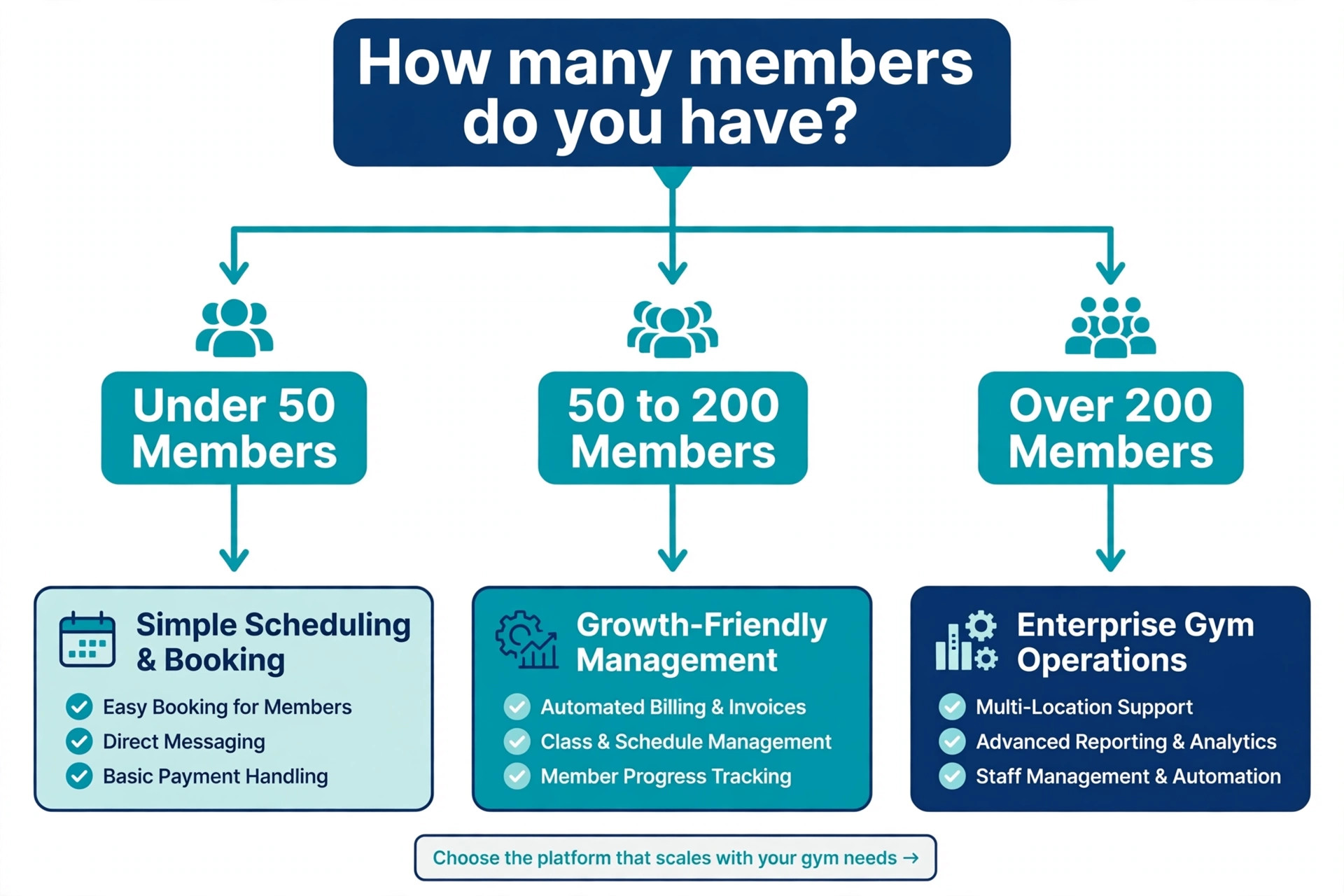
Start with your member count, because it decides which pricing model helps you and which one punishes you. Under 50 members, a free plan or a flat 75 dollar plan wins, and PushPress free or Gymdesk cover the whole job for almost nothing. From 50 to 200 members, compare the per active member cost across PushPress Pro, Zen Planner and TeamUp, because the same studio can pay 99 dollars on one platform and 189 dollars on another for the same member list.
That member count test is the fastest way to shortlist the best gym management software for small studios, since it removes every platform priced for a big club before you waste time on a demo. Above 200 members, failed payment recovery and retention automation matter more than the monthly fee, and the platform that recovers five failed payments a month pays for itself.
Next, price the full stack, not the headline. Add the monthly fee, the branded app if you want one, the SMS credits, the marketing module and the processing rate on your real monthly volume. A platform that advertises 79 dollars a month and needs 500 dollars of add ons costs more than a platform that charges 159 dollars with everything included. Ask every vendor for the total monthly cost at your member count and your card volume, in writing, before you compare. Then test the member experience yourself, because the app your members use every day decides retention more than any admin feature.
Finally, check the exit. Ask how you export member data, payment tokens and class history if you leave, and whether the contract locks you in for a year. A platform that makes leaving hard is telling you something about how it keeps customers. The best gym management software for small studios earns renewal by working well, not by holding data hostage, so favour the vendor that answers the export question clearly and quickly.
Mistakes That Waste a Small Studio Budget
- Paying for a branded app before members ask for one. A custom app costs 39 to 100 dollars a month on top of the software, and a studio with 40 members can run on the standard member app for a year before the branded version earns its cost.
- Choosing the cheapest headline price without checking processing. A free plan at 4.99 percent plus 30 cents costs more per month than a 159 dollar plan at 2.9 percent once card volume passes about 10,000 dollars a month, so the free plan can be the expensive choice.
- Ignoring failed payment recovery. Five failed payments a month at 120 dollars each is 600 dollars of revenue, and the platforms with strong dunning and retry logic recover far more of it than the ones that send a single email and give up.
- Buying marketing automation for a studio with no funnel. A 249 dollar a month marketing module is wasted when the studio has no trial offer, no follow up sequence and no one to run it, so fix the offer first and buy the automation second.
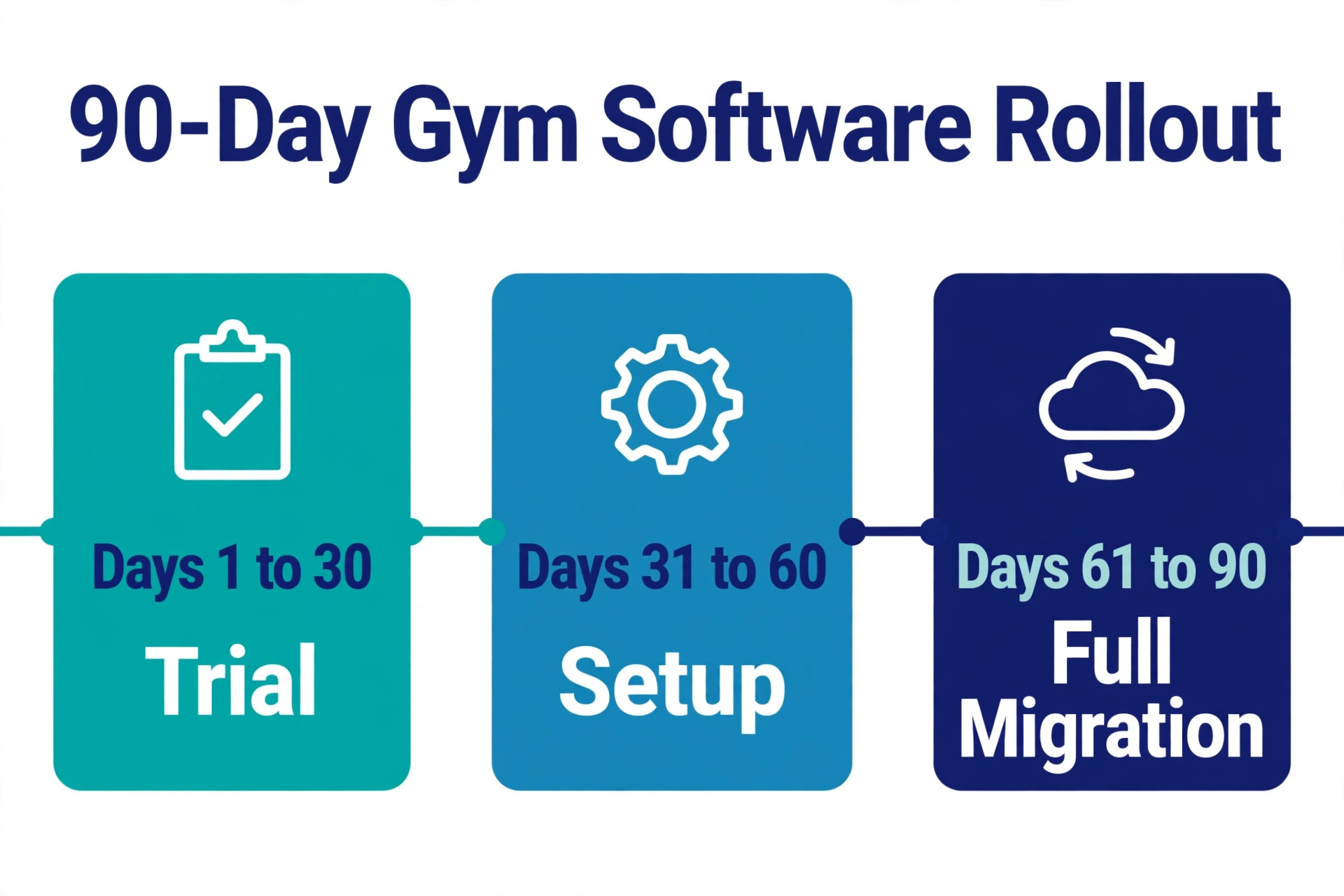
- Migrating without a data export test. Moving members, payment details and class history between platforms is the hardest part of a switch, so export a sample from the old system and import it into the trial account before you cancel anything.
Our Verdict
PushPress is the pick for most small studios, because the free plan lets a new gym open without a software bill, Pro at 159 dollars a month covers the full job, and the gym first workflows match how a small studio actually operates. The processing rate on the free plan is high, so move to a paid plan once card volume grows, but the path from free to paid is the smoothest in this guide. Gymdesk is the pick when the budget is fixed and the studio wants one flat price with every feature, at 75 dollars a month for up to 50 active members.
Mindbody is the pick when discovery matters more than price, because the marketplace fills classes in a way no rival can copy, and a studio in a competitive city can earn the higher cost back in filled spots. Glofox is the pick when the branded app is the priority and the studio wants a polished member experience without the Mindbody stack. Whatever you choose, price the full stack at your real member count, test the member app yourself, and remember that the best gym management software for small studios is the one your members enjoy using and your budget can carry for years.

Frequently Asked Questions
What is the best gym management software for a small studio?
PushPress is the best overall pick for a small studio, because the free plan is genuinely usable, paid plans start at 159 dollars a month, and the platform is built for gyms rather than adapted from another industry. Gymdesk is the best budget pick at 75 dollars a month with every feature included, and Mindbody is the best pick when class discovery through its marketplace matters more than price. The right answer depends on member count, class format and whether the studio sells appointments, classes or both.
How much does gym management software cost per month?
Gym management software costs from zero on a free plan to about 200 dollars a month for a single small studio, before payment processing and add ons. Real 2026 entry prices include Gymdesk at 75 dollars a month, WellnessLiving at 69 dollars, Zen Planner at 99 dollars, PushPress Pro at 159 dollars and Wodify at 199 dollars, with Mindbody from 79 dollars a month per location before add ons. The median published entry point across the platforms in this guide is about 99 dollars a month, and processing adds roughly 2.3 to 5.0 percent on card payments.
Is there free gym management software for small studios?
Yes, PushPress offers a genuinely free plan that covers class scheduling, attendance and basic billing, and Momence offers a free plan to start. PushPress free is the most usable of the two, though its processing rate of 4.99 percent plus 30 cents is the highest on this list, so a busy studio pays more in processing than it saves on the monthly fee. A free plan is the right start for a new studio, and the right move is to switch to a paid plan once monthly card volume makes the lower processing rate cheaper.
Does Mindbody work for a small studio?
Yes, Mindbody works for a small studio, and its marketplace can fill classes that would otherwise run half empty, which is a real advantage in a competitive city. The risk is cost, because the entry plan starts at 79 dollars a month per location and real monthly costs reach 500 dollars or more once marketing automation, a branded app and SMS are added. A small studio should model the full stack, including processing at 2.99 percent plus 30 cents, before committing, and compare it with Glofox or PushPress at the same member count.
What is the cheapest gym management software?
Vagaro is the cheapest at 30 dollars a month for one bookable calendar, but it is an appointment tool rather than a gym platform, so it only fits personal training and appointment led studios. Among full gym platforms, Gymdesk at 75 dollars a month with every feature included is the cheapest honest price, followed by WellnessLiving at 69 dollars a month for a single staff member. PushPress free costs nothing a month, but its 4.99 percent processing rate makes it more expensive than Gymdesk once card volume grows.
Can I switch gym software without losing member data?
Yes, but the migration needs a test before you cancel the old platform. Export members, payment details, memberships and class history from the old system, import a sample into the new platform, and check that billing dates, class packs and payment tokens carried over correctly. Payment tokens sometimes cannot transfer between processors, which means some members must re-enter card details, so tell members in advance and plan the switch for a quiet week. Ask the new vendor what it imports for free and what needs manual work.
A small studio does not need the most software, it needs the software that fits its member count, its class format and its budget, and that keeps working when the owner is teaching instead of sitting at a desk. Start free or cheap, price the full stack including processing, and let the member experience decide. The platform that fills classes, collects payments on time and brings members back is the one worth paying for, and for most small studios in 2026 the best gym management software for small studios is PushPress or Gymdesk.