Substack takes 10 percent of every paid subscription forever. Beehiiv takes 0 percent and charges 49 dollars a month. Kit takes 3.5 percent plus 30 cents per sale. That single difference decides whether a creator earning 3,000 dollars a month keeps 2,700 dollars, 2,951 dollars or 2,895 dollars, and it is why the platform you choose matters more than the editor you write in. Beehiiv is the strongest pick among the best newsletter tools for small creators when you want to grow and earn from sponsorships.
Substack is the better choice when you only want to write and get paid with no setup. Kit is the best choice when you sell courses and digital products. We compared eleven tools on free limits, monthly price at 1,000 subscribers, the cut each platform takes, and the growth tools that actually bring new readers. This guide gives you the numbers, so you can pick a platform that fits your list today and still fits it at 10,000 subscribers.
A small creator newsletter is not a small version of a corporate email program. It is a different product, because one person writes, sends, grows and monetizes the list, and the tool must help with all four jobs without a team. The best tools in this list share three traits. They make it easy to start free and send your first issue today. They give you a way to grow the list beyond your existing followers. And they take a fair share of the money you earn, or no share at all.
Prices in this guide were checked against vendor pricing pages and current 2026 roundups in November 2026. Newsletter pricing changes often, and several vendors price by subscriber count, so the figures below use a 1,000 subscriber list unless stated otherwise. Confirm the price on the checkout page before you pay, and check the revenue cut in the terms, because that cut matters more than the monthly fee once you earn.
How We Compared Eleven Tools
We set the same test for every tool before we looked at a single price. The test creator was a solo writer with 1,000 subscribers, sending one issue a week, earning a small amount from paid subscriptions, and planning to grow to 5,000 subscribers in a year. That profile matches most readers of this guide, and it keeps the comparison honest, because a tool that only shines for a media company with a team of ten will not shine here.
We scored each tool on five points. Free start covered how many subscribers you can have before you pay, and what the free plan actually lets you do. Growth tools covered referrals, recommendations, discovery and sponsorship features, because a list that does not grow is a hobby, not a business. Monetization covered paid subscriptions, sponsorships and product sales, and the cut the platform takes from each. Ease of use covered the editor, the setup time and the learning curve. Price at scale covered what the tool costs at 1,000 subscribers and at 10,000 subscribers, because a platform that is cheap at 1,000 and expensive at 10,000 will punish your growth.
The Best Pick for Each Job
| Job | Pick | Why it wins |
|---|---|---|
| Growing a newsletter business | Beehiiv | Referrals, recommendations and sponsorships built in |
| Writing and getting paid simply | Substack | No setup, built in discovery and payments |
| Selling courses and products | Kit | The strongest automation and commerce engine |
| Owning your publication | Ghost | A real website, paid memberships, 0 percent cut |
| All in one on a budget | MailerLite | Automations, website and paid newsletters for 19 dollars |
| Writing first, nothing else | Buttondown | Markdown, simple archive, 9 dollars at 1,000 subs |
| General email marketing | Mailchimp | Mature tools for a small business list |
| The lowest priced paid plan | EmailOctopus | 13.50 dollars at 1,000 subscribers |
| Beautiful emails fast | Flodesk | Flat price, visual templates, easy editor |
| Cheap sends at volume | Brevo | 17 dollars at 1,000 subscribers, pay by sends |
| Simple and cheap to start | Sender | 15 dollars at 1,000 subscribers |
Use this table as a shortcut for the best newsletter tools for small creators, then read the full section for the tool you are leaning toward. The cheapest option is not the best value when it takes a cut of your earnings, and the most expensive option is not the best choice when you only need to write and send.
The Best Newsletter Tools for Small Creators in 2026, Ranked
The eleven tools below fall into three groups. The first group is the newsletter first platforms, and these are the strongest picks for most small creators. The second group is the all in one email tools, and these suit creators who also need a website, automations and landing pages. The third group is the low cost and specialist picks, and these suit creators who want the lowest price or the simplest editor.
1. Beehiiv
Beehiiv was built by former Morning Brew operators, and it shows. Everything is aimed at growing a newsletter into a real business, with a built in referral program, a recommendation network that surfaces your newsletter to readers of similar publications, Boosts that pay you to recommend other newsletters, and a native sponsorship marketplace with verified sponsors. That growth engine is why Beehiiv wins for newsletters that prioritize sponsorship revenue.
Pricing starts free up to 2,500 subscribers, with unlimited sends and a website. Scale costs 49 dollars a month for up to 10,000 subscribers, and Max costs 99 dollars a month for up to 100,000 subscribers. Beehiiv takes 0 percent of your subscription revenue, so every paid dollar is yours minus Stripe fees. At 25,000 subscribers the Scale plan costs 99 dollars a month, and at 100,000 subscribers the Max plan costs 399 dollars a month. A creator who billed 1,847 dollars in sponsorships through Beehiiv on a 1,840 subscriber list in 30 days shows what the marketplace can do at a small scale.
Beehiiv fits best when your newsletter exists to grow and earn from sponsorships, when you have more than 1,000 subscribers, and when you want growth tools built in rather than added on. It fits worst when you only want to write personal essays with no monetization plan, because the growth features add weight you will not use.
2. Substack
Substack is the simplest way to start a paid newsletter. You sign up, write, and hit send, with almost nothing to configure. Its real strength is discovery, because the built in reader network, the Notes social layer and the recommendations from other writers bring you audience without paid ads. For a writer who wants to focus on the writing and let the platform handle payments and discovery, Substack is hard to beat.
Substack fits best for writers who want simplicity above everything else, for personal essay publications, and for creators who value the built in discovery network. It fits worst for creators who earn meaningful subscription revenue, because the 10 percent cut will soon cost more than any monthly fee on Beehiiv or Kit.
3. Kit
Kit, the platform formerly known as ConvertKit, is built for creators who sell things, such as courses, digital downloads, coaching and memberships. The automation engine is the strongest in this category, with visual automations, sequences, tagging and subscriber scoring that turn a newsletter into a sales funnel. When your newsletter exists to drive product sales, Kit is the tool that does that job best.
Pricing starts free up to 10,000 subscribers, which is the most generous free tier in this list, although the free plan holds back the advanced automations. Creator costs 39 dollars a month at 1,000 subscribers on monthly billing, or 33 dollars billed yearly, and it rises to 139 dollars a month at 10,000 subscribers. Creator Pro costs 66 dollars a month at 1,000 subscribers and adds newsletter referral tools, advanced reporting and subscriber scoring. Kit charges 3.5 percent plus 30 cents on every paid subscription and product transaction, on every plan.
Kit fits best for creators selling digital products, courses or coaching, for anyone who needs serious automation, and for creators who want the biggest free list before they pay. It fits worst for pure newsletter writers who never sell a product, because the commerce features add cost and complexity you will not use.
4. Ghost
Ghost is the pick when you want to own your publication. It gives you a real website with your own design, paid memberships with 0 percent cut, and open source software you can take anywhere, including self hosting for free if you have the technical skill. That ownership matters when you build a publication for the long term, because you are not locked into one vendor pricing or one vendor revenue cut.
Ghost Pro pricing starts at 18 dollars a month billed monthly for Starter, or 15 dollars billed yearly, for up to 1,000 members with unlimited sends. Publisher costs 35 dollars a month, or 29 dollars billed yearly, and it is the plan that lets you charge readers, with 0 percent Ghost transaction fees. At 10,000 subscribers, Publisher costs 105 dollars a month, or 88 dollars billed yearly. There is a 14 day trial and no free hosted plan, although self hosting is free.
Ghost fits best for consultants and writers monetizing a small high value audience, for publications that need a real website and gated posts, and for creators who want to keep every dollar of subscription revenue. It fits worst when you want a free start with no setup, because Ghost Pro is paid from day one and self hosting needs technical work.
5. MailerLite
MailerLite is the best all in one pick for most solo creators. At up to 1,000 subscribers, Comfort costs 19 dollars a month, or 17.10 dollars billed yearly, and it includes automations, a website builder, landing pages and paid newsletters through Stripe. That is the lowest published price in this list for one plan that does all of those jobs, and it is why MailerLite wins for creators who want a website, a blog and email on a budget.
MailerLite fits best for solo creators who want one tool for email, website and landing pages, for creators on a budget, and for anyone who wants automations without paying Kit prices. It fits worst when you need a built in discovery network or a sponsorship marketplace, because MailerLite does not offer those growth tools.
6. Buttondown
Buttondown is the cleanest choice for writers who want markdown, code friendly formatting, a simple archive and minimal newsletter overhead. It is the simplest tool in this list, and that simplicity is the point. You write in markdown or rich text, send from your own domain, and your readers get a clean email with no clutter. For technical writers and developers, that workflow feels right in a way the bigger platforms do not.
Buttondown fits best for minimalists, developers and technical writers who want a writing first tool. It fits worst when you need growth tools, sponsorships, automations or a visual editor, because Buttondown deliberately leaves those features out.
7. Mailchimp
Mailchimp is the mature general email marketing tool in this list, and it suits a small business that needs marketing email rather than a publication. It has scheduling, A B testing, automation flows up to four steps on Essentials, a basic website builder, and a large integration library built over many years. For a business that sends promotions, announcements and newsletters from one account, Mailchimp is a safe choice.
Mailchimp fits best for small businesses that need general email marketing, for teams that want a mature platform with many integrations, and for anyone who already uses Mailchimp for other marketing. It fits worst for creators who want paid subscriptions or a newsletter first workflow, because Mailchimp is built for marketing email, not for publications.
8. EmailOctopus
EmailOctopus is the lowest priced paid plan in this list at 1,000 subscribers, at 13.50 dollars a month. It is a simple email platform built on Amazon SES, which keeps the sending cost low and passes the saving to the creator. The editor is clean, the automations cover the basics, and the price stays low as the list grows, which makes it a good fit for a creator who wants a cheap, reliable sender without extra features.
9. Flodesk
Flodesk is the pick when you want beautiful emails fast. It has a flat price, visual templates and an easy editor that makes every issue look designed, even when you have no design skill. The templates are modern, the workflow is simple, and the price does not rise with your list size in the same way as the other tools, which makes budgeting easy.
Flodesk fits best for creators who care about design, for lifestyle and visual newsletters, and for anyone who wants a flat price that does not punish growth. It fits worst when you need serious automations, paid subscriptions or growth tools, because Flodesk is built for beautiful sends, not for a newsletter business.
10. Brevo
Brevo, formerly Sendinblue, is the cheap sends pick. It charges by the number of emails you send rather than by the number of subscribers, which suits a creator who sends infrequently to a large list, or a business that sends transactional emails alongside newsletters. At 1,000 subscribers, Brevo costs 17 dollars a month, which is cheaper than Mailchimp and Kit at the same list size.
11. Sender
Sender is the simple and cheap pick for a creator starting out. At 1,000 subscribers it costs 15 dollars a month, which is cheaper than Mailchimp, Kit and Beehiiv at the same list size. It covers the core jobs of sending, automations and landing pages, with a clean editor and a straightforward pricing page that does not hide the cost behind subscriber tiers.
What a Newsletter Really Costs at 1,000 Subscribers
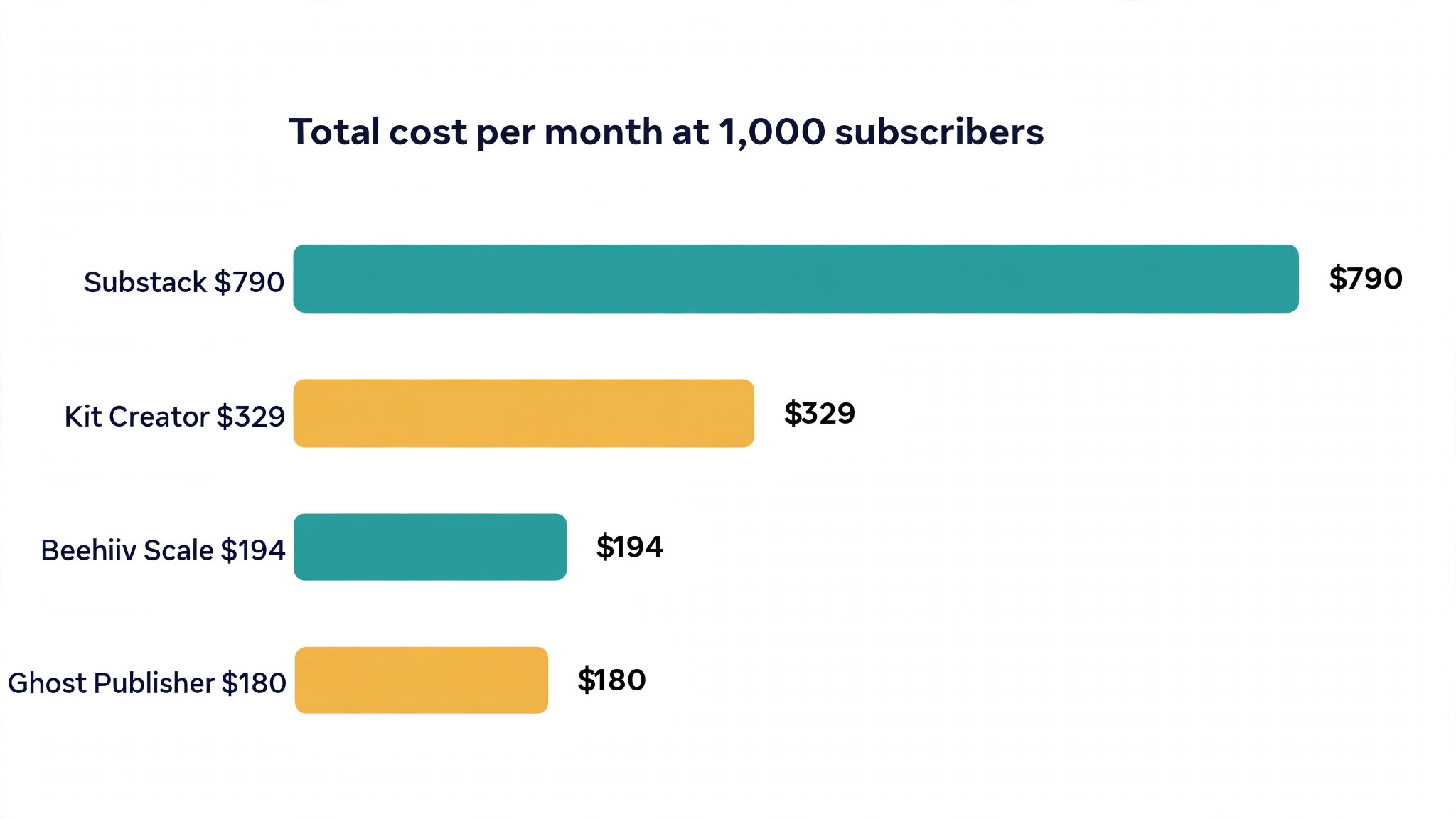
The monthly price is only part of the bill, because the revenue cut decides the real cost once you earn. The table below shows the platform bill at 1,000 subscribers and the fees on 500 paid subscription payments of 10 dollars each, which is 5,000 dollars of revenue in a month.
| Platform | Platform bill at 1,000 subs | Fees on 500 payments | Total per month |
|---|---|---|---|
| Substack | 0 dollars | About 500 dollars plus Stripe | About 790 dollars |
| Beehiiv Scale | 49 dollars | About 145 dollars Stripe only | About 194 dollars |
| Kit Creator | 39 dollars | About 290 dollars | About 329 dollars |
| Ghost Publisher | 35 dollars | About 145 dollars Stripe only | About 180 dollars |
| MailerLite Comfort | 19 dollars | About 145 dollars Stripe only | About 164 dollars |
| Buttondown | 9 dollars plus 9 dollars paid add on | About 145 dollars Stripe only | About 163 dollars |
At 500 paid subscribers, Beehiiv and Substack cost approximately the same when you count only the platform fee, but at 1,000 paid subscribers Substack costs about 1,000 dollars a month while Beehiiv Scale costs 49 dollars. That gap is the reason to choose a platform with a 0 percent cut when you plan to earn from paid subscriptions. A creator earning 3,000 dollars a month hands Substack about 300 dollars monthly, where Beehiiv Scale at 49 dollars or Kit Creator at 33 dollars would cost far less.
The other cost to watch is the price at 10,000 subscribers. Beehiiv Scale costs 49 dollars at 10,000 subscribers on some listings and 99 dollars on others, Kit Creator costs 139 dollars, Ghost Publisher costs 105 dollars, MailerLite Comfort costs 89 dollars, and Buttondown costs 79 dollars. A platform that is cheap at 1,000 subscribers and expensive at 10,000 will punish the growth you worked for, so check both numbers before you choose.
How to Choose the Right Newsletter Tool
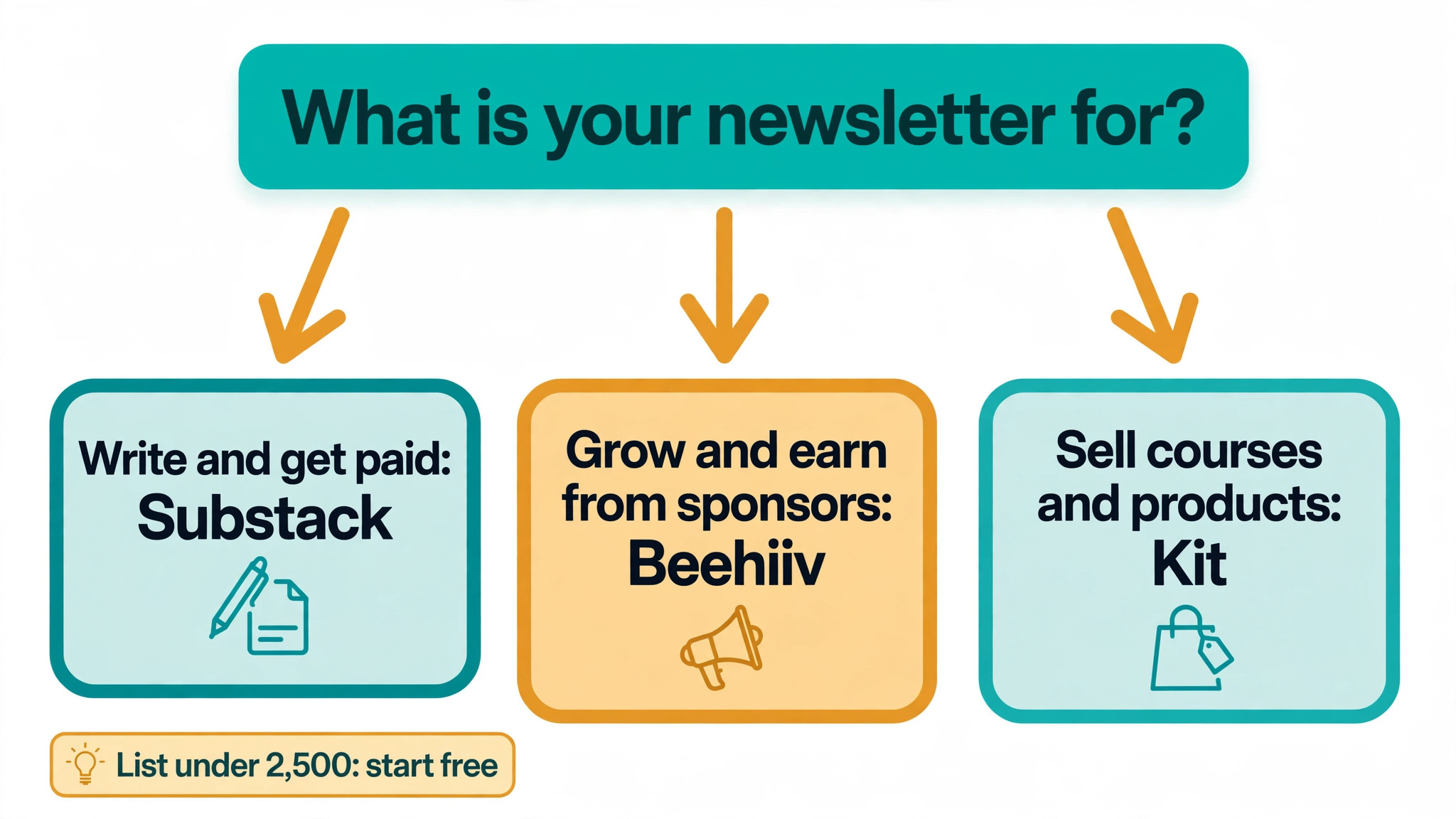
Start with the job, not the brand. Write down whether your newsletter exists to write, to grow, to sell products, or to earn from sponsorships. When the answer is to write and get paid simply, Substack is the right tool. When the answer is to grow and earn from sponsorships, Beehiiv is the right tool. When the answer is to sell courses and products, Kit is the right tool. When the answer is to own a publication, Ghost is the right tool. A tool that does your main job well beats a tool that does five jobs averagely.
Next, count your subscribers and your earnings. Count the subscribers you have today, and count the paid subscribers you expect in a year. A platform that takes 10 percent of your revenue costs nothing when you earn nothing, and it costs 1,000 dollars a month when you earn 10,000 dollars. A platform that charges 49 dollars a month costs the same whether you earn nothing or 10,000 dollars. Do that maths before you enter card details, because the cheapest tool on the page will often change when you count the revenue cut.
Then check the free limit against your list size. Kit free covers up to 10,000 subscribers, Beehiiv free covers up to 2,500, MailerLite free covers up to 250, Mailchimp free covers up to 250 contacts, and Buttondown free covers up to 100. A creator with 500 subscribers cannot start free on MailerLite or Mailchimp, and a creator with 3,000 subscribers cannot start free on Beehiiv. Pick the free plan that actually covers your list, or budget for the paid plan from day one.
Finally, test the editor with a real issue. Every tool here offers a free plan or a free trial, so write one real issue in two tools and send it to yourself. An editor that feels easy with your content is the right editor, and an editor that feels hard will stay hard after you pay. The best newsletter tools for small creators earn their place in that test, not on the sales page, so spend an hour testing before you spend a year paying.
What to Check Before You Pay
Check the revenue cut first in any best newsletter tools for small creators comparison, because it matters more than the monthly fee once you earn. Substack takes 10 percent of paid subscriptions, Kit takes 3.5 percent plus 30 cents per transaction, and Beehiiv, Ghost and MailerLite take 0 percent plus Stripe fees. Read the terms on the pricing page, and work out the cut on your expected earnings, not just on the monthly fee.
Check the price at 10,000 subscribers second, because several tools price by list size and the bill rises fast. Kit Creator rises from 39 dollars at 1,000 subscribers to 139 dollars at 10,000, Ghost Publisher rises from 35 dollars to 105 dollars, and MailerLite Comfort rises from 19 dollars to 89 dollars. A platform that is cheap today and expensive at scale will punish the growth you worked for.
Check what the free plan actually includes third, because free plans hold back different features. Kit free holds back advanced automations, Beehiiv free includes unlimited sends and a website, MailerLite free caps at 250 subscribers, and Ghost has no free hosted plan. The free plan that covers your list and your features is the free plan worth starting on.
- Confirm the revenue cut on paid subscriptions and product sales.
- Confirm the monthly price at 1,000 subscribers and at 10,000 subscribers.
- Confirm the free plan subscriber limit and which features it holds back.
- Confirm whether automations, paid subscriptions and referrals cost extra.
- Confirm whether you can export your list and leave without losing subscribers.
Mistakes That Waste Money
The most common mistake is choosing Substack for a newsletter that earns real money, and then paying 10 percent forever. A creator who earns 5,000 dollars a month pays Substack 500 dollars a month, or 6,000 dollars a year, for a platform that costs 49 dollars a month on Beehiiv. That is a 5,400 dollar a year mistake, and it is easy to avoid by choosing a 0 percent platform before you start earning. Start on Substack when your list is small and your earnings are zero, and move to a 0 percent platform before the revenue grows.
The second mistake is paying for a tool whose free plan already covers the job. A creator with 800 subscribers can run Kit free up to 10,000 subscribers, or Beehiiv free up to 2,500 subscribers, without paying anything. Paying 39 dollars a month for features you do not use yet is wasted money, and the fix is simple. Start free, send every week, and only pay when you need a feature the free plan holds back.
The third mistake is picking a platform you cannot leave. A creator builds a list of 10,000 subscribers on a platform that makes export hard, and then cannot move without losing readers. Check the export terms before you choose, and make sure you can download your list with email addresses at any time. The best newsletter tools for small creators are the ones that let you leave, because a platform that locks you in will charge you more later.
Our Verdict
Beehiiv is the pick for most readers among the best newsletter tools for small creators, because the free plan covers up to 2,500 subscribers, the Scale plan costs 49 dollars a month, the growth tools bring new readers, and the 0 percent revenue cut means you keep what you earn. Start free, use the referral and recommendation tools, and pay for Scale when you pass 2,500 subscribers or when you want the sponsorship marketplace.
Substack is the pick when you only want to write and get paid with no setup, because the discovery network and the simple payments are worth the 10 percent cut while your earnings are small. Kit is the pick when you sell courses and products, because the automation and commerce engine turn a newsletter into a sales funnel. Ghost is the pick when you want to own your publication and keep every dollar, and MailerLite is the pick when you want the cheapest all in one plan that covers email, website and landing pages for 19 dollars a month.
Start free, send every week, and pick the platform that fits the job your newsletter actually does. A newsletter that grows is worth paying for, and a newsletter that earns is worth a platform that takes no cut.

Frequently Asked Questions
Which of the best newsletter tools for small creators is the cheapest?
Buttondown at 9 dollars a month at 1,000 subscribers is the cheapest paid plan in this list, and EmailOctopus at 13.50 dollars and Sender at 15 dollars are the next cheapest. Among free plans, Kit free covers up to 10,000 subscribers, which is the most generous free tier, and Beehiiv free covers up to 2,500 subscribers. The cheapest plan is not always the best value, because Buttondown charges extra for paid subscriptions and automations, while Kit free holds back advanced automations. Count your subscribers and your earnings before you judge a price.
Is Substack free?
Substack is free to start, with no monthly fee and no subscriber limit on the free plan. It takes 10 percent of all paid subscription revenue forever, plus Stripe processing of about 2.9 percent plus 30 cents per transaction. At small scale that cut costs little, because 10 percent of nothing is nothing, but at 1,000 paid subscribers paying 10 dollars a month it costs 1,000 dollars a month. Substack is only free when you never charge your readers.
How much does Beehiiv cost?
Beehiiv is free up to 2,500 subscribers, with unlimited sends and a website. Scale costs 49 dollars a month for up to 10,000 subscribers, and Max costs 99 dollars a month for up to 100,000 subscribers. Beehiiv takes 0 percent of your subscription revenue, so every paid dollar is yours minus Stripe fees. At 25,000 subscribers Scale costs 99 dollars a month on some listings, and at 100,000 subscribers Max costs 399 dollars a month, so check the current pricing page for your list size.
Can I move my newsletter from Substack to Beehiiv?
Yes, you can move your list from Substack to Beehiiv, and most platforms offer an import tool for subscribers and content. Export your subscriber list with email addresses from Substack, import it into Beehiiv, and redirect your readers to the new home. The hard part is not the technical move, it is telling your readers where to find you, so send a final issue on the old platform with a link to the new one, and expect some readers to drop off in the move. Check the export terms on both platforms before you start.
What is the best newsletter tool for selling courses?
Kit is the best newsletter tool for selling courses, because the automation engine, the visual automations, the sequences and the subscriber scoring turn a newsletter into a sales funnel. Creator costs 39 dollars a month at 1,000 subscribers, and Creator Pro adds referral tools and advanced reporting. Kit charges 3.5 percent plus 30 cents on every sale, so count that fee on your expected course revenue before you choose, and compare it with Ghost, which takes 0 percent and gives you a real website for your course.
Do I need a website as well as a newsletter tool?
It depends on the tool. Ghost gives you a real website and a newsletter in one account, Beehiiv gives you a website with the free plan, and MailerLite gives you a website builder with Comfort. Substack gives you a newsletter page and an archive, but not a full website, and Buttondown gives you an archive rather than a website. When you want a publication with gated posts and a custom design, Ghost is the right choice, and when you only need a place to send and archive issues, Beehiiv or Substack is enough.
A newsletter grows when you send every week, when readers can find you, and when you keep what you earn. Pick the platform that fits your list today, check the price at 10,000 subscribers, and make sure you can export your list and leave whenever you choose.