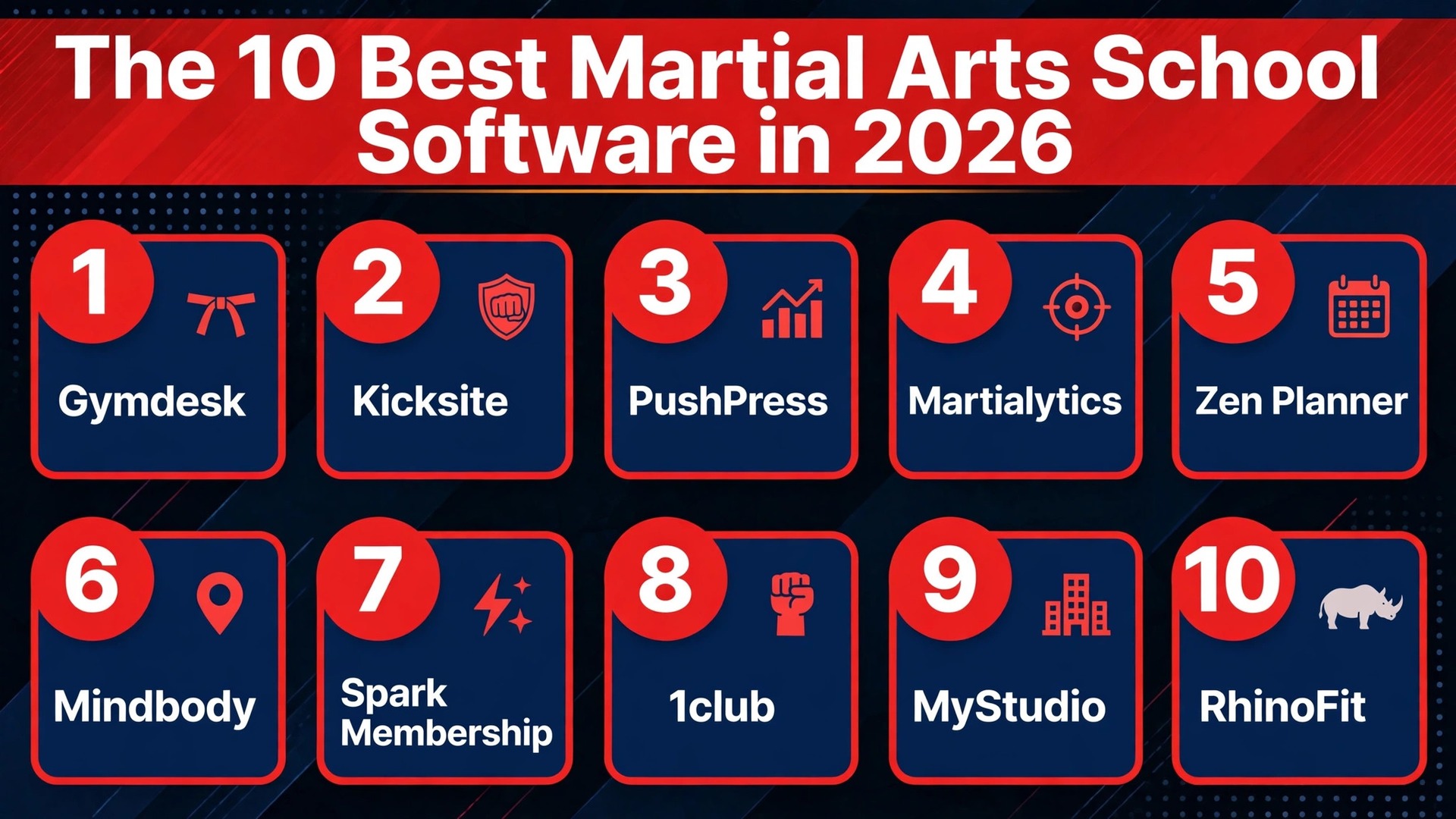
Gymdesk is the best overall pick among the best martial arts school software we compared, because it was built for martial arts first, it covers belt tracking and family billing on every plan, and its flat price starts at 75 dollars a month with no payment markup. Kicksite is the better choice for a small traditional dojo that wants the simplest setup, and PushPress is the strongest option when you want a free plan to start with.
We compared 10 platforms on the features a school actually uses every day, which are belt and rank tracking, family billing, class scheduling, attendance, waivers for minors, and the true monthly cost once add ons are counted. This guide shows what each tool does, what it costs, and where it falls short, so you can stop comparing homepages and pick one.
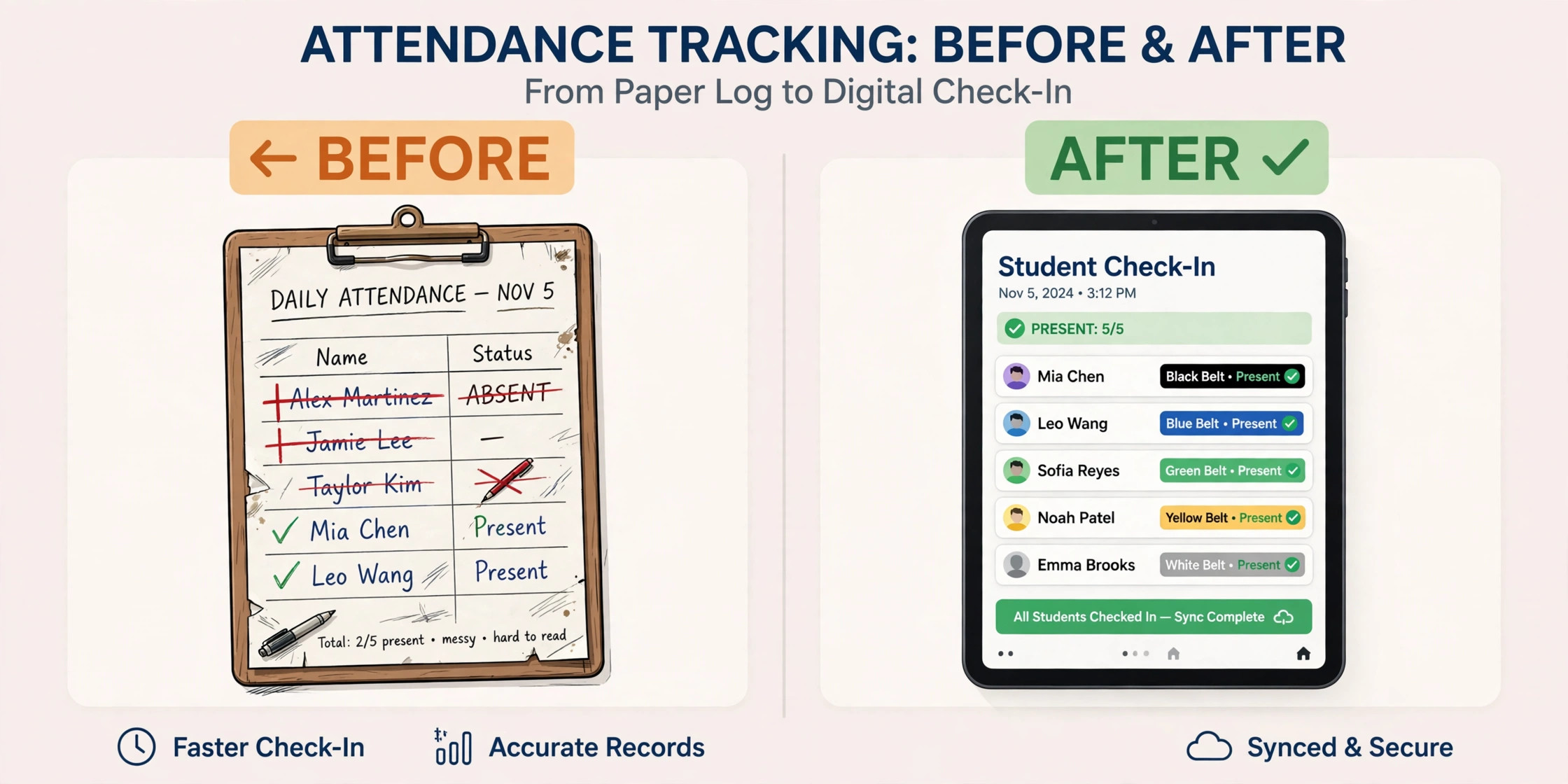
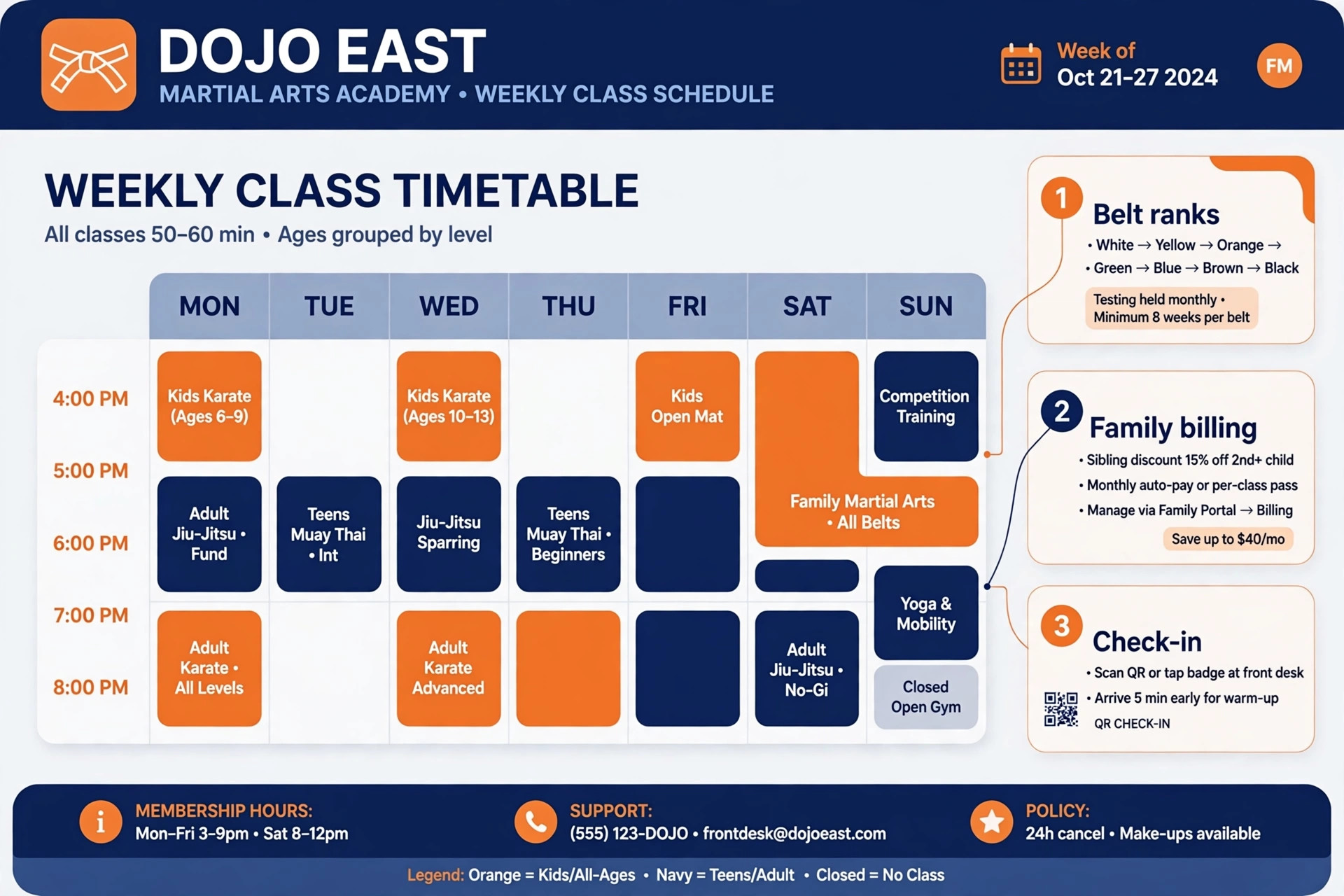
A martial arts school runs on details that a general gym system misses. A student is not just a member, because that student holds a belt rank, a stripe count, an attendance record, and a promotion date, and all four decide when the next test happens. A family is not just two members, because parents pay once for several children and expect one bill with sibling discounts. A class is not just a time slot, because a gi class and a no gi class need different rooms, different instructors, and different rank requirements. Software that ignores those details forces the front desk back to spreadsheets, and the spreadsheets are where students get missed.
The cost of the wrong system shows up quietly. Failed payments go unnoticed for a month. A student who stopped attending never triggers a follow up. A parent is billed twice for two children on separate plans. None of those problems looks like a software failure on its own, but together they cost a school students and revenue every term. The right system catches all four automatically, and that is the test this guide applies to every tool on the list.
How We Tested 10 Martial Arts Platforms
We scored each platform on six points that decide whether a school can run on it day to day. Belt and rank tracking covered custom rank ladders, stripes, promotion history, and test readiness based on attendance. Family billing covered one bill for several children, sibling discounts, and a single parent login. Scheduling covered multi program classes, online booking, and waitlists. Attendance covered check in, at risk student flags, and reports a coach can read in a minute. Billing covered recurring payments, failed payment retries, and whether the vendor adds a markup on processing. Ease of setup covered how fast a school can move from a spreadsheet to a live system without a consultant.
Prices in this guide were checked against vendor pricing pages and current 2026 roundups in November 2026, and every price below comes from a published plan, not a sales call, which is how the best martial arts school software should be compared. Martial arts software pricing changes often, and several vendors show different prices by region or run short promotions, so confirm the price on the checkout page before you pay. Where two trusted sources disagreed on a price, we say so in the tool section and give both numbers, because a school should budget on the higher figure until the vendor confirms the lower one.
The Best Martial Arts School Software for Each Job
| Job | Pick | Why it wins |
|---|---|---|
| Best overall for most schools | Gymdesk | Martial arts first, flat price, every feature on every plan |
| Simplest setup for a small dojo | Kicksite | Clean interface, belt tracking included, 49 dollars a month |
| Best free starting point | PushPress | Free Core plan covers billing, scheduling, and check in |
| Best for grading focused schools | Martialytics | Attendance led promotion tracking, simple active student pricing |
| Best for a large established school | Zen Planner | Mature billing and belt tracking at 100 plus students |
| Best for growth and marketing | Spark Membership | Lead funnels, follow up sequences, and belt based triggers |
| Best budget pick for a new school | 1club | Free for up to 100 active students with belt tracking |
| Best for a website plus software | MyStudio | Built in website, member app, and unlimited students |
Use this table as a shortcut, then read the full section for the tool you are leaning toward. The cheapest option is not the best value when it cannot track belts properly, and the most expensive option is not the best choice when you only need billing and scheduling for forty students.
The Best Martial Arts School Software in 2026, Ranked
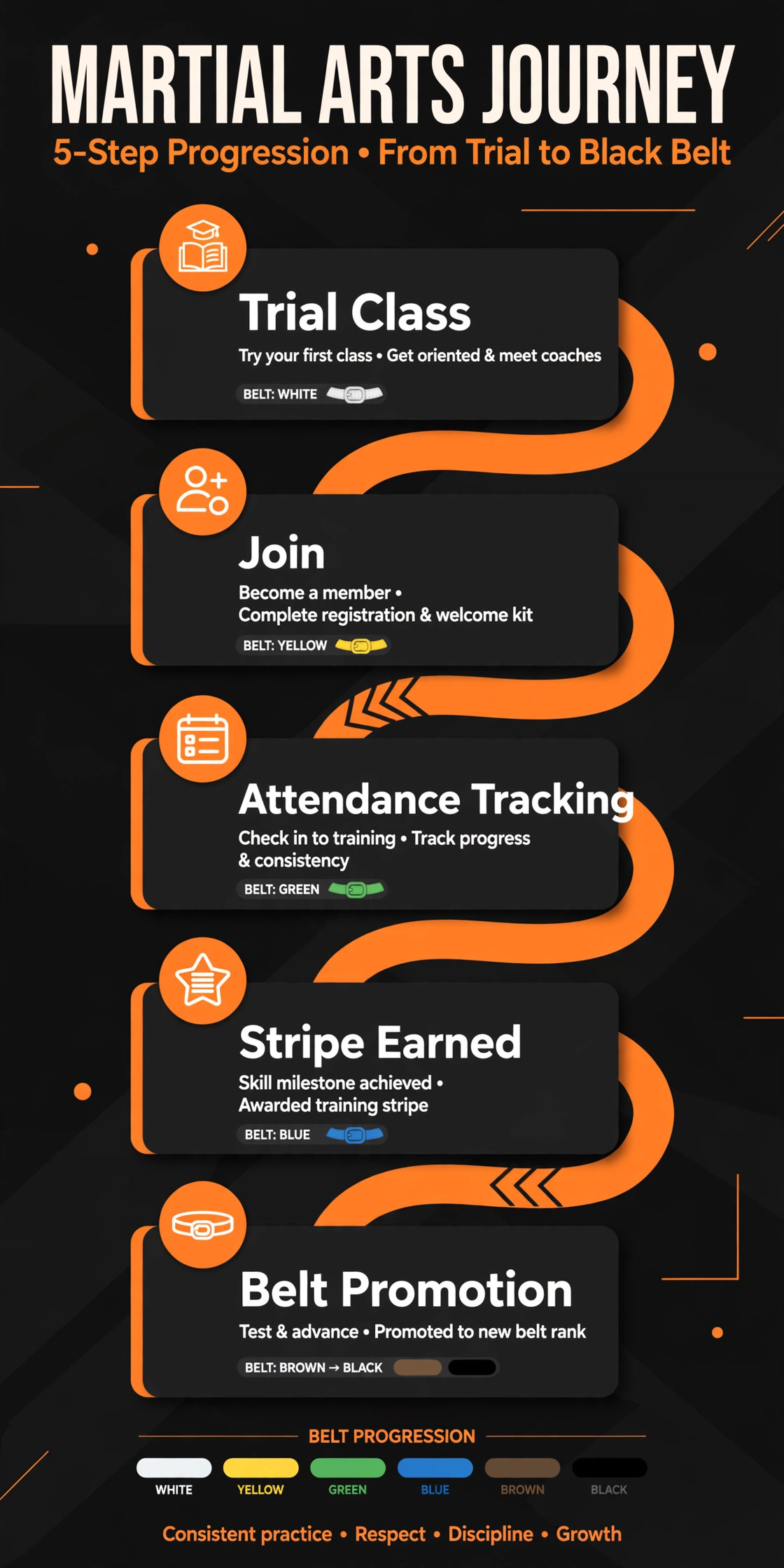
The 10 tools below fall into three groups. The first group is built for martial arts from the ground up, and these are the strongest all round picks for most schools. The second group is built for gyms and fitness in general but configured for martial arts, which suits larger schools that need mature billing and reporting. The third group is built for growth, with marketing and lead follow up as the main selling point, and these suit schools that are actively trying to fill classes. Every tool on this list tracks belts, so the differences come down to price, family billing, and how much hand holding the setup needs.
1. Gymdesk
Gymdesk started as martial arts software, and it still shows in the details. Belt promotions tie directly to the attendance the platform already tracks, so a coach can see who is ready to test without opening a spreadsheet. Family memberships with sibling discounts are native, waivers for minors are built in, and every feature is included on every plan, so there is no tier where belt tracking suddenly disappears. The platform serves more than 4,000 gym owners across 34 countries, including well known BJJ academies, which is a useful sign that the martial arts workflows have been tested at real scale.
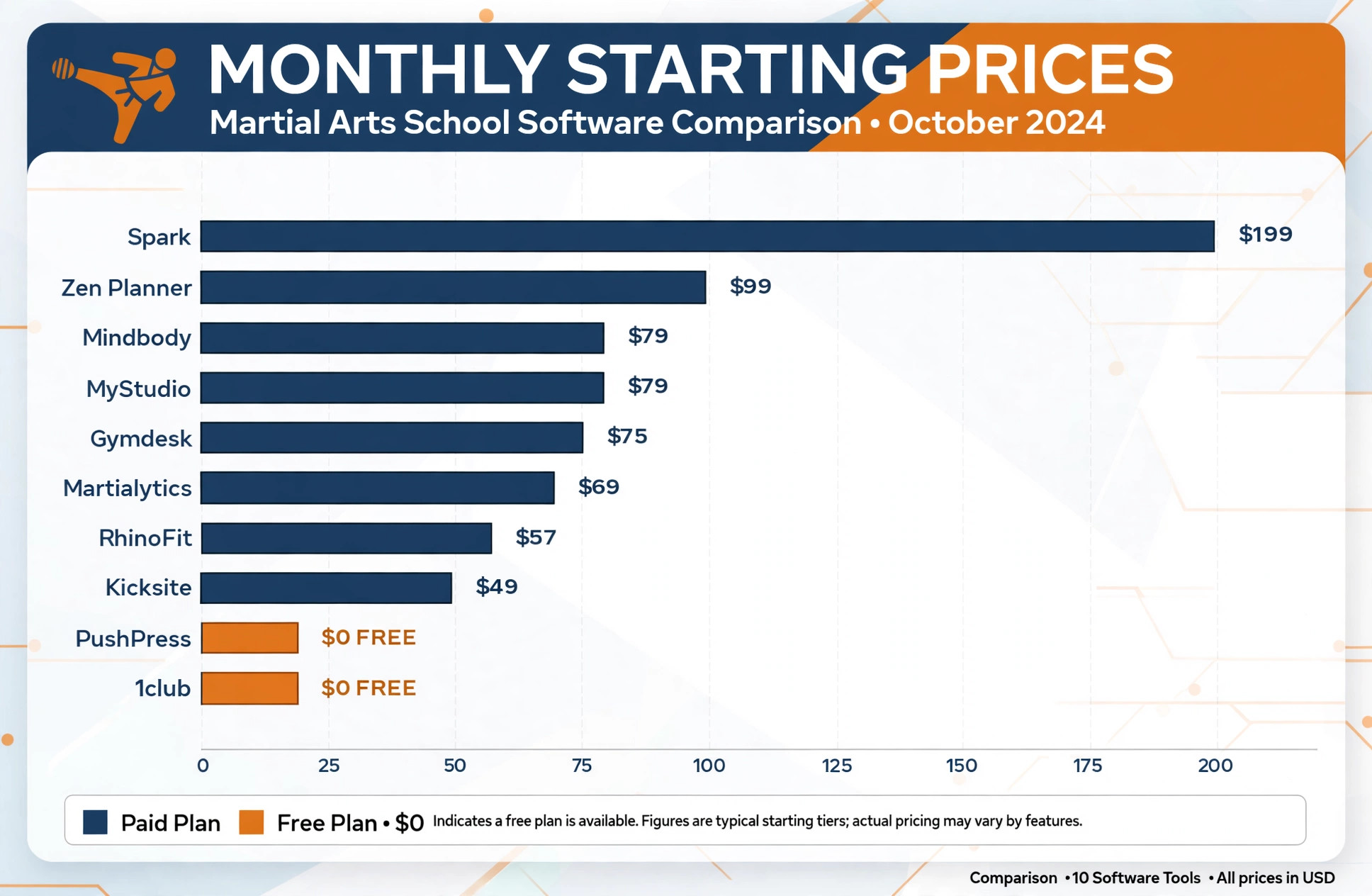
Pricing is flat and clear. Plans run from 75 dollars a month for up to 50 members to 200 dollars a month for larger schools, when you use Gymdesk Payments, and the vendor states it adds no markup when a school connects a supported external processor. That transparency is rare in this category, where the advertised price often hides paid add ons for the website, the branded app, or the marketing module. The trade off is a smaller marketing toolkit than Spark Membership, so a school that needs heavy lead follow up will add a separate tool or pick a growth focused rival.
2. Kicksite
Kicksite is the simplest tool on this list, and that is its whole appeal. A small traditional dojo can set it up in a day, with belt tracking, recurring billing, scheduling, attendance, and digital waivers in one clean interface. There are no sprawling menus and no marketing automation to configure, which suits owners who want software that stays out of the way. The support team has a strong reputation with small schools, and the trial period of 30 days is long enough to run a full billing cycle before deciding.
Pricing starts at 49 dollars a month, with tiers that rise by student count, and the lowest tier caps at around 25 students. That cap is the main limit, because a growing school outgrows it within a year and moves to a higher tier. For a school under 25 students, Kicksite is the easiest yes on this list. For a school past 100 students, the per student tiers become less attractive next to a flat price tool such as Gymdesk.
3. PushPress
PushPress is the only tool here with a genuinely useful free plan. The free Core plan covers recurring billing, class schedules, member check in, and a member app, which is enough for a new school to run its first term without paying for software. The paid plans start at 159 dollars a month for Pro and 229 dollars a month for Max, and the martial arts product adds belt and stripe tracking on the paid plans. The platform also offers an AI lead assistant and a CRM add on for schools that want follow up built in.
The catch is that the free plan is a starting point, not a full system. Native belt tracking needs a paid plan, and the CRM add on costs extra, so the real monthly bill for a school that uses the whole platform climbs past the headline price. PushPress suits a school that wants to start free, prove the system works, and then pay for the features it actually uses. A school that needs belt tracking from day one should budget for Pro from the start.
4. Martialytics
Martialytics is built specifically for martial arts schools, with a focus on attendance, grading, and belt progression. The platform tracks which students are ready to test, records promotion history, and keeps inactive students and leads out of the billing count, so a school pays only for active students. Unlimited locations, users, and email are included, and a student app comes with the plan. That combination suits traditional schools where grading is the centre of the student journey.
Pricing is where the sources disagree, so budget carefully. The vendor’s United States pricing lists 69 dollars a month for up to 50 students, rising to 99 dollars for 51 to 100 students, 129 dollars for 101 to 200, and 199 dollars above 200, with every feature on every plan. European pricing seen in 2026 roundups starts at 29 euros a month for up to 50 active students. Confirm the price for your region on the vendor’s pricing page before you commit, and use the higher figure in your budget until it is confirmed.
5. Zen Planner
Zen Planner is the established choice for larger schools, with mature billing, scheduling, attendance, a member app, reporting, and belt or skill tracking. The Studio product starts at 99 dollars a month and scales by active members, which keeps the entry cost reasonable for a school with a hundred students or more. The platform has served martial arts and fitness schools for years, so the billing and reporting workflows are deep, and the support documentation covers the edge cases a growing school will hit.
The weakness is the add on ladder. The marketing module, the website, and the branded app are separate paid extras, and roundups of loaded costs put a comparable Zen Planner setup near 387 dollars a month once those extras are added. That is not a hidden fee, because each extra is priced openly, but it does mean the 99 dollar starting price is not the real monthly cost for a school that wants the full system. Compare the loaded price, not the base price, when you put Zen Planner next to an all in tool.
6. Mindbody
Mindbody is the biggest name in fitness software, and it brings marketplace discovery that no martial arts only tool can match. Students can find your school through the Mindbody app and website, which is a real source of trial bookings for a studio in a busy area. The platform covers scheduling, billing, a member app, and reporting at a scale that suits multi location operators, and a martial arts configuration adds belt tracking and program scheduling to the standard fitness workflows.
Pricing starts at 79 dollars a month per location, and the full feature set needs higher tiers. Mindbody is a broad fitness platform first, so the martial arts features feel configured rather than native, and the setup takes longer than a tool built for a dojo. Choose Mindbody when discovery and multi location reporting matter more than martial arts depth. Choose a native tool when belt tracking and family billing are the daily work.
7. Spark Membership
Spark Membership is the growth pick. The platform combines billing, rank tracking, and lead management in one system, with lead funnels, follow up sequences, SMS and email automation, and belt based triggers that message a student when a promotion is near. Free student data migration is included, which removes the usual fear of switching, and the marketing automation is the deepest on this list. A school that is actively trying to fill classes will feel the difference within a month, because the follow up that used to depend on the front desk now runs on its own.
Pricing is the trade off. Published prices put Spark Membership at 199 dollars a month for a single plan, while some 2026 roundups list it from 239 dollars a month, so confirm the current price before you budget. Either figure makes it the most expensive tool here for a small school, and the cost only makes sense when the marketing features bring in new students. A school that is already full should spend the money on coaching, not on lead funnels.
8. 1club
1club is the budget pick for a new or owner run academy. The free plan covers up to 100 active students and includes belt tracking and family billing, which no other free plan on this list does. Paid plans start at 63 dollars a month for the Run plan, and the platform covers belts, families, attendance, scheduling, and billing in one system. The Capterra rating of 4.8 out of 5 is the joint highest on this list, and the 30 day trial gives a school time to test with real students before paying.
The limit is maturity. 1club is newer than Zen Planner or Mindbody, so the integration library is smaller and the reporting is less deep. A school that needs a specific accounting or marketing integration should check that it exists before committing. For a school under 100 students that wants belt tracking and family billing without a monthly bill, 1club is the obvious first trial.
9. MyStudio
MyStudio is the pick for a school that wants a website, a member app, and management software from one vendor. Every plan includes a built in website, a member app, rank and belt tracking, online sales of trials, memberships, events, and retail, plus automated check in and follow ups, with unlimited students on every plan. Rank testing is the centre of the product, with test ready alerts based on attendance, testing events that collect fees, bulk promotions, and belt inventory tracking. The Growth plan at 159 dollars a month adds those testing tools, and the Scale plan at 239 dollars a month adds unlimited automations and full branding across the app and portal.
Pricing starts at 79 dollars a month for Essentials, and card processing runs from 2.9 percent plus 30 cents per transaction, with 1 percent for ACH payments. The trade off is that the cheapest plan holds back the testing depth that makes MyStudio special, so a grading focused school should budget for Growth. A school that also needs a new website will find the bundle good value, because the website alone would cost that much from a separate vendor.
10. RhinoFit
RhinoFit is the low cost workhorse for a small gym or dojo. The Standard plan costs 57 dollars a month, and a genuine free Startup tier covers very small gyms with under 20 members. Belt tracking is customisable, with subcategories inside a rank, test timing, digital shadow boxes, and an alert when a student is due to test. Members get a free app for class reservations, belt achievements, and attendance history, and the platform covers memberships, recurring billing, scheduling, waivers, point of sale, and optional 24 hour door access.
Read the payment terms before you sign, because this is where RhinoFit draws complaints. Reviewers report that the platform ties the school to its own payment processor, with a higher monthly fee when a school uses another processor, and a three year agreement with a cancellation fee near 400 dollars has been reported. Those terms may suit a school that wants one vendor for everything, but a school that values flexibility should confirm the contract in writing before committing.
How to Choose the Right System for Your School
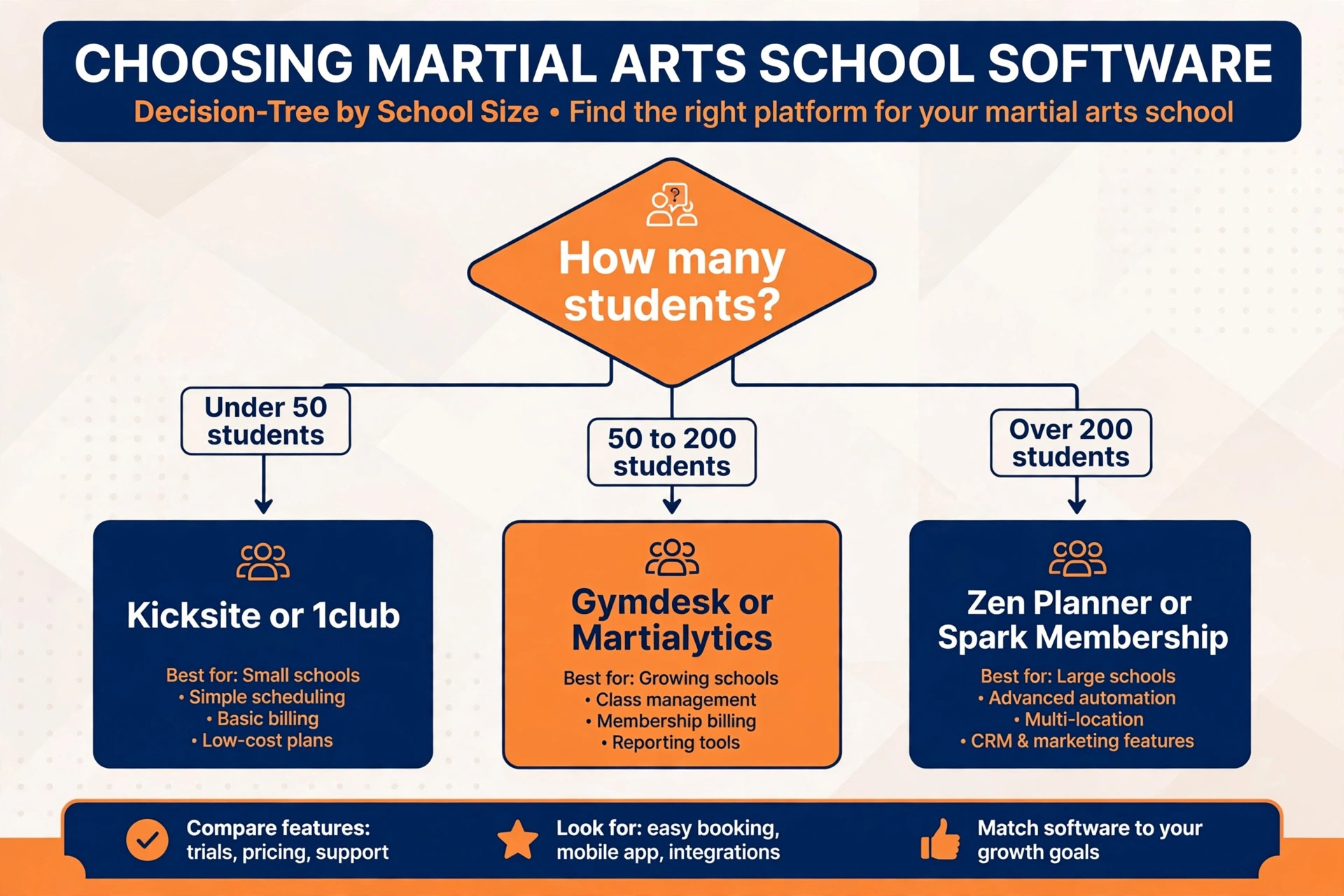
Start with your student count, because it decides the pricing model. A school under 50 students should look at Kicksite, 1club, or the free PushPress Core plan, where the bill stays low while the school grows. A school between 50 and 200 students should compare Gymdesk, Martialytics, and MyStudio, where flat or active student pricing keeps the monthly cost predictable. A school past 200 students should look at Zen Planner, Mindbody, or Spark Membership, where the reporting and marketing depth justify a higher bill. The best martial arts school software for a 30 student dojo is rarely the right pick for a 300 student academy, and the student count is the fastest way to shorten the list.
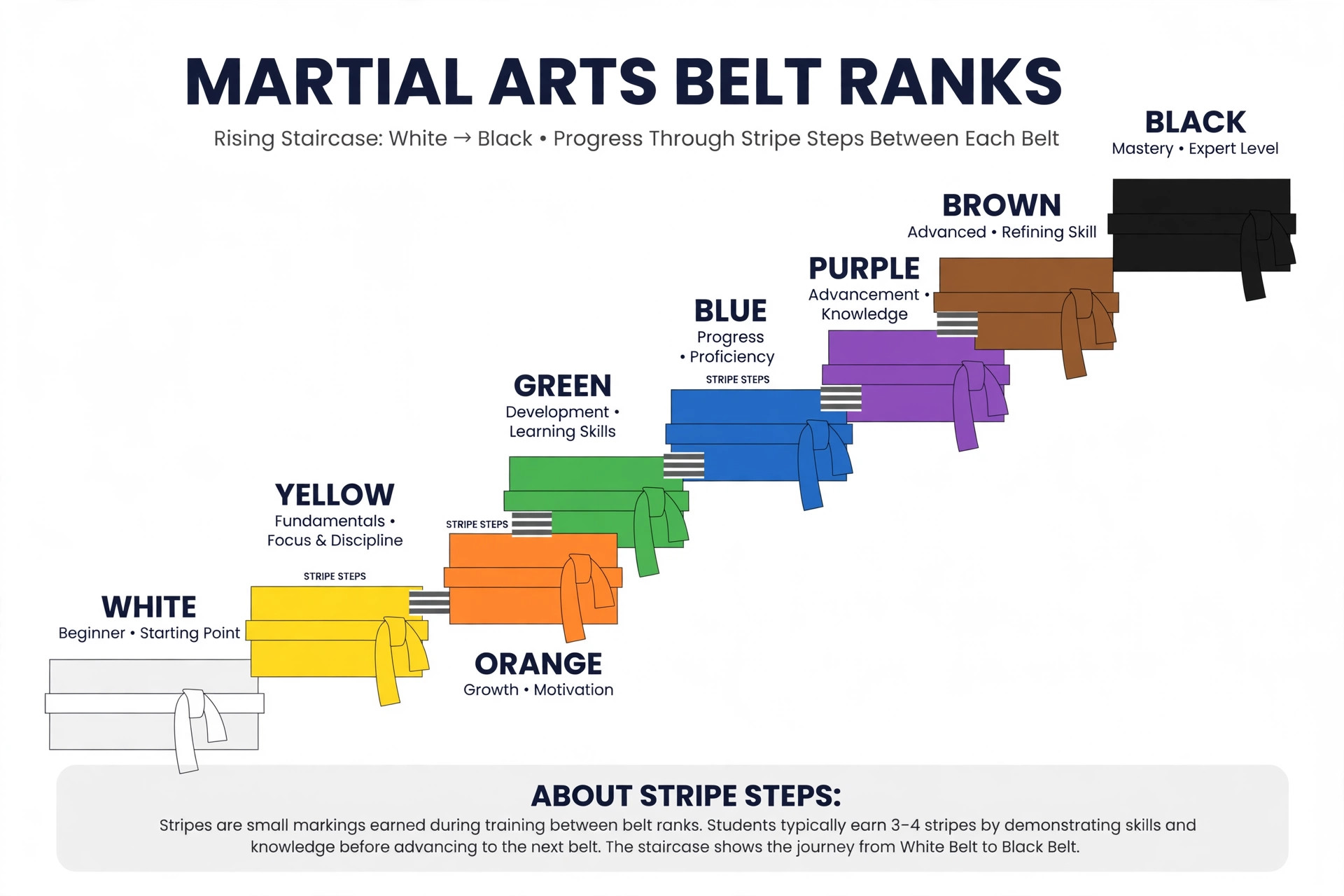
Next, test belt tracking with your own rank ladder. Every tool on this list claims belt tracking, but the depth differs. Can it handle stripes inside a belt. Can it hold a separate ladder for kids and adults. Can it flag a student as ready to test based on attendance. Can it record a failed test and keep the history. Run your real ladder through the trial of your top two tools and see which one handles it without a workaround. A tool that forces your rank system into its template will create manual work every grading cycle.
Then check family billing with a real family. Add two children and one parent, apply a sibling discount, and look at the invoice the parent receives. If the parent gets two separate bills or two separate logins, the tool has failed the test that matters most to the person paying. Ask about failed payments too, because a system that retries a failed card automatically and tells the front desk is worth more than a system that silently lets a membership lapse.
Finally, add up the loaded cost. Take the base price, add the branded app, the website, the marketing module, and the payment processing markup, and compare that total across your finalists. A 99 dollar base price that loads to 387 dollars a month is not cheaper than a 159 dollar plan that includes everything. Ask each vendor for the loaded monthly total in writing before you sign, and keep that email when the first invoice arrives.
What to Verify Before You Sign
A martial arts platform is a contract as much as a piece of software, so read the terms with the same care you give the feature list. Confirm the payment processing rate and whether the vendor adds a markup, because the markup is a monthly cost that never appears in the headline price. Confirm who owns the student data and how you export it, because a platform that will not export your student list is a platform you can never leave. Confirm the contract length and the cancellation fee, because a three year term with a 400 dollar exit fee changes the value of a low monthly price.
- Confirm belt tracking handles your rank ladder, stripes, and test history without a workaround.
- Confirm family billing puts several children on one bill with sibling discounts and one parent login.
- Confirm the loaded monthly total, including the app, the website, the marketing module, and any processing markup.
- Confirm you can export your full student list, attendance, and belt history at any time.
- Confirm the contract length, the cancellation fee, and the payment processor rules in writing.
Mistakes That Cost Schools Students
The most common mistake is choosing a general gym system and discovering too late that belt tracking is an afterthought. The front desk ends up running promotions from a spreadsheet, the spreadsheet goes out of date, and students wait months for a test they already earned. Test the belt workflow with real students during the trial, not with a demo account, because the demo always looks smooth. A second mistake is ignoring family billing until the first complaint arrives. Parents notice a double bill immediately, and they notice it again every month until it is fixed.
A third mistake is buying on the base price and meeting the add ons later. The website, the branded app, and the marketing module each look small on their own, and together they can triple the monthly bill. The best martial arts school software for your budget is the one whose loaded price you can afford every month, not the one whose starting price looks good in a comparison table.
A fourth mistake is migrating without a data check. Import your student list, check five records by hand, and confirm belts, attendance, and payment dates survived the move before you cancel the old system. A fifth mistake is launching without telling parents what changes. A short message that explains the new app, the new login, and where to pay prevents a week of confused phone calls.
Which Tool Fits Your School
Gymdesk is the pick for most schools among the best martial arts school software, because the martial arts first design, the flat price from 75 dollars a month, and the every feature on every plan rule remove the usual surprises. Kicksite is the pick for a small traditional dojo that wants the simplest setup at 49 dollars a month. PushPress is the pick for a school that wants to start free and pay later, and 1club is the pick for a new academy that wants belt tracking and family billing without a monthly bill at all.
Run your real rank ladder and one real family through the trial of your top two tools, compare the loaded monthly totals in writing, and pick the system your front desk can run without a spreadsheet.

Frequently Asked Questions
Which of the best martial arts school software options is cheapest?
1club is the cheapest starting point, because the free plan covers up to 100 active students with belt tracking and family billing included. Kicksite at 49 dollars a month is the cheapest paid starting point, and RhinoFit at 57 dollars a month is close behind. PushPress Core is free, but belt tracking needs a paid plan from 159 dollars a month, so the free plan is not the cheapest route to a full martial arts system.
Do I need belt tracking in my software?
Yes, when your school runs a rank system with belts or stripes. Belt tracking ties promotion readiness to attendance, keeps a history of every test, and stops students from being missed at grading time. A school that tracks belts in a spreadsheet will spend hours before every grading and still miss students. A school with no rank system, such as a drop in only striking gym, can run on a general gym platform without it.
What is the best software for a small dojo under 50 students?
Kicksite is the simplest pick at 49 dollars a month, and 1club is the strongest budget pick because the free plan covers up to 100 students. Gymdesk at 75 dollars a month is the best all round pick when the school wants flat pricing and every feature included. The right choice depends on whether the school values the lowest bill, the simplest setup, or the deepest martial arts features.
How much should a martial arts school pay for software?
Most small schools pay 49 to 159 dollars a month for the software itself, plus card processing fees of around 2.9 percent plus 30 cents per transaction. Larger schools and growth focused schools pay 199 to 239 dollars a month, and a loaded Zen Planner setup can reach near 387 dollars a month with add ons. Budget on the loaded monthly total, not the base price, and confirm the total in writing before you sign.
Can I switch software without losing student records?
Yes, when you check the export before you cancel the old system. Most platforms on this list offer free data migration, and Spark Membership includes it as a standard service. Export your student list, belt history, attendance, and payment dates, check five records by hand, and only then cancel the old subscription. A platform that will not export your data is a reason to avoid it, not a reason to stay.
Does martial arts software handle waivers for minors?
Yes, most platforms on this list include digital waivers that a parent signs for a child, with secure storage of the signed document. Gymdesk, Kicksite, PushPress, and RhinoFit all include waivers as part of the core system. Check that the waiver is tied to the student record and that the platform can show who has signed and who has not, because an unsigned waiver is a risk the front desk needs to see at check in.
A school does not need the most expensive system, and it does not need the system with the longest feature list. It needs belt tracking that matches its own rank ladder, family billing that gives parents one bill, and a monthly total it can afford without surprises. Test those three things with real students during the trial, and the right tool will be obvious before the trial ends.