
Most small businesses do not fail at social media because they post too little, they fail because they post everywhere, inconsistently, with no idea which platform brings a customer. Buffer 2026 analysis of more than 100,000 accounts found that accounts posting 3 to 5 times a week see about 12 percent more reach per post than accounts posting once or twice, and roughly double the follower growth rate, yet the same research shows that accounts which skipped a week consistently underperformed their own baseline. A small business social media strategy that works is therefore a promise you can keep, not a volume target you cannot.
Consistency is the lever that matters most. Accounts that posted at least once a week for twenty or more consecutive weeks achieved engagement rates about 4.5 times higher per post than accounts that posted irregularly, according to Buffer 2026 data. That finding changes the whole plan, because it means a business that posts three good times a week for a year will beat a business that posts daily for a month and then goes quiet, even when the daily poster makes better content.
This guide gives you a complete plan, which platforms to pick, what to post first, how often to post, and how to measure whether any of it brings a customer. It is built for an owner who can give social media about four hours a week, with no full time marketer and no large ad budget. Follow it in order, because the sequence matters, and the first week of work makes every later week easier.
The framework, in one page
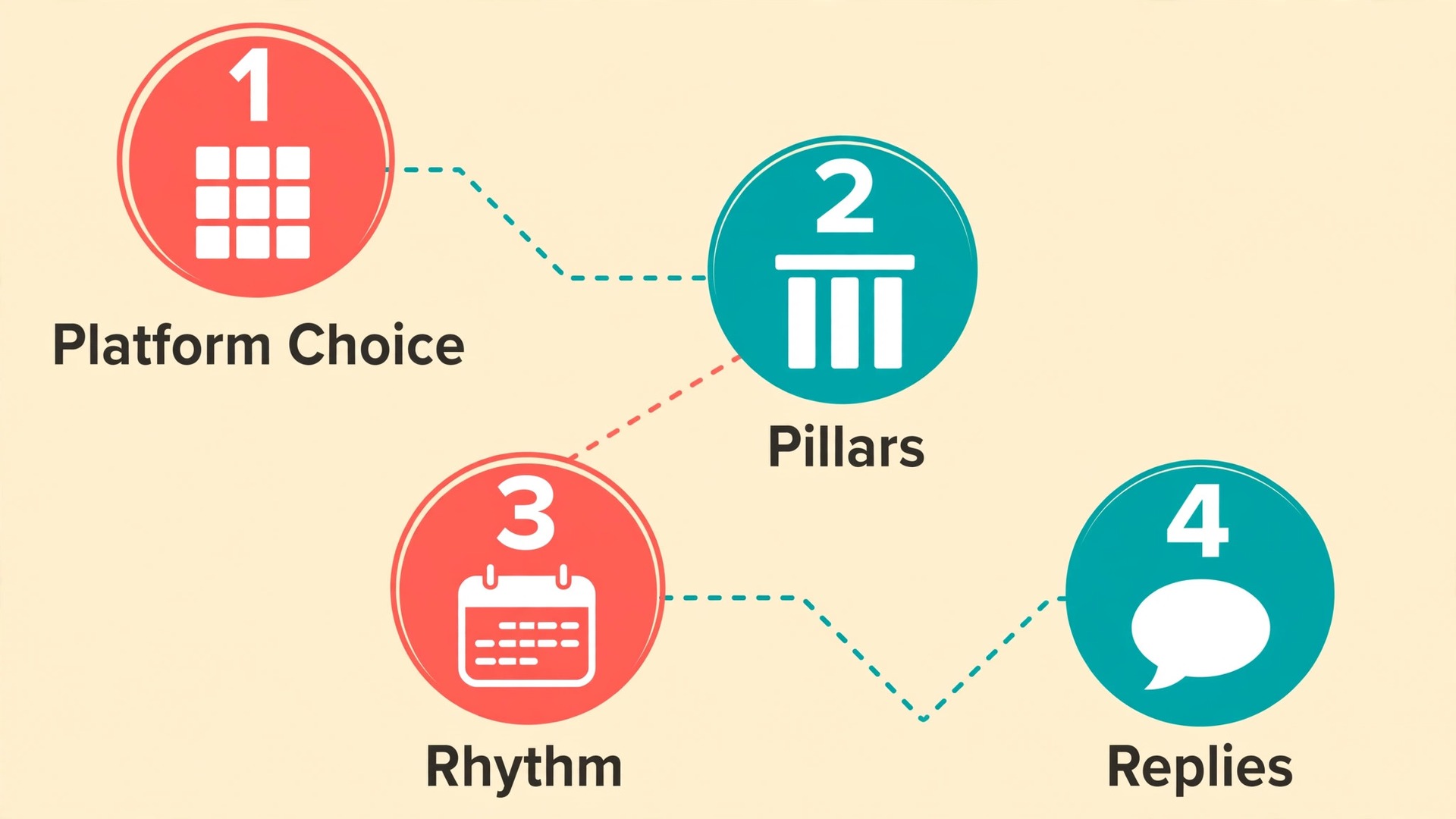
The framework has four parts, and they run in this order. First, pick one or two platforms where your customers already spend time, because a thin presence on five platforms earns less than a strong presence on one. Second, pick three content pillars that you can sustain for a year, because a pillar you run out of in week three is not a pillar. Third, post on a fixed weekly rhythm that you can keep in your busiest month, because consistency beats volume. Fourth, answer every comment and message the same business day, because replies are the part of social media that turns a viewer into a customer.
Each part has a single measure that tells you whether it works. Platform choice is measured by messages, calls and bookings from that platform, not by followers. Content pillars are measured by saves and shares, which show that the post was useful enough to keep. Rhythm is measured by weeks without a gap, because a gap costs more than a weak post. Replies are measured by response time, because a reply that arrives the same day can save a sale that a reply next week cannot.
The framework works because it matches the way customers actually use social media. They check one or two platforms, they follow businesses that post useful things on a predictable rhythm, and they message the business when they are ready to buy. A plan that covers all three of those habits will earn customers, while a plan that chases followers on five platforms will earn only a large follower count.
In small business social media strategy, the system comes first, because a plan without a system is only a wish list.
Week 1, what to do first
Week 1 has three jobs, and none of them is posting every day. First, pick your platforms, using the rule that you only pick a platform where you can name ten customers who use it. Second, write your three content pillars and list ten post ideas under each one, because thirty ideas is a month of content and it proves the pillars can last. Third, set up the profile properly, with a clear photo, a clear description of what you sell, and a link that goes to a page where a visitor can buy or book.
The pillars are the most important job, because they decide whether you run out of ideas in week three. A good pillar is a topic you can talk about for a year without repeating yourself, and it must be useful to the customer, not just interesting to you. For most small businesses the three pillars are real work, customer questions, and proof, which means photos of real jobs, answers to questions customers ask every week, and reviews and results from real customers.
Do not post on five platforms in week 1. Post on the one or two you picked, three times that week, and answer every comment the same day. That small, steady start proves the rhythm works, and it gives you a baseline to measure against. A business that posts three times in week 1 and three times in week 2 has already done more than most of its competitors, because most competitors post in a burst and then go quiet.
The 90 day plan in small business social media strategy gives each part enough time to show a real result before you judge it.
The 30, 60 and 90 day plan for small business social media strategy
| Period | Main job | What good looks like |
|---|---|---|
| Days 1 to 30 | Two platforms, three pillars, three posts a week | No missed week, replies same day |
| Days 31 to 60 | First format test, first customer story, first offer post | Saves and shares rising, messages arriving |
| Days 61 to 90 | Double down on the best pillar, drop the weakest platform | Bookings or calls from social, steady rhythm |
Days 1 to 30 are for building, not for judging. The numbers in the first month will be noisy, because the list is small, the account is new, and the learning period is still running. Judge the first month by whether the system is built, whether the tracking works, and whether the rhythm held, not by whether the revenue beat a benchmark. A system that is built and measured can be improved, while a system that was never built cannot.
Days 31 to 60 are for the first real test. Change one thing at a time, run it for two weeks, and compare the result with the previous two weeks. A subject line test, a format test, or a keyword test each needs a clean comparison, and changing three things at once makes the result unreadable. Keep a simple log of what you changed and what happened, because that log becomes the most valuable document in your marketing within a year.
Days 61 to 90 are for the decision. If the numbers beat your target, raise the budget or the frequency by a small step, about 20 percent, and watch the cost per result for two weeks. If the numbers miss the target, fix the weakest part, which is usually the offer, the landing page, or the targeting, before you spend more. If the numbers miss badly and the fix does not help, pause and rethink the channel, because three months of evidence is enough to make a real decision.
A small business social media strategy that you can keep in your busiest month is worth more than an ambitious plan you abandon in week three.
Budget and tools, the honest numbers
A small business can run this plan for $0 a month in tools, plus about four hours a week in time. Scheduling tools help, and Buffer Essentials costs $5 per channel a month billed yearly, while Later Starter costs $18.75 a month billed yearly, but neither is needed in the first month. Start with the free tools on each platform, post directly, and only buy a scheduler when the manual posting starts to take more than an hour a week.
Spend the time where it earns, which is the content and the replies, not the tools. A photo of real work with a useful caption outperforms a polished graphic with a vague caption, and a reply that arrives the same day outperforms a post that arrives on time. Put two hours a week into making the posts, one hour into replying, and one hour into planning the next week, and the results will follow the time, not the tool budget.
If you do buy ads later, start with $5 a day on your best performing post, and only boost a post that already earned saves, shares or messages without ads. A boosted post that nobody liked for free will not earn likes when you pay for it, while a post that already earned engagement will earn more when it reaches a wider audience. That rule saves more ad money than any targeting trick.
Review small business social media strategy every week, and change one thing at a time, so the result of each change is clear.
What to measure, and what to ignore
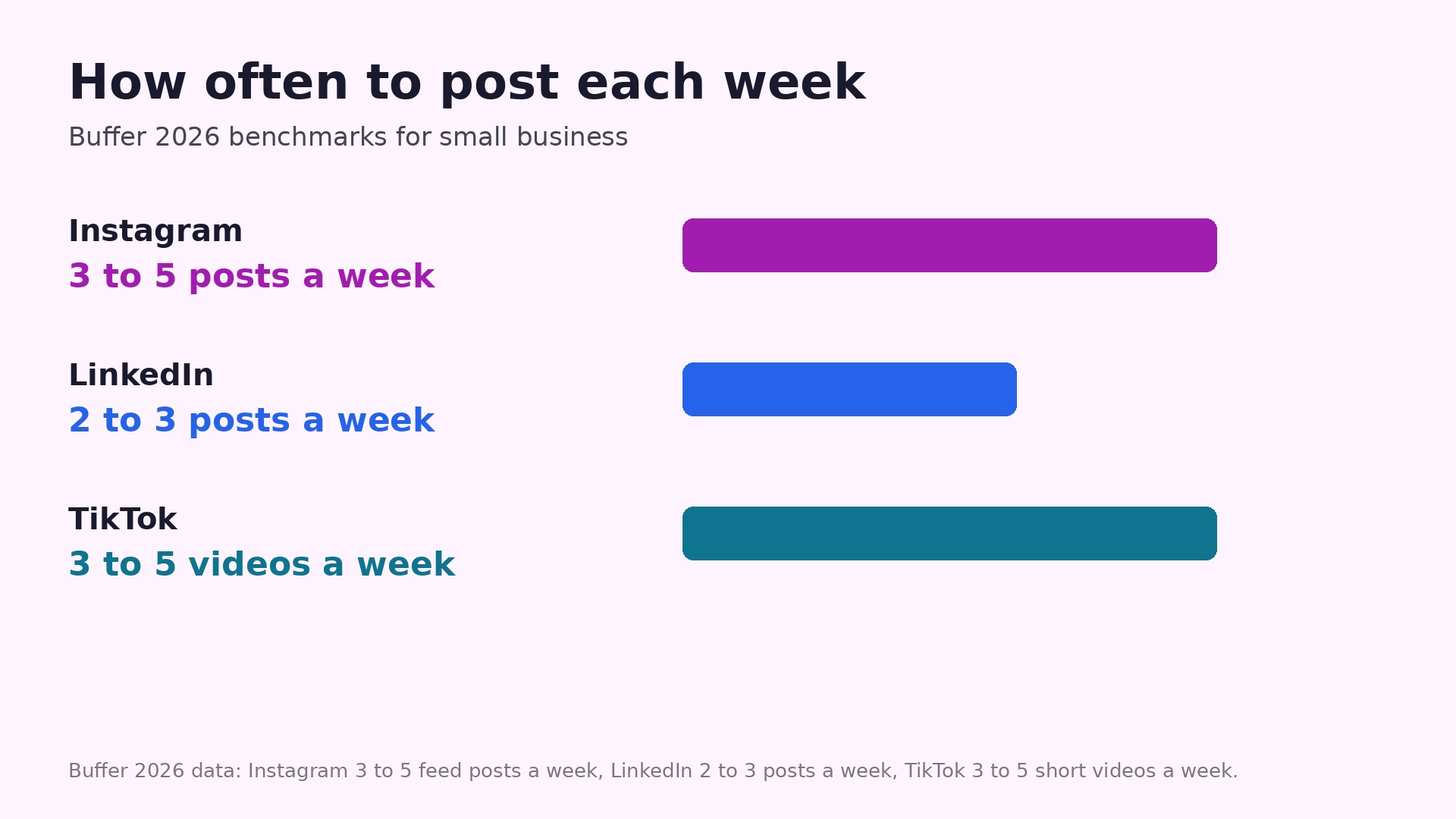
Measure messages, calls, bookings and reach per post, and ignore follower count as a headline metric. A follower who never sees a post is worth nothing, while a viewer who messages you is worth a sale. Buffer 2026 data puts the useful range at 3 to 5 feed posts a week on Instagram, 2 to 3 posts a week on LinkedIn, and 3 to 5 short videos a week on TikTok, with 1 to 2 posts a day on Facebook in broad benchmarks. Compare your reach per post against your own last month, not against a national brand, because the benchmarks come from accounts with far larger followings.
Ignore likes as a headline metric, because a like is the weakest signal a viewer can give. Saves and shares are stronger, because they show the post was useful enough to keep or to pass on, and comments are stronger still, because they show the viewer is willing to talk. A post with 20 saves and 5 comments has done more for your business than a post with 200 likes and no comments, even though the like count looks better on a screenshot.
Review the numbers once a week, at the same time, and write down the three numbers that matter, reach per post, messages received, and bookings or calls from social. A weekly review that takes ten minutes will show which pillar earns, which platform earns, and which format earns, and that evidence is what decides the next month of content. Without it, you are guessing, and guessing is the most expensive part of social media.
The worked example in small business social media strategy shows what good looks like at real numbers, not at benchmark averages.
Common mistakes that waste the budget
The first mistake is starting with the wrong order, which is campaigns before flows, five platforms before one, or keywords before maths. The order in this guide exists because the first job earns the most and makes the later jobs easier, while the reverse order spends money before the system can use it. Follow the order, even when it feels slow, because the slow start is what makes the fast months possible.
The second mistake is copying a big brand. A national brand can post daily on five platforms, send five campaigns a week, and spend $10,000 a month on Ads, because it has a team and a budget for it. A small business that copies that volume will burn out in a month and conclude the channel does not work, when the real problem was the volume. Copy the principles, not the volume, and set a pace you can keep in your busiest month.
The third mistake is never cleaning, never testing, and never stopping. A list that is never cleaned gets more expensive and less engaged every month. A post that is never tested stays average forever. A campaign that is never paused keeps spending after it stops earning. Put a monthly clean, a fortnightly test, and a weekly cost check in your calendar, and the plan will keep itself honest.
The fourth mistake is judging too early. A flow needs a month of data, a social rhythm needs twenty weeks of consistency, and an Ads campaign needs two weeks of learning before the numbers mean anything. Judge the system after the period it needs, not after the first week, and judge it by the metric that matters, which is revenue or leads, not by the metric that looks good on a screenshot.
Use small business social media strategy as a calendar, not as a wish list, because the dates are what make the plan real.
A worked example with real numbers
Take a plumbing business with no marketing team, posting on Facebook and Instagram. The owner picks three pillars, real work, customer questions, and proof, and posts three times a week on each platform, which is six posts a week in total. In the first month the posts earn modest reach, but the owner answers every comment and message the same business day, and by week 6 the messages start to arrive, first one a week, then three a week, mostly from people who saw a photo of a real job in their own town.
By day 90 the business has posted for thirteen weeks without a gap, and the engagement rate per post is about three times higher than it was in week 1, which matches the Buffer finding that steady posting over twenty weeks lifts engagement sharply. The owner has not bought a single ad, yet the business gets four to six bookings a month that the customer traces to a social post or a message, and the owner can name the post that brought each one. The follower count has grown slowly, but the bookings have grown faster, because the plan was built for bookings, not for followers.
The lesson is the rhythm. Three posts a week for thirteen weeks beats thirty posts in one week followed by silence, because customers trust a business that shows up every week. The owner batches the posts in a two hour session on Monday, replies for fifteen minutes each morning, and plans the next week on Friday, which is four hours a week in total. That rhythm is the whole plan, and it is the part most competitors cannot keep.
Your first month calendar, week by week
| Week | Job | Hours |
|---|---|---|
| Week 1 | Pick platforms, write pillars, set up profiles | 4 |
| Week 2 | Post three times, reply same day, note what earns saves | 4 |
| Week 3 | Post three times, share the first customer story | 4 |
| Week 4 | Review the month, keep the best pillar, plan the next month | 3 |
The calendar above is deliberately light, because a plan that needs ten hours a week will be abandoned in the second month. Four hours in week 1 and three hours a week after that is enough to build the system, and the system then does the work while you run the business. If a week is busy, do the minimum, which is the flow, the post, or the weekly check, and skip the rest, because the minimum keeps the rhythm alive and the rhythm is what earns.
Put the calendar in your own diary, with a fixed time each week, because a task without a time will be pushed aside by the urgent work of the day. A Monday morning session for making content, a Friday afternoon review for the numbers, and a fifteen minute reply slot each morning will carry the whole plan, and the fixed times are what stop it from slipping. After a month the times will feel like part of the week, not like extra work.
Tools to use, and tools to skip for now
Use the free tools on each platform first, and add a scheduler only when manual posting takes more than an hour a week. Buffer Essentials at $5 per channel a month billed yearly and Later Starter at $18.75 a month billed yearly are both good choices when that moment arrives, but neither is needed in the first month. Use your phone camera for photos, because a real photo of real work outperforms a stock photo, and use the analytics that each platform already provides, because reach per post, saves and messages are all reported for free.
Skip the content calendar apps, the hashtag tools and the AI caption writers until the rhythm is proven, because those tools optimise a posting habit that does not exist yet. A simple spreadsheet with the date, the pillar and the post idea is enough for the first three months, and it has the advantage that you can see the whole month at a glance. Spend the money you save on better photos, such as a phone tripod or a small light, because the quality of the photo matters more than the tool that scheduled it.
Worth Noting
Keep a simple log of what you decided and what happened next, because the log is what turns a one off purchase or fix into a habit you can repeat. Note the date, the price you paid or the fix you tried, and the result you measured a month later. After three months the log will show whether the choice saved money, whether the problem returned, and whether the next decision should be the same or different. That evidence is worth more than any review you read before you started, because it is about your business and your customers, not about an average user.
Test one change at a time, and give each change enough time to show a real result. A price test, a subject line test, a format test and a keyword test each need at least two weeks of data, because a single week can be skewed by a holiday, a quiet day, or a single large order. Changing three things at once makes the result unreadable, and you will end up keeping a change that hurt and dropping a change that helped, simply because you could not tell them apart.
Review the numbers on a fixed day each week, at the same time, and write the three numbers that matter in the same place every week. A review that takes ten minutes will catch a rising bill, a falling engagement rate, or a fix that stopped working, weeks before a monthly review would. The fixed time matters more than the tool, because a review without a time will be pushed aside by the urgent work of the day, and the problem will grow while nobody is watching it.
Keep your own copy of anything important, outside the tool that created it. Export your customer list, your course files, your designs and your campaign settings, and store them in a place you control. A tool can change its price, close your account, or lose your data, and the export you made last month is the difference between a bad week and a lost business. Set a monthly reminder to export, and test the export by opening it, because a backup you cannot open is not a backup.
Ask your customers what worked, because they will tell you in plain words what the numbers only hint at. A short question at the end of a purchase, a reply to a message, or a comment on a post will reveal which offer mattered, which page confused them, and which feature they actually used. That feedback is free, it arrives every week, and it is more useful than a survey sent once a year, because it comes from people who have just bought from you.
Plan for the busy month, not the quiet month, because the plan that only works when you have spare time will fail exactly when you need it most. Set a minimum version of the routine, one post, one campaign, one check, that you can keep even in your busiest week, and do the full version when time allows. The minimum keeps the rhythm alive, and the rhythm is what earns, while a plan that stops for a month takes a month to restart.
Compare your results with your own last month, not with a national brand, because the benchmarks in this guide come from accounts and lists far larger than yours. A small business with 800 subscribers, 500 followers, or a $1,500 budget will never match the averages of a company with a team of ten, and it does not need to. What matters is whether your numbers improve month by month, whether the cost per result falls, and whether the customers keep coming back.
Give every new tool, fix, or plan a clear end date for the test, and decide in advance what result will make you keep it, fix it, or stop it. A test without an end date drifts on forever, and a test without a decision rule ends with you keeping a tool you do not need because you never decided to stop. Write the date and the rule down when you start, and honour it when the date arrives, even when the result is disappointing.
Write the plan down in one page, and keep it where you can see it, because a plan that lives only in your head will change every week without you noticing. One page with the goal, the three numbers that matter, the weekly rhythm, and the review date is enough, and it is the document you will actually read. When a new idea arrives, check it against the one page first, and only add it when it fits, because a plan that grows every week is not a plan, it is a list.
Talk to one customer a week, in person or by message, and ask what nearly stopped them buying. The answer will usually be a small thing, a confusing price, a missing detail, or a slow reply, and fixing that small thing will earn more than any new campaign. That weekly conversation is the cheapest research a small business can do, and it keeps the plan grounded in real customers rather than in benchmarks and averages.
Set a budget for learning, and keep it separate from the budget for earning. The learning budget pays for the first month of a new tool, the first test of a new format, and the first campaign in a new channel, and it is money you expect to spend while you find out what works. The earning budget only grows when the learning budget has proved the maths, and keeping the two apart stops a test from eating the money that should go to the work that already earns.
End every month with a short note to yourself, three lines only, what worked, what did not, and what you will change next month. That note takes five minutes and it becomes the most useful record in your business within a year, because it shows the pattern that a spreadsheet hides. A month that looks average in the numbers will often show a clear lesson in the note, and that lesson is what makes the next month better.
Frequently Asked Questions
How often should a small business post on social media?
Post 3 to 5 times a week on Instagram, 2 to 3 times a week on LinkedIn, and 3 to 5 short videos a week on TikTok, on each platform you are serious about. That range is the Buffer 2026 benchmark, and it is a pace most owners can keep for a year.
Which social media platform should a small business pick first?
Pick the one or two platforms where you can name ten customers who use them. For most local businesses that is Facebook and Instagram, for business to business it is LinkedIn, and for a young audience it is TikTok. A strong presence on one platform beats a thin presence on five.
What should a small business post first?
Post real work first, photos of real jobs, real products, and real customers, then answer the questions customers ask every week, then share reviews and results. Those three pillars give you a month of content and they are the posts that earn saves, shares and messages.
How much time does social media take?
About four hours a week, with two hours for making posts, one hour for replying, and one hour for planning the next week. Batch the posts in one session, reply the same business day, and the rhythm will hold even in a busy month.
Do I need to pay for social media ads?
No, not in the first month. Build the organic rhythm first, then boost your best performing post with $5 a day, and only boost a post that already earned saves, shares or messages without ads. A post nobody liked for free will not earn likes when you pay for it.
How do I know if social media is working?
Measure messages, calls and bookings from each platform, not follower count. A weekly review of reach per post, messages received, and bookings or calls will show which platform and which pillar earns, and that evidence decides the next month of content.