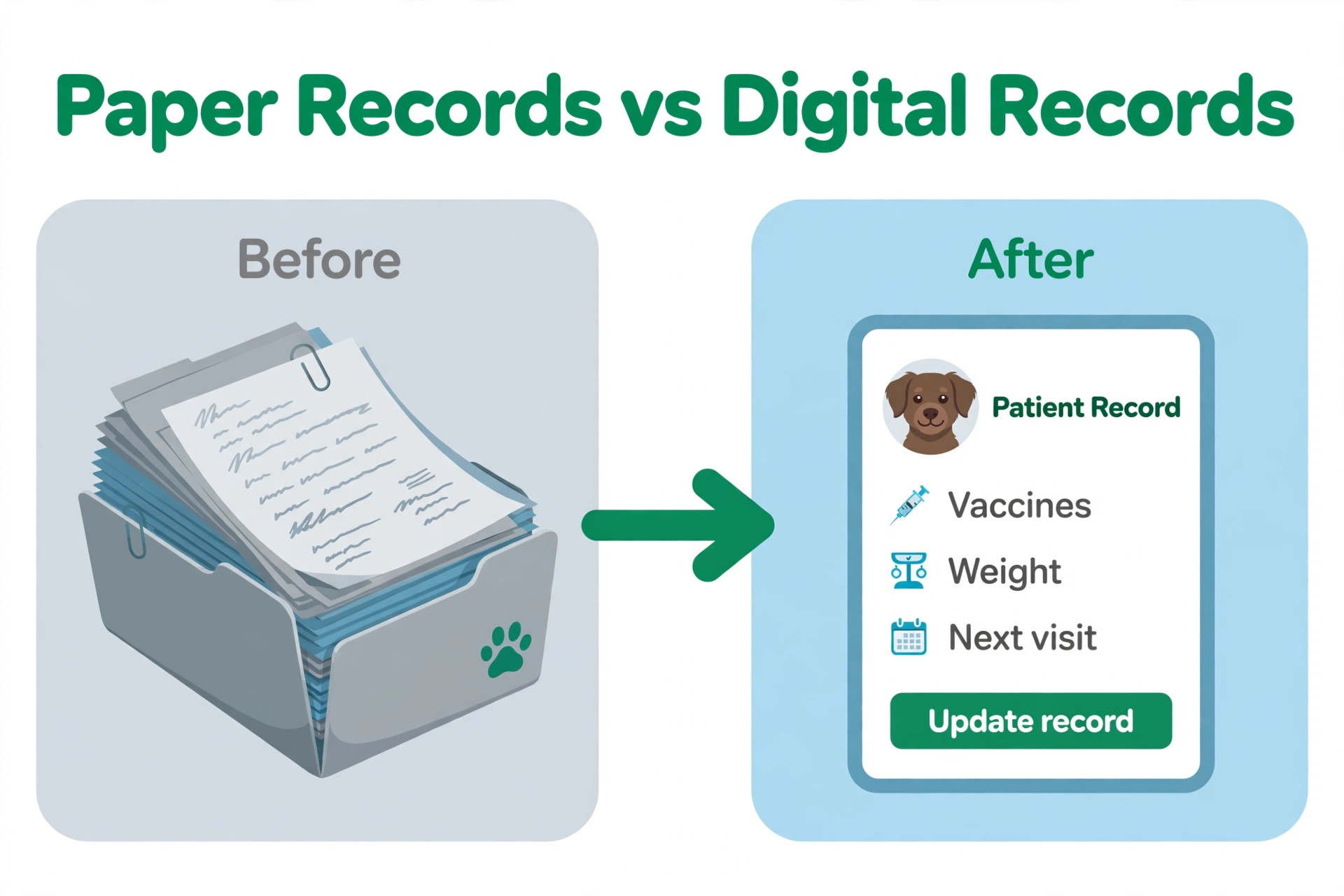
A two vet clinic that still runs on paper loses the same hour every day in three different ways. The front desk hunts for a file, the vet rewrites notes after hours, and the invoice gets built from memory at the end of the visit. The best veterinary practice management software for small clinics removes all three, because the record, the treatment plan, the lab order and the invoice live in one flow, and documenting the visit builds the bill automatically.
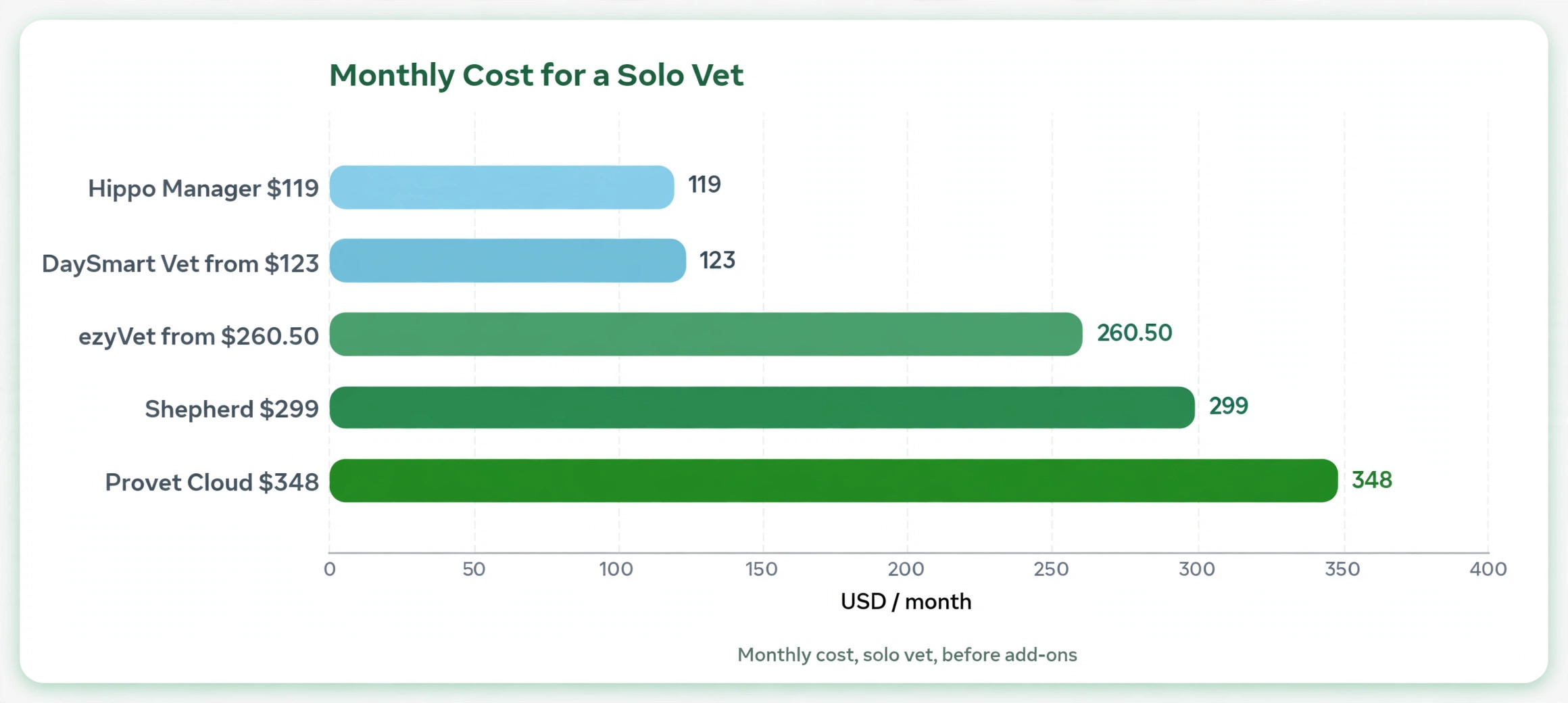
The price spread in this category is wide, and most vendors hide their numbers behind a demo call. Only three vendors publish clear prices, and they range from 119 dollars a month per vet to 299 dollars a month per vet, while the legacy server systems quote per practice and add server, backup and IT costs on top. A small clinic should judge the total cost over three years, not the first year, because switching practice software is a multi month migration and the wrong choice is expensive to undo.
This guide compares ten systems that small clinics actually run in 2026, with prices checked against vendor pages and current roundups in November 2026. Cloud and server systems are both covered, because the right answer depends on your internet, your lab, and how your team works. SOAP notes, dental charts, inventory, client messaging and per vet pricing are all compared, so a one to four doctor practice can pick a system it will still be happy with in five years.
How to Judge Vet Software for a Small Clinic
Start with cloud against server, because the choice shapes everything else. Cloud systems update themselves, work from any room and any location, and need no server in the back office. Server systems keep your data in house and keep working when the internet drops, but they age fast, need backups you manage yourself, and tie you to one building. For a one to four doctor clinic with no IT person, cloud is the safer default, and the only strong reason to stay on a server is a fast workflow your team already knows on a healthy machine.
SOAP notes are the second check, because the note is where the vet day is won or lost. A good system builds the note from the visit itself, with templates for common exams, voice to text or an AI scribe that drafts the note from the conversation, and a treatment plan that flows into the invoice without retyping. Trial the note workflow with a real exam, not a sales demo script, and count the clicks from check in to invoice. If the vet still finishes charts after hours, the software has failed at its main job.
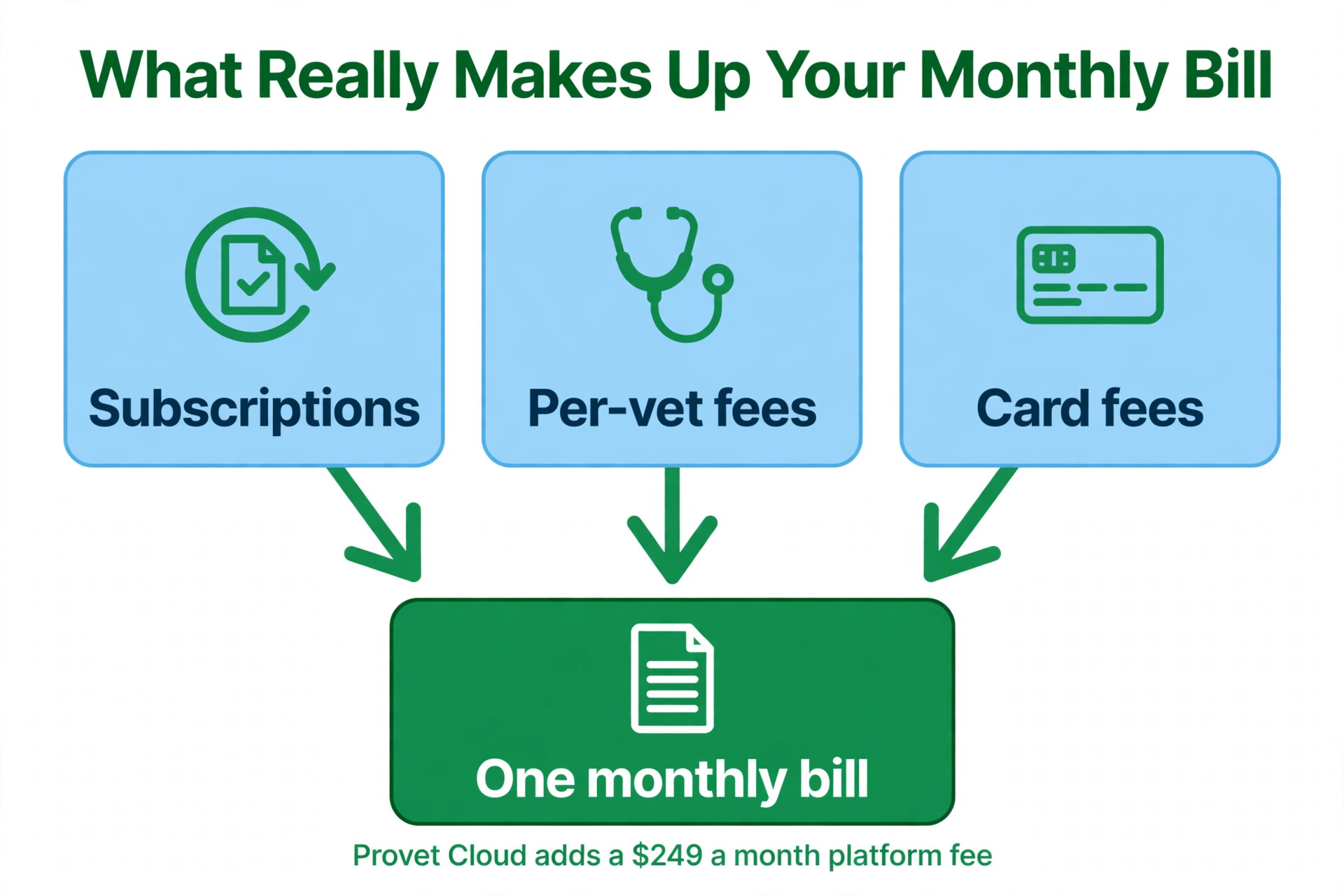
Pricing is the third check, and it is the hardest because most vendors quote. Compare per vet pricing against per user pricing carefully, because a system that charges per vet with unlimited staff is cheaper for a clinic with four receptionists than a system that charges per user. Ask about data migration, texting, online pharmacy, payment processing and lab integrations, because those are the costs that appear after the sale and push the bill up by a third.

Best Veterinary Practice Management Software for Small Clinics in 2026 at a Glance
| Tool | Starting price | Best for | Watch out |
|---|---|---|---|
| Shepherd | 299 dollars a month per vet | Fastest adoption | No online pharmacy link |
| Hippo Manager | 119 dollars a month per vet | Lowest per vet price | Simpler feature set |
| ezyVet | from 260.50 dollars a month | Specialty and growth | Quote only, no trial |
| Digitail | quote only | AI native features | No published price |
| Provet Cloud | 99 dollars a month per vet plus 249 dollars a month platform fee | Open API, no contract | Platform fee on top |
The first five tools cover the most common shop sizes, and the next five cover the cases where a specialist feature or a lower price changes the answer.
| Tool | Starting price | Best for | Watch out |
|---|---|---|---|
| Neo | quote only | Simple IDEXX option | Quote only |
| DaySmart Vet | from 123 dollars a month | Budget cloud move | Lighter feature depth |
| Cornerstone | quote only | Deep IDEXX legacy | Server costs on top |
| AVImark | quote only | Fastest legacy workflow | Server model, dated design |
| Pulse | quote only | Covetrus ecosystem | Quote only |
The 10 Systems, Reviewed in Full
The ten systems below are ordered by fit for a small clinic, starting with the fastest to adopt and ending with the legacy systems that some clinics still run well.
1. Shepherd
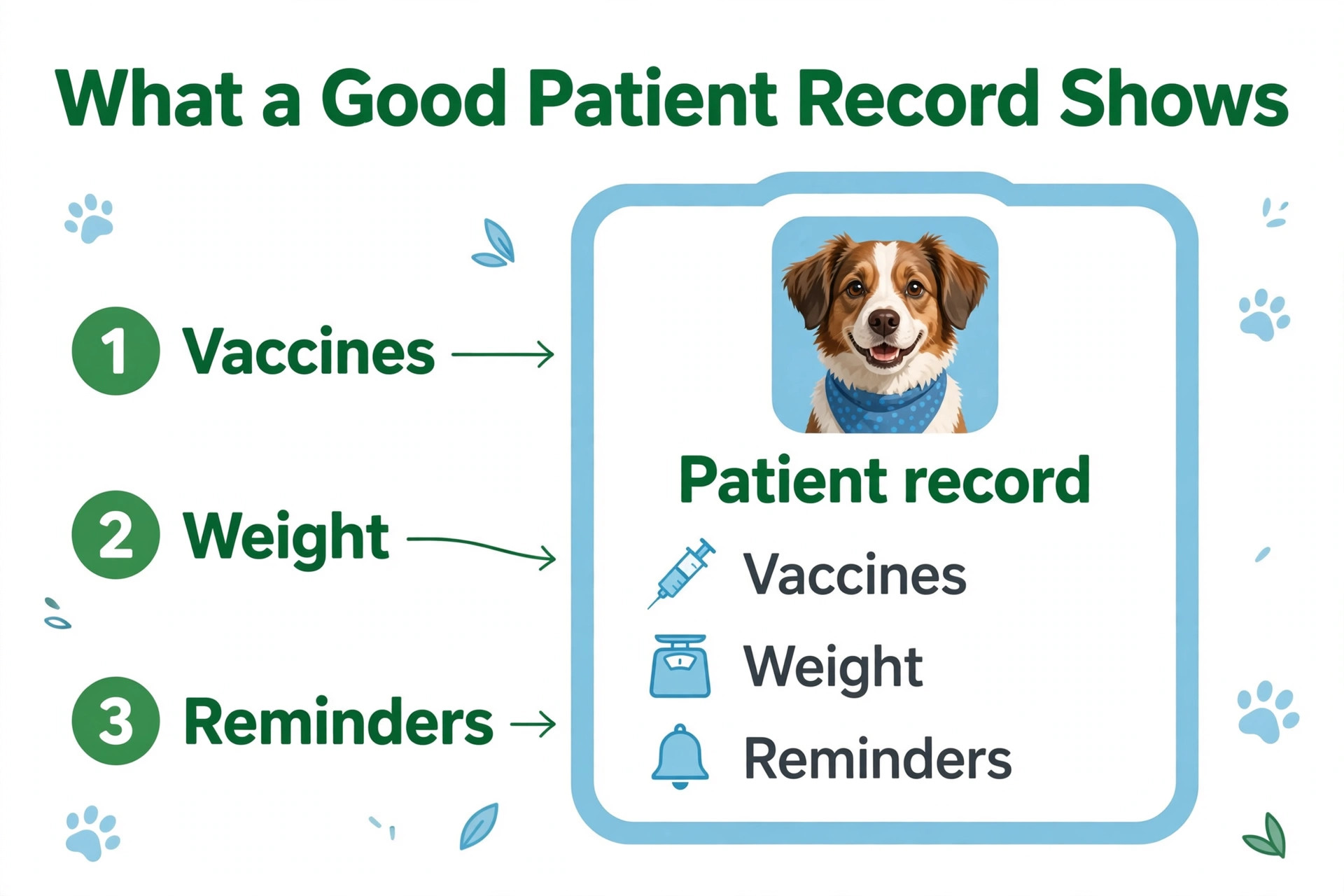
Shepherd was built by practicing veterinarians, and the workflow shows it. Medical records, treatment plans, lab orders and invoices connect in one flow, so documenting care during the visit builds the invoice automatically, and the TranscribeAI feature drafts SOAP notes from the appointment conversation. It is the fastest system in this list to adopt, which matters for a small clinic with no IT support, and the per vet price with unlimited staff keeps the bill predictable as the front desk grows.
Pricing starts at 299 dollars a month per vet. One doctor costs 299 dollars a month with Shepherd Pay, its payment service, or 349 dollars a month without it. Two doctors cost 398 dollars a month with Shepherd Pay. Staff users are unlimited. Pricing note. Shepherd pulled its public pricing page in mid 2026, so the figures above come from current roundups rather than a live pricing page, and a quote may differ.
Pick Shepherd when you want the fastest adoption and a workflow that returns your evenings by drafting notes and invoices as you work. Skip it when you rely on a third party online pharmacy, because that integration is still missing.
2. Hippo Manager
Hippo Manager is the affordable independent cloud option, and it earns its place on price alone. At 119 dollars a month per vet it costs less than half of Shepherd, and it still covers records, scheduling, point of sale, reminders, inventory and a whiteboard. It is a simpler product than the premium cloud systems, with fewer AI features and a smaller integration list, but for a small clinic where budget rules and the team wants a clean cloud system, it is the best value in this comparison.
Pricing starts at 119 dollars a month per vet. Hippo Manager costs 119 dollars a month per full time veterinarian, which is the lowest published per vet price in this list. Records, scheduling, point of sale, reminders, inventory and a whiteboard are included, with lab, pharmacy and payment integrations available.
Hippo Manager fits best when budget rules everything and you want a clean cloud system at the lowest per vet price. It fits worst when you want AI scribing or deep specialty workflows, because the feature set is simpler.
3. ezyVet
ezyVet, now part of IDEXX, is the cloud platform that specialty and referral hospitals standardize on, and it brings that depth to a small clinic that plans to grow. It handles complex clinical workflows, multi department scheduling and advanced reporting that general practice tools cannot, and IDEXX ownership means lab orders and results flow directly into patient records. The trade off is an enterprise sales process with quote based pricing, paid implementation and data migration, and no free trial, only demos.
Pricing starts at from 260.50 dollars a month. ezyVet lists a starting price of 260.50 dollars a month, with one model that includes all features. Enterprise pricing for groups is by quote, with a six month initial term. Some roundups report per user pricing of 150 to 260 dollars a month, so confirm whether the quote is per user or per practice before you budget.
Pick ezyVet when you plan to grow into specialty or multi site work and already use IDEXX diagnostics. Skip it when you want a published price and a self serve trial, because neither is offered.
4. Digitail
Digitail is the AI native option in this list, and it is built for clinics that want the newest tools. The Growth plan adds Tails AI Scribe, dental charts and a boarding calendar, and the Growth AI plan adds an AI assistant, intake, record summaries and a tool that turns voice notes into invoice items. It covers AI SOAP notes, smart charge capture, inventory and a pet parent app. The weakness is price transparency, because nothing is published and the reported per user figure would make a four vet clinic expensive fast.
Pricing starts at quote only. Digitail lists four plans and no prices, so you book a demo for a quote. One roundup reports 289 dollars a month per user, but the vendor does not publish that figure. Onboarding, data migration and round the clock support are included in every plan, which softens the quote based model.
Digitail fits best when you want built in AI tools for notes, intake and charge capture in one system. It fits worst when you need a published price before a sales call, because Digitail does not list one.
5. Provet Cloud
Provet Cloud is an independent cloud system built for multi site and compliance heavy practices, with a fully open API and more than 150 integrations. It suits a small clinic that wants to own its data and connect to any tool, because the open platform avoids the lock in that comes with the big vendor ecosystems. The per vet price looks low, but the platform fee pushes the total above Shepherd for a solo vet, so it only makes financial sense from two vets upward or for a clinic that values the open API.
Pricing starts at 99 dollars a month per vet plus 249 dollars a month platform fee. Provet Cloud charges 99 dollars a month per vet plus a 249 dollar monthly platform fee, with no annual contracts. The platform fee means a solo vet pays about 348 dollars a month, so the per vet headline understates the real bill for the smallest clinics.
Pick Provet Cloud when you want an open platform with many integrations and no annual contract. Skip it when you are a solo vet, because the platform fee pushes the total above the premium options.
6. Neo
Neo is the IDEXX answer for small clinics, and it is the simplest system in the IDEXX family. It covers scheduling, records, invoicing and lab integration in a clean cloud interface, with the IDEXX lab connection built in rather than added on. Reviewers rate it as the best fit for a one to four doctor practice that is already committed to IDEXX and wants maximum simplicity. The weakness is the same as the rest of the IDEXX family, because pricing is quote only and the ecosystem rewards clinics that stay inside it.
Pricing starts at quote only. Neo does not publish pricing. It is sold as the small clinic option inside the IDEXX family, with a quote per practice. As an IDEXX product it connects directly to IDEXX labs and reference lab results, which is the main reason to choose it.
Neo fits best when you are committed to IDEXX labs and want the simplest system in that family. It fits worst when you want a published price or freedom to mix lab vendors.
7. DaySmart Vet
DaySmart Vet is the budget cloud option from the DaySmart family, and it suits a small clinic that wants to move off paper without a large bill or a long implementation. It covers appointments, records, invoicing and client communication in a straightforward cloud system, with a free trial so the team can test it before paying. It lacks the AI scribing and deep specialty workflows of the premium tools, and the integration list is shorter, but for a clinic where price and simplicity matter most, the 123 dollar starting price is hard to ignore.
Pricing starts at from 123 dollars a month. DaySmart Vet lists a starting price of 123 dollars a month, which is among the lowest published figures in this list. It is positioned as easy cloud software for small clinics, with a free trial available, though the feature depth is lighter than the premium systems.
Pick DaySmart Vet when you want the cheapest easy cloud move off paper with a free trial. Skip it when you need AI notes, specialty workflows or deep integrations.
8. Cornerstone
Cornerstone is the legacy IDEXX server system that many established clinics still run, and it earns its place through depth and speed. It covers the full clinical and business workflow with deep IDEXX lab integration, and experienced teams work fast in it because the keyboard driven workflow rewards practice. The cost is the server model itself, with hardware, backups and IT support to manage, an aging interface, and a migration that takes months. A clinic with a healthy server and a fast team has a real reason to stay, and a clinic starting fresh has little reason to choose it.
Pricing starts at quote only. Cornerstone does not publish pricing. It is sold per practice with a quote, and server, backup and IT costs sit on top of the licence. It is the long standing IDEXX server system, and clinics that run it well tend to stay, because the workflow is fast once learned.
Cornerstone fits best when your team is fast on it, the server is healthy, and you want deep IDEXX integration. It fits worst when you are starting fresh or have no IT support, because the server model needs both.
9. AVImark
AVImark is the other legacy server system in this list, and its reputation rests on speed. Teams that know it move through records, invoices and treatment plans faster than on most cloud systems, because the interface is built for keyboard work rather than mouse clicks. It is a Covetrus product with the lab and pharmacy connections that come with that family. The trade off is the same as Cornerstone, with a server to maintain, backups to manage, and an interface that feels dated next to the cloud tools, so it suits a clinic that already runs it well rather than a new buyer.
Pricing starts at quote only. AVImark does not publish pricing. It is sold per practice with a quote, as a server system with the same hardware and backup costs as Cornerstone. It is known for speed, and clinics that value a fast, keyboard driven workflow often prefer it to the newer cloud tools.
Pick AVImark when speed matters most and your team already knows the keyboard workflow. Skip it when you want cloud access, modern design or no server to maintain.
10. Pulse
Pulse is the Covetrus cloud system, and it fits a clinic that already buys supplies, pharmacy or lab services through Covetrus. It covers scheduling, records, invoicing and inventory in a cloud interface, with the ecosystem connections built in rather than bolted on. It is less well known than the independent cloud tools and the feature list is thinner on AI, but for a Covetrus clinic the single vendor relationship simplifies support and billing. Pricing is quote only, so the bill is whatever the sales process produces, and that is the main risk.
Pricing starts at quote only. Pulse does not publish pricing. It is a Covetrus cloud system sold by quote, positioned for clinics already in the Covetrus family. Its strength is the Covetrus ecosystem, with pharmacy, lab and supply connections that other systems need integrations to match.
Pulse fits best when you already run your supply, pharmacy or lab through Covetrus and want one vendor. It fits worst when you want a published price or the newest AI features.
Best Pick by Clinic Size
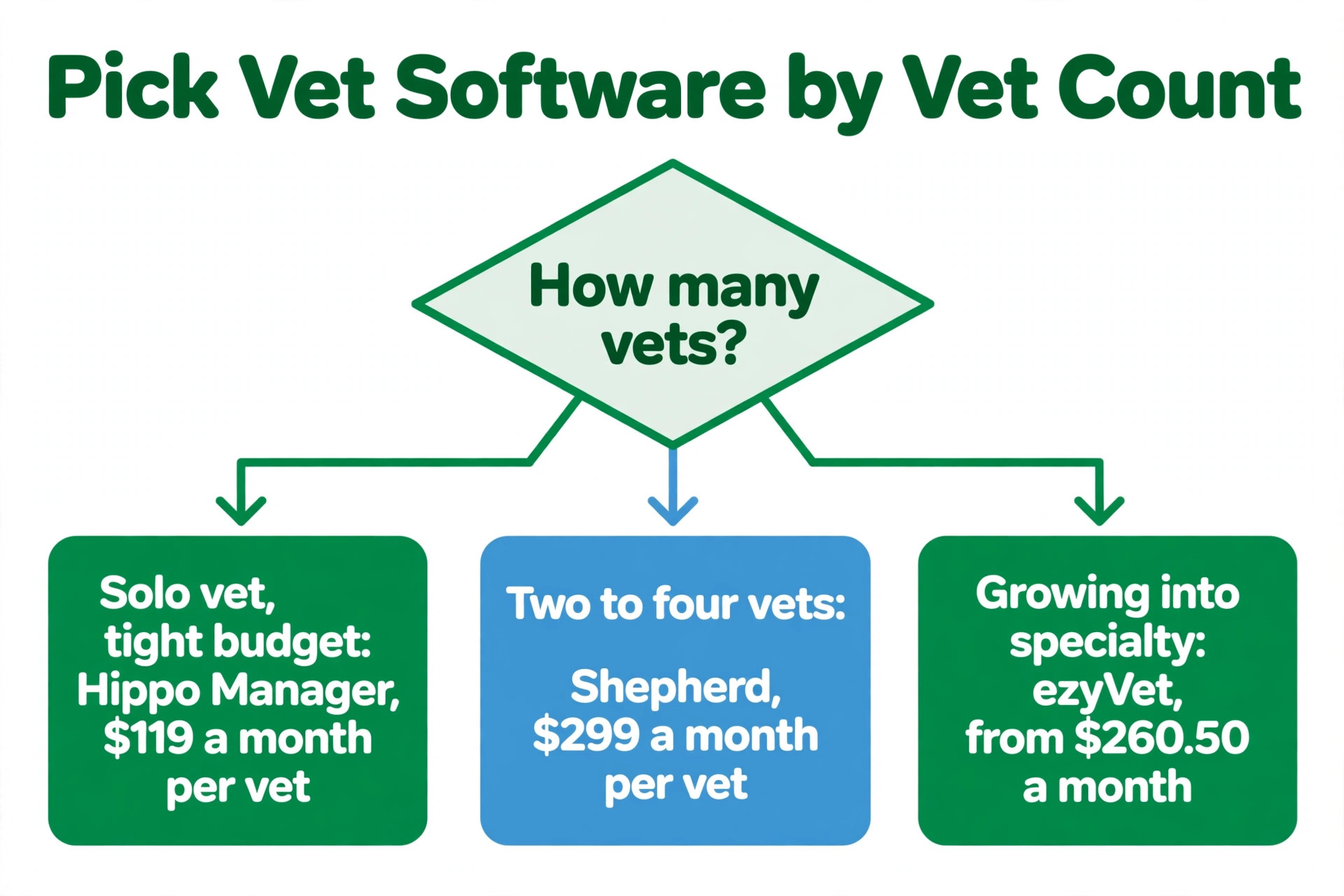
Clinic size decides the answer, because per vet pricing punishes a clinic with many vets while per user pricing punishes a clinic with many staff. Use the table below as the short version of this guide.
| Job | Pick | Why |
|---|---|---|
| Solo vet, tight budget | Hippo Manager | 119 dollars a month per vet, full cloud system |
| Solo vet, IDEXX labs | Neo | Simplest IDEXX system, lab results built in |
| 2 to 4 vets, fastest start | Shepherd | 299 dollars a month per vet, unlimited staff |
| Growing into specialty | ezyVet | Deep workflows, IDEXX labs, from 260.50 dollars a month |
| Already fast on a server | Cornerstone or AVImark | Stay put if the server is healthy and the team is fast |
What a Two Vet Clinic Actually Pays
The monthly subscription is only the first line of the bill, because texting, migration, payment processing and lab integrations decide the real cost. The table below shows the yearly subscription for a two vet clinic on the entry plan, before add ons. Hippo Manager and DaySmart Vet stay under 3,000 dollars a year, ezyVet starts near the same range, Shepherd costs about 4,776 dollars a year for two vets, and Provet Cloud costs more because of the platform fee. Add ons sit on top of every figure here, and a clinic that texts every client and runs an online pharmacy can add a third to the bill.
| Tool | Monthly | Yearly | What is extra |
|---|---|---|---|
| DaySmart Vet | 123 dollars | 1,476 dollars | Migration and texting extra |
| Hippo Manager, 2 vets | 238 dollars | 2,856 dollars | Lab and pharmacy links extra |
| ezyVet, from | 260.50 dollars | 3,126 dollars | Implementation quoted separately |
| Shepherd, 2 vets | 398 dollars | 4,776 dollars | Shepherd Pay included |
| Provet Cloud, 2 vets | 447 dollars | 5,364 dollars | Platform fee included |
The lesson is to compare the yearly total at your real vet count and staff count, not the monthly headline. A per user system can cost far more than a per vet system once receptionists and technicians are counted, and a quote that excludes migration is not a quote. Ask every vendor for the all in monthly cost for your team, in writing, and the cheapest system usually reveals itself in one line of maths.
Mistakes That Cost Small Clinics Money
The most common mistake is comparing the headline price without counting the add ons. Texting, data migration, online pharmacy, payment processing and lab integrations can add a third to the bill, and they are rarely on the pricing page. Ask every vendor for the all in monthly cost for your vet count and your staff count, in writing, before you sign. A quote that excludes migration is not a quote, it is a starting point. That comparison is the heart of choosing the best veterinary practice management software for small clinics.
The second mistake is choosing on a sales demo instead of a real exam day. A demo shows the happy path, with clean data and a patient who does what the script says. Trial the system with your real workflows, from a walk in with no record, through a dental with lab work, to an invoice that needs a payment plan, and count the clicks and the after hours charting. If the vet still finishes notes at home, the software has failed at its main job.
The third mistake is underestimating the migration. Moving years of paper and old system records takes months, not weekends, and the data mapping decides whether the new system is useful on day one. Patient history, vaccine dates, lab results and open balances all need a home in the new system, and the clinic that plans the migration in stages, with one vet piloting first, goes live with far less disruption than the clinic that switches everyone on a Monday.
Our Verdict
Shepherd is the pick for most small clinics in this guide, because 299 dollars a month per vet with unlimited staff buys the fastest adoption, a workflow that builds the invoice as you document, and an AI scribe that drafts SOAP notes from the visit. It is the system most likely to return your evenings, and that is worth more than the price gap to the budget options. That is why it leads this guide on the best veterinary practice management software for small clinics.
Hippo Manager is the pick when budget rules, because 119 dollars a month per vet buys a clean cloud system with the essentials covered. ezyVet is the pick for a clinic growing into specialty or multi site work, from 260.50 dollars a month. Trial two systems with a real exam day before you commit, and treat the choice as a ten year decision, because switching again is the most expensive option of all.
Frequently Asked Questions
What is the best veterinary practice management software for a small clinic?
Shepherd is the strongest pick for most small clinics, because 299 dollars a month per vet with unlimited staff buys the fastest adoption and a workflow that builds the invoice as you document the visit. Hippo Manager at 119 dollars a month per vet is the best budget pick, and Neo is the best pick for a clinic committed to IDEXX labs. The right answer depends on vet count, lab choice and whether you want cloud or server. That is the short answer on the best veterinary practice management software for small clinics for most readers.
How much does veterinary software cost for a small clinic?
Published prices run from 119 dollars a month per vet for Hippo Manager to 299 dollars a month per vet for Shepherd, with ezyVet from 260.50 dollars a month. Most vendors do not publish prices, so expect a quote. A two vet clinic on Shepherd pays about 398 dollars a month, while the same clinic on a per user system can pay far more once receptionists and technicians are counted as users.
Is cloud or server better for a small vet clinic?
Cloud is better for most small clinics, because it updates itself, works from any room, and needs no server or IT person. Server systems such as Cornerstone and AVImark keep data in house and keep working when the internet drops, and they suit a clinic whose team is already fast on them with a healthy server. A clinic starting fresh has little reason to buy a server system in 2026.
Does vet software include SOAP notes?
Yes, every system in this guide includes SOAP notes, but the quality differs widely. Shepherd drafts notes with TranscribeAI from the appointment conversation, Digitail adds an AI scribe and record summaries, and ezyVet offers deep clinical templates. Trial the note workflow with a real exam and count the clicks from check in to invoice, because a system that leaves the vet charting after hours has failed at its main job.
What data migrates when you switch vet software?
Patient and owner records, vaccine history, lab results, open balances and appointment history normally migrate, but the quality depends on the old system and the new one. Digitail includes onboarding and data migration in every plan, while ezyVet charges for implementation and migration. Paper records need scanning and manual entry, so plan the migration in stages with one vet piloting first rather than switching the whole clinic at once.
Do I need a free trial before buying vet software?
Yes, and the trial should use your real workflows rather than a sales demo script. Shepherd, Hippo Manager and DaySmart Vet offer free trials, while ezyVet offers demos only. Run a walk in with no record, a dental with lab work, and an invoice that needs a payment plan, then check the after hours charting. That one day tells you more than a month of sales calls.
How long does it take to switch vet software?
A small clinic should plan eight to twelve weeks from decision to go live, with one vet piloting first. The slow part is the data, because patient history, vaccine dates, lab results and open balances all need a home in the new system, and paper records need scanning and manual entry. Digitail includes migration in every plan, while ezyVet charges for it, so ask who does the work and what it costs before you sign.
Trial two systems with a real exam day, count the clicks and the after hours charting, and pick the one your vets will still like in five years.
That is the short answer on best veterinary practice management software for small clinics for most small businesses.
If you only remember one thing about best veterinary practice management software for small clinics, make it the total yearly cost, not the monthly sticker price.