The short answer is that most small businesses do not need the most expensive tool in this list. They need the tool that covers scheduling, billing and customer records without a long setup and without a contract that locks them in for years. This guide compares coworking space software pricing for small operators across 10 tools, so you can see the price, the limits and the best fit before you pay.
Prices in this guide were checked against vendor pricing pages and current 2026 comparisons in November 2026. Where sources disagreed on a price, both figures are flagged in the tool section so you can see the conflict before you decide. All prices below are in US dollars per month unless stated otherwise, and annual billing is noted where it changes the monthly figure.
The right tool depends on the size of the business and the work it does every day. A solo operator needs fast quoting and simple invoicing. A team of five needs dispatch, reminders and a shared customer record. A team of fifteen needs reporting, permissions and a price book that stays accurate. The sections below rank the tools by value for a small business, not by brand size, and the best pick table at the end matches each tool to the job it does best.
Coworking Space Software Pricing For Small Operators at a Glance
Use this table as a shortcut for coworking space software pricing for small operators, then read the tool sections below for the limits that decide the real bill. The cheapest entry price is not the cheapest yearly bill once seat counts, per client fees and add ons are counted.
| Tool | Entry price | Best for |
|---|---|---|
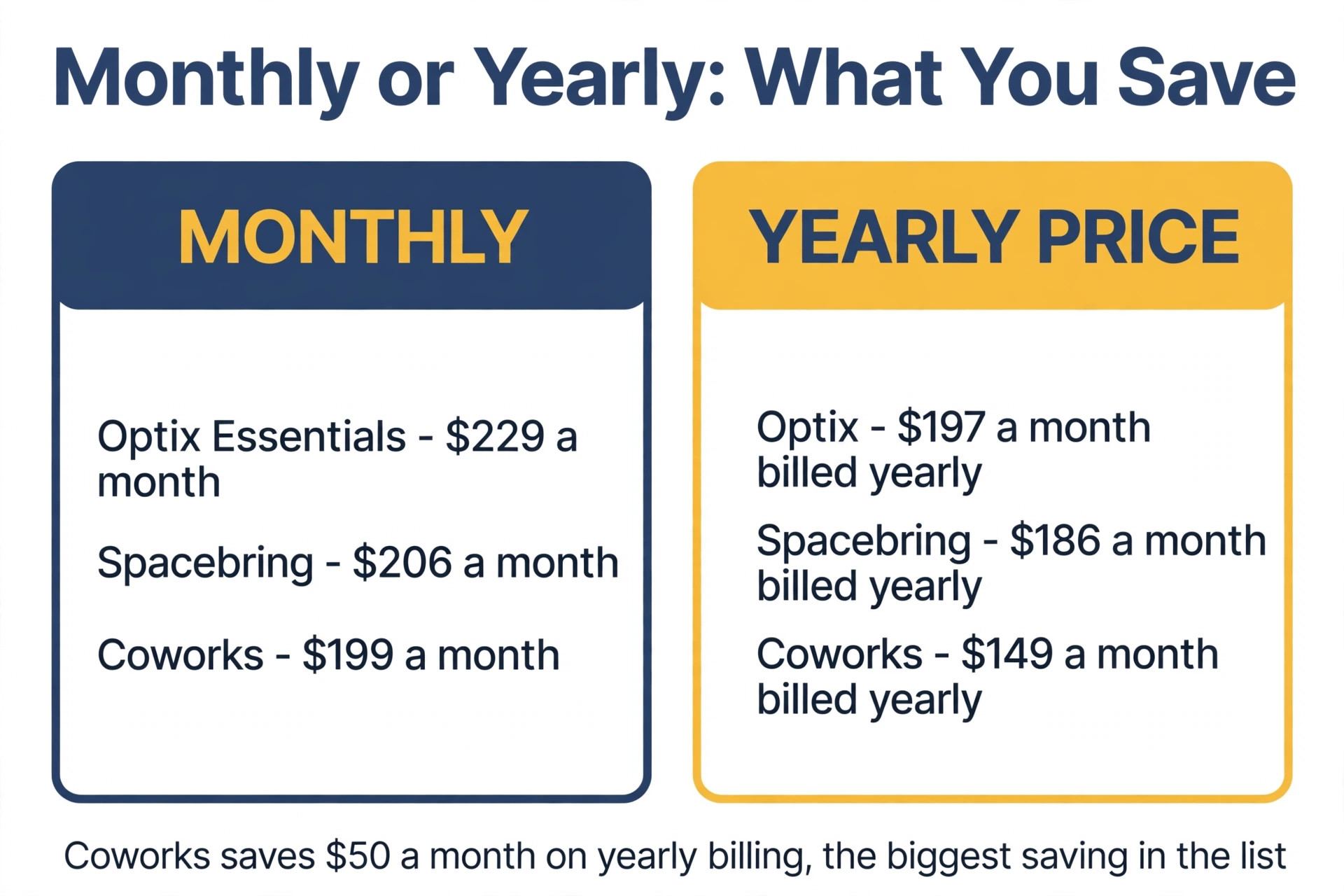
| Optix | Essentials 229 dollars a month or 197 dollars billed yearly | spaces that want a polished member app |
| Nexudus | from 150 dollars a month per location | large operators that need deep customisation |
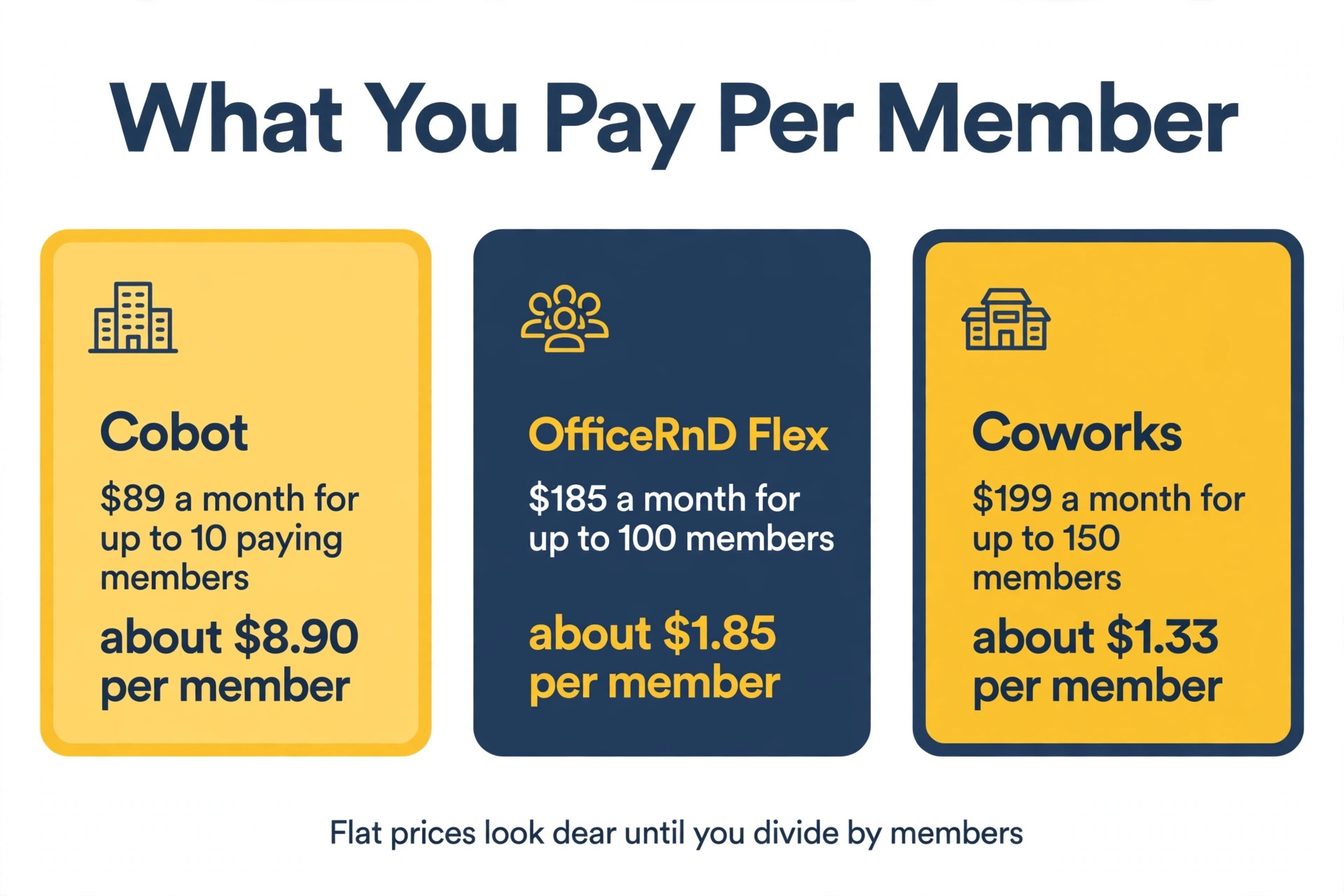
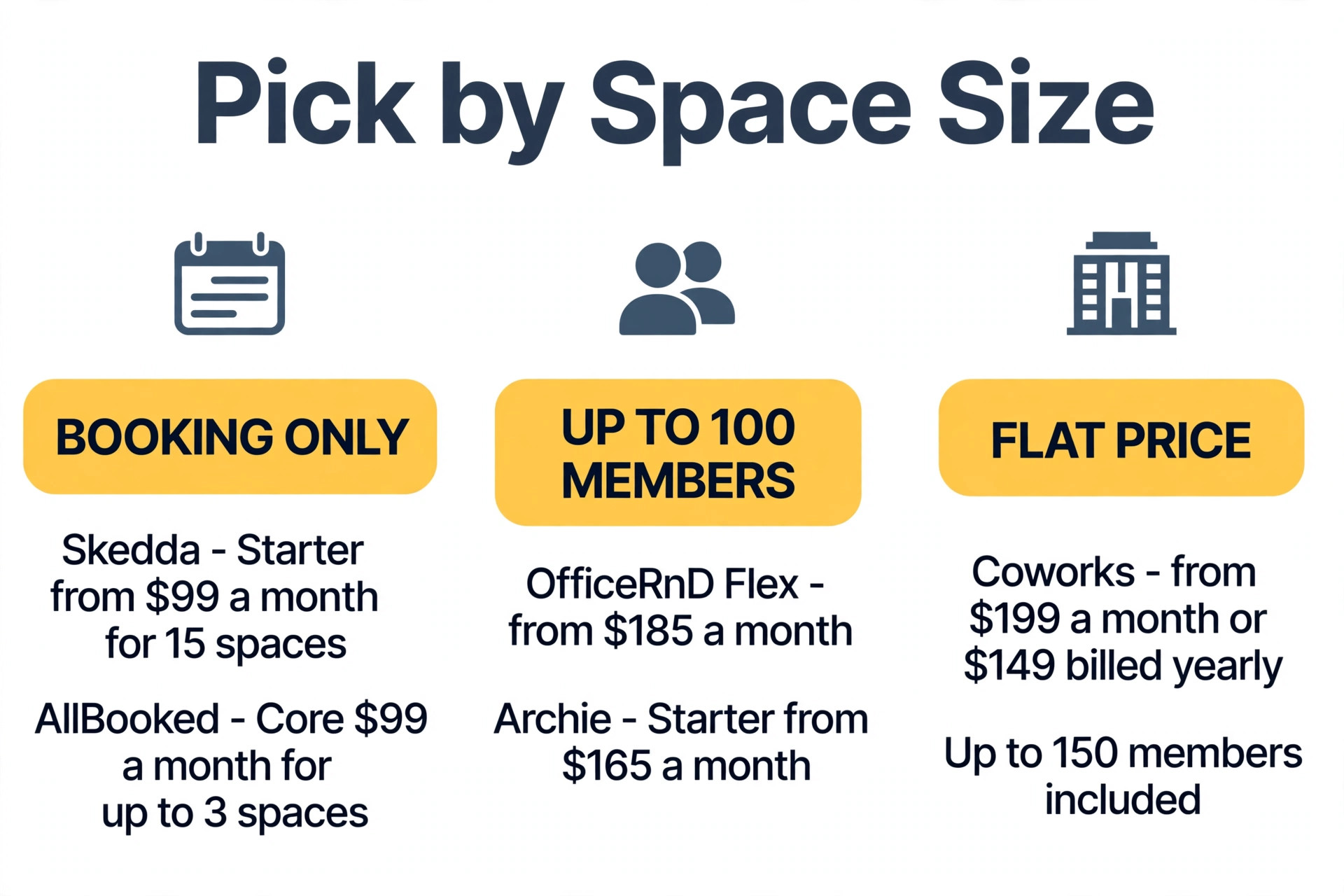
| Cobot | from 89 dollars a month for up to 10 paying members | small spaces that want to pay only for paying members |
| OfficeRnD | Flex from 185 dollars a month for 1 location and up to 100 members | operators that want CRM plus access control plus billing |
| Spacebring | from 206 dollars a month or 186 dollars billed yearly for about 100 users | small to mid sized spaces that want a modern platform |
| Archie | Starter from 165 dollars a month for 1 location and up to 100 active members | mid sized and growing spaces with multiple locations |
| Coworks | from 199 dollars a month or 149 dollars billed yearly | spaces that want a flat price for up to 150 members |
| Skedda | Starter from 99 dollars a month for 15 spaces | spaces that mainly need desk and room booking |
| AllBooked | Core 99 dollars a month for up to 3 spaces | small spaces that want simple booking by space |
| Workivo | Launch 59 pounds a month for 1 location | small UK spaces that want flat pricing |
The 10 Tools in Full
The 10 tools below are ordered by value for a small business, starting with the options that cost least for the job they do. Each section gives the price, the strength that earns its place, and the limit to check before you buy. Read the best pick table after the tool sections to match a tool to your size.
1. Optix
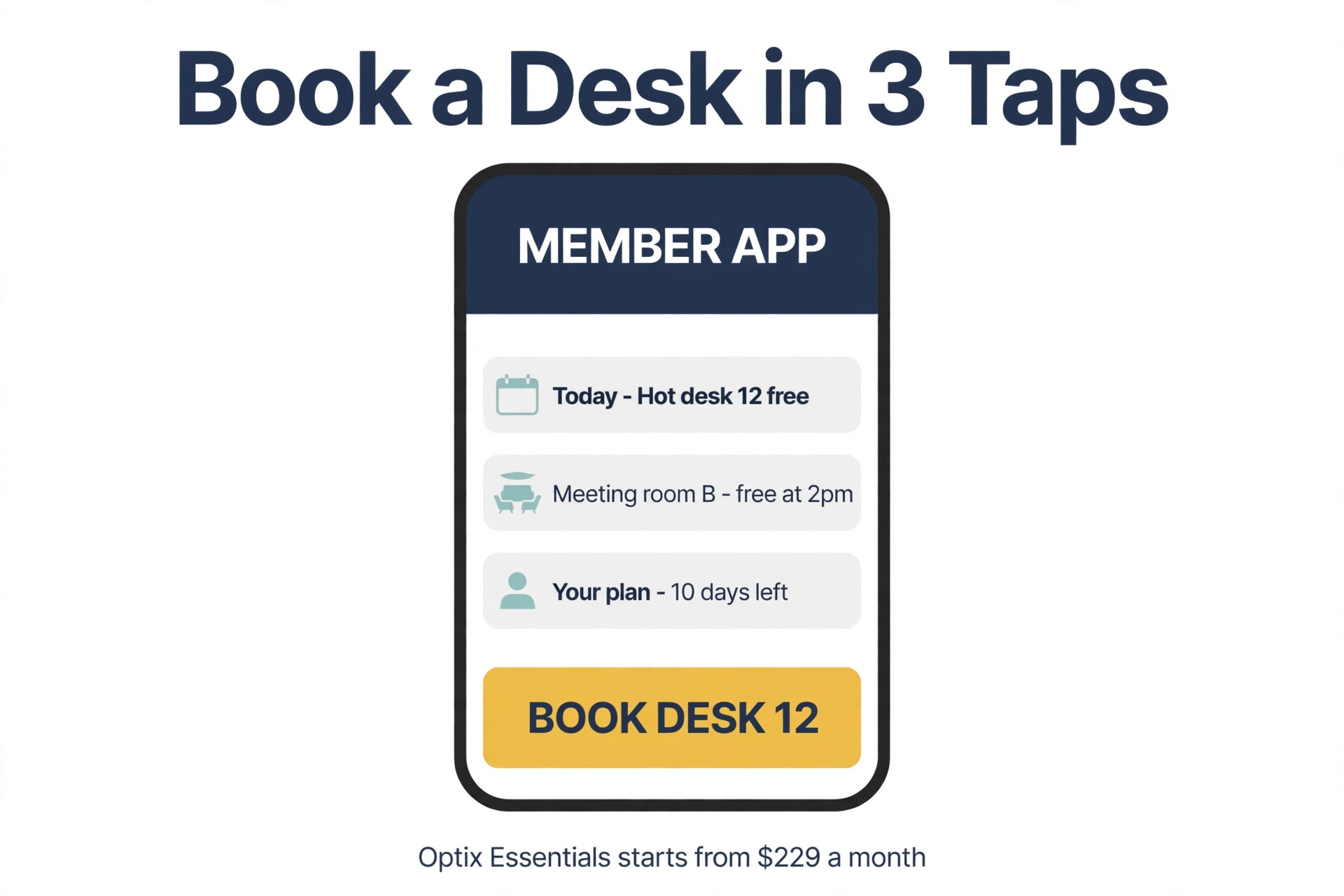
Optix is a strong option for spaces that want a polished member app. Best member app in the category, automations and bookings. Pricing runs Essentials 229 dollars a month or 197 dollars billed yearly, Pro 349 dollars or 299 dollars, Grow 579 dollars or 498 dollars, extra locations 111 to 129 dollars a month. For a small business the entry tier is the number to test first, because the features that matter most usually sit on the first paid plan rather than on the top tier.
In daily use Optix handles the core job well, and the team can learn it without a long training course. The setup is straightforward for a business that already has customer records in a spreadsheet or in another tool, and the vendor offers a trial or a demo so you can test it on real jobs before you commit to a year.
Best for spaces that want a polished member app. Watch out for one thing. Admin tools are desktop only and white label app costs extra.
2. Nexudus
Nexudus is a strong option for large operators that need deep customisation. Deep customisation, large integrations marketplace and white label app. Pricing runs from 150 dollars a month per location, bands to 525 dollars a month for 450 to 499 active users. For a small business the entry tier is the number to test first, because the features that matter most usually sit on the first paid plan rather than on the top tier.
In daily use Nexudus handles the core job well, and the team can learn it without a long training course. The setup is straightforward for a business that already has customer records in a spreadsheet or in another tool, and the vendor offers a trial or a demo so you can test it on real jobs before you commit to a year.
Best for large operators that need deep customisation. Watch out for one thing. Each location is billed separately and the learning curve is steep.
3. Cobot
Cobot is a strong option for small spaces that want to pay only for paying members. Only paying members count, so day pass users cost nothing. Pricing runs from 89 dollars a month for up to 10 paying members, to 599 dollars a month for 171 to 179 members, 180 plus custom. For a small business the entry tier is the number to test first, because the features that matter most usually sit on the first paid plan rather than on the top tier.
In daily use Cobot handles the core job well, and the team can learn it without a long training course. The setup is straightforward for a business that already has customer records in a spreadsheet or in another tool, and the vendor offers a trial or a demo so you can test it on real jobs before you commit to a year.
Best for small spaces that want to pay only for paying members. Watch out for one thing. Cost climbs fast past 50 members, near 480 dollars a month at 100 members.
4. OfficeRnD
OfficeRnD is a strong option for operators that want CRM plus access control plus billing. CRM, access control, visitor management and billing in one platform. Pricing runs Flex from 185 dollars a month for 1 location and up to 100 members, Grow from 289 dollars a month for 2 locations. For a small business the entry tier is the number to test first, because the features that matter most usually sit on the first paid plan rather than on the top tier.
In daily use OfficeRnD handles the core job well, and the team can learn it without a long training course. The setup is straightforward for a business that already has customer records in a spreadsheet or in another tool, and the vendor offers a trial or a demo so you can test it on real jobs before you commit to a year.
Best for operators that want CRM plus access control plus billing. Watch out for one thing. Priced above Nexudus at the entry tier.
5. Spacebring
Spacebring is a strong option for small to mid sized spaces that want a modern platform. Modern interface, bookings, billing and member app. Pricing runs from 206 dollars a month or 186 dollars billed yearly for about 100 users, white label app add on from 118 dollars a month. For a small business the entry tier is the number to test first, because the features that matter most usually sit on the first paid plan rather than on the top tier.
In daily use Spacebring handles the core job well, and the team can learn it without a long training course. The setup is straightforward for a business that already has customer records in a spreadsheet or in another tool, and the vendor offers a trial or a demo so you can test it on real jobs before you commit to a year.
Best for small to mid sized spaces that want a modern platform. Watch out for one thing. Six month minimum commitment in third party reports.
6. Archie
Archie is a strong option for mid sized and growing spaces with multiple locations. Multi location support and a clean admin flow. Pricing runs Starter from 165 dollars a month for 1 location and up to 100 active members. For a small business the entry tier is the number to test first, because the features that matter most usually sit on the first paid plan rather than on the top tier.
In daily use Archie handles the core job well, and the team can learn it without a long training course. The setup is straightforward for a business that already has customer records in a spreadsheet or in another tool, and the vendor offers a trial or a demo so you can test it on real jobs before you commit to a year.
Best for mid sized and growing spaces with multiple locations. Watch out for one thing. Priced above Spacebring at the entry tier.
7. Coworks
Coworks is a strong option for spaces that want a flat price for up to 150 members. Flat pricing and a simple admin flow. Pricing runs from 199 dollars a month or 149 dollars billed yearly, base plan covers up to 150 members. For a small business the entry tier is the number to test first, because the features that matter most usually sit on the first paid plan rather than on the top tier.
In daily use Coworks handles the core job well, and the team can learn it without a long training course. The setup is straightforward for a business that already has customer records in a spreadsheet or in another tool, and the vendor offers a trial or a demo so you can test it on real jobs before you commit to a year.
Best for spaces that want a flat price for up to 150 members. Watch out for one thing. Less customisation than Nexudus.
8. Skedda
Skedda is a strong option for spaces that mainly need desk and room booking. Priced per space, not per member, so a busy space pays less. Pricing runs Starter from 99 dollars a month for 15 spaces, Plus from 149 dollars a month, Premier from 199 dollars a month, billed annually. For a small business the entry tier is the number to test first, because the features that matter most usually sit on the first paid plan rather than on the top tier.
In daily use Skedda handles the core job well, and the team can learn it without a long training course. The setup is straightforward for a business that already has customer records in a spreadsheet or in another tool, and the vendor offers a trial or a demo so you can test it on real jobs before you commit to a year.
Best for spaces that mainly need desk and room booking. Watch out for one thing. Booking focused, so billing and CRM are lighter.
9. AllBooked
AllBooked is a strong option for small spaces that want simple booking by space. Simple per space pricing and a 14 day trial. Pricing runs Core 99 dollars a month for up to 3 spaces, Business 149 dollars a month, Advanced 199 dollars a month, billed annually. For a small business the entry tier is the number to test first, because the features that matter most usually sit on the first paid plan rather than on the top tier.
In daily use AllBooked handles the core job well, and the team can learn it without a long training course. The setup is straightforward for a business that already has customer records in a spreadsheet or in another tool, and the vendor offers a trial or a demo so you can test it on real jobs before you commit to a year.
Best for small spaces that want simple booking by space. Watch out for one thing. Booking focused, so member billing is lighter.
10. Workivo
Workivo is a strong option for small UK spaces that want flat pricing. Flat pricing with no per user or per space charges and a 90 day trial. Pricing runs Launch 59 pounds a month for 1 location, Growth 129 pounds a month for unlimited locations, 25 percent less billed yearly. For a small business the entry tier is the number to test first, because the features that matter most usually sit on the first paid plan rather than on the top tier.
In daily use Workivo handles the core job well, and the team can learn it without a long training course. The setup is straightforward for a business that already has customer records in a spreadsheet or in another tool, and the vendor offers a trial or a demo so you can test it on real jobs before you commit to a year.
Best for small UK spaces that want flat pricing. Watch out for one thing. UK focused, so check currency and payment support for US operators.
Best Pick by Business Size
The best pick depends on size, and coworking space software pricing for small operators rewards a buyer who matches the tool to the job rather than to the brand. A solo operator should optimise for price and speed. A team of five should optimise for dispatch and reminders. A larger team should optimise for reporting and control.
| Business size | Best pick | Why |
|---|---|---|
| Solo operator | Optix | Lowest cost entry with the core job covered |
| Team of 2 to 5 | Nexudus | Strong booking and messaging without enterprise cost |
| Team of 6 to 15 | Cobot | Deepest dispatch and reporting for a growing team |
| Budget first | OfficeRnD | Best value when every dollar is counted |
What a Small Business Actually Pays
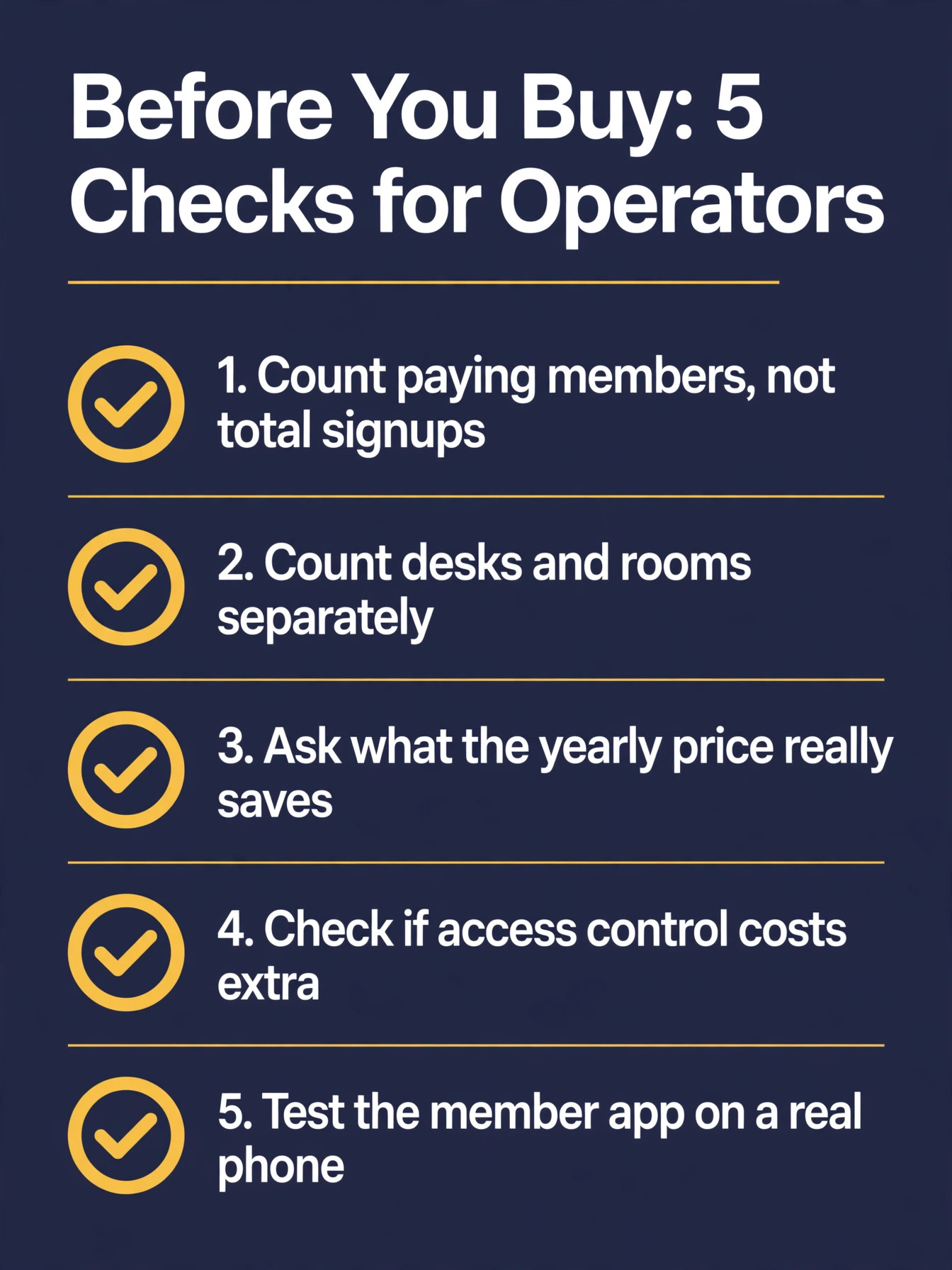
The sticker price is only the start, and coworking space software pricing for small operators only makes sense as a yearly bill. Multiply the monthly price by twelve, add the per user or per client fees, and add the add ons for reminders, payments and integrations. A tool that looks cheap at 29 dollars a month can cost more than a tool at 59 dollars a month once the whole team is counted.
Payment processing is the hidden cost most buyers miss. Most tools charge around 2.9 percent plus a small fixed fee on every card payment that runs through the platform, and that fee sits on top of the subscription. Add ons are the second hidden cost. Text reminders, a branded app, extra users and premium support are often sold separately, so ask for the full loaded price in writing before you sign.
Mistakes That Waste Money
The most common mistake in coworking space software pricing for small operators is paying for a tool when the free plan already covers the job. Trial the free plan for a full month before you enter card details, and count the jobs, the reminders and the invoices that actually run through it. The second mistake is buying seats for people who only read notes or check a schedule.
The third mistake is ignoring the limit until it bites. A team buys a plan with a job cap or a user cap, fills it in week three, and then pays for an upgrade under pressure. Count your real volume for a month before you buy, and pick the plan whose cap covers that number with room to spare. The fourth mistake is skipping the data export test, which only matters on the day you want to leave.
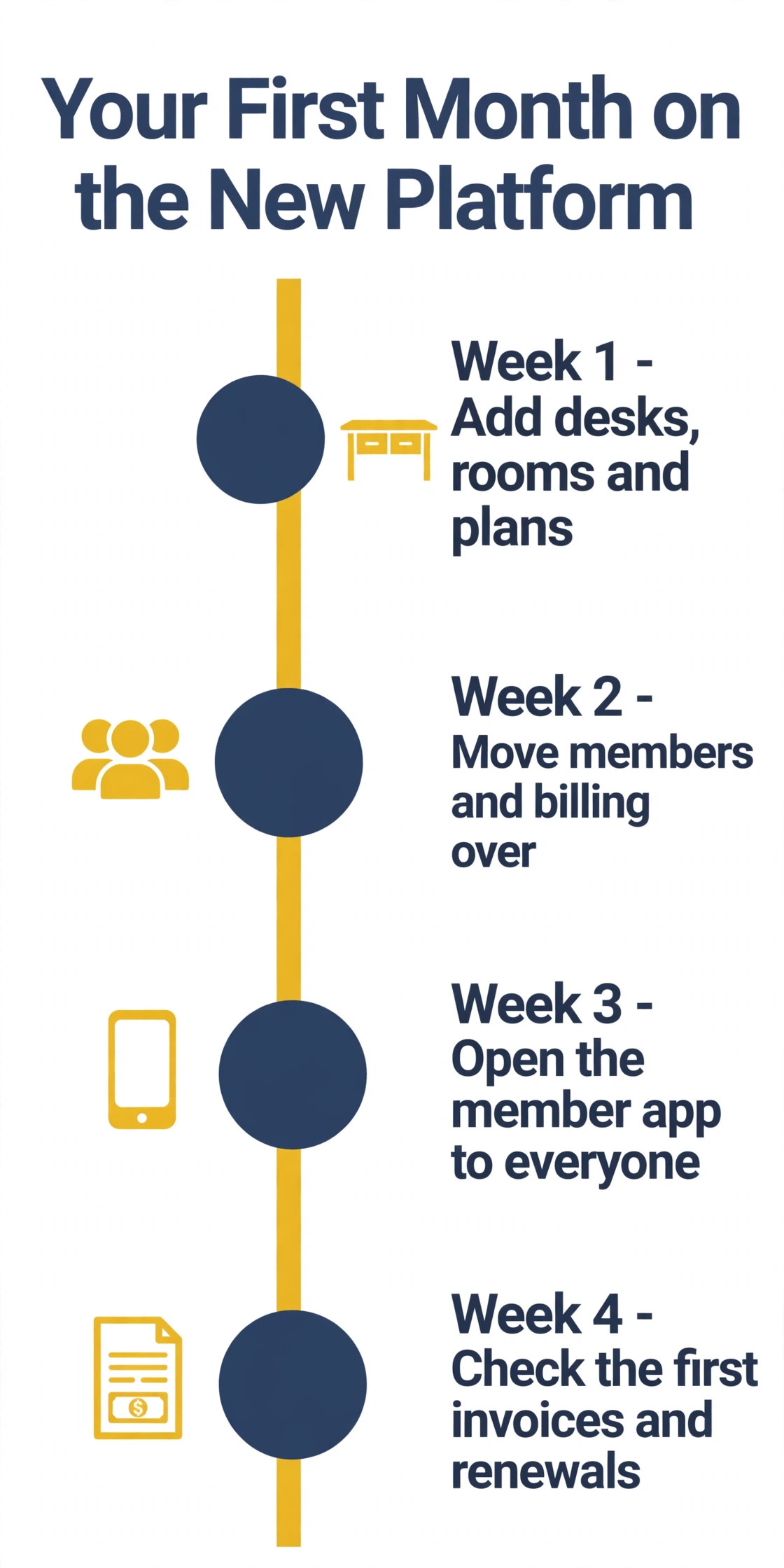
Start with a free trial whenever one is offered, and run it on real jobs rather than on demo data. A trial that covers two full weeks of live work shows the scheduling quirks, the invoice errors and the slow screens that a sales demo never shows. Invite the person who will use the tool every day, not only the owner, and ask them to complete ten real tasks before the trial ends.
Read the contract before you pay for a year in advance. Some vendors lock the price for twelve months and then raise it at renewal, while others let you leave month to month with no penalty. Ask in writing what happens to your data if you cancel, how long an export takes, and whether there is a fee to take your customer records with you.
Data export matters more than most buyers expect. A tool that exports customers, jobs, invoices and payment history in a standard file lets you move without retyping a year of records. A tool that exports only a partial list locks you in quietly, so test the export during the trial and open the file yourself to check that nothing is missing.
Training time is a real cost, and it falls on the busiest person in the business. A tool that a new hire can learn in an afternoon saves more money than a cheaper tool that needs a week of videos. Ask the vendor how long onboarding takes for a team your size, and ask for two customer references from businesses with the same headcount as yours.
Support quality shows up at the worst moment, usually on a Friday afternoon when a job is stuck. Check whether support runs by chat, phone or email, and check the hours in your time zone. A vendor that answers in minutes during the trial usually answers in minutes after you pay, while a vendor that takes a day to reply during the trial will not get faster later.
Integrations decide whether the tool saves time or creates a second job. If the software syncs with your accounting package, your payment processor and your calendar, the admin work shrinks. If it needs manual exports every week, the time you save on scheduling comes back as spreadsheet work, so map the three integrations you need most before you choose.
The mobile app deserves a real test, because most of the team will live in it. Open it on a phone with weak signal, try to complete a job, add a photo and send an invoice, and see where it stalls. A desktop tool with a weak app forces the field team back to paper, which defeats the reason you bought the software in the first place.
Security and access control matter once more than one person touches customer data. Check who can see prices, who can edit invoices and who can delete a job, and check whether the vendor offers two factor sign in. A small business rarely needs enterprise security, but it does need to stop a former employee from opening the customer list from home.
Keep a backup of your own records even when the vendor promises to keep them safe. Export customers, jobs and invoices once a month and store the file where you control it. The habit takes ten minutes and it turns a vendor outage or a cancelled account from a crisis into a short delay while you restore your own copy.
Check the price again on the checkout page before you pay, because list prices move and some vendors show different prices by region or run short promotions. The figures in this guide were checked against vendor pricing pages and current 2026 comparisons in November 2026, and any figure that sources disagreed on is flagged in the tool section so you can see both numbers before you decide.
Ask the vendor what happens when you grow past the plan you buy. Some tools let you add a user for a flat fee, others force a jump to the next tier that doubles the bill, and a few charge per job or per client so growth raises the price even when headcount stays flat. The cheapest plan today is not the cheapest plan at twice your current size.
Measure the result after ninety days, not after the first week. Count the hours saved on scheduling, the invoices paid faster, the no shows avoided and the jobs completed per day, then compare that total with the monthly bill. A tool that pays for itself in the first quarter is worth keeping, and a tool that does not should be replaced while the switch is still cheap.
Ask for a written quote that lists every line item, including the base fee, the per user fee, the add ons and the payment processing rate. A verbal price is easy to forget and hard to dispute, while a written quote gives you a document to compare against the first invoice. If the first invoice does not match the quote, raise it on day one rather than after three months of overpayment.
Check whether the vendor charges for onboarding, data migration or training, because those fees often appear only in the contract. Some vendors include onboarding free, others charge a one off fee that rivals a month of subscription, and a few charge per hour for migration help. The total first year cost is the subscription plus onboarding plus add ons, not the monthly figure on the pricing page.
Look at the review scores with a sceptical eye. A tool with thousands of reviews and a score near four and a half stars is usually a safe bet, while a tool with twenty reviews and a perfect score tells you little. Read the one star and two star reviews first, because they describe the failures that matter, such as lost data, slow support and surprise price rises.
Test the calendar sync with a real booking before you commit. Create a booking in the tool, check that it appears on the phone calendar, move it, cancel it, and check that every change lands in both places. A sync that works in the demo and fails in daily use creates double bookings, which are the most expensive mistake in this whole category.
Check how the tool handles deposits and cancellations, because those two features decide whether no shows cost you money. A deposit taken at booking time cuts no shows sharply, and a cancellation policy that releases the slot automatically lets you refill it the same day. A tool without either feature leaves the revenue to chance.
Our Verdict
Start with Optix if price matters most, move to Nexudus when booking and reminders become the bottleneck, and consider Cobot only when the team is large enough to use its reporting. The right choice is the tool that fits the business you run today, with room to grow into the next tier without a painful migration.
Frequently Asked Questions
These answers cover the questions buyers ask most often about coworking space software pricing for small operators.
What does the cheapest option cost?
The cheapest real option in this list starts from the lowest entry price shown in the table above, and several tools offer a free tier or a free trial. A free tier usually caps jobs, users or history, so check the cap before you rely on it for live work.
Do these tools charge per user or per month?
Most tools in this list charge a flat monthly fee for a set number of users, with extra users billed separately. A few charge per client, per job or per technician, so compare the billing unit before you compare the headline price.
Is there a free trial?
Most tools in this list offer a free trial of 7 to 30 days, and several offer a free tier with a cap. Run the trial on real jobs for at least two weeks, invite the daily user, and test the export before the trial ends.
Which tool is best for a solo operator?
A solo operator should pick the tool with the lowest entry price that still covers quoting, scheduling and invoicing without add ons. In this list that is usually the first tool in the ranking, because it was chosen for value at a small size rather than for brand size.
Can I switch tools later without losing data?
Yes, if the tool you choose exports customers, jobs and invoices in a standard file. Test the export during the trial, keep a monthly backup of your own, and budget a week for the move including training the team on the new workflow.
What hidden costs should I check?
Check payment processing fees, text reminder credits, extra user fees, branded app fees and implementation charges. Ask for the loaded monthly total in writing, including every add on you will actually use, before you sign a yearly contract.